1914: The war at sea
Battle of Cocos
- Dates:
- 9 November 1914
- Front:
- War at sea
- Location:
- Cocos (Keeling) Islands, eastern Indian OceanOn the battle map →
- Sides:
- AustraliaJohn GlossopGerman EmpireKarl von Müller, Hellmuth von Mücke
- Result:
- Australian victory. The cruiser Emden was destroyed, and most of her crew were killed or captured. The landing party escaped on the schooner Ayesha.
- Author:
- Natalia
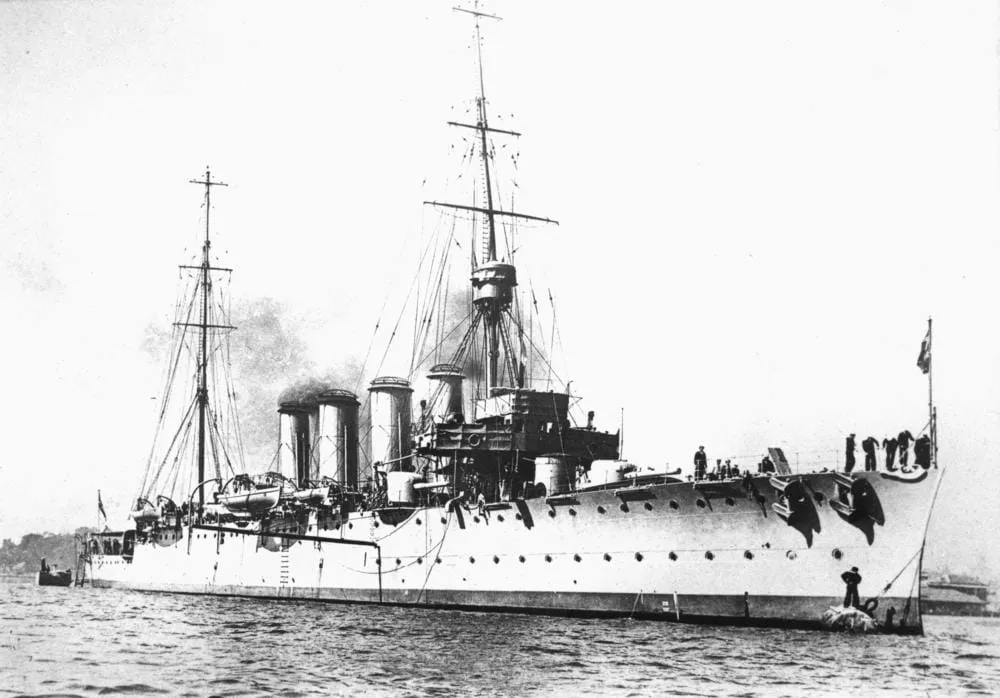
The Battle of Cocos was fought on 9 November 1914 in the Indian Ocean. The Australian light cruiser HMAS Sydney caught the German cruiser Emden, which for two months had been wreaking havoc on the shipping lanes around India. After less than two hours of fighting the shattered Emden ran herself onto a reef. It was the first engagement of a ship of the Australian navy with the enemy.
The target: the station on Direction Island
After the raid on Penang, Fregattenkapitän Karl von Müller decided to strike at British communications. On the Cocos Islands, a small atoll halfway between Ceylon and Australia, an important cable station operated on the islet of Direction Island. Submarine telegraph cables linking Australia with Africa and Asia met there, and next to it stood a wireless station. Destroying it was meant to cut Australia’s communications with the world for a time and to throw off the pursuit.
Müller did not know that in those same days a large convoy carrying Australian and New Zealand soldiers to Egypt was sailing west of Australia. It was escorted by the British armoured cruiser Minotaur, the Australian cruisers Melbourne and Sydney and the Japanese Ibuki. Minotaur detached shortly before the battle, called away to other duties.
The landing and the alarm signal
At dawn on 9 November Emden, once again with a false fourth funnel, appeared at the entrance to the lagoon. A party of about 50 sailors went ashore under the first officer, Kapitänleutnant Hellmuth von Mücke. The station staff, however, recognised the German ship, and before the Germans reached the buildings the wireless operator managed to send a signal about a strange warship. The Germans blew up the wireless mast, destroyed the equipment and tried to cut the submarine cables. They did not harm any of the station’s staff.
The signal was picked up by the convoy, about 50 nautical miles away. The commander of the escort, Captain Mortimer Silver of Melbourne, at first wanted to sail to the Cocos Islands himself, but decided that he could not leave the transports, and sent Sydney under Captain John Glossop. The captain of Ibuki asked for permission to give chase, but had to stay with the convoy.
The duel
At about 9.15 a.m. Emden was sighted from Sydney. Müller, who had rather expected his collier Buresk, realised that a warship was approaching and had to put to sea without his landing party. The odds were unequal. Sydney was newer, bigger and faster, and her eight 152 mm guns outranged Emden’s ten 105 mm guns.
Emden opened fire first, at about 9.40 a.m., from a range of over 9 kilometres. Her gunners shot accurately and her very first salvoes hit Sydney, destroying among other things the rangefinder. Many of the shells failed to explode. Glossop used his advantage in speed and range, drew off to a distance from which the Germans could not hit him effectively, and methodically battered his opponent. Sydney’s shells brought down Emden’s funnels and mast, destroyed her guns and started fires.
At about 11.20 a.m. Müller, unable to escape or to fight on, ran the burning ship onto the reef of North Keeling Island to save the wounded and prevent her sinking. Sydney went off after Buresk, which her German crew scuttled themselves. In the afternoon Glossop returned to the wreck. Emden’s ensign was still flying from her mast and the Germans did not answer signals, so Sydney fired two more salvoes. Only then was the ensign lowered on the ship and a white flag hoisted.
Losses
Sydney lost four killed, and the number of wounded is given by different sources as between a few and over a dozen. On Emden, depending on the source, between about 115 and over 130 men were killed, and several dozen were wounded. The wounded and survivors spent the night on the wreck, without water, in the heat. Sydney came back for them the next day and took on board over 200 prisoners, whom she carried to Ceylon, to Colombo. Müller was taken prisoner.
Escape on the Ayesha
Mücke’s party remained on Direction Island and watched from the shore as their ship was destroyed. That same day the Germans seized the old, barely seaworthy schooner Ayesha, lying in the lagoon, and put to sea in her in the evening. So began one of the most extraordinary odysseys of the war. The schooner reached Dutch Sumatra, where in December the Germans transferred to a German steamer. They crossed the Arabian Sea to Arabia, and from there, fighting Bedouin along the way, made their way overland and by rail to Constantinople, which they reached in May 1915.
Significance
The destruction of Emden ended the most famous cruiser raid of the war and freed the Indian Ocean from a threat that for two months had tied down many Allied ships. Convoys from Australia and New Zealand could now sail more safely. For the young Australian navy it was its first victory and a source of great pride. Sydney received the battle honour “Emden 1914”, and her tripod mast stands today as a memorial on Bradleys Head in Sydney Harbour.
Spotted a mistake?Report an error