1914: The Far East and the Pacific
Siege of Tsingtao
- Dates:
- 2 September – 7 November 1914
- Front:
- Asia and the Pacific
- Location:
- Tsingtao (Qingdao) and the Shantung peninsula, ChinaOn the battle map →
- Sides:
- JapanMitsuomi Kamio, Sadakichi KatōUnited KingdomNathaniel BarnardistonGerman Empire and Austria-HungaryAlfred Meyer-Waldeck
- Result:
- Victory for Japan and the United Kingdom. The German leased territory of Kiautschou, with the port of Tsingtao, passed under Japanese control.
- Author:
- Łukasz Skowroń
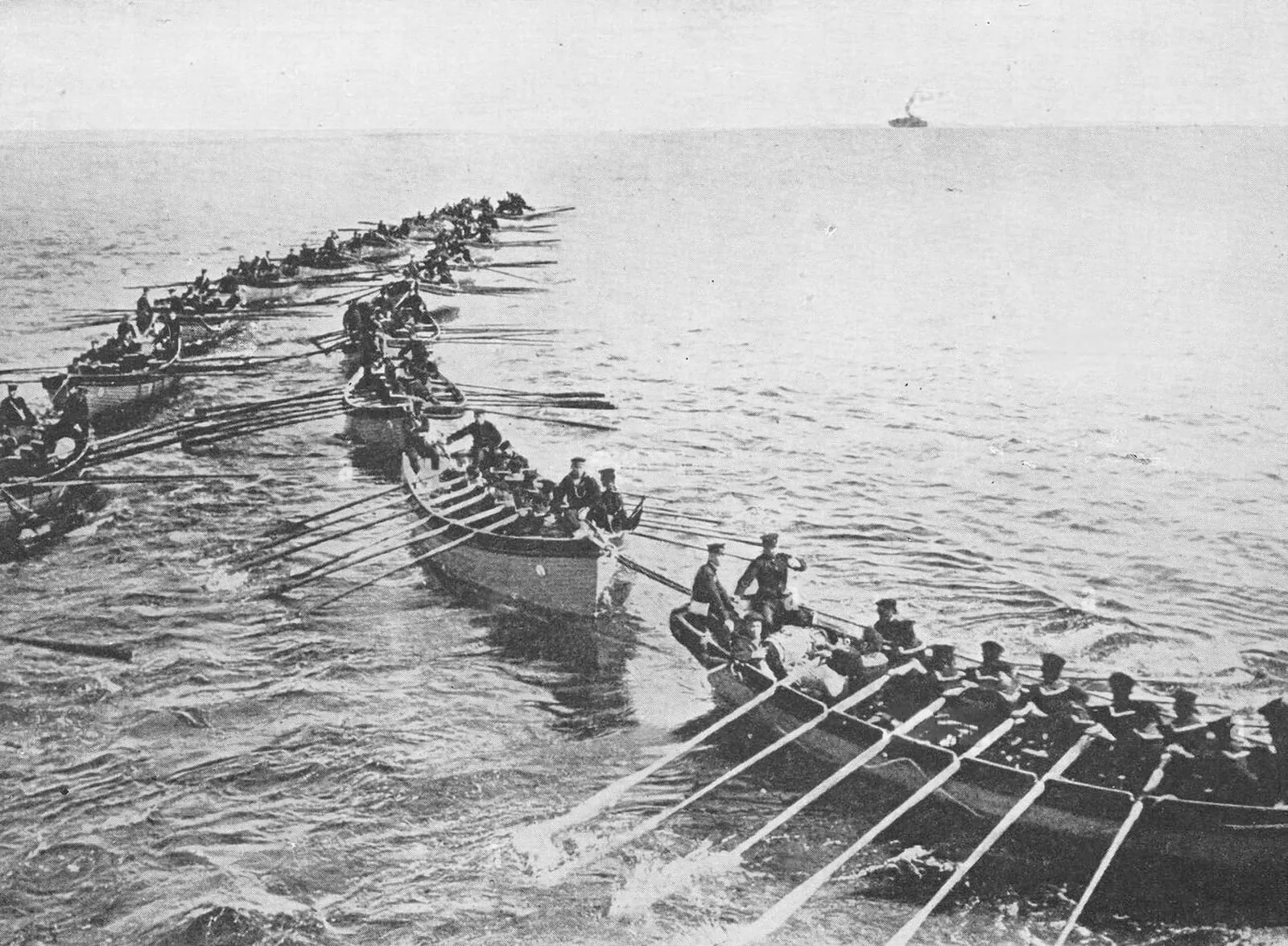
The Siege of Tsingtao was the only major land battle of the First World War fought in East Asia. For more than two months in the autumn of 1914 Japanese troops, supported by a small British contingent, fought to take the German fortress on the coast of China. The fighting ended on 7 November 1914 with the surrender of the garrison.
The start of the siege can be dated in different ways. The Japanese fleet began the blockade of Tsingtao from the sea as early as 27 August, and many accounts count the siege from that day. This page takes 2 September as the start, when the first Japanese units landed at Longkou on the northern coast of Shantung. That day began the land operation that led to the fall of the fortress.
A German colony in China
In November 1897, after the murder of two German missionaries in the province of Shantung, a German squadron occupied Kiautschou Bay on the southern coast of the peninsula. In March 1898 China was forced to lease the area to Germany for 99 years. The leased territory of Kiautschou was directly subordinate to the German Imperial Naval Office, and its governor was always a naval officer.
On the site of a fishing village the Germans built the modern city of Tsingtao, today’s Qingdao, with a port, a shipyard, a railway to Jinan, European quarters and what later became a famous brewery. The port became the main base of the German East Asia Squadron. On the seaward side it was defended by a system of coastal batteries, among them the battery on Bismarck Hill with four 280 mm howitzers. On the landward side, a few kilometres from the city, ran a line of five infantry works linked by trenches and wire entanglements. Behind it, on the Moltke, Bismarck and Iltis hills, stood artillery batteries. In front of the main line the Germans prepared advanced positions on the hills, including Prince Heinrich Hill.
The defenders
The governor of Kiautschou since 1911 had been Captain Alfred Meyer-Waldeck. When war broke out, the ships of Admiral Maximilian von Spee’s East Asia Squadron were far from the base and did not return to it. The fortress garrison consisted of the III Marine Battalion, sailors, gunners and reservists brought in from all over China, as well as volunteers from among the Germans living there. Figures for the number of defenders vary, usually from about 3,600 to over 4,500 men.
Also in port was the Austro-Hungarian cruiser SMS Kaiserin Elisabeth. Part of her crew went ashore and manned guns removed from the ship. The fortress was further defended by several German gunboats and the torpedo boat S90. The defenders knew they could not count on relief.
Blockade and landing
After declaring war on Germany on 23 August, Japan sent against Tsingtao the 18th Division of General Mitsuomi Kamio, reinforced with heavy siege artillery. The land forces numbered about 23,000 soldiers and over 140 guns. From the sea they were supported by the fleet of Vice-Admiral Sadakichi Katō, which was joined by the British battleship HMS Triumph and the destroyer HMS Usk.
The Japanese did not want to land under the guns of the fortress. On 2 September the first units went ashore at Longkou, on neutral Chinese territory, more than 150 kilometres from their objective. Torrential rain and floods turned the roads into a swamp, and the march lasted weeks. On 18 September some of the troops landed much closer, in Laoshan Bay east of Tsingtao. On 22–23 September Brigadier-General Nathaniel Barnardiston’s British contingent landed at the same place: the 2nd Battalion of the South Wales Borderers from the garrison in Tientsin, and later also half a battalion of the 36th Sikhs, about 1,500 men in all.
The first fighting in the air
At Tsingtao aircraft played a real role for the first time in the war in the Far East. The Japanese fleet brought the converted transport Wakamiya with four Farman seaplanes. On 5 September her aircraft flew over the fortress, and the next day they attacked the cruiser Kaiserin Elisabeth and the gunboat Jaguar with bombs, though without hits. These are regarded as the first air raids in history carried out by aircraft launched from a ship. On 30 September Wakamiya struck a mine and had to leave for repairs, and her seaplanes continued to operate from land. By the end of the siege they had flown several dozen combat sorties and dropped about 190 bombs, though the damage was not great. Japanese army aircraft also flew over the fortress.
On the German side essentially only one aircraft flew, the Taube monoplane of naval lieutenant Gunther Plüschow. A second had crashed at the start of the war. Plüschow carried out reconnaissance, and the first encounters between aircraft in this part of the world took place over the fortress. By his own account he shot down a Japanese aircraft with pistol fire, but this was never confirmed and historians treat the story with caution. On 6 November Plüschow flew out of the besieged fortress with dispatches. After adventures in China and America he ended up in British captivity, from which he escaped and returned to Germany.
The siege
On 26 September the Japanese moved forward. In the last days of September they took the German advanced positions, including Prince Heinrich Hill, from which the whole city and the main line of defence could be seen. The Germans then scuttled some of their ships in the harbour so that they would not fall into enemy hands. The defenders replied with artillery fire, and Kaiserin Elisabeth and the gunboats shelled the Japanese positions from the bay.
Kamio did not attempt an assault on the march. He conducted the siege methodically, as the Japanese had at Port Arthur ten years earlier, but much more cautiously. His soldiers dug parallel lines of trenches and approach saps ever closer to the German fortifications, while sappers and gunners brought the heavy siege guns into position.
At sea the defenders scored one significant success. On the night of 17/18 October the torpedo boat S90 slipped out of the harbour and torpedoed the old Japanese cruiser Takachiho. The ship sank and about 270 sailors were killed. S90 could not return to the blockaded port. Her crew ran her aground on the Chinese coast and blew her up, and were themselves interned by the Chinese.
Bombardment and assault
On 31 October, when the trenches had come close enough, the Japanese began a great bombardment. For a week, with about a hundred heavy guns, including 280 mm howitzers, they shelled the forts, batteries, port and city. Fuel tanks exploded and many German guns were destroyed. On 2 November the crew scuttled Kaiserin Elisabeth, which had run out of ammunition. The German batteries fired less and less often, as they too were exhausting their stocks of shells.
On the night of 6/7 November the Japanese infantry went into the assault on the central sector of the main line and broke into the German works. By dawn the defenders had nothing left to fight with. On 7 November Meyer-Waldeck ordered white flags to be raised and asked for talks. The surrender was signed the same day. Over the following days the Japanese and British took over the city, and on 16 November they staged a ceremonial entry into Tsingtao.
Losses
Figures for losses vary according to the source. On the German side about 200 men were killed and from about 400 to over 500 wounded. The losses of the Japanese army are given very variously: from about 240 to over 700 killed and about 1,300 wounded. To this must be added some 270 sailors from the cruiser Takachiho and other naval losses. According to the National Army Museum the British lost 12 killed and 53 wounded; other sources give somewhat higher figures. Chinese civilians from the surrounding villages were also killed in the fighting.
Prisoners in Japan
Some 4,700 Germans and Austrians went into Japanese captivity. They were held in more than a dozen camps, later concentrated into a few larger ones. The best known was the Bandō camp on the island of Shikoku, where the commandant, Toyohisa Matsue, treated the prisoners with exceptional kindness. The prisoners ran workshops, a printing press, orchestras and courses there, and the local inhabitants, according to local tradition, learned from them how to bake bread and make sausages. On 1 June 1918 the prisoners at Bandō gave the first performance in Japan of Ludwig van Beethoven’s Ninth Symphony. It remains extraordinarily popular in Japan to this day, especially at the end of the year, when it is performed all over the country. The prisoners were not released until the turn of 1919 and 1920, and about 170 of them stayed in Japan for good.
Significance
The fall of Tsingtao deprived Germany of its only base in East Asia. Von Spee’s squadron no longer had anywhere to return to. Japan occupied the leased territory of Kiautschou and the German railways in Shantung, and in 1915 presented China with the Twenty-One Demands, which were intended to make it a Japanese sphere of influence. At the Paris Peace Conference in 1919 the powers granted Japan Germany’s former rights in Shantung, which provoked a wave of protest in China known as the May Fourth Movement. Japan did not return Tsingtao to China until 1922.
The siege was also a military lesson. The Japanese took a strong fortress by methodical sapping and concentrated heavy artillery fire, suffering relatively light losses in the process. At Tsingtao aircraft launched from a ship were used in combat for the first time, heralding a new era of naval warfare.
Spotted a mistake?Report an error