Key event
Outbreak of the Greater Poland Uprising
- Category:
- Military operations
- Front:
- Eastern Front
- Date:
- 27 December 1918
- Author:
- Łukasz Skowroń
- Battle:
- Greater Poland uprising
- Tags:
- Poland, Germany, Greater Poland
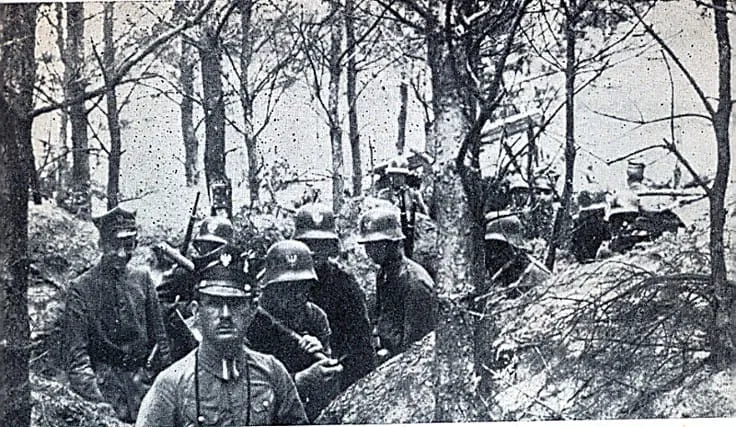
Late in the afternoon of 27 December 1918 shots rang out in the streets of Poznań, and with them the Greater Poland Uprising began. Nobody had planned it for that day. The Polish military underground had been gathering weapons for weeks, but the Supreme People’s Council, which led the Polish movement in the Prussian partition, wanted to wait for a decision of the peace conference. The spark turned out to be the visit of Ignacy Jan Paderewski, whom Poznań had welcomed the day before like a statesman, and the German demonstration organised in response. By morning the Poles controlled a large part of the city.
Before noon
Paderewski, who was staying in the corner suite of the Bazar (PL) hotel, did not appear in public that morning. He put it down to a cold caught on the voyage from England aboard a British warship. Historians at the Poznań branch of the Institute of National Remembrance (IPN) believe it was largely a diplomatic illness. Paderewski was travelling to Warsaw as a man trusted by the Allies, and any violent incident in Greater Poland connected with him could harm the Polish cause in Paris. At noon a procession of several thousand schoolchildren passed in front of the hotel: Polish children with red-and-white pennants, but also German children curious to see the famous pianist. The artist’s wife went out to them, while he himself received a small delegation in bed. Throughout the day, however, he held talks with members of the Commissariat of the Supreme People’s Council, and a banquet in his honour was being prepared for the evening.
The city was decked with flags. The Germans had grown used to red-and-white ones since early December, when the Provincial Diet had sat in Poznań. But they regarded the British, American and French flags hung out to welcome Paderewski and the British officers accompanying him as a provocation. Only a few weeks earlier Poles from the Poznań region had been fighting in German uniforms against those very countries. In the city, which then had about 165,000 inhabitants, Germans made up roughly half the population.
That same morning there was an exchange of fire on the former Russian–Prussian border near Kalisz. At about 11.30 a.m. at Szczypiorno Jan Mertka, a soldier of a Polish border battalion, was killed, and in response the Poles occupied the border village of Boczków on the Prussian side. Polish accounts often call him the first insurgent to fall.
The German march
At about 4 p.m. a rally of the city’s German inhabitants began near the zoo, and from there a march set off towards the centre. According to a communiqué of the Supreme People’s Council published two days later in the Kurier Poznański, it included about 200 armed soldiers of the 6th Grenadier Regiment (PL) from the barracks in Jeżyce, a regiment recently returned from the front. Singing German songs, the soldiers burst into the Council’s headquarters and tore down the English, American and French flags there. They then marched along Święty Marcin, Wiktorii and Berlińska streets to Wilhelmsplatz, forcing their way into houses and tearing Allied and Polish flags from balconies. Outside the bank of the Union of Cooperative Societies, the communiqué claimed, shots were even fired at the bank’s directors, but missed. Crowds of Poles poured into the streets, and Polish units of the People’s Guard and the Guard and Security Service stood ready.
Shots outside the Bazar
As dusk fell the march reached the area of the Bazar and halted in front of a cordon of the People’s Guard (PL). The times given in the sources differ: according to IPN historians it happened between 5 and 5.30 p.m.; some accounts speak of shots “before 5 p.m.”, or even at 4.40 p.m. Who fired first is not known. The Council’s communiqué said that the Germans set up two machine guns at the Police Presidium, opposite the Municipal Theatre, and opened fire, among other targets, at the windows of Paderewski’s suite, and that the Poles “at first did not reply” and began shooting only when people were wounded. The German side blamed the Poles. The IPN historians write simply that “someone in the crowd fired – it is not known who, or at whom”, and in the general tension that was enough to start a gunfight.
Paderewski and his guests, who were just getting ready for the banquet, were moved to rooms deeper inside the hotel. Bullet marks were later found in the windows of the suite, but nobody was hurt. At about 6 p.m. a representative of the Workers’ and Soldiers’ Council came to the Bazar demanding that the Poles lay down their arms, and one of the British officers accompanying Paderewski, Commander Rawlings, tried at the German headquarters of V Corps in Solna Street to obtain protection for the guest and the British mission. Neither attempt achieved anything.
The fight for the Police Presidium
Polish units converged on the centre from the outlying districts: the People’s Guard, members of the Polish Military Organisation of the Prussian Partition (PL) and soldiers of the Guard and Security Service. The first to reach the Bazar was reportedly a hundred-strong company of the People’s Guard from Wilda. The main objective became the Police Presidium, held by the Germans. A platoon of the Guard and Security Service from the fort at Berdychowo, sent to the Imperial Castle, which the Poles held, joined the fighting under fire from the grenadiers. In this fighting 31-year-old Franciszek Ratajczak (PL), a miner from Westphalia and a member of the “Sokół” gymnastic society, was seriously wounded and died in hospital that evening. That same day eighteen-year-old Antoni Andrzejewski (PL) was killed in the same area. Their names were placed on the plaques commemorating the first to fall in Poznań, and for years veterans argued over which of them had fallen first.
The fight for the Presidium went on into the night and ended in an agreement: the Germans left the building with their weapons, and the People’s Guard took their place. The account of the assault, immortalised in a painting by Leon Prauziński, became the stuff of legend. The Poznań military historian Zbigniew Pilarczyk remarks that if everyone who later claimed to have taken part had really fought at the Presidium, insurgents would have had to be brought in from outside the city.
The night
That same evening and night the Poles seized the Main Station, the main post office and part of the city fortifications. At the station they disarmed German soldiers arriving by train. The leaders of the Poznań underground, among them Mieczysław Paluch (PL) and Bohdan Hulewicz (PL), sent the watchword “No more waiting” to the provinces. In the following days Poles took up arms in Gniezno, Września, Środa, Śrem, Kórnik, Jarocin and many other places.
The Supreme People’s Council did not want a fight and for several more days sought an agreement with the Germans. Both sides tried to present the events as an internal conflict within Germany rather than the beginning of a Polish–German war. The Council’s Commissariat, however, had to accept the accomplished facts. The next day the insurgents captured the Citadel and the arsenal in Poznań, and command of the units was entrusted to Captain Stanisław Taczak.
Remember the articles you have read? Only in this browser; nothing is sent anywhere.How it works
Read ·
A voice from the front
“In the Bazar, meanwhile… chaos! In the hall downstairs, tables laid for 120 people… empty! Servants, women terrified; the wounded are being carried in; doctors dress wounds in a side room; every moment we let through people fleeing from the square across the hall and the courtyard into Kozia Street — some 300 people in all filed “in single file” between the tables.”
Translated · Original (pl)
W Bazarze natomiast… chaos! Na dolnej sali stoły nakryte na 120 osób… puste! Służba, kobiety przerażone; przynoszą rannych; lekarze opatrują w bocznym pokoju; co moment przepuszczamy ludzi uciekających z placu przez salę i podwórze na ulicę Kozią — ogółem ze 300 ludzi przesunęło się „gęsiego” poprzez stoły.
Spotted a mistake?Report an error
Meanwhile
(03)Elsewhere in the same days.
- 26 December 1918 · PoliticsPaderewski in PoznańOn 26 December 1918 Ignacy Jan Paderewski arrived in Poznań. Crowds with torches greeted him, and he spoke to the Poles from a window of the Bazar hotel.
- 24 December 1918 · PoliticsChristmas fighting in BerlinOn 24 December 1918 troops shelled the Berlin Palace, held by mutinous sailors. The attack failed, and the coalition of the socialists broke up.
- 30 December 1918 · PoliticsFounding of the KPDOn 30 December 1918 a congress opened in Berlin at which the Spartacus League and left radicals from Bremen and Hamburg founded the Communist Party of Germany.
Related events
(04)The same battle, people or subject.
- 16 February 1919 · DiplomacyArmistice of TrierOn 16 February 1919 at Trier the Allies extended the armistice with Germany and ordered it to stop attacking the Poles in Posen. A demarcation line was drawn.
- 24 October 1918 · SocietySpanish flu in the Polish landsOn 24 October 1918 it was decided to close Kraków's schools because of the Spanish flu and a lack of coal. The epidemic raged in Galicia, the Kingdom and Posen.
- 3 December 1918 · PoliticsPolish Provincial Sejm in PoznańOn 3 December 1918 the Polish Provincial Sejm of the Poles of the Reich met in Poznań. It elected the Supreme People's Council and demanded a united Poland.
- 14 November 1918 · PoliticsFounding of the Supreme People's CouncilOn 14 November 1918 Polish leaders in Poznań came out of hiding as the Commissariat of the Supreme People's Council and called a Provincial Sejm for December.