Key event
Surrender of Mora
- Category:
- Military operations
- Front:
- Africa
- Date:
- 18 February 1916
- Author:
- Natalia
- Tags:
- Kamerun, German colonies, Great Britain, France
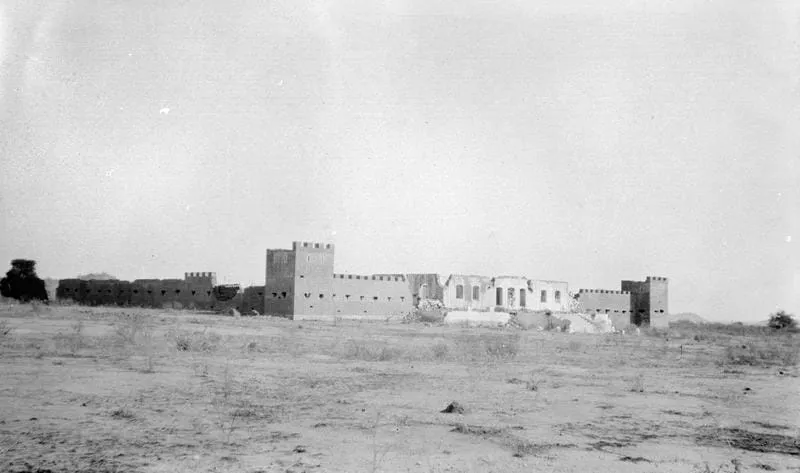
On 18 February 1916 the German garrison of the mountain above Mora, in the far north of German Kamerun, capitulated. Captain Ernst von Raben had held out there since August 1914, when his company beat off the first Allied attack. He surrendered on honourable terms only when he learned that the rest of the German forces in Kamerun had taken refuge in Spanish Muni. According to the British official history (Moberly, Togoland and the Cameroons), the surrender of Mora ended the campaign in Kamerun.
The last winter on the mountain
After the failed assault of September 1915 the Allies again confined themselves to blockading the mountain. The blockade was commanded by the French Captain Rémond, and alongside his company stood detachments of the Nigeria Regiment. The defenders were not idle, however: in October they occupied the Gauala ridge and in night sorties seized cattle, goats and grain. According to Fritz Damis, an NCO of the garrison who published memoirs of the siege in 1929, the supplies were stretched until February 1916. At the same time everything else was already lacking: medicines, anaesthetics, clothes and boots. Many soldiers went about in uniforms sewn from tent sheets and the clothing of fallen enemies, and some Europeans went barefoot. In the dry season water began to run short again.
Meanwhile in the south of the colony the campaign was coming to an end. When on 5 February General Frederick Cunliffe, commander of the British forces in northern Kamerun, left Duala for Lagos, Raben was still holding out. General Charles Dobell then placed at Cunliffe’s disposal a howitzer with a British crew in case Mora had to be taken by force. According to Damis, the defenders saw new enemy troop movements in the last days and expected a decisive attack. Cunliffe, however, after consulting the Governor-General of Nigeria, Frederick Lugard, in Lagos, decided first to offer Raben surrender.
The terms
On 15 February envoys under a white flag again approached the German positions. They brought a letter from Cunliffe, passed on by Captain Rémond. In it the general informed him that all the remaining German forces in Kamerun had withdrawn into Muni and been interned there. If Raben gave up Mora, his officers would keep their swords, the Europeans would go to England as prisoners, and the African soldiers would be set free and given safe passage home.
The garrison had beaten off every attack for a year and a half, so the decision came hard. Damis writes that even a last assault on the besiegers’ positions was considered. Raben concluded, however, that further fighting made no sense: there were no other German forces left in Kamerun to which he could break through. On 17 February the details were settled at a meeting with the Allied commanders. According to Damis, Raben secured that all the Europeans, not only the officers, would keep their bayonets, and that the British would pay 60,000 shillings in arrears of pay to the askaris, who for months had received only part of it.
18 February
On the morning of 18 February the defenders fired a last salute over the graves of the fallen, and then laid down their weapons and ammunition halfway between the lines. The flag, which had still been flying on 27 January, the Kaiser’s birthday, was burned so that it would not fall into the hands of the victors. According to the British official history 11 Germans and 145 African soldiers went into captivity. They handed over 4 machine guns, 183 rifles and about 40,000 rounds. A British company rendered military honours to the defeated. Because the money for the pay had to be brought from distant Maiduguri, the Germans continued for several days to command their askaris in the position already occupied by the Allies, until the company was paid off and disbanded.
Raben and his men were taken into captivity in England. On 22 February King George V sent Dobell a telegram of congratulations on the conclusion of the operations in Kamerun. The colony, where fighting had gone on since August 1914, now had to be divided between the British and the French.
Remember the articles you have read? Only in this browser; nothing is sent anywhere.How it works
Read ·
Spotted a mistake?Report an error
Meanwhile
(04)Elsewhere in the same days.
- 17 February 1916 · Balkan FrontPro-Austrian Albanians occupy BeratIn mid-February 1916 Essad Pasha's men gave up Berat. The town was taken by Albanian units allied with the Austrians, and soon the Bulgarians appeared there.
- 17 February 1916 · PoliticsArrest of the consuls on ChiosIn mid-February 1916 Allied sailors arrested the German and Austro-Hungarian consuls on the Greek island of Chios. Greece protested.
- 16 February 1916 · Middle EastRussians capture ErzurumOn 16 February 1916 Cossacks rode into Erzurum, left by the Turks. The fall of a fortress thought impregnable was Russia's greatest success in the Caucasus.
- 16 February 1916 · Middle EastWar Office takes over the Mesopotamian campaignIn mid-February 1916 control of operations in Mesopotamia passed from the Government of India and the India Office to the War Office in London.
Related events
(04)The same battle, people or subject.
- 3 March 1916 · AfricaProvisional partition of KamerunIn early March 1916 London and Paris agreed a provisional partition of conquered Kamerun. The Picot line gave France almost the whole colony, including Duala.
- 1 January 1916 · AfricaAllies take YaoundéOn 1 January 1916 Col. Gorges's British column entered Yaoundé unopposed. The Germans had left the day before and were falling back south, towards Muni.
- 17 February 1916 · AfricaGermans cross into Spanish GuineaOn 17 February 1916 Kamerun's governor told Berlin he had taken refuge in Spanish Muni with his whole force. The last units had crossed two days earlier.
- 8 October 1915 · AfricaGermans take the Gauala ridgeOn the night of 8/9 October 1915 the besieged Mora mountain garrison took the Gauala ridge, from which the Allies had shelled German positions for a year.