Key event
Battle of Armentières begins
- Category:
- Military operations
- Front:
- Western Front
- Date:
- 13 October 1914
- Author:
- Natalia
- Battle:
- Battle of Armentières
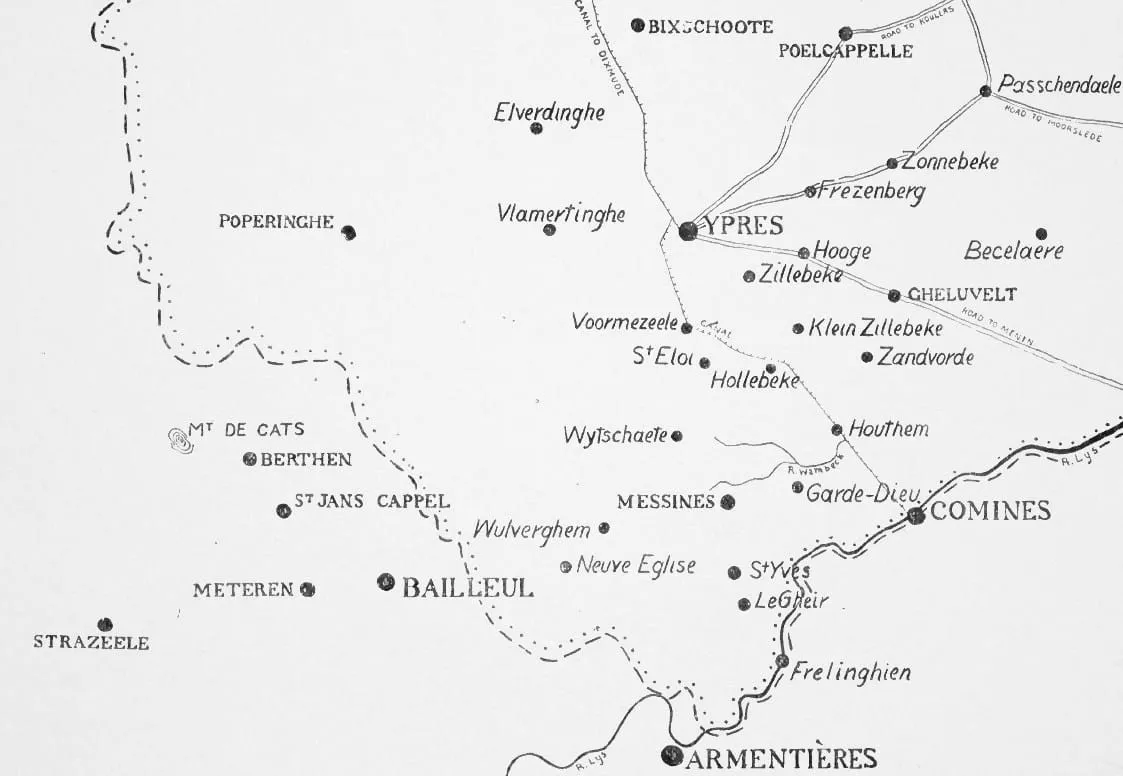
On 13 October 1914 the British III Corps of General William Pulteney went over to the attack from Hazebrouck in French Flanders. At the village of Méteren it ran into entrenched Germans and only took their position after dark, after a whole day of fighting in rain and fog. British nomenclature begins the Battle of Armentières with this engagement, in which III Corps fought for the next three weeks in the valley of the river Lys.
The road to Hazebrouck
III Corps, made up of the 4th and 6th Divisions, was the last of the corps of the British Expeditionary Force to move to Flanders from the Aisne. Its soldiers detrained at Saint-Omer on 10 and 11 October. On 12 October they moved to Hazebrouck, covering part of the way in French buses. The move proved chaotic. The buses arrived late, traffic jams formed in the narrow streets of Saint-Omer and many vehicles lost their way after dark. The corps was ready to march only on the morning of 13 October.
The British were to advance eastwards, towards Bailleul and Armentières, and together with the cavalry of General Edmund Allenby, which the day before had taken the hill of Mont des Cats, pass to the north of Lille. Facing them were the divisions of the German IV Cavalry Corps, reinforced by Jäger battalions and infantry.
The attack on Meteren
In the morning the 6th Division moved off on the right flank, towards Vieux-Berquin and Merris, and the 4th Division on the left, through Flêtre. About eight kilometres beyond Hazebrouck the advance guards came up against Germans entrenched behind the Meterenbecque stream. Their position ran along a low ridge on which stands Meteren, a compact village with a tall church tower. British airmen noticed reinforcements coming up to the defenders from Bailleul. Allenby’s cavalry failed to turn the position from the north.
General Pulteney decided to attack with the whole corps, on a front about eight kilometres long. The British official history calls this attack the first deliberate attack by the British in this war. Preparations took several hours, and the attack began only at about 2 p.m. The day was wet and misty, and the ground was cut up by hedges, buildings and hop fields, so the artillery could help little. The burden of the fighting fell on the infantry.
The Germans defended skilfully. Their trenches were dug just in front of houses, hedges and walls, against which the riflemen’s heads were hard to see, and the excavated earth had not been heaped into a parapet that would have betrayed their position. From the church tower in Meteren observers could see every move of the attackers. Only after dark did the 10th Brigade take Meteren and the 18th Brigade the neighbouring village of Outtersteene. The Germans withdrew in good order. III Corps lost 708 killed, wounded and missing that day.
Lieutenant Montgomery
Among the seriously wounded at Meteren was a 26-year-old lieutenant of the 1st Battalion, Royal Warwickshire Regiment, Bernard Montgomery. Leading his platoon into the attack, he was shot through the lung and then once more, in the knee. A soldier who tried to dress his wounds was killed and fell on top of him. Montgomery lay on the battlefield for several hours, until dark, and the doctors considered his condition hopeless. He survived and received the DSO (Distinguished Service Order) for this action, a rare distinction for such a young officer. In the Second World War he commanded British forces at El Alamein and in Normandy.
What came next
The prisoners taken at Meteren belonged to several German cavalry divisions and to Bavarian Jäger. On the same day news reached the British that the Germans had occupied Lille and that their XIX Corps was already in the area. Pulteney therefore decided to continue the attack the next day, before the German cavalry received infantry reinforcements. It was not necessary. During the night the Germans withdrew behind the Lys. On 14 October the British entered Bailleul, and three days later Armentières. There, however, their advance soon came to a halt.
Remember the articles you have read? Only in this browser; nothing is sent anywhere.How it works
Read ·
Spotted a mistake?Report an error
Meanwhile
(04)Elsewhere in the same days.
- 13 October 1914 · War at seaU-boats on the Southampton–Le Havre routeOn 13 October 1914 a British torpedo boat came upon a German submarine off the Isle of Wight. The Admiralty diverted the Canadian convoy to Plymouth.
- 13 October 1914 · Eastern FrontBattle of Chyrów beginsOn 13 October 1914 the Austro-Hungarian armies launched a general attack on the Russian Eighth Army at Chyrów and Stary Sambor. A hard battle began.
- 13 October 1914 · PoliticsBelgian government in Le HavreOn 13 October 1914 the Belgian government sailed from Ostend to Le Havre. It settled in Sainte-Adresse, and France granted its buildings extraterritoriality.
- 14 October 1914 · AfricaBritish capture YabassiOn 14 October 1914 British troops took the German post of Yabassi on the Wouri river in Kamerun. A first attack a week earlier had failed.
Related events
(04)The same battle, people or subject.
- 14 October 1914 · Western FrontBritish occupy BailleulOn 14 October 1914 the British III Corps entered Bailleul in French Flanders. The Germans had left the town after less than a week of occupation.
- 17 October 1914 · Western FrontThe British retake ArmentièresOn 17 October 1914 the British III Corps entered Armentières, hastily abandoned by the Germans. The town remained in Allied hands until 1918.
- 12 October 1914 · Western FrontBattle of Messines beginsOn 12 October 1914 Allenby's British cavalry took the Mont des Cats in Flanders. The battle for the Messines ridge south of Ypres had begun.
- 11 October 1914 · Western FrontThe British retake MervilleThe British chronology records the recapture of Merville on 11 October 1914. The British 1st Cavalry Division took the Lys town, linking up with the French.