United Kingdom · The Entente
Edmund Allenby
Commander of the Third Army in France (1915–1917), Commander-in-Chief of the Egyptian Expeditionary Force (1917–1919), field marshal
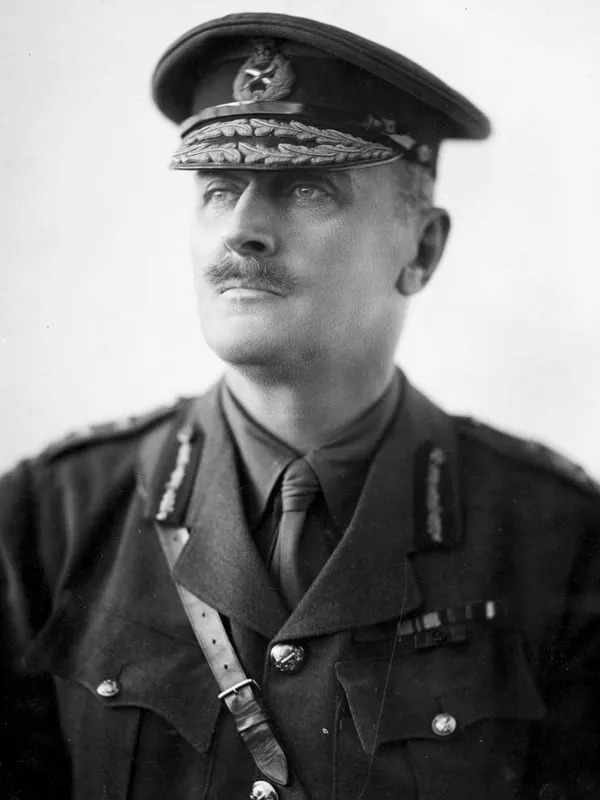
- Born:
- 23 April 1861, Brackenhurst (England)
- Died:
- 14 May 1936, London
- Author:
- Łukasz Skowroń
- Photo:
- autor nieznany, domena publiczna, Wikimedia Commons

Sir Edmund Allenby, a field marshal and Viscount Allenby of Megiddo from 1919, had two wars. On the Western Front he was one of many British generals: he commanded a division, then a cavalry corps, an infantry corps and an army, and his greatest battle, at Arras in the spring of 1917, began brilliantly and ended like all the others, amid mounting losses. He was regarded as a hot-tempered and obstinate commander, and Haig, his rival since their Staff College days, eventually got rid of him. Sent to Egypt, Allenby proved to be one of the best commanders of the war. He took Jerusalem before Christmas 1917, as the Prime Minister wanted, and in September 1918 at Megiddo he crushed the Turkish armies in Palestine in one of the most brilliant operations of the entire war. By the autumn of 1918 his troops were in Damascus and Aleppo, and the Ottoman Empire was asking for an armistice.
Before the war
He was born on 23 April 1861 at Brackenhurst in Nottinghamshire into a family of landed gentry. He was educated at Haileybury College. He did not dream of the army: he first tried to get into the Indian Civil Service, and when he failed the examination he passed into the Royal Military College at Sandhurst. In 1882 he was commissioned as a lieutenant in the 6th (Inniskilling) Dragoons and went with the regiment to southern Africa, where he took part in the expedition to Bechuanaland. In the mid-1890s, at his second attempt, he gained a place at the Staff College at Camberley. In the same intake was Douglas Haig. Allenby was more popular with his fellow officers, and it was he, not Haig, the better horseman, who was chosen as Master of the Drag Hounds. A rivalry began between the two officers then that lasted into the Great War.
In the Boer War he commanded a squadron, then a column and a cavalry brigade, and Lord Kitchener called him a “popular and capable” brigadier in a report. After his return he commanded the 5th Lancers and the 4th Cavalry Brigade, was promoted to major general in 1909 and in 1910 became Inspector of Cavalry. Tall and powerfully built, with a booming voice and a tendency to violent outbursts of temper, he earned the nickname “the Bull”. In 1896 he married Adelaide Chapman. Their only son, Michael, was born in 1898.
1914–1915: the cavalry and Ypres
In August 1914 Allenby led the only cavalry division of the British Expeditionary Force to France. After the Battle of Mons his brigades covered the retreat, and his horsemen supported II Corps at Le Cateau. The retreat also revealed Allenby’s weaknesses. Subordinates complained that he could not explain his intentions clearly, and Brigadier Hubert Gough broke away from the division with his brigade and joined Haig’s corps, which soured relations between the two cavalrymen for a long time.
In the autumn, as the British army moved to Flanders, on 9 October 1914 the two cavalry divisions were combined into a corps under Allenby’s command. It was to cover the arrival of the infantry and outflank the German wing, but the front quickly froze. From then on the cavalrymen fought on foot in trenches, with bayonets and rifles. At Messines they held a long sector for three weeks with thin lines of dismounted men, until at the turn of October and November they lost the ridge in heavy fighting that was already part of the First Battle of Ypres. Allenby won much praise for this fighting, conducted with very slender forces.
In May 1915, during the Second Battle of Ypres, he took over V Corps from Herbert Plumer, defending the salient around the town. His men came through the fighting for Frezenberg Ridge and for Bellewaarde Ridge, but critics accused him of adding to already enormous losses with incessant counter-attacks. In September, to draw German attention away from the attack at Loos, Allenby’s corps attacked at Hooge, again at the cost of many men. His outbursts of temper became legendary: he raged over a badly constructed sentence in a report and over a dead soldier without a helmet, which he had ordered to be worn. In October 1915 he was promoted to lieutenant-general and took over the Third Army.
1916–1917: the Third Army and Arras
The Third Army held the front around Arras. On 1 July 1916, the first day of the Battle of the Somme, its VII Corps carried out a diversionary attack on the German salient at Gommecourt, which ended in heavy losses. Allenby had doubts about Haig’s command, but did not allow his subordinates to criticise him. Officers of his staff who knew him more closely discovered in him a man curious about the world, widely read in everything from botany to poetry, and open to new ideas. J.F.C. Fuller, later the great theorist of armoured warfare, wrote that in time he came to like and respect him.
These qualities could be seen in the plan of the Arras offensive, which in the spring of 1917 was to tie down German reserves ahead of the great French offensive on the Aisne. Allenby wanted to surprise the Germans with a short, 48-hour bombardment rather than a week-long one, but Haig and his artillery adviser decided that the wire could not be destroyed in that time, and the bombardment was lengthened. Huge underground workings beneath the town were prepared for the attack, and successive divisions were to pass through the lines of those ahead of them and take the next lines. When in March the Germans fell back to the Hindenburg Line south of Arras, Allenby wanted to change the plan, but Haig refused.
The Battle of Arras began on 9 April, Easter Monday, with a splendid success. North of the Scarpe the Third Army advanced more than five kilometres, the furthest in a single day since the start of trench warfare, and the Canadians of the neighbouring First Army took Vimy Ridge. On 11 April the British took Monchy-le-Preux. Then the attack bogged down in snowstorms and mud, and the Germans reorganised their defence. Because the French had not broken through on the Aisne, Haig had to keep tying the Germans down at Arras. In successive battles of the Scarpe the Third Army attacked again and again on narrow sectors, suffering heavy losses for small gains. Subordinates criticised Allenby for these persistent, small-scale attacks, and according to the Adjutant-General’s returns his army lost more than 87,000 men in April and May 1917. Allenby lost Haig’s confidence. On 9 June General Julian Byng took over the Third Army from him. His departure from France was widely seen as a dismissal.
Egypt and Gaza
It was not. The Prime Minister, David Lloyd George, wanted a victory in Palestine that would lift the spirits of the exhausted British, and was looking for a commander with drive to replace General Archibald Murray, who had lost two battles of Gaza. The post was first turned down by Jan Smuts, and then the Chief of the Imperial General Staff, General William Robertson, proposed Allenby. Lloyd George told him that the Cabinet expected “Jerusalem before Christmas” and promised that he would get whatever he asked for. According to some historians, Allenby himself thought that the new posting would contribute little to a war that was to be decided in France. On 28 June 1917 he took command of the Egyptian Expeditionary Force.
Allenby at once toured the front and showed himself to the soldiers, which had not been done under Murray, and moved his headquarters from the Savoy Hotel in Cairo to the area of Rafah. He divided his force into three corps: XX, XXI and the Desert Mounted Corps of the Australian general Harry Chauvel. He was won over to the guerrilla war waged east of the Jordan by T. E. Lawrence, and from then on gave him great freedom and money. The forces of Emir Faisal in practice came under his orders and covered the right wing of his army. At the end of July he received news that his only son, the artilleryman Michael, had been killed in Belgium. Those close to him recalled that the blow almost broke him, but Allenby withdrew into himself and threw himself into his work.
He based the plan of the autumn offensive on an appreciation that General Philip Chetwode and his chief of staff Guy Dawnay had prepared even before his arrival: instead of storming Gaza a third time, strike at the other end of the Turkish line, at Beersheba, and capture its wells. Everything depended on water and surprise. On 10 October an officer of Allenby’s staff dropped a haversack with false documents in front of a Turkish patrol, according to which the main attack was to go in at Gaza. The Third Battle of Gaza began at the end of October with a bombardment of the town, but on 31 October XX Corps and the mounted troops attacked Beersheba. When in the afternoon the attack dragged on and there was talk at headquarters of the thirsty cavalry falling back to distant watering places, Allenby had Chauvel told that the town must be taken that same day, and the Australian Light Horse took Beersheba in a charge together with its intact wells. On the night of 6/7 November the Turks abandoned Gaza.
Jerusalem
Allenby gave the Turks no respite. His mounted troops and infantry advanced north along the coastal plain, on 13 November the charge at El Mughar opened the way to the railway junction, and on 16 November the British occupied Jaffa. Allenby then turned into the Judaean Hills. He did not want to fight in Jerusalem itself and ordered the holy places to be spared. The first attacks bogged down in the fighting for Nabi Samwil, so on 24 November he halted the offensive until fresh divisions arrived. At the beginning of December Chetwode’s XX Corps attacked again, the Turks abandoned the city during the night and on 9 December Jerusalem surrendered.
On 11 December Allenby entered Jerusalem on foot through the Jaffa Gate, in deliberate contrast to Emperor Wilhelm II, who had ridden into the city on horseback in 1898. Beneath the Citadel a proclamation was read in several languages assuring that the holy places of all three religions would be respected, and Muslim shrines were guarded by Indian Muslim soldiers. The British press wrote of the last crusade, but Allenby, aware of Turkish jihad propaganda, forbade the use of the word in his communiqués. Lloyd George got the Christmas present he had asked for. A few weeks earlier the British government had issued the Balfour Declaration, so the capture of the city also took on a political dimension. In the following weeks Allenby’s troops repulsed a Turkish attempt to retake the city, and in February 1918 they occupied Jericho and reached the Jordan.
1918: Megiddo
At the beginning of 1918 the government wanted Allenby to press on and sent Smuts to him to agree a plan for an advance on Haifa and Damascus. Allenby first tried to cut the Hejaz Railway. Both spring raids across the Jordan, on Amman in March and on Es Salt at the turn of April and May, ended in retreat, and Chetwode later called them Allenby’s most foolish undertakings. Meanwhile the German offensive in France forced London to take some 60,000 soldiers from him, including two whole divisions and many battalions of British infantry. Allenby had to rebuild his army, mainly from Indian units, which spent the summer learning to work with the rest of the force.
The raids across the Jordan nevertheless had an effect that Allenby did not waste: they convinced the commander of the Turkish army group, General Otto Liman von Sanders, that the British would strike again on the eastern flank. Allenby sustained this belief throughout the summer with dummy camps, canvas horses and troop movements in the Jordan Valley, while in secret he moved most of his infantry, artillery and mounted troops to the coast and hid them in orange groves. On 22 August he surprised his corps commanders with a plan far bolder than their own ideas: after the front was broken, the mounted troops were to pass to the Turkish rear and close their lines of retreat.
The Battle of Megiddo began on 19 September at 4.30 a.m. with a short, violent bombardment. The infantry of XXI Corps broke through the front by the sea within a few hours, and the Desert Mounted Corps rode through the gap. Aircraft bombed the telephone exchanges and headquarters of the Turkish armies, which lost contact with the front. That same night the cavalry passed through the passes of the Carmel range into the Jezreel Valley, and on the morning of 20 September a brigade burst into Nazareth, Liman barely escaping ahead of it. Within a few days the Turkish Seventh and Eighth Armies ceased to exist, and the Fourth Army was retreating in disorder beyond the Jordan. According to the British official history, by the end of October the British had taken more than 75,000 prisoners, losing some 5,700 men in that time.
Allenby did not stop. On 1 October Damascus was occupied by British and Arab troops, then Beirut and Homs fell, and on 26 October Aleppo. Horses were dying and men were falling sick with malaria and influenza, but the pursuit went on until on 30 October the Turks signed the Armistice of Mudros. Victory also brought Allenby political difficulties. He had to reconcile the promises made to the Arabs with the agreement with France. He told Faisal that he recognised an Arab administration east of the Jordan as far as Damascus, but not on the coast, which was to go to France, and when Faisal’s men raised the Arab flag in Beirut, he had it taken down.
After the war
In March 1919, when a revolt against British rule broke out in Egypt, Allenby became Special High Commissioner for Egypt. In July he received his field marshal’s baton, and in October the title of Viscount Allenby of Megiddo. In Cairo he combined suppression of the riots with concessions. He agreed to let the nationalist leader Saad Zaghloul travel to Paris, later had him deported, but in 1922 he pushed through in London the ending of the protectorate and the recognition of Egypt’s independence, albeit with reservations that left the British in control of important matters. After the assassination of the Sirdar of the Egyptian Army, Sir Lee Stack, in November 1924 he imposed harsh terms on Egypt, including a fine of half a million pounds, which alienated the Egyptians and also drew criticism in London, because he had acted without waiting for instructions. In 1925 he resigned. He died suddenly in London on 14 May 1936. His ashes were laid in Westminster Abbey.
Assessment
On the Western Front Allenby did not stand out among British generals. At Messines in 1914 his cavalry defended itself bravely, but at Ypres in 1915 and on the Scarpe in 1917 his attacks and counter-attacks cost a great deal and achieved little. His temper meant that subordinates were afraid to report bad news to him, which did not make command easier. Archibald Wavell, an officer of his staff and later his biographer, admitted that in 1916 Allenby was regarded as an obstinate and hot-tempered “Bull”, a general given to banging his head against a wall. Wavell argued, however, that this was only half the truth.
In Palestine he showed another face. He understood that in the desert war is decided by water, supply and the health of the soldiers, and he cared for them more than anyone before him. He could surprise the enemy, deceive him about the direction of the blow and throw his mounted troops deep into his rear. Historians, including the author of the British official history, Cyril Falls, regard the Battle of Megiddo as one of the most successful operations of the war, and Allenby as one of the British Army’s finest operational commanders. Critics point out that in 1918 he had an enormous superiority over the Turks in men, artillery and aircraft, and that his opponent was exhausted, hungry and decimated by desertion. The most contested remains the political legacy of his victories: the promises to the Arabs, the agreement with France and the Balfour Declaration, which his soldiers put into effect in the conquered lands, shaped the fate of the Middle East for many decades.
Sources
Spotted a mistake?Report an error
Commanded in battles
(23)- 26 August 1914Battle of Le CateauWestern Front
- 12 October – 2 November 1914Battle of Messines (1914)Western Front
- 19 October – 22 November 1914First Battle of YpresWestern Front
- 26 January 1915 – 30 October 1918Sinai and Palestine campaignMiddle East
- 8–13 May 1915Battle of Frezenberg RidgeWestern Front
- 24–25 May 1915Battle of Bellewaarde RidgeWestern Front
- 22 February – 5 April 1917German retreat to the Hindenburg LineWestern Front
- 9 April – 16 May 1917Battle of Arras (1917)Western Front
- 9–14 April 1917First Battle of the Scarpe (1917)Western Front
- 23–24 April 1917Second Battle of the Scarpe (1917)Western Front
- 28–29 April 1917Battle of ArleuxWestern Front
- 3–4 May 1917Third Battle of the Scarpe (1917)Western Front
- 27 October – 7 November 1917Third Battle of GazaMiddle East
- 31 October 1917Battle of BeershebaMiddle East
- 13–14 November 1917Battle of Mughar RidgeMiddle East
- 17–24 November 1917Battle of Nebi SamwilMiddle East
- 7–9 December 1917Capture of JerusalemMiddle East
- 21–22 December 1917Battle of JaffaMiddle East
- 26–30 December 1917Defence of JerusalemMiddle East
- 19–21 February 1918Capture of JerichoMiddle East
- 21 March – 2 April 1918First raid on AmmanMiddle East
- 30 April – 4 May 1918Second raid on Es SaltMiddle East
- 19–25 September 1918Battle of MegiddoMiddle East
Mentioned in battles
(06)Often appears with
People who appear in the same events.
On the timeline
(42)1914
August
October
- 13
- Key eventBattle of Armentières beginsOn 13 October 1914 the British III Corps attacked the Germans at Meteren in Flanders. After a day's fighting in rain it took the village, losing over 700 men.
- Allies return to YpresIn mid-October 1914 Rawlinson's British IV Corps, falling back from Ghent, reached Ypres. French Territorial divisions took up positions beside it.