1917: Baghdad and Gaza
First Battle of Gaza
- Dates:
- 26–27 March 1917
- Front:
- Middle East
- Location:
- Gaza and the hills on its southern and eastern approaches (Ali Muntar, Mansura, Sheikh Abbas) and the plain east and north of the town, between the Wadi Ghazze and the road to Beersheba, in southern Ottoman Palestine (today the Gaza Strip)On the battle map →
- Sides:
- United Kingdom, Australia and New ZealandArchibald Murray, Charles Dobell, Philip Chetwode, Harry Chauvel, Alister DallasOttoman Empire, Germany and Austria-HungaryDjemal Pasha, Friedrich Kress von Kressenstein, Tiller
- Result:
- Ottoman victory. The British surrounded the town and took Ali Muntar, but broke off the battle and withdrew behind the Wadi Ghazze. They lost nearly 4,000 men, the Turks and Germans about 2,400.
- Author:
- Łukasz Skowroń
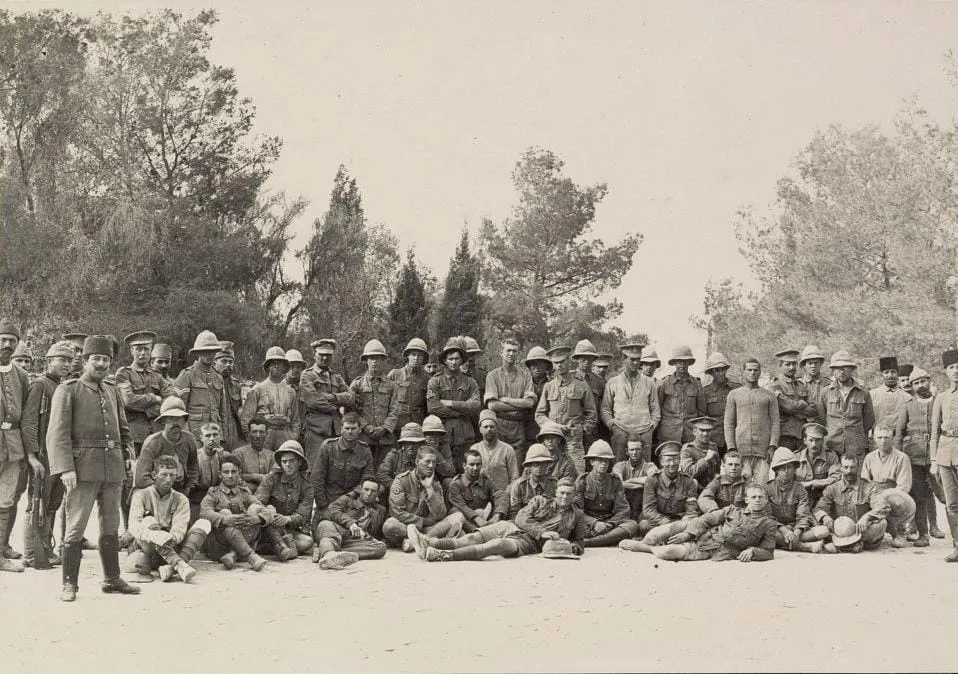
The First Battle of Gaza was the first British attempt to break into Palestine. On 26 March 1917, after a night march and a morning fog, Australian, New Zealand and British cavalry surrounded Gaza from the east and north, and in the afternoon the Welsh 53rd Infantry Division took Ali Muntar, the hill that dominates the town. At dusk the garrison was close to surrender, but the British commanders did not know it. Fearing the approaching Turkish reinforcements and thinking of the horses, which had stood without water all day, they ordered the cavalry to break off the fight. Through a misunderstanding the infantry abandoned the positions it had captured, on 27 March it tried in vain to retake them, and on the night of 27/28 March the whole army went back behind the Wadi Ghazze. Gaza, which had been all but taken, remained in Turkish hands for more than seven months.
Name and dates
The British official history (George MacMunn and Cyril Falls, Military Operations: Egypt and Palestine, vol. I) calls the engagement the First Battle of Gaza, to distinguish it from the second battle in April and the third in the autumn of 1917. Polish literature uses the same name. The battle lasted two days: on 26 March the cavalry crossed the Wadi Ghazze before dawn, and on the afternoon of 27 March General Charles Dobell gave the order to withdraw. The last infantry units crossed back over the wadi before four in the morning of 28 March, which is why some accounts give the dates 26–28 March. We take 27 March, the last day of fighting, as the end of the battle. Times are given, as in the official history, in Cairo time.
Background
After the action at Rafah on 9 January 1917 there were no Turks left in Sinai, and General Archibald Murray’s troops stood on the threshold of Palestine. London, however, did not yet want a major offensive. A War Office telegram of 11 January postponed the advance on Jerusalem until the autumn, and at the beginning of February Murray had to send the 42nd Division to France. He was left with three infantry divisions, the 52nd, 53rd and 54th, and two mounted divisions. In the spring of 1917, though, the Allies were pressing on every front, and on 11 March the British entered Baghdad. The War Cabinet knew that Murray was thinking of attacking Gaza and wanted him to play his part too.
The standard-gauge railway from Kantara followed close behind the army: on 1 March it reached Sheikh Zuweid, and on 21 March the station at Rafah was opened. At the beginning of March the Turks fell back from their fortified position at Shellal to the line Gaza – Tel esh Sheria – Beersheba. Their commander, the Bavarian colonel Friedrich Kress von Kressenstein, the same man who had lost at Romani, would have preferred to defend Shellal, but he was too weak to hold that position and cover Gaza at the same time. Murray and the commander of the Eastern Force, Lieutenant-General Sir Charles Dobell, the conqueror of Kamerun, feared that the Turks would withdraw further before they could be reached. They therefore decided to repeat on a larger scale the raids on Magdhaba and Rafah: to take Gaza and its garrison by a swift stroke (coup de main), and at the same time to occupy the line of the Wadi Ghazze to cover further railway construction.
Gaza, one of the five cities of the Philistines, had been the gateway to Palestine for thousands of years. It had been taken by the Assyrians, Alexander the Great, the Caliph Omar, Saladin and Napoleon. Before the war it had about 40,000 inhabitants and exported barley to Britain. To the south and east it was surrounded by gentle, treeless ridges. On the highest of them, half a mile from the eastern quarter, the Muslim shrine of Ali al-Muntar stood above the town, on the hill to which, according to tradition, Samson carried the city gates. Between the hill and Gaza stretched orchards, gardens and fields cut up by a maze of prickly pear hedges, so tall and dense that they could be breached only with explosives or long work with an axe. The trenches had little wire, but they commanded the bare slopes.
Plan
Dobell entrusted the attack to Lieutenant-General Sir Philip Chetwode’s Desert Column. For this operation it was given Major-General Harry Chauvel’s Anzac Mounted Division, Major-General Henry Hodgson’s new Imperial Mounted Division (both less one brigade) and Major-General Alister Dallas’s 53rd (Welsh) Division. The Imperial Camel Brigade, the 52nd and 54th Divisions and the 229th Brigade, the only ready brigade of the 74th Division then forming, remained under Dobell’s own orders. Murray’s headquarters approved the plan on 19 March, and the Eastern Force operation orders were issued on 24 March.
Before dawn on 26 March the cavalry was to cross the Wadi Ghazze, go round the town from the east, close the lines of retreat and hold off reinforcements that might come from the camps at Huj, Jemmameh and Tel esh Sheria. The 53rd Division was to occupy the Mansura and Es Sire ridges and then storm Ali Muntar and the town. The 54th Division was to take up position on the Sheikh Abbas ridge and cover its rear to the east. Everything had to be decided within a single day, because the horses had last been watered before midnight on 25 March, and their next sure water was in Gaza or back on the Wadi Ghazze. The railway ended a dozen or so miles behind, and supplies were carried by wagons and camels. Artillery was also short: the whole army had only twelve 60-pounder guns, and six of them were brought up to Gaza. In the end the 53rd Division’s assault was supported by 42 guns.
Chetwode estimated the Gaza garrison at about 2,000 men. He did not know that Kress, warned by his airmen, had recently almost doubled it. According to Otto Liman von Sanders, the town was defended under the command of the German Major Tiller by seven infantry battalions, with two batteries of Austro-Hungarian mountain howitzers and German 10-centimetre guns, almost twice as many as Chetwode believed. The 3rd Division stood at Jemmameh, the 16th Division at Tel esh Sheria, and the 53rd Division was coming along the coast from Jaffa. The Turkish general staff later put the forces that took part in the battle at 16,000 rifles.
Course of the battle
Night and fog. After three days of marches, made mainly at night to hide them from the airmen, the Eastern Force had reached the Wadi Ghazze by midnight on 25 March: the cavalry and the 53rd Division at Deir el-Belah, the 54th Division at In Seirat, and the 52nd Division at Khan Yunis. At 2.30 a.m. the Anzac Mounted Division moved off, and the 160th Brigade of the 53rd Division crossed the wadi at 3.45 a.m. At about four a fog came in from the sea, so thick, which is rare in March, that at dawn nothing could be seen at 20 metres. The cavalry went on by compass and the fog if anything helped it, because it hid it from observers. The infantry groped its way forward. Above all, though, the fog delayed the reconnaissance without which Dallas would not issue orders for the assault. It began to lift at about 7.30, although it lay in the ravines for several more hours.
A ring round the town. At about eight the 2nd Light Horse Brigade scattered the first Turkish patrol near Sheikh Abbas, cut the Gaza – Beersheba road together with the telegraph line, and after nine reached Beit Durdis. At 10.30 it took the village of Jabalia north-east of Gaza, and half an hour later its 7th Regiment extended as far as the sea. Surprise was complete. An Australian patrol captured the commander of the Turkish 53rd Division, who was driving with his staff in a carriage to Gaza to take command there. The Imperial Mounted Division was in position at ten near Khirbet er Reseim, facing east, and the Camel Brigade near El Mendur. The 54th Division dug in on Sheikh Abbas. By about 10.30 the town was cut off from the east and north, and the cavalry had formed a corridor for the main attack.
The 53rd Division’s attack. Two of Dallas’s brigades were on the Mansura and Es Sire ridges by 8.30, but the assault was delayed. Dallas’s conference with his brigade commanders met at Mansura only at 10.15, the 159th Brigade received its order to march only at 9.30, and the reserve brigade could not be found for a long time. Chetwode and Dobell, who stood side by side on a hill near In Seirat, urged Dallas on by telephone and telegraph. The official history remarks that a commander whose superior is looking over his shoulder feels constrained, and compares the situation to the Battle of Spion Kop in 1900. The bombardment began at noon, and the infantry a few minutes earlier. It advanced over bare slopes under shrapnel and machine-gun fire. The Australians and New Zealanders watched the attack from the ridges as if from an amphitheatre, and the official history called it a model of precision and steadiness.
At 1.30 p.m. the 160th Brigade took the Labyrinth, a tangle of entrenched gardens south of the town. Other battalions were held up in front of the hedges and under machine-gun fire from Green Hill and Clay Hill. At 3.50 p.m. about forty men of the 5th Battalion, Royal Welsh Fusiliers, and as many from the 5th Battalion, Welsh Regiment, broke in with a sudden rush into the trenches east of the Ali Muntar mosque, taking prisoner twenty Germans and Austrians and twenty Turks. The 161st (Essex) Brigade took Green Hill at 5.30 p.m., and the 159th Brigade had taken Clay Hill already at 4.45 p.m. By 6.30 p.m. the whole position was in British hands, and the Turks were fleeing into the town.
Cavalry in the gardens of Gaza. In the afternoon Chetwode concluded that the infantry alone would not finish before dark, and at 1 p.m. he threw the Anzac Mounted Division into the fight. The order, however, took a full hour by telegraph, and regrouping took another two. Chauvel issued his orders at 3.15 p.m., and the attack began at four. The Australians fought in the gardens in the north of the town, firing at the Turks from a few metres through the cactus hedges. New Zealanders of the Wellington regiment captured two Krupp field guns, turned them round and at close range shot up the houses from which they were being fired on. A squadron of the Canterbury regiment rode into the Ali Muntar trenches just behind the Welsh infantry. At dusk the cavalry stood in the northern and western outskirts, and during the night its patrols met patrols of the 53rd Division in the eastern streets.
The order at dusk. Meanwhile the Turkish reinforcements were approaching. Kress ordered Major Tiller to defend the town to the last man and sent the 3rd and 16th Divisions to relieve it. At 4.50 p.m. the Imperial Mounted Division reported 3,000 infantry coming from Huj. At 5.15 p.m. the Turks occupied a hill north of Beit Durdis, but were stopped there. From the north, from the direction of Deir Sneid, further columns were coming. The sun set at six. Chetwode still had no news of the fall of Ali Muntar, half his cavalry was fighting in the gardens and the other half was under attack from the north and east. All day the horses had drunk only from a few pools, and according to a deserter almost all the wells in Gaza had been blown up. At 6.10 p.m., with Dobell’s consent, Chetwode reluctantly ordered the cavalry to break off and withdraw behind the Wadi Ghazze. The Australian official history writes that Chauvel protested strongly. Chetwode denied that any such protest had reached him. As the order was going out, a report from Dallas arrived that a redoubt beyond Ali Muntar had been taken, but Chetwode did not change it.
No one on the staff knew how close victory was. British intelligence in Cairo, which had the key to the Turkish cipher, was intercepting wireless messages between Gaza and Kress’s headquarters. Tiller reported that the English were in the town, that his officers did not want to fight at dawn, and that without reinforcements there was no hope. He asked Kress for an attack at two in the morning, because his soldiers would not withstand another artillery bombardment, and Kress replied that he must hold on at all costs, because the 3rd and 16th Divisions would arrive at dawn. At least four such messages reached the staff at Rafah before 6.30 p.m., but Dobell received them only at about eleven at night. The wireless station in Gaza had already said goodbye to Kress’s headquarters, and in the morning it was blown up.
A night of misunderstandings. Shortly before seven in the evening Chetwode telephoned Dallas that the cavalry was leaving, so the 53rd Division must draw back its right flank and make contact with the 54th Division. Dallas protested and asked for reinforcements, but received a firm order. No one told him that the 54th Division was just then coming down from Sheikh Abbas to the Burjabye ridge, north of Mansura. Dallas believed he was to join it at Sheikh Abbas, several kilometres away, and at 10.30 p.m. he ordered the whole division to abandon the hills it had taken. When around midnight his staff realised the mistake, the withdrawal was already under way. At 11 p.m. Dobell, who by then knew Tiller’s messages, ordered Dallas to dig in on the line he held, but the order did not reach the 53rd Division, because at Desert Column headquarters it was thought merely to repeat an earlier instruction. By about four in the morning of 27 March the Welsh were back on the ridges south of Gaza, and Ali Muntar and Green Hill stood empty.
27 March. Chetwode realised what had happened only at five in the morning. Patrols sent forward found that the Turks had not yet returned, and a company of the 7th Battalion, Essex Regiment, reoccupied Ali Muntar, and two more Green Hill. Meanwhile the Turkish reinforcements went over to the attack. At dawn they attacked the withdrawing Australian 3rd Light Horse Brigade, which was covered by the machine guns of light armoured cars, occupied the abandoned Sheikh Abbas and from its ridge fired into the rear of the 53rd Division. At 9.30 a strong attack retook Ali Muntar, and two Essex battalions, almost surrounded on Green Hill, withdrew with difficulty. Dallas judged the position a bad one as long as the Turks held Sheikh Abbas. Dobell did not want to commit the 52nd Division, because regrouping would take a long time and in his view supplying water, food and ammunition was impossible. Murray reluctantly agreed by telephone. At 4.30 p.m. Dobell ordered the 53rd and 54th Divisions to withdraw behind the wadi. The withdrawal began at seven in the evening and the Turks did not interfere with it. That day a hot khamsin began to blow, and the exhausted soldiers suffered from heat and thirst.
Casualties
According to a return drawn up in mid-April, British losses amounted to 3,967 men: 523 killed and died of wounds, 2,932 wounded, most of them lightly, and 512 missing, of whom 246 were taken prisoner. Almost all of them were suffered by the 53rd Division and the 161st Brigade attached to it. The British took 837 prisoners, among them the commander of the Turkish 53rd Division with his whole staff and four Austrian officers and 37 Austrian soldiers, as well as two guns. Murray put the enemy’s losses at 6,000–8,000 men. According to the Turkish general staff, whose figures the official history cites, they amounted to 2,447 men, including about 300 killed and over a thousand missing. Other returns give less, about 1,700 men. Among the dead was the commander of the Austro-Hungarian artillery.
Significance
The official history writes that few battles of the war aroused so much controversy. At dusk on 26 March Gaza had practically been taken, and Dobell’s decision would probably have been different had he received Tiller’s messages in time. Several causes contributed to the outcome: the fog, which delayed the reconnaissance, the delay in the 53rd Division’s attack, the lack of water for the horses, small and overworked staffs, and communications through which orders took hours. On top of this came the night misunderstanding, through which the infantry gave up hills won at a high price. The official history adds that even holding Ali Muntar, with the Turkish artillery on Sheikh Abbas, would have been very difficult if the town had not fallen at once.
Murray’s reports had even greater consequences. On 28 March he reported to London that his troops had advanced 15 miles to the Wadi Ghazze, had fought heavily for two days against about 20,000 of the enemy, had inflicted 6,000–7,000 casualties on them and had taken 900 prisoners. On 1 April he added that the operation had been very successful and that only fog and lack of water had prevented it from ending in the complete defeat of the enemy. On this news congratulations came from the King, the Imperial War Cabinet and General Nivelle, and the Chief of the Imperial General Staff, General William Robertson, decided as early as 30 March that Murray’s aim should now be to defeat the Turks south of Jerusalem and take the city. The official history states that Murray unwittingly played down the extent of the setback, and that his reports raised exaggerated hopes in London.
The Turks drew the right conclusions from the battle. Kress wanted to go over to the offensive, but Djemal Pasha, commander of the Fourth Army, forbade it. Instead, within three weeks the Turks turned Gaza into a fortress and extended the trench line towards Beersheba. The Second Battle of Gaza, on 17–19 April 1917, a carefully prepared frontal assault using tanks and gas, ended in a heavy defeat. After it Murray dismissed Dobell, and in June he was himself replaced by General Edmund Allenby. Gaza fell only at the beginning of November 1917, in the third battle, after the Turkish line had been outflanked at Beersheba.
Spotted a mistake?Report an error