Ottoman Empire · The Central Powers
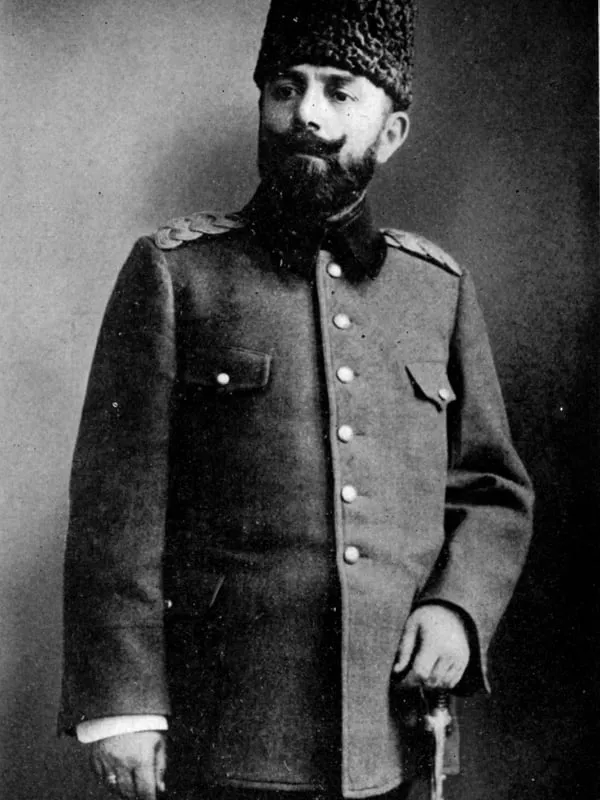
Djemal Pasha
Minister of the navy (1914–1918), commander of the Fourth Army and governor of Syria (1914–1917)
- Born:
- 6 May 1872, Mytilene on Lesbos (Ottoman Empire)
- Died:
- 21 July 1922, Tiflis (Georgia)
- Author:
- Natalia
- Photo:
- Underwood & Underwood, New York, domena publiczna, Wikimedia Commons

Ahmed Djemal, known as Djemal Pasha (in Turkish Cemal Paşa), was, together with the minister of war Enver and the minister of the interior Talat, one of the three Young Turk leaders who ruled the Ottoman Empire during the Great War. He was minister of the navy throughout the war, but played a more important role as commander of the Fourth Army and almost autocratic governor of Syria, which then also included Lebanon and Palestine. Twice he sent troops against the Suez Canal, and from 1916 he fought the Arab Revolt and the British in Palestine. The Arabs remembered him as “al-Saffah”, the Butcher, for the executions of nationalist activists in Beirut and Damascus. His role in the Armenian genocide is disputed by historians. He was killed in 1922 in Tiflis by Armenian assassins.
Before the war
He was born on 6 May 1872 in Mytilene on the island of Lesbos, the son of a military pharmacist. He graduated from the military school and the general staff academy in Constantinople, and then served in the European part of the empire, building fortifications in the Edirne district and as a railway inspector near Salonika. There he joined the secret Committee of Union and Progress, and after the Young Turk Revolution of 1908 he entered its inner leadership. In 1909 he took part in suppressing the counter-revolution in the capital, and then, as governor of Adana, restored order after the massacre of the Armenians there. Christian missionaries praised him at the time as an efficient administrator. In 1911–1912 he was governor of Baghdad, and in the First Balkan War he commanded reserves in Thrace as a colonel.
He rose to power together with Enver. After the coup of January 1913 he became military commandant of Constantinople, and when the grand vizier Mahmud Şevket Pasha was assassinated in June, he dealt with the opposition, sending many of its leaders to the gallows. The historian Hasan Kayalı sees in this a foretaste of the methods he later applied in Syria. At the end of 1913 he became minister of public works and received the title of pasha, and at the beginning of 1914 minister of the navy. He was regarded as a supporter of France and in the summer of 1914 went to Paris in search of an alliance, but returned empty-handed.
The road to war
As minister of the navy Djemal sponsored the building of a fleet whose greatest hope was two modern battleships ordered in Britain. At the turn of July and August 1914 the British kept them for themselves, which provoked a wave of indignation in Turkey and made it easier for Enver to draw closer to Germany. Djemal did not belong to the narrow group that concluded the secret alliance with Germany on 2 August, and was initially sceptical of it, but in the end he backed Enver. When Goeben and Breslau were let through the Dardanelles in August, the German admiral Wilhelm Souchon in practice took command of the Turkish fleet. At the end of October Souchon’s ships shelled Russian ports and Turkey found itself at war.
Syria and the Suez Canal
In November 1914 Djemal took command of the Fourth Army and the powers of governor in Syria, while keeping the navy ministry. In December he arrived in Damascus with extraordinary military and civil powers. His first task was an attack on Egypt. In January 1915 his army crossed the Sinai desert, and on 3–4 February it tried to force the Suez Canal. The operation was in practice prepared and conducted by his German adviser, the Bavarian officer Friedrich Kress von Kressenstein. The Turks hoped that at the sight of the army of the sultan-caliph the Egyptians would rise against the British. Nothing of the kind happened, the attack was repulsed, and Djemal withdrew his troops to Beersheba. The second expedition, carefully prepared with German artillery and aircraft, was led by Kress in the summer of 1916, but it too collapsed in August at Romani. From then on the Turks were on the defensive on this front.
Djemal’s rule in Syria was harsh. In captured documents of the French consulates he found evidence of contacts between Arab activists and France and put them before a court martial. In August 1915 in Beirut, and on 6 May 1916 in Beirut and Damascus, more than thirty politicians, journalists and clergymen, Muslims and Christians, were hanged in all. In Lebanon and Syria 6 May is still Martyrs’ Day. Influential Syrian families were exiled to Anatolia. Conscription, requisitions, the blockade of the coast by the Entente fleet, speculation and a plague of locusts led to a great famine which, according to various estimates, killed hundreds of thousands of people in 1915–1918, most of them in the mountains of Lebanon. Kayalı points out that at the same time Djemal built roads and railways, opened schools, published newspapers and rebuilt Damascus and Jaffa, which gave rise to speculation that he dreamt of a Syrian state of his own, independent of Constantinople. According to historians who have seen Russian documents, at the end of 1915 he even sounded out the Entente through intermediaries, offering to overthrow the government in Constantinople in exchange for power over the Asian part of the empire. Nothing came of the talks, partly because of French opposition.
The Arab Revolt
The executions of 6 May 1916 hastened the outbreak of the Arab Revolt. The son of the Sharif of Mecca, Faisal, was then staying in Damascus as Djemal’s guest and at the same time his hostage. A few days after the executions he persuaded the governor that he should go to Medina to fetch volunteers from the Hejaz, and on 16 May he left. Djemal, sensing something, sent the energetic general Fahreddin to Medina at the end of May. On 5 June the Arabs attacked Medina, and Sharif Hussein proclaimed the revolt, naming Djemal alongside Enver and Talat among the men who ruled the state “as they pleased”. Fahreddin held Medina until the end of the war, but Mecca and the ports of the Hejaz passed into the hands of the insurgents. The war against the Arabs, who were supported by the British, including the officer Thomas Edward Lawrence, from then on tied down part of the Fourth Army along the Hejaz railway.
Gaza and departure from Syria
At the beginning of 1917 the British advanced out of Sinai to Gaza. Kress had earlier advised giving up the whole peninsula, but Djemal refused for political reasons. In the First Battle of Gaza on 26 March the garrison held the town, and when Kress wanted to pursue the retreating British, Djemal forbade it. Instead the Turks turned Gaza into a fortress and in April repulsed the second assault. Fearing a landing and espionage, Djemal then ordered the population of Jaffa to be expelled, including thousands of Jews from Jaffa and Tel Aviv, many of whom later died of hunger and disease.
In the summer of 1917 the Germans and Enver formed the “Yıldırım” Army Group under General Erich von Falkenhayn. Djemal, who for three years had been master in Syria, suddenly found himself in the shadow of a German commander with whom he quarrelled bitterly. Close to him in this resentment of German dominance was Mustafa Kemal, commander of the Seventh Army. In September the German command summoned Djemal to Germany for consultations, from which he returned a month later. In the autumn the Bolsheviks revealed the secret Sykes–Picot Agreement, and Djemal used it in propaganda, telling the Arabs that the British and French wanted to divide their lands, and tried to reconcile with the sharif. To no avail. In December, as the British were taking Jerusalem, he took leave and went to Constantinople. He never returned to Syria.
Downfall and death
Djemal remained minister of the navy until October 1918, when, after Bulgaria’s capitulation, Talat’s government resigned and Ahmed İzzet Pasha became grand vizier. Two days after the signing of the Armistice of Mudros, on the night of 1–2 November, he fled Constantinople together with Enver and Talat on a German ship. In 1919 a court martial in Constantinople sentenced him to death in absentia. After stays in Berlin, Munich and Switzerland he went to Moscow, and from there to Kabul, where the emir of Afghanistan invited him to reform his army. From Tiflis he acted as an intermediary in contacts with the Bolsheviks and supported Mustafa Kemal’s national movement. On 21 July 1922 in Tiflis he was shot dead by members of the Armenian Dashnaktsutyun party as part of Operation Nemesis, a campaign of revenge against the perpetrators of the Armenian genocide. He was buried in Erzurum. In the early 1920s his memoirs of the war years were published in Turkish, English and German.
Assessment
Djemal is one of the most ambiguous figures of the Young Turk triumvirate. As a commander he won no great victory: both expeditions against the Suez Canal ended in defeat, and in Syria he could neither prevent the Arab Revolt nor stop the British. As governor he left behind roads, schools and rebuilt cities, but above all the memory of terror and famine. In Arab historiography the years of his rule, known as “seferberlik” (mobilisation), became a symbol of Turkish oppression and a foundation of Arab national memory.
The greatest controversy surrounds his attitude to the Armenian genocide. Djemal was not a chief organiser of the deportations; in Syria he opposed indiscriminate massacres and often argued with Talat on the matter, and some of the deported Armenians survived in the territories under his control. According to the German historian Wolfgang Gust, while saving the lives of perhaps 150,000 Armenians in very harsh conditions, he helped to kill as many again. The Turkish historian Ümit Kurt points out that Djemal differed from Talat and Enver mainly in method: instead of killing, he preferred to convert and assimilate the Armenians by force, but like them he sought to make them disappear as a nation from Ottoman lands. That is why Kurt, like many other scholars, counts him among the perpetrators of the genocide.
Sources
Spotted a mistake?Report an error
Commanded in battles
(05)Mentioned in battles
(01)Often appears with
People who appear in the same events.