Ottoman Empire · The Central Powers
Mustafa Kemal
Commander of the 19th Division and the Anafarta Group at Gallipoli (1915), XVI Corps (1916–1917), Second and Seventh Armies (1917–1918), Yildirim Army Group (1918)
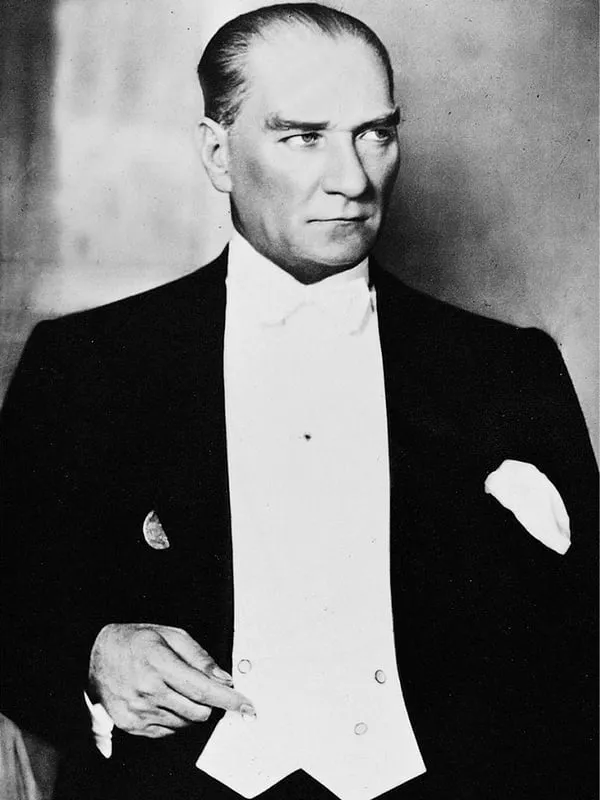
- Born:
- 19 May 1881, Salonica (Ottoman Empire)
- Died:
- 10 November 1938, Istanbul (Turkey)
- Author:
- Natalia
- Photo:
- autor nieznany, domena publiczna, Wikimedia Commons

Mustafa Kemal, known from 1934 as Atatürk, entered the Great War as a little-known lieutenant-colonel, military attaché in Sofia, and came out of it as one of the most highly regarded generals of the Ottoman army. On 25 April 1915, on his own initiative, he threw his division into a counter-attack against the Australians and New Zealanders landing at Gallipoli, and in August he retook the Sari Bair ridge and stopped the British at Suvla. In the following years he commanded a corps in the Caucasus, where he recaptured Muş and Bitlis, and then an army in Palestine and Syria. He was a critic of Enver Pasha and of the German advisers, and was not afraid to tell his superiors that the war was lost. After the defeat he placed himself at the head of the Turkish national movement, won the war for the borders of the new Turkey and proclaimed the republic, of which he was the first president.
Before the war
He was born in 1881 in Salonica, then one of the most important cities of the European part of the Ottoman Empire. The exact date of his birth is unknown. He himself did not know it for certain, and later adopted 19 May as a symbolic date, the anniversary of his landing at Samsun in 1919. His father, Ali Rıza, was a minor official and timber merchant who died when Mustafa was a child. Against his mother’s wishes the boy entered the military school in Salonica. There, according to one version, a teacher gave him his second name Kemal, meaning “perfection”. He went on to study at the military high school in Monastir, today’s Bitola, at the War College in Constantinople and at the general staff academy, from which he graduated in 1905 with the rank of staff captain.
He served in Damascus and Salonica and joined the conspiratorial Committee of Union and Progress, but played no great part in the Young Turk Revolution of 1908. He soon fell out with the committee’s leaders, especially his contemporary Enver, because he demanded that officers keep out of politics. During the war with Italy in 1911–1912 he fought in Cyrenaica near Tobruk and Derna, where he was wounded in the eye. In the First Balkan War he was a staff officer with the troops defending the Bulair isthmus at the neck of the Gallipoli peninsula and took part in the unsuccessful attack on the Bulgarians, which was repulsed by the division of Georgi Todorov. In the summer of 1913 he was present at the recovery of Adrianople.
In the autumn of 1913 his friend Ali Fethi (later Fethi Okyar) became envoy in Sofia and brought Kemal in as military attaché. From November 1913 Kemal observed at close quarters the army and politics of Bulgaria, the enemy of yesterday, whom Constantinople was now trying to win over. On 1 March 1914 he was promoted to lieutenant-colonel. The outbreak of war, and Turkey’s entry into it in November 1914, found him in Sofia. He considered it a mistake, and he had no high opinion of Enver, who had dragged the country into the war on Germany’s side. He asked for a posting to the front. He was refused until, in January 1915, he was given command of the 19th Division, then being formed in Thrace. On 20 January he left Sofia.
Gallipoli
Kemal’s division was sent to the Gallipoli peninsula. When in March the German general Otto Liman von Sanders took command at the Dardanelles, he placed it in reserve near the village of Boghali, from where it could move in several directions. On the morning of 25 April 1915, when the Australians and New Zealanders landed near the headland of Ari Burnu, Kemal did not wait for orders from his superiors. He led the 57th Infantry Regiment and an artillery battery onto the Sari Bair ridge, stopped fleeing soldiers of the 9th Division and threw his battalions into a counter-attack. According to his later recollections, he told his soldiers then that he was not ordering them to attack but to die, because before they died other units and other commanders would come to take their place. The 57th Regiment almost ceased to exist, but the ANZAC troops were penned into a narrow beachhead at the foot of the hills. Liman von Sanders later wrote that the situation had been saved by the immediate and independent action of Kemal’s 19th Division. The landing, which was to open the road to Constantinople, turned into trench warfare.
Through May Kemal commanded the sector opposite Anzac, and on 1 June he was promoted to colonel. His great moment came in August. During the night of 6–7 August the British landed at Suvla Bay, and from the Anzac beachhead night columns set off for the Sari Bair ridge. The New Zealanders reached the summit of Chunuk Bair. On the evening of 8 August Liman, angered by the delay of the commander of the troops that were to counter-attack at Suvla, relieved him of command and entrusted it to Kemal. Kemal took over the Anafarta Group, and soon the whole front from Suvla to Chunuk Bair. On 9 August his divisions seized the ridges above Suvla ahead of the advancing British, and at dawn on 10 August, after a personal reconnaissance, he led the attack that drove the British off Chunuk Bair. According to Turkish tradition a shrapnel fragment was stopped by his pocket watch that day. At the end of August his troops beat off the last great attacks on Scimitar Hill and the hills above Anafarta.
These days made Kemal a hero. The Constantinople press wrote of “the hero of Anafarta”. The British official historian Cecil Aspinall-Oglander later wrote that seldom in history had the efforts of a single divisional commander had so great an influence not only on the course of a battle but perhaps on the fate of a campaign. Kemal was exhausted and ill, quarrelled with the German officers and with Enver, and when the front froze again he asked to be relieved. On 10 December 1915 he left the peninsula, less than two weeks before the evacuation of the Allied troops from Anzac and Suvla.
The Caucasus
In January 1916 he took command of XVI Corps at Edirne. In February the Russians took Erzurum and Muş, and at the beginning of March Bitlis, and the corps was moved deep into Anatolia, to Diyarbakır, which it reached at the end of March. On 1 April 1916 Kemal became a brigadier-general, that is a pasha, at the age of 35. His corps became part of the Second Army of Ahmed İzzet Pasha, which together with the Third Army was to retake Erzurum. Before the Second Army had assembled, the Russians routed the Third Army and took Erzincan. At the beginning of August XVI Corps struck on its own and recaptured Bitlis and Muş, one of the few Turkish successes that summer. A Russian counter-offensive soon took Muş from him again, but Bitlis remained in Turkish hands.
Several officers with whom he built the state a few years later served under Kemal at that time, among them İsmet, later İnönü. In the winter of 1916/1917, when the army was starving and sick with typhus, he deputised for the commander of the Second Army, and on 7 March 1917 he took command of it himself. He turned down an offer to command the troops that were to relieve besieged Medina. In the spring his units recovered Muş, but the exhausted Second Army had by now become merely a reservoir from which soldiers were taken for other fronts.
Palestine and the quarrel with Falkenhayn
In the summer of 1917 Kemal became commander of the Seventh Army, part of the new Yildirim Army Group. Under the command of Erich von Falkenhayn it was to retake Baghdad, and was later sent to Palestine. Kemal opposed this plan. In September, together with İsmet, he wrote a report to the Grand Vizier Talat warning that the country was exhausted, the army too weak for an offensive, and that the Germans were treating the empire like a colony. He proposed a defence in Syria under Turkish command. The report was ignored. At the beginning of October 1917 Kemal resigned his command and returned to Constantinople. A few weeks later the British broke through the front at Gaza and Beersheba, and in December they took Jerusalem.
At the turn of 1917 and 1918 Kemal accompanied the heir to the throne, Mehmed Vahdettin, on a journey to Germany. He met Wilhelm II, Hindenburg and Ludendorff, visited the Western Front in Alsace and, according to his memoirs, told his hosts openly that he did not believe in victory. After his return he fell seriously ill with a kidney complaint. In the summer he took a cure in Vienna and Karlsbad, and on the way home he also went through Spanish flu.
1918: Megiddo and Aleppo
After the death of Mehmed V in July 1918 Vahdettin became sultan as Mehmed VI, and in August he again sent Kemal to Palestine, at the head of the Seventh Army. Kemal took over the positions in the hills near Nablus at the beginning of September and saw that his divisions were shadows of their former selves. On 19 September General Allenby’s British broke through the front by the sea, and the Battle of Megiddo began. The Eighth Army on the plain ceased to exist, and the Seventh Army, retreating from the hills towards the Jordan, was bombed from the air in the Wadi al-Fara gorge and lost most of its guns and transport.
Kemal nevertheless managed to lead part of his men away to the north. Liman von Sanders ordered him to rebuild an army from the remnants near Aleppo. During the night of 25–26 October the Arabs broke into the city, but that same day at Haritan the Turks under his command stopped the British cavalry. It was the last engagement of the campaign. Kemal held a line north of Aleppo, on the edge of the lands inhabited by Turks, and there the Armistice of Mudros found him. On 31 October he took over command of the Yildirim Army Group from Liman. When the British announced that they would occupy Alexandretta, he wanted to resist, but the government ordered him to give way. The group was dissolved, and on 13 November Kemal arrived in Constantinople, where Allied warships were already anchored in the Bosporus.
After the war
In May 1919, as inspector of the troops in Anatolia, he landed at Samsun on 19 May and placed himself at the head of the resistance movement against the partition of the country. In 1920 the Grand National Assembly met in Ankara and elected him its president. In the war with Greece he halted the Greeks on the Sakarya in 1921, and in August 1922 he routed their army and in September recovered Smyrna. In November 1922 the sultanate was abolished. The Treaty of Lausanne of July 1923 recognised Turkey’s independence within borders close to today’s, and on 29 October 1923 Kemal proclaimed the republic and became its first president. He ruled in authoritarian fashion, abolished the caliphate, and introduced the Latin alphabet, laws modelled on European ones, and surnames. In 1934 parliament gave him the surname Atatürk, “father of the Turks”. He died on 10 November 1938 in the Dolmabahçe Palace in Istanbul. He rests in the mausoleum in Ankara.
Assessment
Kemal’s wartime career is hard to assess apart from his later legend. In Turkey Gallipoli became the founding myth of the republic, and his role was told in such a way that other commanders, from Esat Pasha to Liman von Sanders, were left in the shade. Historians, British and German among them, nevertheless agree that on 25 April and 9–10 August 1915 his decisions were of decisive importance, and that he showed exceptional tactical sense, courage and an ability to take independent decisions. In the Caucasus and in Syria he did not have troops with which he could win great victories, but he knew how to save what could be saved. His British biographer Lord Kinross wrote that he was the only Turkish general of the war who was never defeated. Others point out that Megiddo was a defeat for his army too.
What set him apart was his sober judgement of the strategic situation. He judged early that entering the war was a mistake, opposed Enver’s expeditions and the offensive on Baghdad, and warned against dependence on Germany. He was also ambitious, quarrelsome and difficult to work with, which cost him several posts. During the Armenian genocide in 1915 he was fighting at Gallipoli, and historians do not attribute any part in it to him. The dispute concerns his later attitude to these crimes, and the fact that the national movement he led also relied on people implicated in them, while the republic he created denied them for decades.
Sources
Spotted a mistake?Report an error
Commanded in battles
(07)- 26 January 1915 – 30 October 1918Sinai and Palestine campaignMiddle East
- 19 February 1915 – 9 January 1916Gallipoli campaignMiddle East
- 25–26 April 1915Landing at GallipoliMiddle East
- 6–10 August 1915Battle of Sari BairMiddle East
- 6–15 August 1915Landing at Suvla BayMiddle East
- 21 August 1915Battle of Scimitar HillMiddle East
- 19–25 September 1918Battle of MegiddoMiddle East
Often appears with
People who appear in the same events.