Ottoman Empire · The Central Powers
Talat Pasha
Minister of the interior (1913–1918) and grand vizier of the Ottoman Empire (1917–1918), chairman of the Committee of Union and Progress
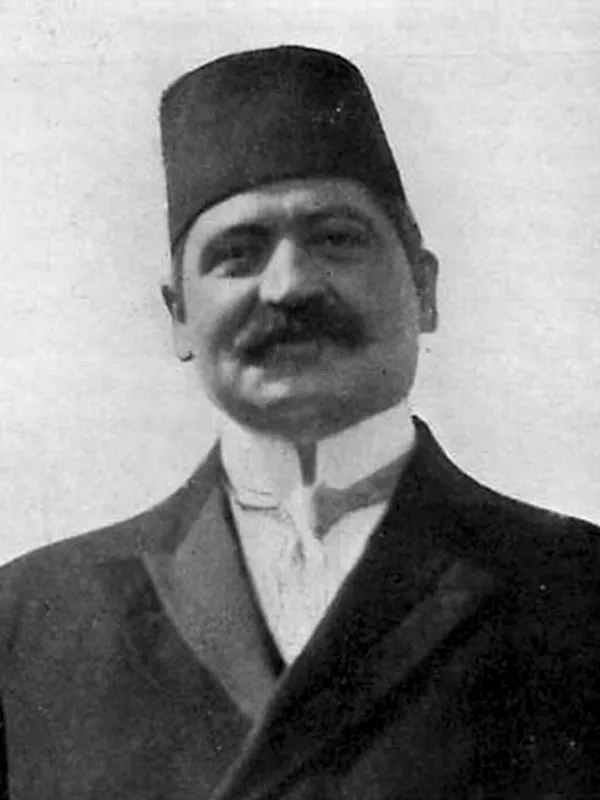
- Born:
- 1 September 1874, Kardzhali (Ottoman Empire, now Bulgaria)
- Died:
- 15 March 1921, Berlin
- Author:
- Łukasz Skowroń
- Photo:
- Ambassador Henry Morgenthau, Sr, domena publiczna, Wikimedia Commons

Mehmed Talat, known as Talat Pasha (in Western spelling also Talaat), was the most important civilian leader of the Ottoman Empire during the Great War. Together with the minister of war, Enver Pasha, and the minister of the navy, Djemal Pasha, he formed the Young Turk triumvirate which from 1913 ruled the state in the name of the Committee of Union and Progress. As minister of the interior he directed, from the spring of 1915, the deportations of the Armenians, which turned into genocide, and historians regard him as the chief organiser of that crime. In February 1917 he became grand vizier. At Brest-Litovsk he recovered for the empire the lands lost to Russia in 1878, but in the autumn of 1918 he had to admit defeat. He fled to Germany, a court in Constantinople sentenced him to death in absentia, and in 1921 he was shot dead in Berlin by an Armenian who had lost his family in the deportations.
Before the war
He was born in 1874, on 1 September according to the most commonly given date, in Kardzhali in Rumelia, now in Bulgaria, into a modest Muslim family. His father was a kadı, a sharia judge. When the Russians occupied the region during the war with Russia of 1877–1878, the family fled to Constantinople. His biographers see this experience as one of the sources of his fervent nationalism. He did not finish school and became a telegraph clerk in Adrianople. For his activity in secret organisations opposed to the autocracy of Sultan Abdul Hamid II he was imprisoned and then exiled to Salonica, where he worked at the post office. There, in 1906, he co-founded a secret committee which the following year merged with the Paris-based Committee of Union and Progress. He won over many young officers of the Third Army to the cause, among them Enver.
After the Young Turk Revolution of July 1908 Talat became deputy for Adrianople, and in 1909 minister of the interior. He quickly became the de facto leader of the committee, whose programme was shifting from cooperation among all the nations of the empire towards Turkish nationalism. In January 1913, during the lost Balkan War, he and Enver prepared a coup d’état which overthrew a government ready to give up besieged Adrianople. After the assassination of the grand vizier Mahmud Şevket Pasha in June that year, the committee took full power. Talat returned to the ministry of the interior and kept it until 1918. As early as the spring of 1914 his men were organising the forced expulsion of Greeks from the Aegean coast.
War
Talat belonged to the narrow circle of leaders who on 2 August 1914 concluded the secret alliance with Germany. Historians assess his role differently: some consider him more cautious than Enver and long weighing the chances of neutrality, while his biographer Hans-Lukas Kieser sees him as a co-author of the course towards war. After the fleet’s attack on the Russian ports at the end of October Talat backed the war. When the finance minister Mehmed Cavid resigned in protest, Talat also took over his ministry for a time. The war gave the committee an opportunity to throw off dependence on the great powers: the government unilaterally abolished the capitulations, the privileges of foreigners, and suspended the reforms in the eastern provinces which the powers had forced through in favour of the Armenians only a few months earlier.
Enver’s defeat at Sarikamish in the winter of 1914/1915 and the failed attack on the Suez Canal dashed hopes of a quick victory. In March 1915 the Allied fleet attacked the Dardanelles, and in April it landed on Gallipoli. In this atmosphere of threat the committee’s leaders decided to deal with the Armenians, whom they regarded as an internal enemy.
The Armenian genocide
On the evening of 24 April 1915, on Talat’s orders, the police in Constantinople arrested, in a first wave, several hundred members of the Armenian elite: politicians, writers, clergymen, doctors and merchants. Most of them were murdered in the following months. In the summer Talat’s former political allies, the Armenian deputies Krikor Zohrab and Vartkes Serengülian, were also arrested and murdered. The deportations from Cilicia had already been under way for several weeks, and at the end of May the government adopted a temporary deportation law which gave them a semblance of legality. By the summer they covered almost all the Armenian communities in Anatolia. Talat’s ministry issued the expulsion orders, directed the columns into the Syrian desert and supervised the camps on the Euphrates in which tens of thousands of survivors were massacred in 1916. At the same time the secret Special Organisation, linked to the committee’s leadership, was at work, and officials who refused to take part in the crime were dismissed and sometimes killed. According to his wife’s account, Talat had a telegraph apparatus at home, which he used to send instructions himself.
Talat did not hide the aims of this policy from diplomats. The American ambassador Henry Morgenthau recorded that in August 1915 the minister told him that the policy towards the Armenians was settled and that there would be none of them anywhere in Anatolia. German diplomats reported to Berlin his words that the Armenian question “no longer exists”. In public, for instance in an interview with the Berliner Tageblatt in 1916, he blamed “bad officials” who had exceeded their orders. As early as May 1915 the Entente powers warned that they would hold members of the Ottoman government personally responsible.
According to most historians’ estimates, between about 600,000 and more than a million Armenians died in 1915–1916, while the Armenian side speaks of 1.5 million. Similar repression struck the Assyrians in the east and the Greeks of the Black Sea coast. Talat also directed the forced resettlement of Kurds and the settling of Muslim refugees from the Balkans on the lands left by the Armenians. Surviving documents of his ministry, published in 2008 by the Turkish journalist Murat Bardakçı, show that the ministry kept a precise count of the deportees.
Grand vizier
On 4 February 1917 Talat became grand vizier, keeping the ministry of the interior and the chairmanship of the party, and received the title of pasha. Historians debate whether he was from then on the de facto dictator of the empire, as Kieser believes, or whether he shared power with Enver, who ran the army, as Erik-Jan Zürcher holds. His government carried out several modernising reforms, among them a new family law in 1917, but the country was exhausted, and corruption and food profiteering flourished under the committee’s protection. In the spring of 1917 Talat travelled to Germany, and the empire broke off relations with the United States. In March the British took Baghdad, and in December Jerusalem. Earlier, in September, General Mustafa Kemal warned him in a report that the country was exhausted and that the Germans were treating it like a colony. After the Balfour Declaration Talat called it a bluff in an interview and promised the Jews the fulfilment of their “legitimate wishes” under Ottoman rule.
The collapse of Russia brought Talat his greatest success. In January 1918 he came to Brest-Litovsk and, in the agreed rotation, chaired some sessions of the conference. On 9 February he signed the peace with Ukraine. The treaty with Soviet Russia of 3 March, signed on behalf of the empire by other delegates, returned to Turkey Kars, Ardahan and Batum, lost in 1878. Ottoman troops took Kars, in June the empire imposed the Treaties of Batum on Armenia and Georgia, and in September the Army of Islam captured Baku, against German objections. Talat tried to reconcile Enver’s expansion in the Caucasus with the interests of the ally, but the spring of 1918 was already the peak of the committee’s power.
Defeat and flight
In the summer the new sultan, Mehmed VI, who had ascended the throne in July, wanted to free himself from the committee’s influence. In September Talat went to Berlin and, returning through Sofia, learned that Bulgaria was asking for an armistice. After Bulgaria’s capitulation and the defeat at Megiddo he concluded that the government responsible for entering the war would not obtain tolerable terms. His cabinet still decided to ask President Wilson for mediation, and on 8 October, according to some accounts a day earlier, Talat resigned. He remained in office until the appointment of Ahmed İzzet Pasha on 14 October. On 30 October the new government signed the Armistice of Mudros.
On 1 November, at the committee’s last congress, Talat admitted that in many places officials had used force “beyond what was necessary” and that innocent people had died, but argued that the crimes had been exaggerated by the press. The committee decided to dissolve itself. That same night, according to some sources the following one, Talat, together with Enver, Djemal and other leaders, left Constantinople aboard a German warship. On 10 November he reached Berlin.
After the war
In Berlin he lived under the assumed name Ali Sai, and the German government refused to extradite him to Turkey. In July 1919 a court martial in Constantinople sentenced him to death in absentia for dragging the country into the war and organising the massacres. From exile he kept in touch with Mustafa Kemal and the national movement in Anatolia. On 15 March 1921, on a street in Charlottenburg, he was shot dead by Soghomon Tehlirian, a member of the Dashnaktsutyun party who had lost his family in the deportations. It was the first assassination of Operation Nemesis. A Berlin court acquitted the assassin in June 1921, and the trial, at which witnesses of the deportations and German officers testified, including Otto Liman von Sanders, drew the world’s attention to the fate of the Armenians. It was followed by the young Raphael Lemkin, who later coined the term genocide. In 1943 Talat’s remains were brought from Berlin to Istanbul and buried with state honours.
Assessment
Among historians of the Armenian genocide there is agreement that Talat was its chief architect. Taner Akçam, Raymond Kévorkian, Ronald Suny and Kieser, author of the biography entitled Talaat Pasha: Father of Modern Turkey, Architect of Genocide, differ in their assessment of when the decision on extermination was taken and what role wartime defeats played in it, but not on his responsibility. Kieser describes him as an exceptionally adroit politician, charming in conversation and at the same time ruthless, who in the name of saving the state accepted violence against the defenceless as a legitimate tool of policy.
Part of Turkish historiography and public opinion still sees him as a great statesman and revolutionary who saved the empire from partition and prepared the ground for the republic, and disputes the classification of the events of 1915–1916 as genocide. Turkey does not recognise that classification, but many states have recognised it, including Poland. Even critics of his role in the crime concede that he was the ablest politician in the Young Turk leadership. His policy, however, led the empire to defeat and the peoples who lived in it to catastrophe.
Sources
Spotted a mistake?Report an error
Mentioned in battles
(01)Often appears with
People who appear in the same events.
On the timeline
(10)1914
1915
1917
1918
January
July
October
- 14
- İzzet Pasha becomes grand vizierOn 14 October 1918, after Talat Pasha's resignation, Marshal Ahmed İzzet Pasha became grand vizier. His task was to lead the empire out of the war.
- Turkish peace noteOn 14 October 1918 President Wilson received, via Spain, an Ottoman government note asking for an armistice and peace on the basis of the Fourteen Points.