Key event
Peace of Brest-Litovsk with Ukraine
- Category:
- Diplomacy
- Front:
- Eastern Front
- Date:
- 9 February 1918
- Author:
- Łukasz Skowroń
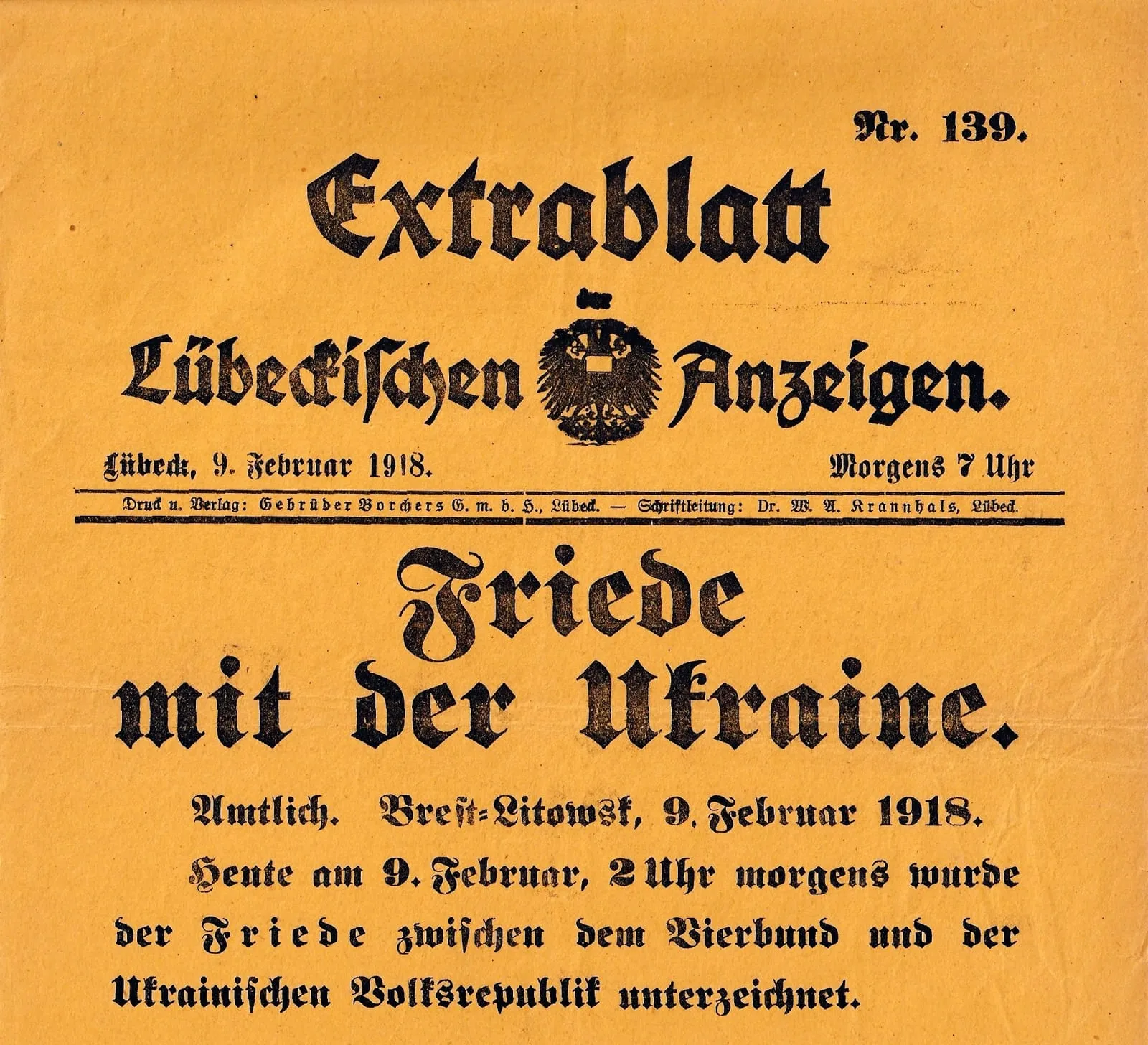
On 9 February 1918 (27 January by the Julian calendar), at about two in the morning, the first peace treaty of this war was signed in the citadel of Brest-Litovsk. Germany, Austria-Hungary, Bulgaria and Turkey made peace with the Ukrainian People’s Republic, which a week earlier they had recognised as an independent state. The Austro-Hungarian Foreign Minister, Count Ottokar Czernin, who had worked for this agreement from the first days of the negotiations, called it the “bread peace” (Brotfrieden). Ukraine promised grain to starving Vienna and Berlin, and in return received a border which cut off Chełm Land and part of Podlasie from the Polish lands. For the Poles it was the “fourth partition”.
A signing in the spotlight
The last week of the negotiations was tense. On 7 February Czernin, who preferred to wait a little longer and seek a compromise with Leon Trotsky, visited him in his quarters in the evening and offered to mediate between Russia and Germany. Trotsky agreed to discuss specifics, but set a condition: no separate treaty with Ukraine. The next day General Max Hoffmann, speaking on behalf of the German Supreme Army Command, demanded the immediate signing of peace with the Ukrainians, to clear the way for an ultimatum to the Bolsheviks. Trotsky refused to recognise any agreement with a government which, in his view, did not represent Ukraine and in reality no longer existed. Richard von Kühlmann and Czernin assured him that they had other information, but rejected his proposal to send a staff officer to Kiev to check on the spot.
Trotsky was right. In the night of 8–9 February, while the last details were being settled at Brest, the Ukrainian Central Rada left Kiev, which Bolshevik troops were entering. The ceremony was nevertheless staged with pomp, on the birthday of the commander-in-chief on the Eastern Front, Prince Leopold of Bavaria, in the harsh light of a film camera’s lamps. For the Central Powers the treaty was signed by Kühlmann and Hoffmann, Czernin, the Bulgarian Prime Minister Vasil Radoslavov and the Turkish Grand Vizier Talaat Pasha. For Ukraine it was signed by the head of the delegation Oleksandr Sevriuk, Mykola Lyubynsky, Mykola Levytsky and Serhiy Ostapenko, all of them young; Sevriuk was about 25. “I wonder whether the Rada is really still sitting in Kiev,” Czernin noted that day.
What was agreed
The treaty ended the state of war and provided for an exchange of prisoners, a mutual renunciation of war indemnities, the establishment of diplomatic relations and the evacuation of occupied areas after its ratification. Two articles were the most important. Article II set the borders. Between Austria-Hungary and Ukraine the old pre-war Austro-Russian border was to remain. Further north the Ukrainian border was to run from Tarnogród along the line Biłgoraj – Szczebrzeszyn – Krasnystaw – Puchaczów – Radzyń – Międzyrzec – Sarnaki – Mielnik – Kamieniec Litewski – Prużany. The details were to be settled by a mixed commission “according to ethnographic conditions and with regard to the wishes of the population”. This meant handing Ukraine the former Chełm governorate, and even more, because the line ran west of its borders, through districts with a clear Polish and Catholic majority.
Article VII concerned trade. The parties were to exchange their surpluses of agricultural and industrial products, and the Ukrainian grain surplus, which the Rada guaranteed at a minimum of one million tonnes, was to go to the Central Powers. Fixing its size was entrusted to a commission which was to meet in Kiev, and by 31 July 1918 the parties were to conclude a detailed trade agreement. The Austrians made sure that their territorial and political concessions depended on the deliveries: if the grain did not arrive, Vienna was to be released from its obligations.
A secret protocol, signed by Czernin and the Ukrainians already on 8 February, was attached to the treaty. In it Austria-Hungary undertook to unite the Ukrainian part of Eastern Galicia with northern Bukovina into a separate crown land of the monarchy. The Ruthenians in western Galicia were guaranteed language rights. For the Poles this meant the division of Galicia, which they regarded as Polish, and the severing of Lviv and Przemyśl from Kraków.
Why Vienna agreed
Czernin knew that concessions to the Ukrainians at the Poles’ expense would cost him dearly. Throughout the negotiations he had counted on the Austro-Polish solution: the union of the Kingdom of Poland with the Habsburg monarchy. But in January Vienna faced the spectre of famine. The Austrian administration warned that without grain from outside a food catastrophe would follow within two months, and the January strikes had shown what a lack of food and peace threatened. At the crown council on 22 January Emperor Karl agreed to the terms negotiated with the Ukrainians, including on Chełm Land. Czernin then compared Austria to a man jumping from the third floor of a burning house, not counting whether he will break one leg or both.
The Germans had their own reasons. An independent Ukraine under their influence was a counterweight to Russia and to a future Polish state, and its grain, ores and cattle were to help them survive the blockade. After the signing of the treaty Hoffmann and Ludendorff could also at last put pressure on Trotsky. For now, however, the Central Powers had signed peace with a government that had no capital. They returned with it to Kiev at the beginning of March, but on the bayonets of their own troops.
“The fourth partition”
The Chełm governorate had been separated from the Kingdom of Poland by the tsarist government in 1912, amid fierce Polish opposition, and incorporated into Russia proper. Now the Central Powers, which since 1916 had been promising the Poles an independent state, were recreating that work and giving Ukraine even more. The Poles had demanded a part in the Brest negotiations from the very beginning, but had not been admitted to them. The news from Brest provoked in the Kingdom and in Galicia an explosion of indignation such as the occupiers had not yet seen. While Vienna hung out flags in honour of the peace, newspapers in Warsaw and Lublin appeared with black borders.
Within a few days the whole order which the Central Powers had been building in the Kingdom since the Act of 5 November was shaken. Already on 11 February the government of Jan Kucharzewski, the first cabinet of the Kingdom of Poland, resigned. On 13 February the Regency Council issued a proclamation in which it wrote that the plenipotentiaries of Germany and Austria-Hungary had “carved out a piece of Polish land and given it to the Ukrainians”. “We raise our voice before God and before the world, before the face of men and before the tribunal of history, before the German people and before the peoples of Austria-Hungary, protesting against a new partition, refusing it our recognition and branding it an act of violence,” the regents declared. From then on they were to exercise power “relying on the will of the Nation”, and not on the monarchical acts of the occupiers. General Stanisław Szeptycki resigned in protest from the post of Austro-Hungarian Governor-General in Lublin.
Strikes and demonstrations swept the country. According to some sources a general strike was declared in Warsaw on 14 February, and the protests spread to Lublin, Chełm, Kielce, Radom, Piotrków and the Dąbrowa Basin. The Governor-General of Warsaw, Hans Hartwig von Beseler, imposed a levy of 250,000 marks on Warsaw. In Galicia the day of national protest was 18 February. “On that day all life came to a complete standstill throughout Galicia,” recalled the leader of the peasant movement Wincenty Witos. Railways, offices and factories stopped, requiem services were held in the churches, and rallies took place in towns and villages. Officials resigned, and holders of Austrian decorations sent them back. The Polish Club (PL) in the Vienna parliament, until then usually supporting the government, went over to the opposition, and Polish deputies also protested in the Reichstag.
The soldiers went furthest. In the night of 15–16 February part of the Polish Auxiliary Corps, formed from the former Legions, led by the II Brigade of Colonel Józef Haller, broke through the front at Rarańcza in Bukovina to the Russian side, in order to join the Polish units in Russia. The Austrians disarmed and interned the Corps’ remaining units, and put their officers on trial.
First concessions
Vienna quickly understood how much the bread from Ukraine was costing it. On 19 February there were stormy scenes in the Austrian Chamber of Deputies when Sevriuk appeared in the gallery, and Prime Minister Ernst Seidler, under pressure from the Poles, Czechs and Slovenes, announced that Chełm Land would not pass automatically to Ukraine, but that its fate would be determined by a commission with the participation of representatives of Poland, in accordance with the will of the population. The Poles received this with disbelief. The clause on the division of Galicia never came into force, and the Austrians later forced the Ukrainians to return the document containing this commitment. The Poles’ trust in the Central Powers, however, could no longer be rebuilt. The day after the signing of the treaty at Brest Trotsky declared that Russia was ending the war, but would not sign a peace on German terms. For Ukraine the bread peace meant recognition and help against the Bolsheviks, but also occupation: in the second half of February German troops entered its lands, and soon Austro-Hungarian troops as well.
Remember the articles you have read? Only in this browser; nothing is sent anywhere.How it works
Read ·
Voices from the front
“This evening peace with Ukraine is to be signed. The first peace in this terrible war. But is the Rada really still sitting in Kiev?”
Translated · Original (de)
Heute abend soll der Friede mit der Ukraine unterschrieben werden. Der erste Friede in diesem fürchterlichen Kriege. Ob nun die Rada wirklich noch in Kiew sitzt?
“This population was not asked which state it wishes to belong to. Its fate was decided with one stroke of the pen: and so the principle of the self-determination of peoples, the right to decide for oneself, so often and so solemnly proclaimed by German and Austrian diplomats, has been violated with regard to Poland.”
Translated · Original (pl)
Nie zapytano tej ludności, do jakiego państwą chce należeć. Jednem pociągnięciem pióra postanowiono o jej losie: i tak zasada wolności samookreślenia ludów, prawo stanowienia o sobie, tylokrotnie i tak uroczyście wygłaszane przez dyplomatów niemieckich i austrjackich, zostały w stosunku do Polski pogwałcone.
Spotted a mistake?Report an error
Meanwhile
(04)Elsewhere in the same days.
- 11 February 1918 · DiplomacyWilson's Four PrinciplesOn 11 February 1918 Wilson answered Hertling and Czernin before Congress, set out four principles of peace and called self-determination a principle of action.
- 11 February 1918 · PoliticsSuicide of KaledinOn 11 February 1918 the Don Cossack ataman Alexey Kaledin laid down his powers and shot himself in Novocherkassk. The Cossacks would not defend the Don.
- 11 February 1918 · PoliticsResignation of the Kucharzewski governmentOn 11 February 1918 Jan Kucharzewski's government resigned in protest against the Treaty of Brest, which gave the Chełm Land to Ukraine.
- 6 February 1918 · Balkan FrontGerman ultimatum to RomaniaIn early February 1918 Mackensen gave Romania four days to open peace talks. The Brătianu government, which had taken the country into the war, resigned.
Related events
(04)The same battle, people or subject.
- 1 February 1918 · Eastern FrontCentral Powers recognise UkraineOn 1 February 1918 at Brest Czernin declared that the Central Powers recognised the Ukrainian People's Republic as an independent, sovereign state.
- 18 February 1918 · Eastern FrontOperation Faustschlag beginsAt noon on 18 February 1918 the armistice on the Eastern Front expired. The Germans advanced and that same day, almost without a fight, took Dvinsk and Lutsk.
- 8 January 1918 · Eastern FrontTrotsky at Brest-LitovskOn 8 January 1918 peace talks resumed at Brest-Litovsk. The Soviet delegation was now led by Trotsky, who turned the sessions into a verbal duel with Kühlmann.
- 22 December 1917 · Eastern FrontPeace negotiations open at Brest-LitovskOn 22 December 1917 the Central Powers and Soviet Russia opened a peace conference at Brest-Litovsk. Joffe set out six principles of peace without annexations.