1918: The Eastern Front
Operation Faustschlag
- Dates:
- 18 February – 3 March 1918
- Front:
- Eastern Front
- Location:
- Eastern Front from the Gulf of Riga and the Dvina to Volhynia; Livonia and Estonia, Belarus and Right-bank Ukraine (now Latvia, Estonia, Belarus, Ukraine and western Russia)On the battle map →
- Sides:
- German Empire and Austria-Hungary (with Ukrainian People's Republic troops)Prince Leopold of Bavaria, Max Hoffmann, Hermann von Eichhorn, Alexander von Linsingen, Eduard von Böhm-ErmolliSoviet RussiaNikolai Krylenko, Mikhail Bonch-Bruyevich
- Result:
- Central Powers victory. In less than two weeks they took Livonia, Estonia and much of Belarus and Ukraine, including Kiev. Soviet Russia accepted harsher terms and signed the Treaty of Brest-Litovsk on 3 March.
- Author:
- Natalia
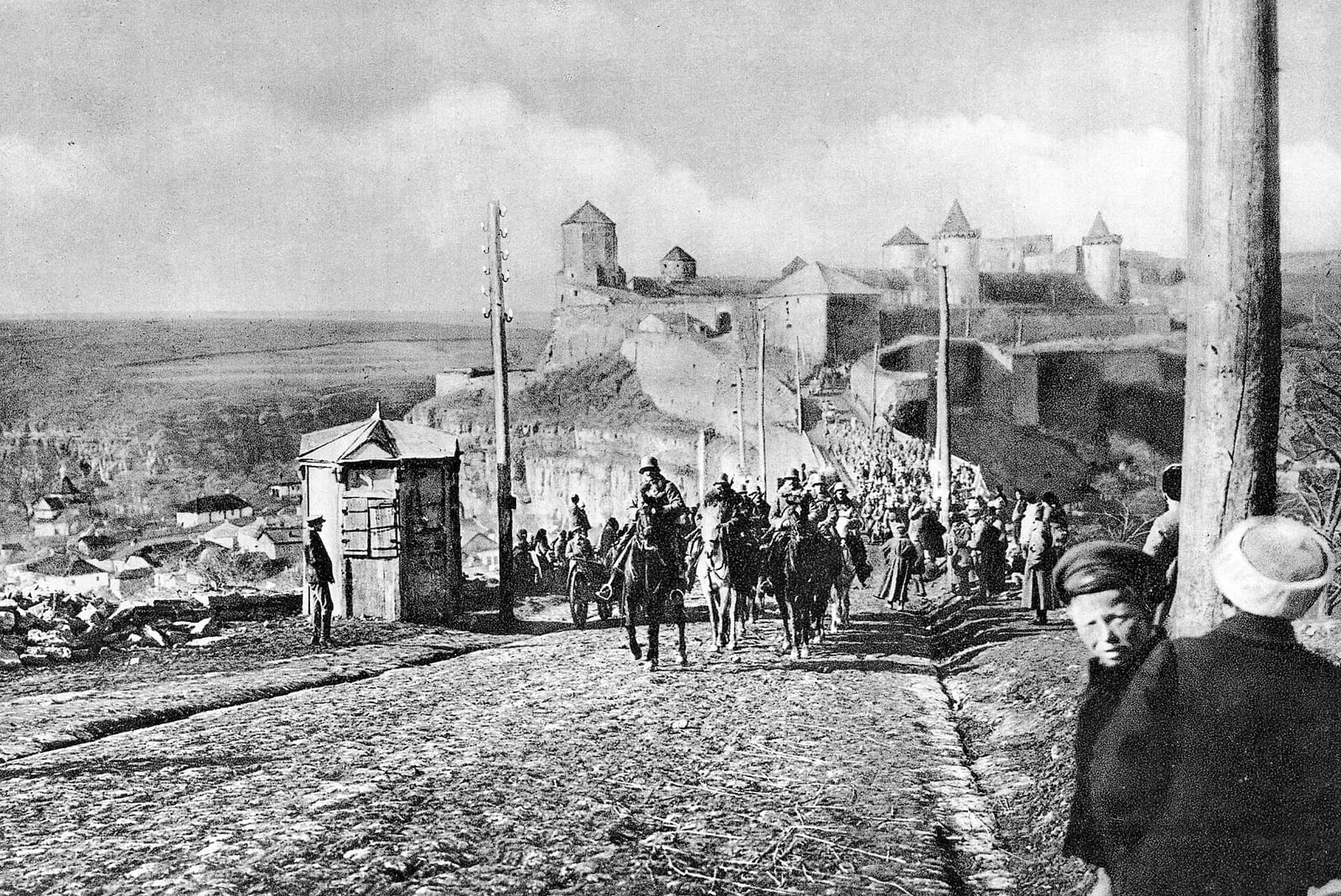
Operation Faustschlag (“Fist Punch”) was the last great offensive on the Eastern Front of the First World War. After the Bolsheviks at Brest had declared the war over but refused to sign a peace, the Germans terminated the armistice and on 18 February 1918 set off eastwards. The disintegrating Russian army offered almost no resistance. Small detachments, carried by rail from station to station, took within a few days towns over which months-long battles had been fought in 1915–1917. The offensive forced Vladimir Lenin’s government to accept far harsher terms than those it had rejected in January, and it ended with the signing of the Treaty of Brest-Litovsk on 3 March 1918.
Name and dates
The name Unternehmen Faustschlag comes from German operational nomenclature and has become established in historiography. The historian of the Russian Civil War Evan Mawdsley calls these operations the “Eleven Days’ War”, and the Germans also spoke of the “railway campaign” (Eisenbahnfeldzug), because the whole offensive ran along the tracks. Its start is taken to be 18 February 1918. The armistice expired at noon that day, and Ludendorff wrote that operations were resumed in the afternoon of 18 February and the morning of 19 February, depending on the sector. The end is usually taken to be 3 March, the day the peace was signed at Brest. In the north, operations in practice went on for one more day: the Germans took Narva on the morning of 4 March and then halted on a line from Narva across Lake Peipus to Pskov. In Ukraine the advance continued for several months after the peace, by then as the occupation of an allied country.
Background
The peace talks at Brest-Litovsk, begun in December 1917 after the conclusion of the armistice, had stalled over the question of borders. The Central Powers demanded that Poland, Lithuania, Courland and part of Livonia be detached from Russia. The Bolsheviks spun out the talks, counting on a revolution in Germany. On 9 February 1918 Germany and Austria-Hungary signed a peace with the Ukrainian People’s Republic, although its government was just then losing Kiev to the Bolsheviks. A day later Leon Trotsky announced that Russia was leaving the war and demobilising its army, but would not sign an annexationist peace.
The German high command had no intention of tolerating this. On 13 February, at a conference with Kaiser Wilhelm II at Bad Homburg, the chancellor and the vice-chancellor came over to the side of Erich Ludendorff, who demanded “a short but strong blow”. Only the state secretary Richard von Kühlmann objected. Ludendorff later explained that he had wanted to obtain grain and raw materials, cut the Entente off from Petrograd and the Gulf of Finland, advance through Livonia and Estonia to Narva, support Finland and shield the Reich from Bolshevik propaganda. The line from Dvinsk across Lake Peipus to the Gulf of Finland was, he argued, hardly longer than the existing one. On 12 February the Ukrainian delegation asked the Germans for armed help against the Bolsheviks, which gave the offensive in the south the appearance of a rescue expedition. The date for resuming operations was calculated as if Trotsky’s declaration of 10 February had been a termination of the armistice. On the evening of 16 February General Max Hoffmann, chief of staff to the Commander-in-Chief East, informed the Russian general Aleksandr Samoylo, who had been left at Brest, that the armistice would expire at noon on 18 February.
Russia no longer had anything to defend itself with. Demobilisation had been under way since the beginning of 1918, and on 11 February the commander-in-chief Nikolai Krylenko issued an order ending the war. Soldiers were going home en masse, and the regiments still holding positions had lost their discipline and their will to fight. The Red Army, created by a decree of 28 January, was only just being formed. Along the front lay huge stocks of guns, ammunition and rolling stock that no one had managed to remove.
Forces
Formally the operations were directed by the Commander-in-Chief East, Prince Leopold of Bavaria, and in practice by his chief of staff Hoffmann. According to the figures of the German historian Winfried Baumgart, 47 infantry divisions and 5 cavalry divisions went into the attack along the whole front, from the Baltic to the Carpathians. Other studies give figures from about 40 to 53 divisions. Most of them were weaker formations, largely of the Landwehr, because the best divisions were already being moved west before the great spring offensive.
In the north operated the army group of Field Marshal Hermann von Eichhorn. General Günther von Kirchbach’s 8th Army advanced from the Riga bridgehead and the Dvina on Livonia, Estonia and Pskov, and from the islands taken in October 1917 troops crossed to the mainland and set off through Haapsalu towards Reval. The 10th Army marched on Minsk and on towards Smolensk. In the south the troops of General Alexander von Linsingen’s army group advanced from Volhynia on Kiev, their northern flank covered by General Gronau’s group, which moved along the railway from Pinsk to Gomel. Small Ukrainian detachments marched with the Germans, about 2,000 men according to Russian studies.
Austria-Hungary at first refused to take part. Emperor Charles I wanted to avoid the impression that the monarchy was waging war again and was hoping for peace. The Germans, however, threatened not to share the grain from territory taken by their own troops. On 24 February the emperor gave way and ordered troops sent to Ukraine. Austro-Hungarian units, mainly from Field Marshal Eduard von Böhm-Ermolli’s 2nd Army, set off on 27–28 February into Podolia, towards Odessa.
On the Russian side Krylenko was formally in command, but the front no longer existed as a whole. Here and there resistance was offered by units of the Red Guards, Latvian Riflemen, sailors and volunteers from the old regiments. On 22 February the former general Mikhail Bonch-Bruyevich arrived in Petrograd from Stavka and began organising the defence of the capital.
Course: Livonia, Estonia and the road to Petrograd
The offensive began at noon on 18 February. That same evening a detachment of fewer than a hundred men, according to Russian studies, took Dvinsk, before which the German army had stood in vain since the autumn of 1915. It housed the headquarters of the Russian 5th Army. Russian units fled or surrendered in whole crowds. Wheeler-Bennett cites a case in which a lieutenant with six soldiers accepted the surrender of six hundred Cossacks. On 21 February the Germans took Rezhitsa. To nearby Lutsin, according to the press of the time, came just 42 Germans in two wagons, who disarmed a Russian troop train waiting at the station and let the soldiers go.
The 8th Army set off northwards from the Riga bridgehead, which it had won in the Battle of Riga in September 1917. On 22 February it took Wolmar and Walk (Valga), where according to Pravda a detachment of about 300 Latvian Riflemen held out. On 24 February the Germans entered Dorpat (Tartu) and, according to Estonian sources, Pernau, and on 25 February Reval (Tallinn), from which the last ships of the Russian Baltic Fleet sailed for Helsinki that same day. A day earlier the Estonian Salvation Committee had proclaimed Estonia’s independence in Tallinn, but the Germans did not recognise it.
The heaviest fighting took place at Pskov, which housed the headquarters of the Russian Northern Front. In theory the town was covered by the Russian 12th Army, but its soldiers were fleeing en masse along the road to Luga. The Germans approached from Ostrov and Walk in small detachments, with an improvised armoured train and armoured cars. At Pskov the defenders were Red Guards, Latvian Riflemen and the volunteer 2nd Regiment of the Red Army. According to Pskov researchers the main clash, on the river Cherekha, took place on 24 February and not on the 23rd, as Soviet propaganda later claimed. On the evening of 24 February the Germans outflanked the defenders and took the railway station, and by about two o’clock in the night of 25 February they held the whole town. According to Soviet accounts, the blowing up of wagons of explosives at the former pyroxylin stores killed more than two hundred Germans, but this figure is not confirmed by independent sources.
On 25 February the Germans also set off from Estonia towards Narva. On 3 March the sailors of Pavel Dybenko defending it abandoned the town after a short fight and fled as far as Gatchina. The Germans entered Narva on the morning of 4 March, after the peace had already been signed. They went no further. Narva lies about 150 kilometres from Petrograd, and Pskov about 280 kilometres.
Course: Belarus
In the centre the 10th Army marched on Minsk, about 250 kilometres from the front on the day the offensive began. The Russian authorities of the city tried to organise its defence, but the guards abandoned their posts and rushed for the trains. In the night of 19–20 February much of the city was briefly seized by Polish conspirators and soldiers of General Józef Dowbor-Muśnicki’s I Polish Corps, which had been fighting the Bolsheviks since January. On 21 February the Germans entered Minsk, capturing the headquarters of the Russian Western Front. Dowbor soon concluded an agreement with them that made his corps a neutral force in the area between the Dnieper and the railway. By the beginning of March the Germans had reached Polotsk, Orsha and Mogilev, where the Stavka of the Russian army had still been located in November 1917. Gronau’s group took Gomel on 1 March.
Course: Ukraine
In Ukraine the Germans came as allies of the Central Rada, which the Bolsheviks had driven out of Kiev on 8–9 February. The Bolshevik units defended themselves better here than in the north and destroyed bridges and tracks as they retreated, but they could not stop a regular army. On 18 or 19 February the Germans took Lutsk, the next day Rovno, on 21 February Novograd-Volynsky, on 22 February Korosten and on 24 February Zhitomir, with the help of Ukrainian railwaymen. The Bolshevik authorities evacuated Kiev eastwards. At the beginning of March units of the Ukrainian People’s Republic entered the city first, followed by the Germans. Sources give dates from 1 to 3 March. The Austro-Hungarians, who had set off at the end of February, entered Odessa together with the Germans on 13 March. In April the two powers took control of the whole of Ukraine, with Kharkov, the Donbas and the Crimea.
Lenin’s capitulation
In the night of 18–19 February, after stormy meetings of the Central Committee, Lenin and Trotsky informed Berlin by radio that they would accept the Brest peace terms. The Germans were in no hurry to reply, because they wanted to reach Lake Peipus before negotiations resumed. “He seems to be in a great hurry; we are not,” Hoffmann wrote of Trotsky. On 21 February the Council of People’s Commissars proclaimed that “the socialist fatherland is in danger”, and in Petrograd a Committee of Revolutionary Defence was set up, with Yakov Sverdlov among its leaders. On 23 February a new and far harsher ultimatum reached Petrograd: Russia was to evacuate Livonia and Estonia, make peace with Ukraine and Finland, demobilise its army and disarm its fleet, and it was given 48 hours to reply. Lenin, threatening to resign, forced its acceptance through the Central Committee, and in the night of 23–24 February the All-Russian Central Executive Committee agreed to it. Hoffmann replied that the old armistice was “dead” and the war would go on until a peace was signed. The Soviet delegation arrived at Brest on 28 February and on 3 March signed the treaty without discussion.
Hoffmann himself was greatly enjoying it. On 22 February he noted in his diary: “It is the most comical war I have ever known. We put a handful of infantrymen with machine guns and one gun on a train and send them to the next station. They take it, make prisoners of the Bolsheviks, pick up a few more troops and go on. At any rate it certainly has the charm of novelty.” Lenin judged the same reality differently. On 25 February he wrote in Pravda that the week from the capture of Dvinsk to the capture of Pskov had been “a bitter, offensive, hard, but necessary, useful, beneficial lesson”, and he listed the “shameful” reports of regiments that refused to hold their positions, of flight, chaos and helplessness.
Losses
German losses were negligible, although there are no precise figures for the whole operation. No one counted the Russian dead. The booty, on the other hand, was enormous. According to Wheeler-Bennett, in the first 124 hours Hoffmann’s troops advanced about 240 kilometres and captured more than two thousand guns, many thousands of prisoners and a mass of motor vehicles, locomotives and wagons. Martin Gilbert gives for the whole operation 63,000 prisoners, 2,600 guns and 5,000 machine guns. Ludendorff wrote that the amount of captured equipment was “extraordinarily large”.
Significance
Operation Faustschlag turned failed negotiations into a dictated peace. The Treaty of Brest-Litovsk of 3 March took Poland, Lithuania and Courland from Russia, ordered it to withdraw from Livonia and Estonia, which were occupied by a German “police force”, compelled it to recognise the independence of Ukraine and Finland, and to give up the districts of Kars, Ardahan and Batum to Turkey. For fear of a new German blow the Soviet government decided on 26 February to move to Moscow, which it did in March. The dispute over the peace nearly split the Bolshevik party, but it strengthened the position of Lenin, the only one who had foreseen such a course of events from the start.
For Germany it was an illusory victory. The occupied lands had to be garrisoned and guarded, and the grain from Ukraine proved far scantier than expected. Dozens of divisions remained in the east that were missing from the spring offensive in the west. The offensive also had unexpected political consequences. In Estonia independence was proclaimed on the eve of the German entry. The date of 23 February itself later became the Red Army’s holiday in the Soviet Union. From 1938 Stalinist propaganda claimed that on that day the young army had “repulsed” the Germans at Pskov and Narva, although Pskov fell on 24–25 February and Narva was abandoned on 3 March.
Spotted a mistake?Report an error