Russia · The Entente
Vladimir Lenin
Leader of the Bolshevik party, Chairman of the Council of People's Commissars of Soviet Russia (from November 1917)
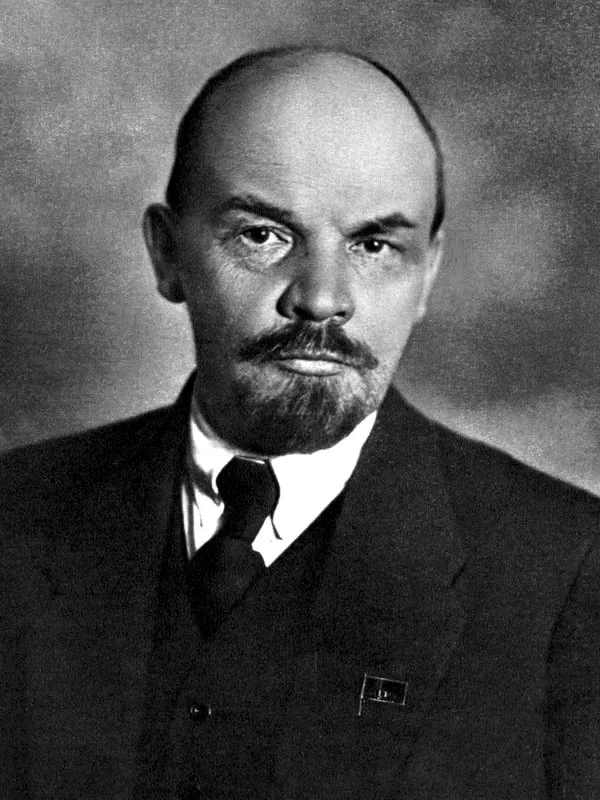
- Born:
- 22 April 1870, Simbirsk (Russian Empire)
- Died:
- 21 January 1924, Gorki near Moscow
- Author:
- Łukasz Skowroń
- Photo:
- autor nieznany, domena publiczna, Wikimedia Commons

Vladimir Ilyich Ulyanov, known by the pseudonym Lenin, was in the First World War the most uncompromising opponent of the war in the socialist camp and, towards its end, the man who changed its course in the east. He appears on the Entente side only because he was a citizen of one of its powers. In reality, from 1914 he wished defeat on his own country’s government and called for the war between states to be turned into a civil war between classes. Until the spring of 1917 he was an émigré in Switzerland, the leader of a small faction. In April the Germans let him through to Russia, counting on him to weaken it from within. Seven months later his party seized power in Petrograd, and in March 1918, against the majority of his own comrades, Lenin forced through the Treaty of Brest-Litovsk, which took Russia out of the war and opened the way for Germany’s last great offensive in the west. His state outlived defeated Germany by more than seventy years.
Before the war
He was born on 22 April 1870 (10 April in the Julian calendar) in Simbirsk on the Volga, into the family of an inspector of elementary schools who had risen to hereditary nobility. In 1887 his elder brother Alexander was hanged for taking part in a plot against the life of Tsar Alexander III. A few months later Vladimir was expelled from the university in Kazan for attending a student meeting. He passed his law examinations as an external student in St Petersburg in 1891, but practised as a lawyer only briefly. He became a Marxist. In 1895 he was arrested for his activity in the St Petersburg “League of Struggle for the Emancipation of the Working Class” and exiled for three years to the village of Shushenskoye in Siberia.
From 1900 he lived mainly abroad. He co-edited the newspaper Iskra, and in the pamphlet What Is to Be Done? (1902) he set out the model of a party of professional revolutionaries, centralised and disciplined. At the congress of the Russian Social Democratic Labour Party in 1903 the dispute over this idea split the party into the Bolsheviks, Lenin’s supporters, and the Mensheviks. During the 1905 revolution he returned to Russia, but from the end of 1907 he again lived in exile, in Geneva, Paris and, from 1912, in Kraków. From there, close to the border, he directed the legal newspaper Pravda and the Bolshevik faction in the Duma. He spent the summer of 1914 with his wife Nadezhda Krupskaya in Poronin in the Podhale region.
1914: war on war
The outbreak of war found him in Galicia as a citizen of an enemy state. On 8 August 1914 the Austrian gendarmerie arrested him on suspicion of spying for Russia and held him in the prison in Nowy Targ. Polish and Austrian socialists interceded for him, among them Ignacy Daszyński and Victor Adler, who is said to have assured a minister that Lenin was a greater enemy of tsarism than anyone in Vienna. He was released after eleven days, and at the beginning of September he left for neutral Switzerland. He settled in Bern and, from February 1916, in Zurich.
What shook him most was that the German, French and Belgian socialists had voted for war credits or joined their governments. He concluded that the Second International had gone bankrupt. He called the war imperialist, waged for the division of colonies and markets, and proclaimed slogans that even many radicals found scandalous: for the Russian proletariat the lesser evil was the defeat of tsarism, and the task of socialists was to turn the imperialist war into a civil war. He also fought fiercely against socialists who merely called for peace, because he believed that without revolution peace would be only a pause before the next war.
In September 1915 he attended the Zimmerwald Conference, where opponents of the war from a dozen or so countries adopted a manifesto written largely by Leon Trotsky. Lenin thought it too mild and gathered around himself a minority, the so-called Zimmerwald Left, which demanded a break with the socialists who supported their governments. It was the same in April 1916 at Kienthal. In 1916 he wrote Imperialism, the Highest Stage of Capitalism, in which he presented the war as the inevitable result of the struggle of the great monopolies and states to divide up the world. At the time he had few followers and little money. In January 1917 he told young Swiss in Zurich that his generation might not live to see the decisive battles of the coming revolution.
1917: the road to power
He learned of the February Revolution from the newspapers in mid-March. The route through France and Britain was closed to him, so he accepted an offer of passage through Germany. Berlin agreed because State Secretary Arthur Zimmermann and the Supreme Army Command counted on the radicals undermining Russia’s war effort. On 16 April Lenin arrived at the Finland Station in Petrograd, and the next day he announced the “April Theses”: no support for the Provisional Government, all power to the soviets, peace. Most socialists, including some Bolsheviks, considered this detached from reality. Within a few weeks, however, Lenin won the party over.
The programme was simple and matched the mood of the soldiers, peasants and workers: peace, land, bread. The Bolsheviks stayed out of the first coalition government, in which moderate socialists such as Irakli Tsereteli and Viktor Chernov took seats, and could freely criticise the authorities for continuing the war and for the failed Kerensky Offensive. In June, at the First Congress of Soviets, Tsereteli said that there was no party in Russia ready to take power alone. Lenin answered from the floor that there was such a party.
After the July Days the government accused the Bolsheviks of acting on German orders and issued a warrant for Lenin’s arrest. He hid near Petrograd and then in Finland, where he wrote The State and Revolution. The question of German money is still disputed today. The files of the German Foreign Office, published after the Second World War, confirm that Berlin passed considerable sums to the Bolsheviks, mainly through intermediaries in Stockholm. Most historians, however, believe that Lenin was nobody’s agent: he took money from anyone who could hasten the revolution, and he intended later to set it alight in Germany as well.
The Kornilov affair in September reversed the course of events. The government of Alexander Kerensky had to arm the workers to defend the capital, the Bolsheviks emerged from the underground and won majorities in the Petrograd and Moscow soviets. From hiding, Lenin bombarded the Central Committee with letters saying that power must be taken at once. In October he secretly returned to the capital and on 23 October (10 October Old Style) forced through a resolution on armed insurrection, against Lev Kamenev and Grigory Zinoviev. The preparations, however, were directed mainly by Trotsky, chairman of the Petrograd Soviet and of its Military Revolutionary Committee. On 7 November the Bolsheviks overthrew the Provisional Government, and the next day the Second Congress of Soviets adopted the decrees on peace and on land written by Lenin and set up the Council of People’s Commissars with him as chairman.
Leaving the war
The Decree on Peace called on all the belligerent states to agree an immediate armistice and a peace “without annexations and without indemnities”. When the Allies remained silent, on 21 November Lenin’s government ordered the high command to propose an armistice to the enemy, and replaced the acting commander-in-chief Nikolai Dukhonin, who refused, with Ensign Nikolai Krylenko. On 15 December the armistice was signed at Brest-Litovsk. For the Entente it was a separate agreement with the enemy, breaking the undertaking of September 1914 that none of the Allies would conclude a separate peace. Lenin had no intention of worrying about this. He regarded the secret treaties of tsarism as void, and Trotsky began to publish them.
At the same time Lenin was building the dictatorship of the party. On 20 December the Cheka was created, and in January 1918 the Bolsheviks dispersed the Constituent Assembly, in which Chernov’s Socialist Revolutionaries held the majority. The government also recognised the independence of Finland, counting on the Finnish Reds soon taking power there.
The peace talks at Brest showed that Germany had no intention of giving up the Polish, Lithuanian and Courland lands. Lenin, unlike most of the party, drew the conclusion that peace must be signed at once, even an annexationist one. The Russian army no longer existed, and the revolution needed a “breathing space”. At a meeting on 21 January his theses were supported by only 15 of the 63 activists present, while the majority came out for the “revolutionary war” of Nikolai Bukharin. The Central Committee finally adopted Trotsky’s formula: drag out the talks and, as a last resort, declare the war over without signing a peace. Lenin agreed to this attempt. On 10 February Trotsky announced at Brest “neither war nor peace”, and eight days later the Germans went on the offensive, meeting almost no resistance.
Then Lenin brought matters to a head. On the night of 18–19 February, after a long dispute, he won over the Central Committee by a single vote to accept the German terms. When even harsher terms arrived on 23 February, he threatened to leave the government and the Central Committee: “If you do not sign them, you will be signing the death sentence of Soviet power within three weeks.” He won because Trotsky and three other members of the committee abstained. On 3 March 1918 the Soviet delegation signed the Treaty of Brest-Litovsk. Russia lost Poland, Lithuania, Courland, Livonia, Estonia, Finland and Ukraine, lands inhabited, by various estimates, by between a quarter and a third of the population of the former empire, with a large part of its industry and most of its coal mines. Lenin compared this peace to the Peace of Tilsit of 1807, and on 15 March he forced through its ratification at the Congress of Soviets. By then the government had already moved to Moscow, further from the Germans.
For the Entente the Peace of Brest was a disaster. Germany could transfer dozens of divisions to the west, and on 21 March Erich Ludendorff launched a great offensive in France. The Allies began landing at Murmansk, Archangel and Vladivostok, at first to prevent war stores from falling into German hands, and soon also to support the Bolsheviks’ opponents. Lenin manoeuvred. He took care not to give the Germans a pretext to march on Moscow, and after the assassination of Ambassador Mirbach in July he crushed the rising of the Left Socialist Revolutionaries, who wanted to break the peace. At the end of August he agreed to the supplementary treaty, in which Russia renounced Livonia and Estonia and undertook to pay six billion marks.
Civil war and terror
Peace abroad opened war at home. In the summer of 1918 the revolt of the Czechoslovak Legion and the rise of anti-Bolshevik governments on the Volga and in Siberia brought Soviet power to the brink of collapse. On the night of 16–17 July in Yekaterinburg the Bolsheviks murdered the imperial family. No known document proves Lenin’s part in the decision, but most historians believe the crime would not have happened without Moscow’s consent. On 30 August 1918 Lenin was seriously wounded in an assassination attempt after a rally at the Michelson factory in Moscow. The response was the Red Terror: mass executions of hostages and “class enemies”, which Lenin had long demanded in confidential orders.
The collapse of Germany in November 1918 allowed him to annul the Treaty of Brest-Litovsk and move west behind the retreating Germans. As early as 29 August 1918 the Council of People’s Commissars had repealed the partition treaties concluded by tsarism with Prussia and Austria, recognising the right of the Polish nation to independence. This did not stop Lenin in 1920 from sending the Red Army towards Warsaw in the hope that the revolution would reach Germany through Poland.
After the war
In March 1919 Lenin founded in Moscow the Third International, which was to direct the world revolution. The Bolsheviks won the civil war, but revolution in the West did not break out, and the defeat at Warsaw in August 1920 closed the road to Germany. The ruined country was gripped by famine and peasant revolts, and in March 1921 the sailors of Kronstadt, until recently the pride of the revolution, mutinied. Lenin had the mutiny crushed and at the same time announced the New Economic Policy, which partly restored free trade. From May 1922 he suffered a series of strokes. In his last notes, later called his testament, he warned against Joseph Stalin, the party’s general secretary, and advised removing him from that post. He died on 21 January 1924 at Gorki near Moscow. His embalmed body was put on display in the mausoleum on Red Square.
Assessment
No figure of the First World War, except perhaps Kaiser Wilhelm II, provokes such extreme judgements. Soviet historiography revered him as a genius who foresaw the fall of tsarism and gave the peoples of Russia peace and land. Western historians such as Richard Pipes and Robert Service see him above all as the creator of one-party dictatorship, of political police terror and of the camp system that Stalin merely expanded. Orlando Figes stresses that without the war and its defeats the Bolsheviks would never have come to power, and that Lenin knew better than anyone how to exploit the soldiers’ war-weariness and the peasants’ hunger for land.
In the history of the war itself Lenin left a double mark. The Germans brought him into Russia as a weapon against the enemy, and for a few months it seemed that the weapon had worked: the Eastern Front vanished, and the Peace of Brest gave the Reich enormous gains. Many historians note, however, that this victory proved illusory. Germany had to leave in the east, by frequent estimates, about a million soldiers to guard the occupied lands, and the idea of revolution that it had helped to ignite reached its own ports and barracks in November 1918. Lenin himself, accused by his contemporaries of treason in Germany’s favour, concluded a humiliating peace with it to save his power, and eight months later watched the fall of the Hohenzollern monarchy that had dictated it to him.
Sources
Spotted a mistake?Report an error
Mentioned in battles
(03)Often appears with
People who appear in the same events.
On the timeline
(51)The 40 most important of 51 events. All tagged “Vladimir Lenin” (34) →