Russia · The Entente
Nikolai Krylenko
Commander-in-chief of the Russian Army by Bolshevik appointment (November 1917 – March 1918)
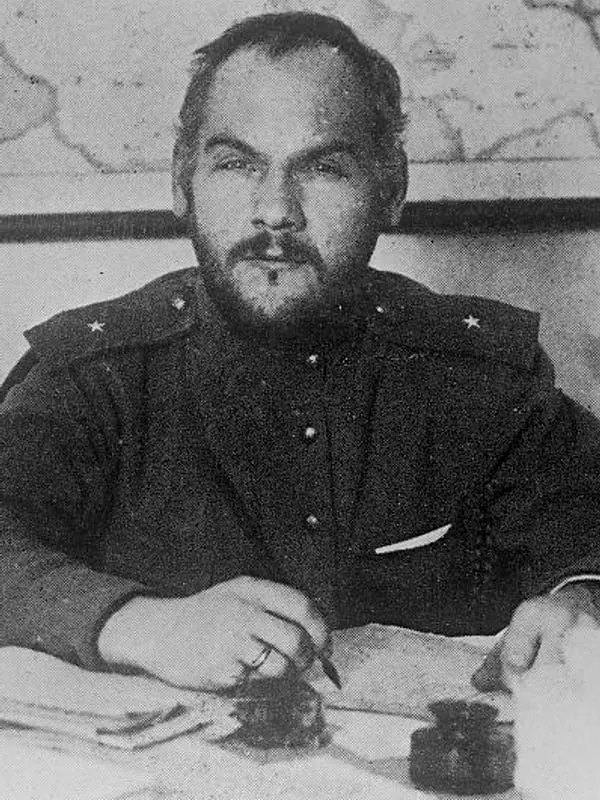
- Born:
- 14 May 1885, Bekhteyevo, Smolensk Governorate (Russian Empire)
- Died:
- 29 July 1938, Kommunarka near Moscow
- Author:
- Natalia
- Photo:
- Bain News Service, domena publiczna, Wikimedia Commons

Nikolai Krylenko was the most improbable commander-in-chief in the history of the Russian Army. A Bolshevik activist with a legal education, during the war an ensign and signals officer in a rifle regiment, in November 1917 he took command, at Lenin’s wish, of an army of many millions. He was not meant to lead it to victory but to lead it out of the war. He sent envoys across the front to the Germans, took over General Headquarters at Mogilev, where his predecessor was murdered before his eyes, and in February 1918 issued the order ending the war and demobilising the army. From the Allies’ point of view it was he, as the executor of Lenin’s policy, who sealed Russia’s exit from the Entente. After the war he was the chief prosecutor in the Soviet show trials, until he himself fell victim to the Great Purge.
Before the war
He was born on 14 May 1885 (2 May in the Julian calendar) in the village of Bekhteyevo in Smolensk Governorate. His father, expelled from university for revolutionary activity, later became a journalist and finally an excise official in the Kingdom of Poland. The family lived in Kielce and then in Lublin, where Nikolai finished the classical gymnasium in 1903. At the Faculty of History and Philology of St Petersburg University he joined the Bolsheviks in 1904. During the Revolution of 1905 he was an agitator and rally speaker, known under the pseudonym “Comrade Abram”. Arrested many times, in 1907 he was sent back to Lublin, and in the following years he drifted away from the party for a while and taught in private Polish schools in Lublin and Sosnowiec.
From 1911 he again worked for the Bolsheviks, on the editorial staffs of Zvezda and Pravda. He visited Lenin in Kraków and gave legal advice to the Bolshevik deputies in the Duma. In 1912–1913 he did one year of military service in an infantry regiment in Lublin and became an ensign of the reserve. At the end of 1913 he was exiled to Kharkov, where he completed a law degree as an external student. In the summer of 1914, fearing another arrest, he left for Austria.
War and revolution in the trenches
The outbreak of war found him in Austria-Hungary as an enemy national, so he moved to Switzerland, where the Bolshevik émigrés were gathered. He shared the position of Lenin, who called for the imperialist war to be turned into a civil war. In the summer of 1915 Lenin sent him and his wife, Yelena Rozmirovich, to Moscow to rebuild the underground. In November Krylenko was arrested as a reserve officer evading service and, after several months in prison in Kharkov, was sent to the front in the spring of 1916 with a note that he was to be watched. He served as a junior signals officer in a Finnish rifle regiment in the 11th Army on the South-Western Front.
After the February Revolution and the rise of elected committees in the army, spread by Order No. 1, Krylenko proved a rousing speaker. The soldiers elected him chairman of the regimental committee, then of the divisional committee, and in April of the committee of the whole 11th Army. But when, after Lenin’s return, he began to preach a ruthless struggle against the Provisional Government and immediate peace, in May he lost the support of the committee’s moderate members and had to step down. In June he joined the Bolshevik Military Organisation and became a member of the All-Russian Central Executive Committee. After the July Days he was arrested on a charge of high treason. He was released in September, when after the Kornilov affair the government was freeing imprisoned Bolsheviks.
In the autumn he chaired the congress of soviets of the Northern Region and was active in the Military Revolutionary Committee (PL) of the Petrograd Soviet. In October he assured the party’s Central Committee that the capital’s garrison would support an uprising. During the coup of 7 November he was one of its leaders.
Commissar and commander-in-chief
On 8 November 1917 the Second Congress of Soviets appointed him to the Council of People’s Commissars as one of the three members of the committee for military and naval affairs, alongside Vladimir Antonov-Ovseenko and the sailor Pavel Dybenko. He helped defend Petrograd against Kerensky’s troops, which tried to retake the capital at Pulkovo.
Lenin’s government wanted an immediate armistice. When the acting commander-in-chief, General Nikolay Dukhonin, refused to open negotiations with the enemy, Lenin dismissed him on the night of 21–22 November and appointed Krylenko commander-in-chief. Choosing an ensign for the highest post in the army was a political gesture: the new authorities wanted to show that generals who did not obey the soviets no longer had any say. At the same time Lenin called on the soldiers to elect their own delegates to talk to the enemy on their sectors.
Krylenko travelled by special train to the Northern Front, dismissing along the way commanders who did not recognise the new government. At Dvinsk he chose three envoys, who crossed the front line on 26 November and returned on 27 November with the German command’s written consent to armistice talks. Krylenko ordered a ceasefire wherever the enemy did not attack, and encouraged regiments to conclude local agreements with the Germans and Austrians. On 28 November he ordered a ceasefire on all fronts and fraternisation with the enemy. The front, from the Gulf of Riga to the Black Sea, practically fell silent even before the plenipotentiaries sat down to talks at Brest-Litovsk.
Mogilev
On 3 December 1917 Krylenko, with an escort of sailors, entered Mogilev, the seat of the Stavka, without a fight. Dukhonin, who had refused to flee, was arrested and brought to Krylenko’s railway carriage. The day before, however, he had ordered the release from Bykhov of the generals arrested after the Kornilov affair, and the rumour that Lavr Kornilov was marching on Mogilev enraged the crowd of soldiers and sailors at the station. According to the most often repeated version, Krylenko spoke against lynch law, but when he left, the crowd dragged the general out of the carriage and killed him on the platform. A few days later Krylenko proposed that the perpetrators should not be prosecuted, and no one was punished. The Whites never forgave him for it. Krylenko announced that he had assumed command.
On 15 December, after the armistice was signed at Brest, he ordered the commanders and committees of all fronts to cease hostilities without waiting for the full text of the agreement. In the following weeks, as commander-in-chief and co-founder of the Red Army, he dealt with the “democratisation” of what was left of the old army: the election of commanders and the abolition of ranks and insignia. In January 1918, together with Lenin and the commissar for war Nikolai Podvoisky, he co-signed demands on Romania, which was disarming disintegrating Russian units; this led to the breaking-off of relations. The conflict with the I Polish Corps of General Józef Dowbor-Muśnicki, who refused to accept elected commanders, ended in fighting. In an order dated the beginning of February Krylenko declared Dowbor an outlawed “enemy of the revolution”.
End of the war and end of the post
On 10 February 1918 Leon Trotsky broke off the talks at Brest with the formula “neither war nor peace” and demanded that Krylenko issue an order ending the state of war. Krylenko issued it on the morning of 11 February. According to some sources, Lenin tried to stop him but was too late. The soldiers, who were going home en masse anyway, took the war to be over. When on 18 February the Germans resumed operations and launched Operation Faustschlag, there was no longer an army that could stop them. As commander-in-chief Krylenko called for the defence of the revolution and worked on the Petrograd defence committee, but his words could change little. The government accepted the German terms, and on 3 March the Treaty of Brest-Litovsk was signed.
The defeat discredited the “democratic” army. Trotsky pushed through a plan to build the new army on former Tsarist officers and to set up a Supreme Military Council headed by General Mikhail Bonch-Bruyevich. Krylenko protested and on 4 March asked to be relieved. On 13 March the government accepted his resignation, and the post of commander-in-chief was abolished.
After the war
Krylenko moved to the People’s Commissariat of Justice. From May 1918 he presided over the Revolutionary Tribunal, and in the following years he was the prosecutor in the main political trials, among them that of the Socialist Revolutionaries in 1922 and of the engineers in the Shakhty trial in 1928. He maintained that verdicts should be decided by political considerations, not by proof of guilt. He was People’s Commissar of Justice of Russia and, from 1936, of the whole USSR. He ran Soviet chess, brought the former world champion Emanuel Lasker to Moscow and led mountaineering expeditions in the Pamirs. In January 1938, after being publicly criticised, he was dismissed and arrested by the NKVD. After interrogation he confessed to fabricated charges. On 29 July 1938, after a twenty-minute trial, he was sentenced to death and shot the same day at the Kommunarka firing range. He was rehabilitated in 1955.
Assessment
Krylenko was not a military commander in any ordinary sense. Historians agree in seeing him above all as the political executor of Lenin’s decisions, whose task was to take over the Stavka and bring about an armistice, not to conduct operations. Contemporaries stressed his gift as a speaker, able to calm a hostile crowd with words, but also his organisational weakness. To the Bolsheviks’ opponents he was the symbol of the army’s disintegration: an ensign in the post of commander-in-chief, in whose presence Dukhonin was killed and the front opened before the Germans. The Allies saw his orders for an armistice and fraternisation with the enemy as a breach of Russia’s obligations, and the silencing of the Eastern Front made it easier for the Germans to transfer dozens of divisions to the west.
Supporters of the revolution defended him, pointing out that Krylenko’s orders merely confirmed what was happening anyway: the soldiers did not want to go on fighting. His later role in the show trials meant that historiography remembers him more as one of the architects of Soviet lawlessness than as a commander-in-chief. His own fate, death by sentence of a court acting on the principles he himself had preached, is sometimes cited as an example of the revolution devouring its own children.
Sources
Spotted a mistake?Report an error
Commanded in battles
(01)Often appears with
People who appear in the same events.
On the timeline
(14)1917
November
December
- 03
- Armistice negotiations open at Brest-LitovskOn 3 December 1917 at Brest-Litovsk Adolph Joffe's Bolshevik delegation sat down to armistice talks with the Central Powers' officers under Gen. Hoffmann.
- Death of General DukhoninOn 3 December 1917 Krylenko's troops occupied the Stavka at Mogilev. The arrested General Dukhonin was lynched at the station by a mob of soldiers and sailors.
1918
January
- 28
- Russia breaks off relations with RomaniaOn 28 January 1918 the Romanian minister had to leave Petrograd. After the Romanians entered Bessarabia, Lenin cut ties and seized Romania's gold in Moscow.
- Creation of the Red ArmyOn 28 January 1918 the Council of People's Commissars decided to create a volunteer Workers' and Peasants' Red Army in place of the disintegrating old army.