Russian Empire · The Entente
Lavr Kornilov
Commander-in-chief of the Russian Army (July–September 1917), co-founder of the White Volunteer Army
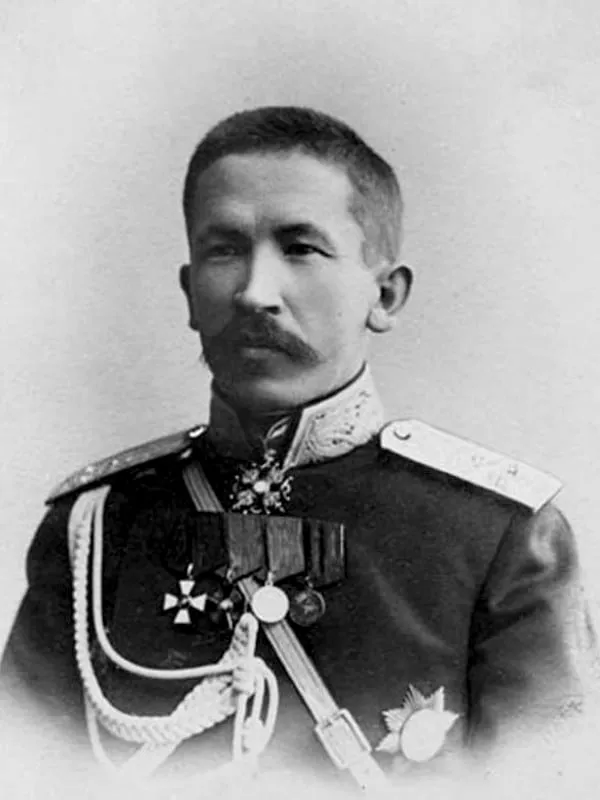
- Born:
- 30 August 1870, Ust-Kamenogorsk (Russian Empire)
- Died:
- 13 April 1918, near Yekaterinodar
- Author:
- Łukasz Skowroń
- Photo:
- autor nieznany, domena publiczna, Wikimedia Commons

General Lavr Kornilov was the most controversial Russian commander of the war. In 1914–1915 he made his name as a recklessly brave divisional commander, in 1916 all Russia talked of his escape from Austro-Hungarian captivity, and in the summer of 1917, after the defeat of the last Russian offensive, the government entrusted him with the supreme command. The right and the officers saw in him the man who would halt the disintegration of the army and the state. The left saw in him a would-be dictator. His September conflict with the prime minister Alexander Kerensky, known as the Kornilov affair or Kornilov putsch, ended in the general’s defeat, but it weakened the Provisional Government still further and opened the way for the Bolsheviks’ coup. After the October Revolution Kornilov co-founded the White Volunteer Army and was killed at its head in the spring of 1918.
Before the war
He was born on 30 August 1870 (18 August by the Julian calendar) in Ust-Kamenogorsk on the Irtysh, today in Kazakhstan. His father was a Siberian Cossack and an interpreter in a Cossack regiment who rose to a modest rank. Various versions circulated about his mother’s origins, with talk of Kazakh or Kalmyk roots. The general’s Asiatic features later attracted attention and gave rise to legends. He had neither fortune nor patrons. He graduated from the cadet corps in Omsk, the Mikhailovsky Artillery School in St Petersburg and the Nicholas General Staff Academy.
For more than a decade he was an intelligence officer and explorer in Central Asia. He led reconnaissance expeditions to Kashgar, Afghanistan and eastern Persia and learnt several of the region’s languages. In the war with Japan he was chief of staff of a rifle brigade. During the retreat from Mukden in 1905 he broke out of an encirclement with the bayonet and led the brigade out with its wounded and its colours. For this he received the Order of St George, 4th Class, and promotion to colonel. In 1907–1911 he was military attaché in China, then served in the Far East. In July 1914 he was a major-general commanding a brigade of Siberian riflemen in Vladivostok.
1914–1915: the “Steel” Division
At the beginning of the war he took over the 48th Infantry Division in General Aleksei Brusilov’s 8th Army. Within a few weeks he turned an ordinary division from the Kazan Military District into one of the best units on the front, later called the “Steel” Division. He fought in the final phase of the Battle of Galicia and in the Carpathians. Brusilov, who disliked him, wrote that Kornilov never spared his division, which suffered terrible losses in every action, and yet the soldiers loved him because they always saw him under fire, in the front line.
These traits, courage and a tendency to act on his own initiative, showed themselves in November 1914. During the second Russian invasion of Hungary Kornilov’s division unexpectedly took Humenné and came down from the mountains onto the Hungarian plain, against the orders of the corps commander. It was quickly cut off and had to fight its way back along mountain paths, losing thousands of men and a battery of guns. Brusilov wanted to court-martial the general, but it ended with a reprimand. In December the division fought at Limanowa, and in winter on the Carpathian ridges. In February 1915 Kornilov became a lieutenant-general.
In the spring of 1915 disaster came. After the German-Austrian breakthrough at Gorlice the 48th Division covered the retreat of the troops from the Carpathians and at the beginning of May was encircled in the Dukla area. Several thousand of its soldiers were taken prisoner. Wounded in the arm and leg, the general hid in the forests with a handful of men for several days, until in mid-May he too fell into Austrian hands. Opinions of this episode differed sharply. The corps commander blamed Kornilov for the destruction of the division, but the front commander, General Nikolai Ivanov, recommended him for a decoration, and the Tsar awarded him the Order of St George, 3rd Class, for enabling part of the division to break through to its own lines.
Captivity and escape
As a prisoner Kornilov passed through several camps and finally ended up in a camp for senior officers at Kőszeg in western Hungary. His first two escape attempts failed. In the summer of 1916, with the help of a Czech pharmacist’s assistant, František Mrňák, who obtained an Austrian uniform and papers for him, the general travelled by rail towards the Romanian border. Mrňák was caught, but Kornilov crossed the mountains into still-neutral Romania and reached Turnu Severin. In Russia he was received as a hero. The Tsar personally presented him with a decoration, and the newspapers printed his portraits and interviews. Some historians, including Alexander Rabinowitch, believe that the press, hungry for successes in a gloomy period of the war, inflated his fame beyond measure. In the autumn of 1916 Kornilov took over XXV Corps on the Southwestern Front.
1917: from Petrograd to Galicia
After the February Revolution the Provisional Government appointed him commander of the Petrograd Military District on 15 March 1917. The popular front-line general was to restore order in the mutinous garrison. On 21 March it was he who informed the Empress Alexandra Feodorovna at Tsarskoye Selo that she was under arrest. The monarchists never forgave him for this, while for the democrats it made him a “revolutionary general”. Yet he could not find common ground with the capital’s garrison, which since Order No. 1 listened to the Soviet more than to its officers. During the April Crisis, at the beginning of May, he wanted to disperse demonstrations with artillery, but the soldiers refused to carry out the order, and the Petrograd Soviet forbade troops to be led out of barracks without its consent. Kornilov resigned, unwilling to watch the Soviet undermine the army. The war minister Alexander Guchkov wanted to give him the Northern Front, but the commander-in-chief Mikhail Alekseyev objected. Kornilov received the 8th Army in Galicia, and from then on the two generals distrusted each other.
In the July Kerensky offensive his army achieved the only clear success. From 6 July it broke through the front of the Austro-Hungarian 3rd Army west of Stanisławów, took about 10,000 prisoners, captured Halicz and, on 11 July, Kałusz. Particularly distinguished was a shock detachment of volunteers under Captain Mitrofan Nezhentsev, the future Kornilov Regiment. The success lasted a few days. The soldiers refused to advance further, and when on 19 July the Germans broke through the front at Złoczów, the whole Russian defence in Eastern Galicia began to fall apart.
Around 20–21 July the prime minister Alexander Kerensky, against Brusilov’s wishes, gave Kornilov the whole Southwestern Front. The general reacted harshly. He ordered machine guns and artillery to fire on units leaving their positions without orders and deserters and looters to be shot without trial, and he telegraphed the government about a fleeing “army of crazed, ignorant men”. He demanded the restoration of the death penalty at the front, and on 25 July the government agreed. The front came to a halt at the state border, on the Zbruch. Kornilov was the only Russian commander to emerge from the July catastrophe with a stronger position.
Commander-in-chief
On 31 July 1917 Kerensky replaced Brusilov with Kornilov. The general at once set conditions: he would answer only “to his own conscience and to the whole people”, the government would not interfere in his operational orders and appointments, and the measures to restore discipline would also cover the rear. The telegram reached the press. He took up his duties at the Stavka in Mogilev only on 9 August. His programme, supported by the commissar Boris Savinkov, also included the death penalty in the rear, curbs on the role of the soldiers’ committees and the militarisation of the railways and the munitions industry. Kerensky, who had to reckon with the soviets, delayed.
At the Moscow State Conference at the end of August officers carried Kornilov out of the station on their shoulders, and the right side of the hall gave him a standing ovation. The general spoke of the disintegration of the army and the fall in munitions production and warned that without a change of policy Russia would lose Riga. On 3 September the Germans did indeed enter Riga. The left suspected that the commander-in-chief had given up the city deliberately to have a pretext for a reckoning with the revolution. There is no evidence of this.
The Kornilov affair
At the beginning of September Kornilov and Kerensky, through Savinkov, agreed that a cavalry corps would come to Petrograd to defend the government against the Bolsheviks if necessary. Kornilov, against Savinkov’s requests, gave the command to General Aleksandr Krymov, known for his monarchist views, and also sent the Savage Division. At the Stavka there was already talk of a new government. At this point the deputy Vladimir Lvov intervened, presenting himself to the general as the prime minister’s emissary. Kornilov told him that he saw a way out in martial law in the capital and the concentration of all power in the hands of the commander-in-chief. On 8 September Lvov passed this on to Kerensky in a form resembling an ultimatum. The prime minister took it as a coup d’état, dismissed the commander-in-chief during the night and declared him a traitor.
Kornilov refused to give up the command and called on the people to save the fatherland from a government which, in his view, was acting under Bolshevik pressure, in accord with the plans of the German general staff. The front commanders, including Anton Denikin, supported him, but the troops did not follow him. Railwaymen tore up the tracks, Soviet agitators persuaded the Cossacks and the Caucasian horsemen that they were being led against the lawful government, and the workers of Petrograd were given arms. The revolt collapsed without a fight. Krymov shot himself on 13 September, and on 14 September Alekseyev, who had accepted the post of chief of staff so that the revolt could be wound up as gently as possible, arrested Kornilov in Mogilev. The general and a dozen or so officers were confined in a former monastery at Bykhov, guarded by the Tekke regiment, which was loyal to him.
The consequences turned out to be exactly the opposite of those intended. The Bolsheviks, who had been hunted down not long before after the July Days, emerged from the affair as defenders of the revolution, with an armed Red Guard and soon with a majority in the soviets of both capitals. The officers did not forgive Kerensky for first summoning the cavalry himself and then imprisoning the commander-in-chief, and in November almost no one stood up to defend his government.
Bykhov and the Volunteer Army
After the Bolshevik coup the prisoners of Bykhov were in danger of being lynched. As the troop trains of the Bolsheviks’ new commander-in-chief, Ensign Nikolai Krylenko, approached Mogilev, General Nikolai Dukhonin ordered the prisoners released on 2 December 1917. The next day he himself was killed by a mob. Kornilov set out for the Don at the head of the Tekke regiment, but after being shelled by an armoured train and a hard march through marshes he sent the horsemen away and continued alone by rail, disguised as a peasant and with a false passport. On 19 December he reached Novocherkassk.
There the Volunteer Army was being formed from officers gathered by Alekseyev. Kornilov took its military command, Alekseyev dealt with politics and finance, and the ataman of the Don Cossacks, Alexey Kaledin, with the affairs of the Don. The two generals, the former commander-in-chief and his recent jailer, barely tolerated each other. The Cossacks did not want to fight the Bolsheviks, and the army numbered only a few thousand men. After Kaledin’s suicide in February 1918 Kornilov led the volunteers out of Rostov to the Kuban. Thus began the Ice March, a legend of the White movement. It was also a cruel march. Both sides shot prisoners, and according to many accounts the volunteers carried out bloody reprisals against the population in the stanitsa of Lezhanka and other places.
Yekaterinodar, which was to have been the goal of the march, had been given up to the Bolsheviks by the Kuban Cossacks back in March. Kornilov joined forces with them and in April began an assault on the city, despite the doubts of some of his generals. On the morning of 13 April 1918 (31 March Old Style) a shell hit the farmhouse outside the city that housed the headquarters and killed the general in his room. Command passed to Denikin, who broke off the assault and withdrew the army to the Don. Kornilov’s body was buried in secret in the German colony of Gnadau. The Bolsheviks found the grave, took the remains to Yekaterinodar, today’s Krasnodar, desecrated them and burnt them.
Assessment
Kornilov divides historians to this day. For the Whites he was a patriot, the only one who tried to save the army from disintegration, and the most famous regiment of the Volunteer Army bore his name. Soviet historiography spoke of “Kornilovshchina”, an attempt at a counter-revolutionary dictatorship. His talents as a commander were also judged differently. Denikin praised his ability to train soldiers, his tenacity and his personal courage. Brusilov and some historians pointed out that his bravado and disobedience cost his division thousands of men, and that his fame as a hero grew more from the escape from captivity than from battles won.
September 1917 arouses the most controversy. Kerensky maintained to the end of his life that he had foiled a carefully prepared right-wing conspiracy. George Katkov and Richard Pipes argued the opposite, that the prime minister had exploited a misunderstanding to get rid of an inconvenient rival. Many scholars, such as William Chamberlin and Harvey Asher, accept an intermediate version: Kornilov preferred to act with the government’s consent, but was ready to do without it, and a coup was indeed being prepared in his entourage. The general himself, as even his supporters wrote, was an excellent soldier but politically naive and easily swayed by advisers. All agree on the outcome. The failed march on Petrograd discredited both the right and Kerensky, and those who gained most from it were the Bolsheviks, who two months later seized power and took Russia out of the war.
Sources
Spotted a mistake?Report an error
Commanded in battles
(02)Mentioned in battles
(02)Often appears with
People who appear in the same events.
On the timeline
(21)1914
1915
1917
May
June
July
August
- 06
- Second coalition government in RussiaOn 6 August 1917, after three weeks of bargaining and Kerensky's resignation, a second coalition of socialists and Kadets was formed in Petrograd.
- Dowbor-Muśnicki takes command of the I Polish CorpsOn 6 August 1917 Gen. Józef Dowbor-Muśnicki took command of the I Polish Corps, formed in Russia on the Naczpol's initiative from Poles in the Russian army.
September
- 14
- Collapse of the Kornilov affairOn 13 September 1917 General Krymov shot himself in Petrograd; next day General Alekseyev arrested Kornilov in Mogilev. The revolt collapsed without a fight.
- Russia becomes a republicOn 14 September 1917 the Provisional Government, not waiting for the Constituent Assembly, proclaimed the Russian Republic under a five-man Directory.