Russian Empire · The Entente
Aleksei Brusilov
Commander of the 8th Army (1914–1916) and the Southwestern Front (1916–1917), commander-in-chief of the Russian Army (1917)
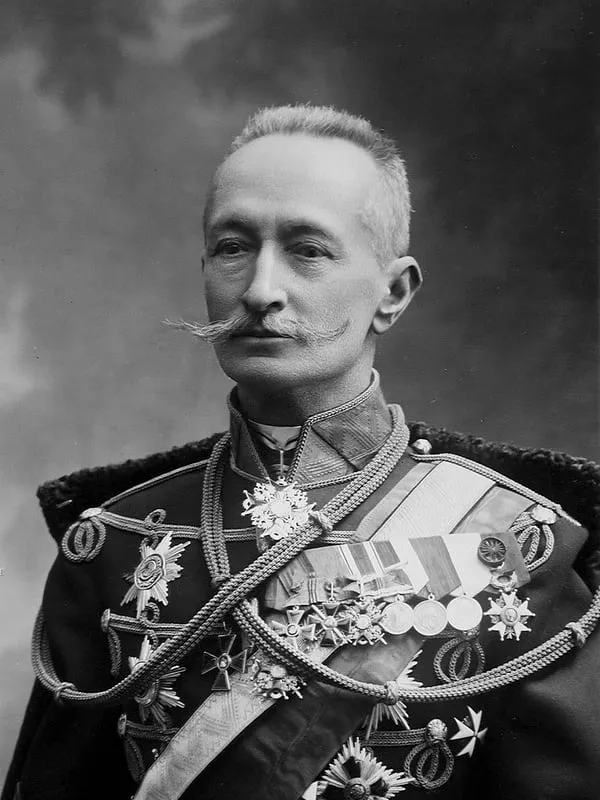
- Born:
- 31 August 1853, Tiflis, now Tbilisi (Russian Empire, now Georgia)
- Died:
- 17 March 1926, Moscow
- Author:
- Natalia
- Photo:
- autor nieznany, domena publiczna, Wikimedia Commons

General of Cavalry Aleksei Brusilov was the ablest commander of the Russian Army in the First World War and one of the few generals of the war whose name is borne by a great operation. In 1914 he led the 8th Army across Galicia into the Carpathians, in 1915 he withdrew it in good order to Volhynia, and in June 1916 his Southwestern Front broke through the Austro-Hungarian front in an offensive that went down in history as the Brusilov offensive. After the February Revolution he quickly adapted to the new order and in the summer of 1917 was commander-in-chief for less than two months. In 1920, during the war with Poland, he supported the Bolsheviks, which long marked his memory both among the White émigrés and in Poland.
Before the war
He was born on 31 August 1853 (19 August by the Julian calendar) in Tiflis, today’s Tbilisi, into a general’s family. His mother was Polish. Orphaned early, he was brought up by relatives in Kutaisi. He graduated from the elite Corps of Pages and as a dragoon officer fought in the Caucasus in the Russo-Turkish War. He was then associated for more than twenty years with the Officers’ Cavalry School in St Petersburg, in 1902–1906 as its commandant. He was regarded as one of the finest experts on horsemanship in Russia.
Thanks to the patronage of Grand Duke Nicholas Nikolaevich, in 1906 he took command of the 2nd Guards Cavalry Division, and in 1909 of XIV Corps in the Warsaw Military District. In 1912 he became deputy commander of that district, but, put off by conflicts in the district staff, he asked for a transfer and in 1913 took command of XII Corps in the Kiev Military District. He was a demanding, energetic commander who laid stress on field exercises, war games and the training of officers.
1914: Galicia and the Carpathians
On the day war broke out with Germany Brusilov became commander of the 8th Army, which formed the left wing of General Nikolai Ivanov’s Southwestern Front. At the end of August it advanced from Podolia into eastern Galicia and, together with General Nikolai Ruzsky’s 3rd Army, routed the Austro-Hungarian 3rd Army on the Złota Lipa and then on the Gniła Lipa. At the beginning of September the 8th Army took Halicz. When the Austrians struck from the west at Gródek and Rawa Ruska, the main weight of their attack fell on Brusilov, who had to throw his last reserves into the fighting but held the front until the enemy retreated. Victory in the Battle of Galicia strengthened his fame.
In the autumn his army spent three weeks repelling Austro-Hungarian attacks between Przemyśl and Stary Sambor in the Battle of Chyrów, which Brusilov simply called the Battle of Przemyśl. It then moved into the Carpathians and towards the passes leading into Hungary. In December some of his troops fought at Limanowa, and in the winter of 1914/1915 the 8th Army fought hard battles in the snow of the Carpathian winter battle, repelling the Austrian attempts to relieve Przemyśl and seizing the crest of the Beskids.
1915: retreat
After the breakthrough at Gorlice in May 1915 Brusilov’s army had to come down from the Carpathians. In the Battle of the San he took over two corps of the shattered 3rd Army and the garrison of Przemyśl, and his counter-attacks were repulsed. Brusilov warned the high command that the positions at the fortress could not be held, but the Stavka wanted to defend Przemyśl for reasons of morale. After the loss of Przemyśl and Lviv he withdrew in good order to Volhynia, avoiding encirclement, and in September he launched his own counter-offensive and on 23 September recaptured Lutsk for a few days.
This year also has a dark side. Brusilov, an ardent Germanophobe, repeatedly pressed for the expulsions of German colonists from Volhynia to be extended. In the autumn of 1915, partly at his instigation, even those who had been spared until then were deported: old people, widows and the mothers of fallen soldiers. He claimed that they were destroying telegraph lines.
1916: the great offensive
At the end of March 1916 Brusilov replaced Ivanov at the head of the Southwestern Front. At a conference at headquarters in Mogilev in April he was the only front commander to assure the others that his troops could and should attack. He was given permission, but only for a subsidiary attack supporting the main offensive of General Aleksei Evert’s Western Front towards Vilna.
Brusilov prepared his attack differently from everyone before him. Instead of concentrating his forces at one point, he ordered each of his four armies to prepare its own breakthrough, so that the enemy would not know where the main blow would fall and could not shift reserves. For weeks the infantry dug forward at night towards the enemy positions, and the artillery was given precise tasks instead of hurricane fire. Even on the night before the attack the Chief of Staff to the Supreme Commander, General Mikhail Alekseyev, urged him by telephone to postpone the attack and concentrate his forces. Brusilov refused.
On 4 June the Brusilov offensive began. General Aleksei Kaledin’s 8th Army broke through the front at Olyka and took Lutsk on 7 June, while in the south the 9th Army broke through in Bukovina and in mid-June took Czernowitz. Within a few weeks Austria-Hungary lost hundreds of thousands of soldiers, including more than a quarter of a million prisoners. The Austrians had to break off their offensive in the Tyrol, the Germans moved divisions from the Western Front to the east, and in August Romania entered the war.
The victory remained incomplete. Brusilov stubbornly aimed at Kovel instead of directing Kaledin’s army towards Lviv, as Alekseyev suggested, while Evert delayed and moved only at the beginning of July at Baranovichi, without success. When the Stavka made the Southwestern Front the main axis, Brusilov received the Guards and further corps, but in the summer and autumn he threw them into the marshes of the Stokhid, suffering enormous losses without taking Kovel. For the offensive he received from the Tsar a golden sword with diamonds rather than the Order of St George, 2nd Class, for which he had been recommended.
1917: commander-in-chief
In March 1917 Brusilov, like the other front commanders, declared in favour of the abdication of Nicholas II. After the revolution he spoke at rallies and cooperated with the soldiers’ committees. When the Minister of War, Alexander Kerensky, was looking for a commander for the summer offensive, he chose him. On 4 June 1917 the Provisional Government appointed Brusilov commander-in-chief in place of Alekseyev. On the same day Brusilov ordered the formation of volunteer “revolutionary shock battalions”. The officers of the Stavka regarded him as an opportunist.
The Kerensky offensive he had prepared began on 1 July and collapsed after a few days, and from 19 July the Germans and Austrians drove the shattered 11th Army across eastern Galicia. On 31 July the government replaced Brusilov with General Lavr Kornilov.
After the war
Brusilov settled in Moscow. During the fighting for the city in November 1917 he was badly wounded by a shell fragment that hit his house, and he was in hospital until the summer of 1918. He refused to join the Whites, and in August 1918 the Cheka arrested him for two months. His son, who had joined the Red Army, was captured by the Whites and killed.
On 30 May 1920, during the Polish–Soviet War, after the Poles had taken Kiev, Pravda published his appeal “To all former officers, wherever they may be”. In it he called on them to forget their grievances and join the Red Army to defend Russia against foreign invasion. According to many accounts it persuaded thousands of former tsarist officers to serve the Bolsheviks. Brusilov chaired a special council attached to the high command of the Red Army and was later inspector of cavalry. He died in Moscow on 17 March 1926 and was buried with military honours in the Novodevichy Cemetery.
His memoirs appeared in 1929. The second volume, dictated to his wife abroad in 1925 and taken out of the country by her, sharply attacked the Bolsheviks. When it was seized, the Soviet authorities declared it a forgery by the widow, but many modern researchers question that conclusion.
Assessment
Brusilov is regarded as the most outstanding Russian commander of the war. Field Marshal Bernard Montgomery counted him among the seven best field commanders of the First World War, and his method of breakthrough, based on careful preparation, surprise and attack on many sectors at once, was studied in many armies. Some historians see similar principles in the German offensives of 1918.
Critics point out, however, that after the great breakthrough Brusilov was unable to exploit it, and that the persistent attacks on Kovel cost the army hundreds of thousands of men, including the flower of the Guards, and contributed to its exhaustion before the revolution. General Anton Denikin, who took part in the offensive, wrote of his wavering at critical moments. The White emigration also never forgave him his flirtation with the revolution in 1917 and his service with the Bolsheviks, while Soviet historiography, though it placed him on a pedestal, censored his memoirs for years. The St Petersburg historian A. V. Smolin notes that the image of Brusilov in the literature is still heavily coloured by ideology and needs to be critically checked against the documents.
Sources
Spotted a mistake?Report an error
Commanded in battles
(14)- 23 August – 11 September 1914Battle of GaliciaEastern Front
- 26–30 August 1914Battle of the Złota LipaEastern Front
- 8–11 September 1914Battle of Gródek and Rawa RuskaEastern Front
- 13 October – 2 November 1914Battle of ChyrówEastern Front
- 1–12 December 1914Battle of LimanowaEastern Front
- 23 January – 15 April 1915Winter Battle in the CarpathiansEastern Front
- 16–23 May 1915Battle of the SanEastern Front
- 24 May – 3 June 1915Recapture of PrzemyślEastern Front
- 12–15 June 1915Battle of Mościska and LubaczówEastern Front
- 17–22 June 1915Recapture of LvivEastern Front
- 27 June – 1 July 1915Battle of the Gniła LipaEastern Front
- 4 June – 20 September 1916Brusilov offensiveEastern Front
- 1–16 July 1917Kerensky OffensiveEastern Front
- 19–28 July 1917Counter-offensive in Eastern GaliciaEastern Front
Mentioned in battles
(02)Often appears with
People who appear in the same events.