Germany · The Central Powers
August von Mackensen
Commander of the Eleventh Army and of army groups on the Eastern Front and in the Balkans (1914–1918), field marshal
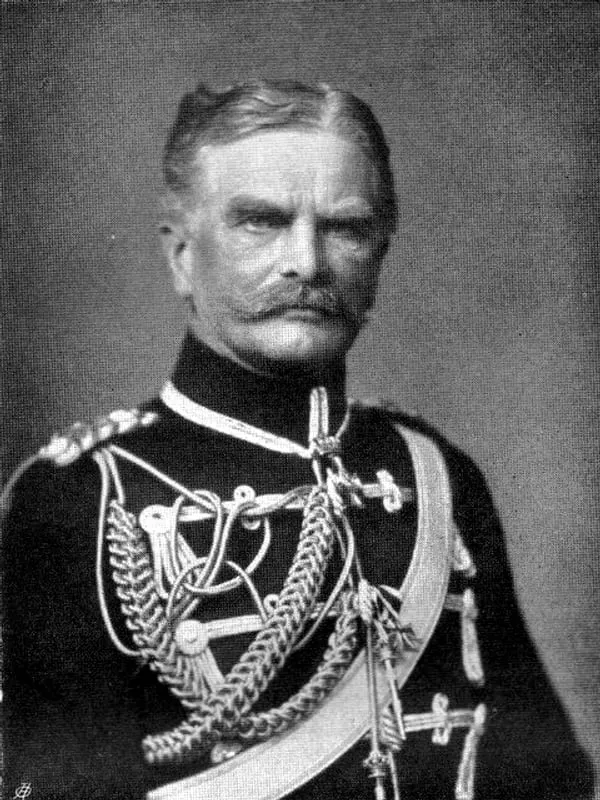
- Born:
- 6 December 1849, Leipnitz (Prussia)
- Died:
- 8 November 1945, Burghorn near Celle
- Author:
- Natalia
- Photo:
- autor nieznany, domena publiczna, Wikimedia Commons

August von Mackensen was one of the most successful commanders of the First World War. In 1914 he commanded a corps in East Prussia and an army in Poland; in May 1915 he broke through the Russian front at Gorlice, which began the Great Retreat of the Russians; in the autumn of that year he conquered Serbia, and in 1916 he defeated Romania and took Bucharest. When the war broke out he was 65; he ended it as a field marshal and, after Hindenburg, the most popular commander in Germany. In the black uniform of the Life Hussars, with a death’s head on his busby, he became a living symbol of the old Prussian army, a symbol that the propaganda of the Third Reich also exploited years later.
Before the war
He was born on 6 December 1849 on the Leipnitz estate in the Prussian province of Saxony, into the middle-class family of an estate manager. His father wanted him to become a farmer. In 1869 Mackensen served as a one-year volunteer in the 2nd Life Hussars, and in the Franco-Prussian War he won the Iron Cross for daring patrols. After the war he studied agriculture in Halle, but in 1873 he returned to the army for good.
He never completed the War Academy, yet he was posted to the Great General Staff and in 1891 became adjutant to its new chief, Alfred von Schlieffen. In the mid-1890s he took over the 1st Life Hussars in Danzig, the famous “death’s heads”, and then, although not a nobleman, became aide-de-camp to Emperor Wilhelm II. In 1899 he was ennobled. From 1903 he commanded the 36th Division in Danzig, and from 1908 XVII Corps in the same city.
1914: East Prussia and Poland
At the start of the war XVII Corps formed part of the Eighth Army defending East Prussia. On 20 August, at the Battle of Gumbinnen, Mackensen led his corps into an attack without adequate reconnaissance, and it broke down under the fire of Russian artillery and entrenched infantry. The corps suffered heavy losses, and some units fell back in disorder. A few days later, now under the new command of Paul von Hindenburg and Erich Ludendorff, XVII Corps defeated Russian troops on the eastern flank and helped close the ring around Alexander Samsonov’s army at the Battle of Tannenberg, and in September it fought at the Masurian Lakes.
In October Mackensen led the northern wing of the Ninth Army towards Warsaw. His group got to within some fifteen kilometres of the city, but faced with a Russian superiority several times over it had to withdraw. At the beginning of November Hindenburg took command of the whole Eastern Front, and the Ninth Army passed to Mackensen. Its troops were moved by rail to the area of Thorn, from where on 11 November they struck the flank of the Russians preparing to march on Silesia. At the Battle of Łódź they almost encircled the Russian Second Army, then were themselves trapped in a pocket at Brzeziny, from which they broke out, and on 6 December they took Łódź. Mackensen received the Pour le Mérite and the rank of colonel-general. In the winter his army became bogged down on the Rawka and the Bzura, and at the end of January 1915 at Bolimów it carried out the first large attack using gas, which failed in the freezing weather.
1915: Gorlice and the Great Retreat
In the spring of 1915 the chief of the German general staff, Erich von Falkenhayn, decided to rescue his ally, threatened by the Russians in the Carpathians. A new Eleventh Army was formed from picked divisions brought from the west, and command was given to Mackensen, who was regarded as a tactful man able to work with the Austrians. Colonel Hans von Seeckt became his chief of staff. The Austro-Hungarian Fourth Army was also placed under him, while he himself was formally subordinate to the high command in Teschen.
On 2 May, after a four-hour bombardment from more than a thousand guns and mortars, his troops attacked at Gorlice and within four days shattered the Russian Third Army. Mackensen gave the Russians no time to dig in. He crossed the San, recaptured Przemyśl on 3 June, and on 22 June the Austro-Hungarian Second Army of his group entered Lviv. That day the emperor made him a field marshal. His armies then turned north, between the Vistula and the Bug, won the Battle of Krasnystaw, took Lublin and Chełm, and on 25 August broke through the ring of forts of Brest-Litovsk. The offensive that had begun at Gorlice forced the Russians to abandon Galicia, the Kingdom of Poland and Lithuania.
1915: the conquest of Serbia
In the autumn of 1915 Mackensen took command of the expedition against Serbia, in which Germany and Austria-Hungary were to strike from the north and Bulgaria, which had just joined the alliance, from the east. On 20 September he arrived in Temesvár, and on 6 October his armies began forcing the Sava and the Danube. On 9 October Belgrade fell. Mackensen wanted to trap the Serbian army in a pocket, first at Kragujevac, then on the Field of Kosovo, but Vojvoda Radomir Putnik each time withdrew his troops in time. At the end of November the Serbs, with the king and the government, set off across the mountains of Albania to the Adriatic. Mackensen considered his objective achieved and did not pursue them into the mountains. The conquest of Serbia opened an overland route from Germany to Turkey, but the Serbian army survived and soon returned to the fight on the Salonika front. According to accounts, Mackensen held Serbian soldiers in high regard and before the campaign warned his subordinates that they would be fighting a brave enemy.
1916–1918: Romania
When in August 1916 Romania entered the war, Mackensen commanded in northern Bulgaria a multinational group of Bulgarian, German, Turkish and Austro-Hungarian troops. On 2 September he advanced into the Dobruja, on 6 September the Bulgarians took the fortress of Turtucaia, and in October Constanța fell, Romania’s main port. Meanwhile Falkenhayn’s army broke through the Carpathians into Wallachia. On 23 November Mackensen crossed the Danube at Zimnicea and advanced on Bucharest from the south. A Romanian counter-attack on the Argeș at the beginning of December turned into a disaster, and on 6 December 1916, the field marshal’s 67th birthday, the troops of the Central Powers entered Bucharest. In January 1917 Mackensen received the Grand Cross of the Iron Cross, the second commander in this war to do so after Hindenburg.
As commander of an army group he exercised authority in occupied Wallachia, whose grain and oil went to meet the needs of the Central Powers. In the summer of 1917 he tried to finish off the Romanian army, but at Mărășești the Romanians stopped his Ninth Army. It was his greatest defeat of the war. After the Bolshevik coup and the disintegration of the Russian army, Romania had to conclude the Armistice of Focșani, and in February 1918 Mackensen presented it with an ultimatum that led to negotiations and the Treaty of Bucharest.
Internment
After the Armistice of Compiègne Mackensen had to withdraw his troops from Romania through Transylvania and Hungary. On 16 December 1918 the Hungarian authorities stopped his train in Budapest and interned the field marshal at the castle of Fót. He nevertheless managed to ensure that his soldiers could continue their journey home. In January 1919 the French took him south. He was held as a prisoner at Futog near Novi Sad, and then in Salonika. He was also placed on the Allied list of persons accused of war crimes. He was released at the end of November 1919.
After the war
In 1920 he left the army and settled near Stettin. He was a declared monarchist and appeared at veterans’ gatherings and in nationalist organisations, always in the uniform of the Life Hussars. The Nazis liked to show him at ceremonies as a symbol of continuity with the old army. In 1933 Hermann Göring appointed him to the Prussian State Council, and in 1935 he received an estate from the state. Mackensen was not, however, uncritical. He demanded the rehabilitation of General Kurt von Schleicher, murdered during the Night of the Long Knives, interceded on behalf of persecuted clergy of the Confessing Church, and in February 1940 wrote a letter to the commander-in-chief of the army, Walther von Brauchitsch, protesting against the crimes committed in occupied Poland. He died on 8 November 1945 at Burghorn near Celle, aged almost 96, the last surviving field marshal of the imperial army.
Assessment
Leaving aside his corps’ failed attack at Gumbinnen, Mackensen did not lose any of the great operations he commanded until Mărășești, and he himself liked to stress that he had never been beaten. He is sometimes regarded as the most successful commander on the side of the Central Powers. Historians of the Eastern Front, such as the British author Norman Stone, point out, however, that he owed his success at Gorlice also to a crushing superiority in artillery and the weakness of the Russian defences, and that in Romania he was fighting an army poorly prepared for war.
Part of the credit is attributed to his chiefs of staff, especially Seeckt, who according to many authors was the brains behind the operations at Gorlice and in Serbia. Mackensen himself was not an outstanding theorist, but a commander who knew how to choose advisers and listen to them, maintained good relations with his allies, the Austrians, Bulgarians and Turks, and never for a moment gave the enemy a respite. His later role in Germany, as an idealised symbol of the old army exploited by the Nazis, yet one who had the courage to protest against some of their crimes, remains a matter of dispute among his biographers.
Sources
Spotted a mistake?Report an error
Commanded in battles
(19)- 20 August 1914Battle of GumbinnenEastern Front
- 28 September – 8 November 1914Battle of Warsaw and DęblinEastern Front
- 11 November – 6 December 1914Battle of ŁódźEastern Front
- 30 November – 17 December 1914Battle of the BzuraEastern Front
- 18 December 1914 – 17 July 1915Fighting on the Rawka and BzuraEastern Front
- 31 January – 6 February 1915Battle of BolimówEastern Front
- 1–5 May 1915Battle of GorliceEastern Front
- 16–23 May 1915Battle of the SanEastern Front
- 24 May – 3 June 1915Recapture of PrzemyślEastern Front
- 12–15 June 1915Battle of Mościska and LubaczówEastern Front
- 17–22 June 1915Recapture of LvivEastern Front
- 1–19 July 1915Second Battle of KraśnikEastern Front
- 16–18 July 1915Battle of KrasnystawEastern Front
- 5 October 1915 – 30 September 1918The Salonika FrontBalkan Front
- 6–9 October 1915Defence of BelgradeBalkan Front
- 6 October – 4 December 1915Conquest of SerbiaBalkan Front
- 2–6 September 1916Battle of TutrakanBalkan Front
- 1–5 December 1916Battle of the ArgeșBalkan Front
- 6 August – 3 September 1917Battle of MărășeștiBalkan Front
Mentioned in battles
(09)Often appears with
People who appear in the same events.
On the timeline
(78)The 40 most important of 78 events. All tagged “August von Mackensen” (27) →
1914
1915
January
May
June
- 22
- Austro-Hungarians retake LvivOn 22 June 1915 troops of the Austro-Hungarian Second Army entered Lviv. After 293 days the Russian occupation of the capital of Galicia came to an end.
- End of the battle of ŻydaczówOn 22 June 1915 the battle of Żydaczów ended. Threatened from the north, the Russians gave up the south bank of the Dniester; the South Army prepared to cross.
July
- 13
- Central Powers' great offensive in the east beginsOn 13 July 1915 the Germans struck from East Prussia towards the Narew. An offensive began that was to drive the Russians out of the Kingdom of Poland.
- Battles of Masłomęcz and Grabowiec beginOn 13 July 1915 the German Army of the Bug took up positions between Hrubieszów and Grabowiec. The attack on the Russian Thirteenth Army began on 15 July.
- 18
- End of the battles of Masłomęcz and GrabowiecOn 18 July 1915 the Russian Thirteenth Army still held off the Bug Army near Hrubieszów and Grabowiec. It fell back that night as the front broke at Krasnystaw.
- End of the Battle of KrasnystawOn 18 July 1915 the Germans held Krasnystaw and the Wieprz bridgehead despite Russian Guards counter-attacks. At night the Russians fell back near the railway.