Germany · The Central Powers
Wilhelm II
German Emperor and King of Prussia (1888–1918), Supreme Warlord of the armed forces
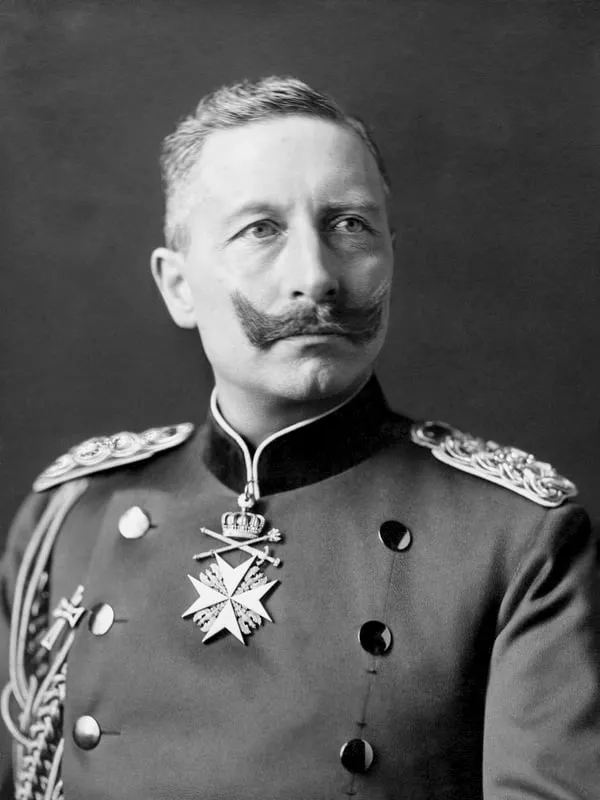
- Born:
- 27 January 1859, Berlin
- Died:
- 4 June 1941, Doorn (Netherlands)
- Author:
- Łukasz Skowroń
- Photo:
- Studio of Thomas Heinrich Voigt, domena publiczna, Wikimedia Commons

For thirty years Wilhelm II was the face of the German Empire. Loud, impulsive and hungry for attention, he wanted to be seen as a ruler who personally directed policy and the army, and his speeches, interviews and whims repeatedly shook Europe. To Germany’s enemies he became the embodiment of Prussian militarism, the “Kaiser” whom British voters wanted to hang in 1918. In July 1914 his assurance that Germany would back Austria-Hungary set off the chain of decisions that led to war. During the war itself, however, his role was surprisingly modest. Formally he was the Supreme Warlord, but in practice he increasingly handed power to his generals, until in 1916 he found himself in the shadow of Hindenburg and Ludendorff. When the war was lost, the army abandoned him and he fled to the Netherlands, where he spent the last twenty-two years of his life.
Before the war
He was born on 27 January 1859 in Berlin, the eldest son of the heir to the Prussian throne, the future Emperor Frederick III, and of Victoria, the eldest daughter of Britain’s Queen Victoria. A difficult birth left him with a withered, shorter left arm, which he tried to hide all his life. Brought up strictly, he had a difficult relationship with his liberal mother and all his life felt a mixture of admiration and envy towards Britain. In June 1888, after his father had reigned for only 99 days, he became German Emperor and King of Prussia at the age of 29.
In 1890 he forced Chancellor Otto von Bismarck to resign and announced that he would direct policy himself. His “personal rule” consisted largely of choosing ministers, making public speeches and meddling in matters he did not understand. Under the banner of Weltpolitik Germany demanded “a place in the sun”, and with the Kaiser’s backing Admiral Alfred von Tirpitz built from 1898 a battle fleet meant to challenge the Royal Navy. The naval arms race alienated Britain from Germany and pushed it towards an understanding with France and Russia. The Kaiser’s appearances, such as his visit to Tangier in 1905 or the interview with a British newspaper that sparked the Daily Telegraph affair in 1908, deepened distrust of Germany. Despite his menacing rhetoric, however, in successive crises up to 1914 Wilhelm II drew back from war, something German nationalists and some generals held against him.
The July Crisis
Wilhelm II was a friend of the Austrian heir to the throne, Franz Ferdinand, whom he had visited as recently as June 1914, and the assassination in Sarajevo shook him deeply. When on 5 July Vienna’s envoys brought a letter from Emperor Franz Joseph to Potsdam, Wilhelm II assured them of Germany’s full support, even if a reckoning with Serbia led to conflict with Russia. This assurance went down in history as the “blank cheque”. The next day, as planned and on the advice of Chancellor Theobald von Bethmann Hollweg, the Kaiser set off on his annual cruise in Norwegian waters so as not to arouse suspicion.
He learned of the ultimatum to Serbia and of the Serbian reply from the newspapers. Against the Chancellor’s advice he cut his cruise short and by 27 July was back in Potsdam. On the morning of 28 July he read the full text of the Serbian reply for the first time. He noted in the margin that it was a great moral victory for Vienna and that with it every reason for war disappeared. He proposed that the Austrians occupy only Belgrade as a pledge and stop there. The Chancellor passed this proposal on to Vienna late and in a weakened form, and that same day Austria-Hungary declared war on Serbia. In night-time telegrams to his cousin, Tsar Nicholas II, he asked that Russian military preparations should not wreck his mediation. When Russia announced general mobilisation, he concluded that he had fallen victim to encirclement by Britain, France and Russia, which had long wanted to destroy Germany.
On 31 July Wilhelm II proclaimed a state of imminent danger of war, and on 1 August he signed the order for mobilisation and the declaration of war on Russia. That same day a misunderstood dispatch arrived from London suggesting that Britain might guarantee France’s neutrality. The Kaiser then ordered his Chief of Staff, Helmuth von Moltke, to send the whole army east, and when Moltke replied that this was impossible, he retorted that his uncle would have given him a different answer. The misunderstanding was soon cleared up and the plan was carried out unchanged. On 4 August, in his speech from the throne to the deputies of the Reichstag, the Kaiser proclaimed internal peace: “I no longer recognise any parties, I recognise only Germans.”
Supreme Warlord
Under the constitution the Kaiser was supreme commander of the army and navy, and in peacetime he liked to play the commander at manoeuvres. In war it quickly became clear that he had neither the knowledge nor the perseverance to command in earnest. Operations were directed by the Chief of the General Staff of the Field Army, while the Kaiser spent the war in a succession of headquarters: at Koblenz, Luxembourg, Charleville-Mézières, Pless, Bad Kreuznach and Spa. He received reports, visited troops, handed out decorations and was increasingly sidelined from real decisions. His moods swung violently, from faith in victory to deep depression. The German historian Wilhelm Deist called him a “shadow emperor”.
He did, however, retain one power no one could take from him: it was he who appointed and dismissed commanders and chancellors. After the defeat on the Marne in September 1914 he agreed to Moltke’s removal and entrusted the army to his confidant Erich von Falkenhayn. For two years he defended him against the attacks of Paul von Hindenburg and Erich Ludendorff, whose popularity he feared. He took particular care of the navy, his beloved creation. After the first losses he would not allow the battleships to be risked in a major battle, which drove Tirpitz to despair, and in the dispute over submarine warfare he long sided with the cautious Chancellor. In March 1916 he let Tirpitz go when the admiral demanded unrestricted warfare.
In the generals’ shadow
The turning point came in August 1916. After Romania entered the war, the Kaiser, who according to those around him said the war was lost, accepted Falkenhayn’s resignation and entrusted the supreme command to Hindenburg and Ludendorff. From then on his position steadily weakened. The field marshal’s popularity exceeded the monarch’s, and the two generals could force any decision by threatening to resign. On 9 January 1917 at Pless Wilhelm II agreed to unrestricted submarine warfare, which in April brought the United States into the war.
In July 1917 the Kaiser still tried to save Chancellor Bethmann Hollweg and on 11 July promised to introduce equal suffrage in Prussia. But when Hindenburg and Ludendorff threatened to resign, and the heir to the throne, Crown Prince Wilhelm, also came out against the Chancellor, Wilhelm II gave way. Georg Michaelis became the new Chancellor, a choice approved by the Supreme Army Command. In the following months the Kaiser agreed to the generals’ further demands, including the removal of his own advisers. In spring 1918 he enthusiastically welcomed the Treaty of Brest-Litovsk and the offensive in the west, and in the first days of Operation Michael proclaimed a great victory.
Downfall
When the Western Front began to give way in August 1918, the Kaiser, at the conference in Spa, still hoped for a peace concluded from a position of strength. On 29 September, when Hindenburg and Ludendorff demanded an immediate request for an armistice, he agreed to an appeal to President Wilson and to the formation of a government based on a majority in the Reichstag. Prince Max of Baden became Chancellor. On 26 October the Kaiser accepted Ludendorff’s resignation. Meanwhile Wilson’s note of 23 October made it clear that the United States would not negotiate with Germany’s “monarchical autocrats”, and more and more Germans believed that the Kaiser stood in the way of peace.
Wilhelm II would not hear of it. On 29 October he left Potsdam for headquarters at Spa, which at home was seen as flight into the generals’ protection, and he rejected calls to abdicate. In early November the sailors’ mutiny at Kiel spread across the whole of Germany. On 9 November at Spa, Ludendorff’s successor, General Wilhelm Groener, told him that the army would march home in good order, but not under his command. The Kaiser wanted to give up the imperial crown but keep the Prussian one, which the constitution ruled out. Meanwhile in Berlin the Chancellor, on his own initiative, announced his abdication, and the Social Democrat Philipp Scheidemann proclaimed a republic. On Hindenburg’s advice Wilhelm II crossed the Dutch border on 10 November. In Germany many, monarchists included, regarded this as desertion.
After the war
The Dutch government recognised him as a private person and granted him refuge in Count Bentinck’s castle at Amerongen. There, on 28 November 1918, Wilhelm II signed a formal act of abdication, renouncing for ever the crowns of Prussia and the Reich. The Treaty of Versailles provided for him to be brought before an international tribunal for “a supreme offence against international morality and the sanctity of treaties”, but the Netherlands refused to hand him over and the victorious powers did not press very hard.
In 1920 he moved to Huis Doorn, an estate he had bought in Doorn, where he spent the rest of his life. In 1921 Empress Augusta Victoria died, and a year later he married the widowed Princess Hermine Reuss. He wrote memoirs in which he rejected responsibility for the war, chopped wood and hoped to the end for the restoration of the monarchy. For a time he pinned these hopes on the Nazi movement, but Adolf Hitler had no intention of restoring the Hohenzollerns. He died at Doorn on 4 June 1941, a year after German troops occupied the Netherlands. In accordance with his wishes he was buried at Doorn and not in Germany, where after his death there was still no monarchy.
Assessment
During the war the Allies portrayed Wilhelm II as the chief culprit of the war. After 1918 his defenders argued that he had been a peaceable ruler who tried to save the peace in July 1914 and was dragged into war by generals and diplomats. In the 1960s the German historian Fritz Fischer and his pupils shifted attention to the responsibility of the German elites as a whole, the Kaiser included, for starting the war and for far-reaching annexationist plans.
The British-German historian John Röhl, author of a monumental biography of Wilhelm II, regards him as the key figure for understanding German policy before 1914 and as largely co-responsible for the outbreak of war. The Australian historian Christopher Clark presents him as a weaker ruler than his rhetoric suggested, torn between aggression and fear of war, whose influence on the decisions of July 1914 was limited. They agree, however, that during the war Wilhelm II was neither the commander nor the statesman he wished to appear. When the test came, it turned out that the German Empire could manage without him, and his role was taken over by the generals who led it to defeat.
Sources
Spotted a mistake?Report an error
Mentioned in battles
(25)- Battle of Heligoland Bight
- Capture of German colonies in Asia and the Pacific
- Battle of the Grand Couronné
- Battle of Gheluvelt
- Battle of Soissons
- Battle of Dogger Bank
- Winter Battle in Masuria
- Battle of the San
- Recapture of Lviv
- Battle of Gotland
- Second Battle of Przasnysz
- Siege of Kovno
- Battle of the Gulf of Riga
- Siege of Novogeorgievsk
- Battle of Jutland
- Battle of Tutrakan
- German retreat to the Hindenburg Line
- Counter-offensive in Eastern Galicia
- Eleventh Battle of the Isonzo
- Capture of Jerusalem
- Operation Faustschlag
- Battle of St Quentin
- Operation Michael
- Battle of Bailleul
- Battle of Amiens
Often appears with
People who appear in the same events.
On the timeline
(106)The 40 most important of 106 events. All tagged “Wilhelm II” (31) →
1890
1898
1905
1911
1913
1914
July
- 31
- Russia begins general mobilisation31 July 1914 was the first day of general mobilisation in Russia. The news of it provoked an immediate reaction from Berlin.
- Germany proclaims a state of imminent danger of warOn 31 July 1914 Germany proclaimed a "state of imminent danger of war" (Kriegsgefahr), the last step before mobilisation. The chancellor admitted it meant war.
August
- 02
- German troops enter LuxembourgOn the morning of 2 August 1914 German troops occupied neutral Luxembourg despite the protests of Grand Duchess Marie-Adélaïde and the government.
- Moltke becomes Chief of the General Staff of the Field ArmyOn 2 August 1914 General Helmuth von Moltke, Chief of the Great General Staff since 1906, took charge of the staff of Germany's field army.