Germany · The Central Powers
Wilhelm, German Crown Prince
Commander of the 5th Army (1914–1916) and of Army Group "German Crown Prince" (1916–1918)
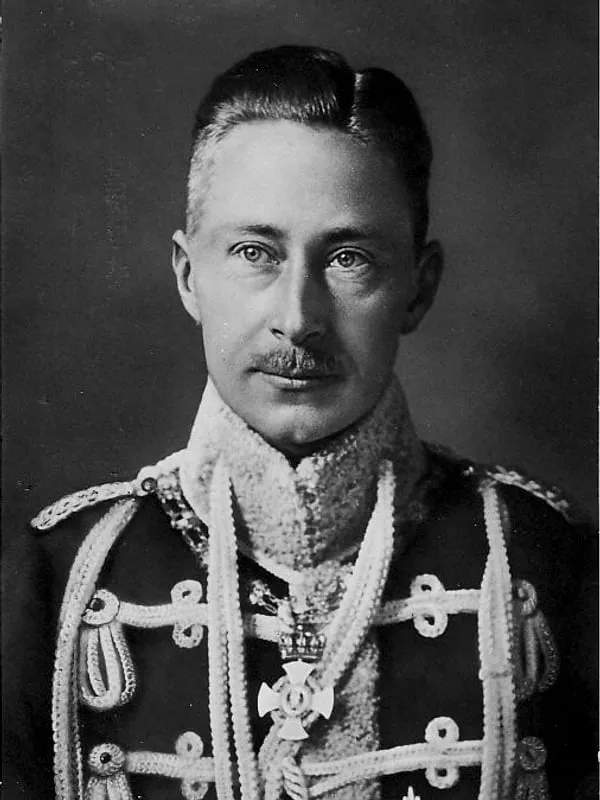
- Born:
- 6 May 1882, Potsdam (Germany)
- Died:
- 20 July 1951, Hechingen (Germany)
- Author:
- Natalia
- Photo:
- E. Bieber, domena publiczna, Wikimedia Commons

Wilhelm, the last crown prince of the German Empire and the Kingdom of Prussia, was throughout the war one of the best-known German commanders, although he almost never truly commanded. In August 1914, as a 32-year-old officer who had never commanded anything larger than a regiment, he was given the 5th Army. It was in fact run by his chief of staff, and his father, Emperor Wilhelm II, told him to follow his advice. In 1916 the crown prince’s army conducted the German offensive at Verdun, and for the French and British the “Kronprinz” became the face of that battle. From the autumn of 1916 to the end of the war he commanded an army group in the central part of the Western Front, which in 1917 repulsed the Nivelle offensive and in 1918 conducted several great offensives. In politics he sided with the generals against the chancellor, and after the war, in exile and after his return home, he fought the republic and helped Hitler on his road to power.
Before the war
Friedrich Wilhelm Victor August Ernst was born on 6 May 1882 in the Marble Palace in Potsdam, the eldest son of the then Prince Wilhelm of Prussia and Augusta Victoria. When his father ascended the throne in 1888, the “Year of the Three Emperors”, the six-year-old Wilhelm became crown prince. He was brought up by military tutors and finished secondary school with his brothers at Plön in Schleswig-Holstein. From 1901 to 1903 he studied law and political science at Bonn. In 1905 he married Duchess Cecilie of Mecklenburg-Schwerin. They had six children, but because of Wilhelm’s numerous affairs the marriage was unhappy.
The crown prince was athletic, an excellent horseman, fond of society and regarded as a playboy. At the same time he held distinct political views, more extreme than his father’s. He publicly displayed his support for the nationalists, in 1911 applauded in the Reichstag the critics of the government’s policy on Morocco, and in 1913 sought contact with the Pan-German League. From 1911 he commanded the 1st Life Hussars Regiment at Langfuhr near Danzig (today Wrzeszcz). At the end of 1913, during the affair in the Alsatian town of Zabern, where officers insulted the population and unlawfully detained civilians, he sent them a telegram of encouragement: “Immer feste druff!” (“Keep hitting them hard!”). He was recalled to the Great General Staff in Berlin, where General Konstantin Schmidt von Knobelsdorf taught him the principles of strategy.
1914–1915: the 5th Army
In August 1914 Wilhelm took over the 5th Army, deployed opposite Luxembourg and Lorraine. His chief of staff was Knobelsdorf, and the emperor is said to have told him: “Whatever he advises you, you must do.” In the Battle of the Ardennes, part of the Battle of the Frontiers, the 5th Army threw back the French 3rd Army at Longwy and Virton and then advanced towards the Meuse and Verdun. During the Battle of the Marne it attacked west of Verdun, around Revigny, but did not encircle the fortress, and after the retreat of the right wing of the German armies it had to fall back. Until the end of 1915 the 5th Army held the front in the Argonne and around Verdun. There the crown prince favoured new methods of fighting: he supported the first flamethrower units, which went into action in February 1915 at Malancourt in his army’s sector.
In October 1914 Wilhelm gave an interview to the American correspondent Karl von Wiegand in which he called the war “the most stupid, senseless and unnecessary war of modern times”, while insisting that it had been forced on Germany. In January 1915 he was promoted to lieutenant-general, and in August that year he received the Pour le Mérite.
Verdun
In December 1915 the Chief of the General Staff, Erich von Falkenhayn, decided to strike at Verdun and entrusted the offensive to the 5th Army. Wilhelm’s staff wanted to attack on both banks of the Meuse at once, but Falkenhayn limited the attack to the right bank and held back some of the reserves. On 21 February 1916 the battle began. That day the crown prince issued an order of the day in which he wrote that the fatherland expected “great things” of the soldiers. After the first successes, including Fort Douaumont, the offensive stalled; it was extended to the left bank of the Meuse and over the following months swallowed ever more German divisions. In June, after the capture of Fort Vaux, Wilhelm received its defender, Major Sylvain-Eugène Raynal, at his headquarters, praised the defence and presented him with an officer’s sword.
The crown prince’s role in conducting the battle is disputed. In his memoirs, published in 1923, Wilhelm claimed that from the spring he had considered further attacks pointless and wanted to break them off, but that Knobelsdorf persuaded Falkenhayn to keep attacking. Historians accept that it was the chief of staff who argued longest for continuing the battle, but they also point out that the crown prince’s memoirs were meant to clear him of responsibility for the slaughter. What is certain is that in August 1916 Wilhelm secured Knobelsdorf’s removal, and that the new supreme command, Paul von Hindenburg and Erich Ludendorff, halted the attacks at the beginning of September. In the autumn the French retook the forts and pushed the Germans back from the city. After the December defeat Wilhelm recalled: “For the first time I understood what it means to lose a battle.” At Verdun he also lost some of his popularity. In the Entente countries, and in time in Germany too, he acquired the reputation of a reckless prince who sent soldiers to their deaths.
The army group and politics
On 26 November 1916, in a reorganisation of the Western Front, Wilhelm gave up the 5th Army and took over Army Group “German Crown Prince” (Heeresgruppe Deutscher Kronprinz), which held the central sector of the front from around Noyon to Verdun. Its chief of staff, and in practice its commander, was from then on General Friedrich von der Schulenburg. In January 1917 the crown prince became a general of infantry. In the spring of 1917 his troops, forewarned of the French plans, repulsed the Nivelle offensive on the Chemin des Dames. In his memoirs he wrote of the soldiers’ admiration for the fruitless, heroic attacks in which the best French regiments perished. In the autumn, after the defeat at La Malmaison, his command agreed to withdraw the troops from the Chemin des Dames ridge.
He became increasingly involved in politics. He sided with Hindenburg and Ludendorff in their conflict with Chancellor Theobald von Bethmann Hollweg, to whom he had long been hostile. On 12 July 1917 he received six Reichstag deputies one after another and asked them whether the chancellor should stay. Most answered that he should not, and the next day Bethmann resigned. According to German biographers, the crown prince called that day the finest of his life. He also backed the generals in their struggle against his father’s civilian advisers, thereby weakening the position of the emperor himself.
1918
Wilhelm’s army group played a large part in the spring offensive of 1918. At the start of Operation Michael General Oskar von Hutier’s 18th Army was transferred to it, which, according to the British official history, made it possible to call the decisive battle the “Emperor’s Battle” (Kaiserschlacht) and to give the emperor’s son a share in the victory. On 27 May its 7th Army broke through the French front on the Aisne and reached the Marne, in June the 18th Army attacked on the Matz, and on 15 July three of Wilhelm’s armies struck on both sides of Reims in Germany’s last great offensive. The attack collapsed, and three days later a French counter-offensive forced his troops to retreat behind the Marne. On 14 August the crown prince took part in the conference at Spa, at which Germany’s leaders admitted that the war could no longer be won. In his memoirs he claimed that from the summer he had pressed for peace negotiations to begin. In the autumn, however, he opposed the parliamentarisation of the Reich.
In November 1918, when the revolution broke out, the soldiers of his guard mutinied. Wilhelm wanted to lead his army group home, but the new government refused, took away his command, and Hindenburg advised him to follow his father’s example. On 12 November, two days after the emperor, he crossed the Dutch border. The Dutch interned him on the island of Wieringen, where on 1 December he signed a renunciation of his rights to the throne.
After the war
The Allies put Wilhelm on the list of people whose extradition as war criminals they demanded from Germany, but he was never tried. In November 1923, thanks to Chancellor Gustav Stresemann and on his word of honour that he would not meddle in politics, he returned to Germany, to the family castle at Oels in Silesia. He did not keep his word. He appeared at rallies of the nationalist veterans’ organisation Stahlhelm, was fascinated by Mussolini and maintained close relations with General Kurt von Schleicher. In 1932 he intended to run for President of the Reich, but his father forbade it. In the second round he publicly endorsed Hitler, and in January 1933, according to historians’ research, he lobbied Hindenburg to entrust Hitler with the chancellorship. In March 1933 he appeared at the “Day of Potsdam”, and later defended the new regime in letters to friends abroad. When Schleicher was killed in the Night of the Long Knives, he did not protest. Hitler, however, had no intention of restoring the monarchy, and Wilhelm gradually lost his importance. After his father’s death in 1941 he became head of the House of Hohenzollern. In 1945 French soldiers took him prisoner in Vorarlberg. He spent his last years in Hechingen, where he died of a heart attack on 20 July 1951, three days before the death of his adversary from Verdun, Marshal Philippe Pétain. He was buried at Hohenzollern Castle.
Assessment
As a commander the crown prince was above all a figurehead. Operational decisions were taken by his chiefs of staff, Knobelsdorf and Schulenburg, and by the supreme command, and historians generally credit him with neither great successes nor great defeats. Some of them note that as an army group commander he behaved more sensibly than in peacetime and judged Germany’s position in 1918 accurately. His political influence mattered most: during the war he strengthened the generals against the government, and after the war he discredited the republic. His role in 1932–1933 became the subject of fierce controversy in the 21st century, because the Hohenzollern family’s property claims against the state depended on how it was judged. The historians Stephan Malinowski and Peter Brandt concluded that the former crown prince had contributed substantially to the establishment of the Nazi dictatorship. Christopher Clark, in an opinion commissioned by the family, saw him as an insignificant figure, although he later partly revised that view. The dispute does not undo agreement on one point: Wilhelm, who was meant to become emperor, showed neither during the war nor after it the abilities that role demanded.
Sources
Spotted a mistake?Report an error
Commanded in battles
(18)- 7–25 August 1914Battle of the FrontiersWestern Front
- 21–24 August 1914Battle of the ArdennesWestern Front
- 25–28 August 1914Battle of the MeuseWestern Front
- 21 February – 18 December 1916Battle of VerdunWestern Front
- 24 October – 18 December 1916First Offensive Battle of VerdunWestern Front
- 16 April – 9 May 1917Second Battle of the AisneWestern Front
- 16 April – 9 May 1917Nivelle OffensiveWestern Front
- 17 April – 20 May 1917Third Battle of ChampagneWestern Front
- 23 October – 1 November 1917Battle of La MalmaisonWestern Front
- 21 March – 5 April 1918Operation MichaelWestern Front
- 25–26 March 1918Battle of NoyonWestern Front
- 27 May – 6 June 1918Third Battle of the AisneWestern Front
- 1–26 June 1918Battle of Belleau WoodWestern Front
- 9–14 June 1918Battle of the MatzWestern Front
- 15 July – 6 August 1918Second Battle of the MarneWestern Front
- 23 July – 2 August 1918Battle of the Soissonnais and of the OurcqWestern Front
- 8 August – 11 November 1918Hundred Days OffensiveWestern Front
- 26 September – 11 November 1918Meuse–Argonne offensiveWestern Front
Mentioned in battles
(03)Often appears with
People who appear in the same events.