1918: The German Spring Offensive
Third Battle of the Aisne
- Dates:
- 27 May – 6 June 1918
- Front:
- Western Front
- Location:
- The Chemin des Dames ridge between the Ailette valley and the Aisne, from near Soissons to Craonne and Berry-au-Bac, and beyond it the country between the Aisne, the Vesle and the Marne as far as Château-Thierry and Dormans (Aisne and Marne departments, France)On the battle map →
- Sides:
- France, United Kingdom and United StatesFerdinand Foch, Philippe Pétain, Louis Franchet d'Espèrey, Denis Duchêne, Alexander Hamilton-GordonGerman EmpireErich Ludendorff, Crown Prince Wilhelm, Max von Boehn, Fritz von Below
- Result:
- German tactical victory. The Germans took the Chemin des Dames ridge in a few hours, crossed the Aisne and the Vesle, took Soissons and reached the Marne, advancing about 50–60 km, but failed to break the shoulders of the breach at Soissons and Reims. Instead of drawing the Allied reserves away from Flanders, they were stuck in a deep salient that was hard to supply. Each side lost about 130,000 men.
- Author:
- Łukasz Skowroń
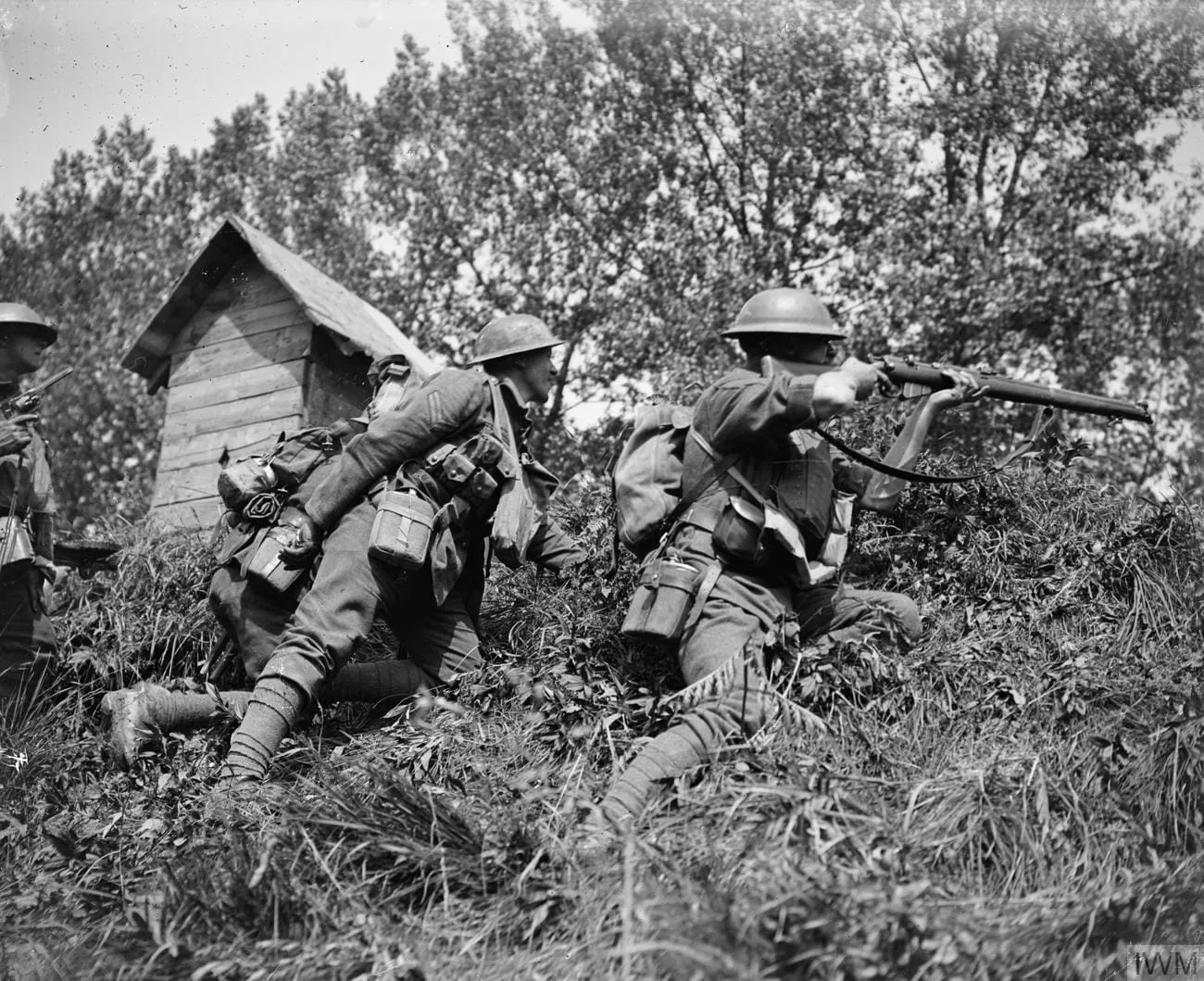
The Third Battle of the Aisne was the third of the great German offensives of spring 1918 and the one that took the Allies most by surprise. After the Battle of the Lys had stalled in April, Erich Ludendorff decided to strike the French on the Chemin des Dames ridge above the river Aisne, in a sector regarded as one of the quietest on the Western Front. It was meant as a subsidiary attack: the aim was to draw French reserves here from Flanders and then deal the British a decisive blow. At one in the morning on 27 May 1918 more than a thousand German batteries opened fire on General Denis Duchêne’s French Sixth Army and on four exhausted divisions of the British IX Corps, which had been sent here to rest. Before noon the Germans had the whole ridge behind them and were crossing the Aisne by undamaged bridges, and by evening they stood on the Vesle, about 20 kilometres from where they had started. Within four days they took Soissons and Fère-en-Tardenois, and on 30 May they reached the Marne, where they had not been since September 1914. Paris was less than 90 kilometres from the front. Success, however, outran the Germans’ plans and means. The shoulders of the breach at Soissons and Reims held, French reserves and the first American divisions barred the road to Paris, and on 6 June the battle died down.
Name and dates
The name “Third Battle of the Aisne” refers to the First Battle of the Aisne of September 1914 and to the Second Battle of the Aisne, that is the Nivelle Offensive of spring 1917, both fought on the same heights. This is the name used by French historiography and by the Polish Wikipedia. The British Battles Nomenclature Committee called it the “Battle of the Aisne 1918” and dated it 27 May – 6 June 1918. The Germans prepared it under the codename “Blücher”, with an accompanying attack by the right wing of the 1st Army called “Goerz”, and the further blow extended to the west was named “Yorck”. Hence the name “Blücher-Yorck”, after two Prussian commanders of the Napoleonic Wars, is often found in the literature. In Germany it was also called the Battle of Soissons and Reims. We give the dates of the British committee; some accounts end the battle on 4 June, when the Germans decided to halt the attack. Facts and times are taken from the British official history (James Edmonds, Military Operations France and Belgium 1918, volume III, 1939), which also summarises at length the German monograph on the battle and the French official history. Times are Allied time, one hour earlier than German time.
Background
On 17 April 1918, while the Battle of the Lys was still going on in Flanders, Ludendorff ordered the army group of Crown Prince Wilhelm to prepare an attack on the Chemin des Dames. He hoped to find a weak spot in the French front there and to force the French to move their reserves away from Flanders. The order of the Supreme Army Command of 1 May stated plainly that the aim was to “loosen” the solid Entente front facing Rupprecht’s army group, so that the offensive against the British could then be successfully resumed under the codename “Hagen”. The original objective was the line of the Aisne, that is the capture of the ridge itself. In May, as prospects looked ever better, it was moved forward to the heights between the Aisne and the Vesle, and finally to a few kilometres beyond the Vesle. The attack was entrusted to General Max von Boehn’s 7th Army and to the right wing of General Fritz von Below’s 1st Army. The date, provisionally set for 20 May, was put back to the end of the month, because moving the artillery and accumulating ammunition took time.
The preparations were a masterpiece of concealment. The Germans brought about thirty additional divisions and more than a thousand batteries to the Aisne, and yet the French noticed nothing. The batteries arrived between 14 and 23 May, only at night, with their wheels muffled, and their tracks across the fields were ploughed over. The guns were not allowed to register on their targets; each could fire only a single trial round. The infantry marched by night, without singing or music, and entered its jumping-off positions only in the last nights before the attack. Aircraft checked from the air whether anything gave the preparations away: too many grazing horses, too much smoke, dust behind lorries. At the same time, opposite the British in Flanders and on the Somme, the Germans lit extra fires, moved units about and increased signals traffic, to focus the enemy’s attention there. The artillery fire was again planned by Lieutenant-Colonel Georg Bruchmüller, the author of the bombardment of 21 March.
On the Allied side the Aisne sector was considered quiet. When General Ferdinand Foch, since April commander-in-chief of the Allied armies in France, wanted to create a general reserve, he proposed exchanging tired British divisions for fresh French ones from quiet stretches of the front. Douglas Haig agreed to send only a few. On 23 April it was decided that four divisions under General Alexander Hamilton-Gordon’s IX Corps, bled white in the March and April battles and refilled largely with half-trained recruits, would go to the French Sixth Army on the Aisne, and a fifth, the 19th Division, to the Fourth Army near Châlons. The British staff suspected that Ludendorff might strike precisely here, but on 3 May General Maxime Weygand, Foch’s chief of staff, gave assurances that the sector was suitable and quiet. Between 6 and 17 May the 50th, 8th and 21st Divisions took over from the French the sector from near Brimont, north-west of Reims, through Berry-au-Bac to the Californie plateau above Craonne, the eastern end of the Chemin des Dames. The 25th Division remained in army reserve. The French officer who handed the positions over to the British is said to have told them: “You are like rats in a trap. If you keep quiet, all may yet end well.”
Defence in the front line
The Chemin des Dames ridge, taken by the French in 1917 at enormous cost in the Nivelle Offensive and in the Battle of La Malmaison, was narrow, in places only a few hundred metres wide, and its northern slopes fell steeply to the marshy valley of the river Ailette. Anyone who knew the ground knew that the ridge itself could not be held against a strong attack preceded by heavy bombardment. The commander-in-chief of the French armies, General Philippe Pétain, in his directive of December 1917 ordered the first line to be held with weak forces and the main battle to be fought on a position further back, out of range of the German artillery. The commander of the Northern Army Group, General Louis Franchet d’Espèrey, designated this position south of the Aisne.
Duchêne objected. He held that in the sector directly covering Paris not a scrap of ground could be given up voluntarily, that the position was strong, and that the loss of the ridge won in 1917 would have a bad effect on public opinion and on the morale of the army. He ordered the first line to be defended to the end and crowded most of his infantry and artillery into it, with a large part of the batteries north of the Aisne. Pétain, unwilling to remove an army commander, reluctantly gave way. The British divisional sectors were wide, 7–9 kilometres each, and the 50th Division on the Californie plateau had to squeeze three lines of trenches into a strip less than half a kilometre deep. Hamilton-Gordon protested that his weak, unrested divisions had sectors that were too wide and that this method of defence was wrong. At a conference on 24 May Duchêne cut the discussion short with the words: “I have spoken.”
There was no lack of warnings. For several days soldiers in the front line had heard columns marching and wagons rumbling at night, and on 22, 23 and 24 May airmen of IX Corps saw clouds of dust on the roads leading towards the Chemin des Dames. Franchet d’Espèrey, however, gave assurances that an attack would certainly not come at once. Only around noon on 26 May did two prisoners taken by the French XI Corps state that a great attack would begin the following night or the night after, after a two-and-a-half-hour bombardment. Duchêne raised the alarm between 4.20 and 4.30 p.m. It was too late to move the batteries, and no one suspected that about 20 German divisions were waiting between Berry-au-Bac and Soissons.
Course of the battle
27 May. At one in the morning the German artillery opened fire on a front of about 38 kilometres, and to mislead the enemy the bombardment covered even wider sectors on both sides. According to the British official history, 855 batteries fired on the 24 miles of the attack front, and as many as 466 on the sector of the British 50th Division and the French 22nd Division in the centre. The whole French Sixth Army had 266. For the first ten minutes all the guns and trench mortars fired gas shells, forcing everyone, right back to divisional headquarters, to put on masks. Then for more than an hour they pounded the Allied batteries, and after that they smashed trenches, bridges, crossroads and command posts all the way back to the Vesle. The British, who had lived through the bombardments of March and April, judged this one the heaviest. At 3.40 a.m., in darkness and in mist thickened by smoke, the German infantry went in to the assault. Against six Allied divisions in the first line and four in reserve the Germans threw seventeen divisions in the first wave and six in the second.
The heaviest blow fell on the French 22nd Division in the central sector of the ridge. By 5.30 the Germans had taken the Chemin des Dames there, and at about 10 they crossed the Aisne at Œuilly. The order to blow the bridges reached the troops too late, and most of the crossings between Vailly and Maizy fell into German hands intact. The British 50th Division on the Californie plateau was attacked from the front and from the west, from the French sector. Craonne fell as early as about 5.10, and by 8 a.m. the 150th Brigade had ceased to exist and its commander, General Hubert Rees, had been taken prisoner. To its right the 8th Division held out in the woods near Ville-aux-Bois. The 2nd Battalion of the Devonshire Regiment, surrounded on the Bois des Buttes hill, fought for almost three hours, until its commanding officer and almost all its men had been killed; the French later decorated the battalion with the Croix de Guerre. The German monograph admits that British resistance in this sector delayed the attack. At about 8 the Germans were at Pontavert on the Aisne, and the artillery of the 50th and 8th Divisions, placed north of the river, was mostly destroyed or captured.
In the afternoon the Germans crossed the Aisne along the whole width of the breach and in the centre took the second position on its southern bank before French reserves could man it. The 25th Division and the remnants of the shattered British divisions held on until evening on the heights near Roucy, and the 21st Division on the right wing swung back its front near Cormicy. In the centre the Germans reached the Vesle in the evening, and one battalion of the German 33rd Division crossed it during the night on felled trees. That day the German long-range gun near Laon resumed the shelling of Paris.
28–29 May. The Germans crossed the Vesle on a broad front and took Fismes. On the evening of 28 May their leading troops entered Soissons, but the corps ordered them to withdraw. Officially this was for fear of French reserves; according to the German monograph it was rather for fear that the soldiers would fall upon the stocks of food and alcohol gathered in the town. Soissons was finally taken the following day. In the fighting on the western wing the commander of the French 151st Division, General Pierre des Vallières, was killed. Duchêne threw the arriving reserves in frontally, division after division, and they melted away before they could dig in. On 29 May, according to the British official history, the Germans took Fère-en-Tardenois, abandoned by the French and the main supply centre of the Sixth Army, and crossed the upper course of the Ourcq. By evening they stood only a few kilometres from the Marne. After three days German reports spoke of more than 35,000 prisoners.
30–31 May. On the morning of 30 May the German divisions of the centre pushed the last French units back across the Marne. In the afternoon the first units stood on the river between Jaulgonne and Dormans, on a front of about 10 kilometres. The bridges had been blown, and the 7th Army command forbade any further advance and ordered only that crossings be seized; during the night one battalion crossed at Jaulgonne and formed a small bridgehead. On 31 May the Germans reached the eastern edge of Château-Thierry. The bridges in the town were defended that day and the next by French colonial troops, supported by the 7th Machine Gun Battalion of the American 3rd Infantry Division, which had come by lorry straight from a training camp. Only now did the French command accept that the Germans might be heading for Paris. The roads south of the Marne were choked with refugees, and in Paris, as General Henri Mordacq, head of the prime minister’s military cabinet, wrote, politicians demanded the heads of Duchêne and above all of Pétain. Prime Minister Georges Clemenceau is said to have told him in those days that the Germans might take Paris, but he would fight on the Loire, on the Garonne, in the Pyrenees and finally at sea, and would never make peace.
1–6 June. The attack was losing strength. On 1 June the Germans, throwing fresh divisions into the fight, advanced a few more kilometres between Château-Thierry and the forests of Villers-Cotterêts, and French sappers blew the main bridge at Château-Thierry. The shoulders of the breach, however, did not move. West and south-west of Soissons the French held their positions, and the attempt by the German 1st Army to encircle Reims, supported by fifteen tanks near Fort de la Pompelle, ended in failure. On the road from Château-Thierry to Paris the American 2nd Infantry Division, with its Marine brigade, took up positions. On 3 June the French eliminated the bridgehead at Jaulgonne. The German divisions were exhausted, artillery and supplies could not keep up, and the whole salient was supplied by a single railway line through Soissons, which lay under French fire. On 4 June, on the advice of the Supreme Army Command, Boehn decided to halt the attack. On 6 June the British repulsed the last German attack on the hill near Bligny on the right wing, and the Americans of the 2nd Division attacked Bouresches and Belleau Wood, opening the Battle of Belleau Wood, which lasted until the end of June.
Losses
According to the British official history, IX Corps and the 19th Division lost 1,298 officers and 27,405 other ranks between 27 May and 19 June, in all almost 29,000 men. The 8th and 50th Divisions suffered most, each losing more than 7,500 men. The French official history gives French losses for 27 May – 6 June of about 98,000 men. The German monograph estimates total Allied losses up to 18 June at more than 170,000 men, including 60,000 prisoners, and the Germans claimed to have captured 850 guns. The same monograph puts German losses at about 130,000 men. Edmonds notes that the German figures do not include the lightly wounded, so the losses of the two sides were probably similar. The monograph adds that, unlike the Allies, the Germans no longer had anything with which to replace their dead.
Significance
27 May was one of the greatest successes of the German army on the Western Front. In a single day it crossed three rivers and shattered four front-line divisions and several reserve ones, and within a few days it advanced further than any army on that front since 1914. The British official history sees the causes of the defeat in surprise, in the enormous superiority of artillery and in the defence of the first line, which Duchêne had imposed against Pétain’s directives. Had the bridges on the Aisne been blown, the Germans would have had to wait for their artillery, and the Allies would have gained time to bring up reserves. Duchêne lost command of the Sixth Army, which General Jean Degoutte took over around 10 June. For the British it was the third defeat in a row in two months, suffered by the same divisions.
Victory, however, proved a trap for the Germans. An attack conceived as a diversion turned into a deep, cramped salient between Soissons and Reims, hard to supply and to defend, and Ludendorff used up in it the divisions prepared for the decisive blow in Flanders, which had to be postponed for several weeks. The battle brought American troops into action on a large scale for the first time, and their conduct at Château-Thierry and in Belleau Wood convinced the French that the Americans were now a real force. On 9 June the Germans struck once more between Noyon and Montdidier to widen the salient, and in July the battle began on the Marne that turned the tide of the war in the west.
Spotted a mistake?Report an error
On the timeline
(06)1918
May
- 27
- Key eventThird Battle of the Aisne beginsOn 27 May 1918, after a bombardment by over 1,000 batteries, the Germans took the Chemin des Dames, broke British IX Corps and crossed the Aisne to the Vesle.
- Germans retake CraonneAt dawn on 27 May 1918 the Germans took the Californie plateau and the ruins of Craonne, held by the British. The Allies had held the village since May 1917.
- 29
- Germans retake SoissonsOn 29 May 1918 the Germans took Soissons on the Aisne. Their troops had entered it the evening before but were pulled back. The occupation lasted until August.
- Germans take Fère-en-TardenoisOn 29 May 1918 the Germans took Fère-en-Tardenois, a railway junction and supply centre of the French Sixth Army. Clemenceau nearly fell into their hands there.