France · The Entente
Ferdinand Foch
Supreme Commander of the Allied Armies on the Western Front (1918), Marshal of France
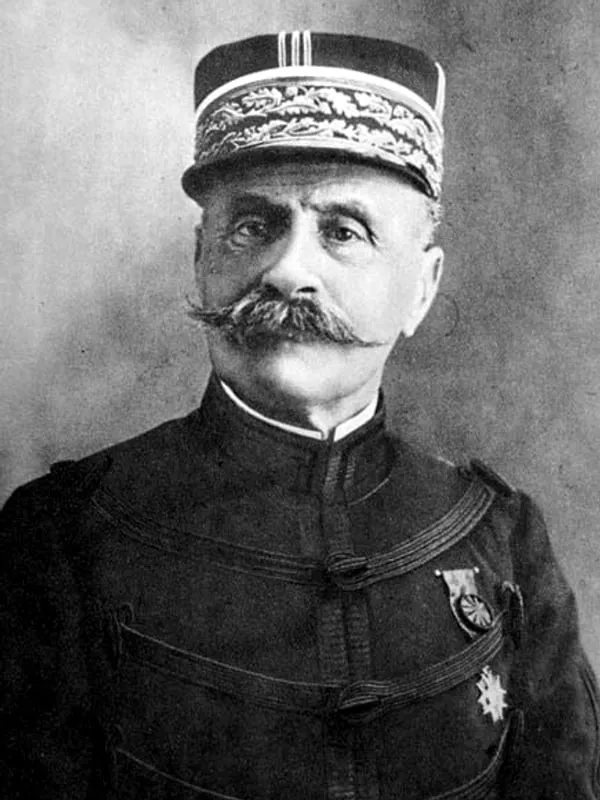
- Born:
- 2 October 1851, Tarbes (France)
- Died:
- 20 March 1929, Paris
- Author:
- Natalia
- Photo:
- Åhlen & Åkerlund, Stockholm 1915, domena publiczna, Wikimedia Commons

Ferdinand Foch is the only commander of this war who in its last year directed the armies of several states at once. Before 1914 he was the best-known French military theorist and the teacher of a generation of officers. In the first months of the war he commanded a corps in Lorraine and an army on the Marne, and then coordinated the defence of Flanders. In 1915–1916 he conducted bloody and largely fruitless offensives in Artois and on the Somme, for which he paid with removal from command. In the spring of 1918, at the moment of greatest danger, the Allies entrusted him with the joint direction of the armies on the Western Front. He halted the last German offensives, went over to the counter-offensive and in November, in his railway carriage in the forest of Compiègne, dictated the armistice terms to the Germans. He was a Marshal of France, a British Field Marshal and a Marshal of Poland.
Before the war
He was born on 2 October 1851 in Tarbes at the foot of the Pyrenees, into the devout Catholic family of a civil servant. He was educated at Jesuit colleges, the last of them in Metz. In 1870 he enlisted as a volunteer in the infantry, but his regiment took no part in the fighting of the Franco-Prussian War. After the defeat he entered the École Polytechnique, became an artillery officer and in 1885 a student at the Higher War College (École supérieure de guerre).
From 1895 to 1901 he taught military history, strategy and tactics at that college. His lectures, published as Des principes de la guerre (1903) and De la conduite de la guerre (1904), revived French military thought’s interest in Napoleon and Clausewitz. Foch taught that war is won by the will to victory, and that defence can only be a prelude to attack. His pupils and successors simplified these views into the doctrine of the offensive at all costs (offensive à outrance), although Foch himself warned against reckless attack. The career of a Catholic whose brother was a Jesuit was not easy in the anticlerical Third Republic, and during the Affaire des Fiches his name appeared in the card files. Nevertheless in 1907 he became a brigadier general and soon afterwards commandant of the War College, which he headed until 1911. According to a well-known anecdote, Prime Minister Georges Clemenceau appointed him to the post regardless of his Jesuit brother. In 1913 he took over the elite XX Corps at Nancy, which covered the border with Germany.
1914: Lorraine, the Marne and Flanders
In August 1914 XX Corps fought as part of General Noël de Castelnau’s Second Army in the Lorraine offensive. On 20 August, when the Germans went over to the counter-attack, Foch himself attacked near Morhange and his corps suffered heavy losses. To this day it is disputed whether he acted against Castelnau’s intentions and how far he contributed to the defeat. A few days later his troops counter-attacked on the Mortagne and helped to halt the German pursuit. On 22 August, the bloodiest day of the war for the French, his only son Germain and his son-in-law, Captain Paul Bécourt, were killed in the Battle of the Frontiers. Foch learned of it only during the Battle of the Marne.
On 29 August the commander-in-chief, General Joseph Joffre, entrusted him with a detachment formed from neighbouring armies, which at the beginning of September was renamed the Ninth Army. Lieutenant Colonel Maxime Weygand then became Foch’s chief of staff and was to stay with him until the end of the war. In the Battle of the Marne the Ninth Army held the centre of the front on the edge of the marshes of Saint-Gond. Attacked by the troops of Karl von Bülow and the Saxon Third Army, it fell back but did not break, while Foch shifted his reserves and counter-attacked without pause. The famous sentence that his centre was giving way, his right was retreating, the situation was excellent, and so he was attacking, is more a later legend than a genuine report, but it captures his attitude well. On 12 September his troops entered Châlons.
On 4 October Joffre made him his deputy and sent him north to coordinate the operations of the French armies and cooperation with the Allies in the Race to the Sea. Formally he had no authority over the British or the Belgians, but Field Marshal John French and King Albert I generally accepted his proposals. In the First Battle of Ypres and on the Yser he moved French reinforcements to wherever the front was most threatened and would not hear of retreat. French then called him the best general in the world. That autumn taught Foch how to command a coalition, although in the first weeks his plans for an advance on Ghent and Roeselare rested on a mistaken belief in German weakness.
Artois and the Somme
At the beginning of 1915 Foch’s command was turned into Army Group North. Foch prepared and conducted two great offensives in Artois, in May and June and in the autumn. On 9 May French infantry reached Vimy Ridge, but the reserves were too far back to exploit the success, and then for weeks the fighting was over individual villages. In the autumn Foch called for a strategic breakthrough, but Joffre allotted ammunition and reserves above all to Champagne. Both battles cost tens of thousands of dead and brought no breakthrough.
In 1916 Army Group North conducted the French part of the Battle of the Somme. Together with Joffre, Foch had earlier persuaded Haig that the front could be broken by a swift blow. On 1 July the French Sixth Army of General Marie Émile Fayolle, better supplied with heavy artillery, achieved more than the British, but in the following months the battle turned into a war of attrition. In December, when the government was changing the high command, he lost command of the army group. Officially his health was given as the reason, and by way of consolation he received the Médaille militaire.
1917: chief of staff
He was moved to study work, but the new Minister of War, General Hubert Lyautey, soon found him a more important task. From January to March 1917 Foch temporarily commanded Army Group East in place of Castelnau, who had gone to Russia, and drew up a plan in case the Germans tried to outflank the front through Switzerland. In April he held talks in Italy about possible French assistance. After the failure of General Robert Nivelle’s offensive, in May the government put Philippe Pétain at the head of the army, and Foch became Chief of the General Staff and adviser to the government. Like Pétain, he believed that until the Americans arrived only attacks with limited objectives should be made. According to Henry Wilson, he called the British offensive in Flanders futile and dangerous.
After the Italian defeat at Caporetto, Foch went to Italy at the end of October and helped to organise French and British assistance. At the Rapallo Conference the Supreme War Council was set up, and Foch was to be the French military representative on it, but Clemenceau sent Weygand there and kept Foch at his side. In February 1918 he became head of a committee that was to create a general Allied reserve. The reserve never came into being, because the commanders-in-chief, Douglas Haig and Pétain, would not give him any divisions.
1918: Allied commander
On 21 March 1918 the Germans struck on the Somme and broke through the front of the British Fifth Army. Haig and Pétain thought above all of their own tasks, and a gap threatened to open between the armies. On 26 March, at the Doullens Conference, the French and British governments entrusted Foch with coordinating the operations of the Allied armies on the Western Front. He won the politicians over with his resolve: they must fight in front of Amiens, where the troops stood, and not retreat another step. On 3 April at Beauvais he was given strategic direction of operations, and on 14 April the title of Commander-in-Chief of the Allied Armies in France. He could not appoint or dismiss foreign generals, and each commander-in-chief could appeal to his own government. His authority rested on trust and on the French reserves.
He showed at once that he did not mean to hand out reserves to everyone who asked for them. During the Battle of the Lys he refused to relieve Haig’s exhausted divisions and husbanded his forces for a future counter-offensive. The British official history admits that this decision cost the British many lives, but admires his judgement and his resistance to pressure. Things went worse on 27 May, when the Germans unexpectedly broke through on the Aisne and reached the Marne. Foch regarded the attack as a diversion from Flanders. In Paris there were calls for the commanders to be dismissed, and Clemenceau had to defend Foch and Pétain in parliament.
The turn came in July. Foch brought British divisions to the Marne and would not let Pétain postpone the prepared counter-offensive. On 18 July Mangin’s army struck the flank of the German salient and in the Second Battle of the Marne the Germans were forced to withdraw. On 24 July, at his headquarters at Bombon, Foch presented the commanders-in-chief with a memorandum in which he announced that the time had come to go over to the offensive. On 6 August he was made a Marshal of France, and two days later the British and French struck at Amiens. From then on Foch gave the Germans no respite. Instead of one great breakthrough he conducted a series of blows at different points of the front, broken off when they lost momentum and resumed elsewhere. At the end of September a general offensive began from the Meuse to the sea, with the Americans in the Argonne and the British on the Hindenburg Line. His watchword was: “Tout le monde à la bataille!” (“Everyone into battle!”).
The plans and decisions were not his alone. In August Haig, against Foch’s pressure, shifted the weight of the attack north of the Somme and was right to do so, while Pershing defended the independence of the American army. Foch, however, knew how to reconcile rival commanders and keep up the tempo. On 4 November his strategic authority was extended to all fronts of the war against Germany. On 8 November in the forest of Compiègne he received the German envoys, refused them a ceasefire and gave them 72 hours to accept the terms. In the early hours of 11 November he signed in his carriage the armistice, which deprived Germany of the ability to resume the war.
After the war
At the Paris Peace Conference Foch demanded that the left bank of the Rhine be separated from Germany and that the crossings over the river be permanently occupied. When Clemenceau agreed to a temporary occupation and American and British guarantees, he regarded it as a mistake. The sentence attributed to him, that the Treaty of Versailles was not a peace but an armistice for twenty years, is known mainly from later accounts, including Winston Churchill’s, but it captures his fears well. In 1919 he became a British Field Marshal and president of the French Supreme War Council (Conseil supérieur de la guerre).
He was a friend of the Polish cause. He supported the formation of General Haller’s army and its transfer to Poland, and in February 1919 at Trier, when the armistice was extended, he made the Germans halt the fighting against the Greater Poland insurgents. In 1921 Józef Piłsudski decorated him with his own Virtuti Militari cross, and on 13 April 1923 President Stanisław Wojciechowski made him a Marshal of Poland. He received the baton during a visit to Poland at the beginning of May. He died on 20 March 1929 in Paris and was laid to rest in the church of Les Invalides in Paris, where Napoleon also lies.
Assessment
Foch owes his fame above all to the last eight months of the war. The American historian Larry Addington considered that the strategy which won the war in the west in 1918 was largely Foch’s work. The British historian Elizabeth Greenhalgh, author of the most important modern biography, stresses that his greatest achievement was keeping the coalition united, managing the reserves skilfully and imposing on the enemy a relentless tempo of attacks. General Henry Rawlinson observed that the Foch of 1918 was a better commander than the Foch of 1916, because failures had cooled his ardour.
Critics point out that his pre-war teaching contributed to the cult of the offensive, which in August 1914 cost France hundreds of thousands of men, and that in 1915–1916 he conducted costly and fruitless attacks. In 1918 he did not foresee the blow on the Aisne, and British commanders felt that he often treated their army as a reserve for the French. Clemenceau, who chose him at Doullens, later wrote of him sardonically that he thought himself a Napoleon. Despite these disputes, few historians question that without his leadership the Allies would have found it harder to survive the spring of 1918 and then to win.
Sources
Spotted a mistake?Report an error
Commanded in battles
(36)- 6–12 September 1914First Battle of the MarneWestern Front
- 15 September – 19 October 1914Race to the SeaWestern Front
- 27 September – 12 October 1914First Battle of ArtoisWestern Front
- 12 October – 2 November 1914Battle of Messines (1914)Western Front
- 13 October – 2 November 1914Battle of ArmentièresWestern Front
- 19 October – 22 November 1914First Battle of YpresWestern Front
- 21–24 October 1914Battle of Langemarck (1914)Western Front
- 29–31 October 1914Battle of GheluveltWestern Front
- 11 November 1914Battle of Nonne BosschenWestern Front
- 22–23 April 1915Battle of Gravenstafel RidgeWestern Front
- 22 April – 25 May 1915Second Battle of YpresWestern Front
- 24 April – 4 May 1915Battle of St. JulienWestern Front
- 9 May – 18 June 1915Second Battle of ArtoisWestern Front
- 25 September – 15 October 1915Third Battle of ArtoisWestern Front
- 1 July – 18 November 1916Battle of the SommeWestern Front
- 1–13 July 1916Battle of Albert (1916)Western Front
- 25–28 September 1916Battle of MorvalWestern Front
- 1–18 October 1916Battle of the Transloy RidgesWestern Front
- 21 March – 5 April 1918Operation MichaelWestern Front
- 4 April 1918Battle of the AvreWestern Front
- 9–29 April 1918Battle of the LysWestern Front
- 17–19 April 1918First Battle of Kemmel RidgeWestern Front
- 25–26 April 1918Second Battle of Kemmel RidgeWestern Front
- 29 April 1918Battle of the ScherpenbergWestern Front
- 27 May – 6 June 1918Third Battle of the AisneWestern Front
- 9–14 June 1918Battle of the MatzWestern Front
- 15 July – 6 August 1918Second Battle of the MarneWestern Front
- 20–31 July 1918Battle of the TardenoisWestern Front
- 23 July – 2 August 1918Battle of the Soissonnais and of the OurcqWestern Front
- 8–11 August 1918Battle of AmiensWestern Front
- 8–15 August 1918Battle of MontdidierWestern Front
- 8 August – 11 November 1918Hundred Days OffensiveWestern Front
- 17–29 August 1918Second Battle of NoyonWestern Front
- 21 August – 3 September 1918Second Battle of the SommeWestern Front
- 12 September – 12 October 1918Battles of the Hindenburg LineWestern Front
- 26 September – 11 November 1918Meuse–Argonne offensiveWestern Front
Mentioned in battles
(36)- Battle of the Frontiers
- Battle of Lorraine
- Battle of the Mortagne
- Battle of the Meuse
- Battle of the Grand Couronné
- Battle of La Bassée
- Battle of Festubert
- Battle of Loos
- Battle of Bazentin Ridge
- Battle of Ginchy
- Battle of the Ancre Heights
- Nivelle Offensive
- Eleventh Battle of the Isonzo
- First Battle of Bapaume
- Battle of Noyon
- Battle of Rosières
- Battle of Estaires
- Battle of Messines (1918)
- Battle of Bailleul
- Battle of Villers-Bretonneux
- Battle of Belleau Wood
- Battle of Albert (1918)
- Battle of the Scarpe (1918)
- Second Battle of Bapaume
- Battle of the Drocourt–Quéant Line
- Battle of Havrincourt
- Battle of Saint-Mihiel
- Battle of the Canal du Nord
- Fifth Battle of Ypres
- Battle of the St Quentin Canal
- Battle of Cambrai
- Battle of Kortrijk
- Battle of the Selle
- Battle of Vittorio Veneto
- Battle of the Sambre
- Greater Poland uprising
Often appears with
People who appear in the same events.
On the timeline
(111)The 40 most important of 111 events. All tagged “Ferdinand Foch” (34) →
1914
August
- 25
- Key eventBattle of the Meuse beginsOn 25 August 1914 the French Fourth Army, pulled back from the Ardennes, took post behind the Meuse from Mézières to Stenay. The fight for the crossings began.
- Key eventBattle of the Mortagne beginsOn 25 August 1914 the armies of Castelnau and Dubail halted the German drive on the Trouée de Charmes in Lorraine and went over to a counter-offensive.
September
October
1915
1916
1917
1918
March
April
May
June
July
August
- 08
- Key eventBattle of Amiens beginsOn 8 August 1918, in fog, Canadians, Australians and tanks broke the front at Amiens, taking over 15,000 prisoners. Ludendorff called it the "black day".
- Key eventStart of the Battle of MontdidierOn 8 August 1918 Debeney's French First Army attacked alongside the British at Amiens. It took Moreuil and crossed the Avre, but did not reach Arvillers.
September
- 12
- Key eventStart of the Battle of Saint-MihielOn 12 September 1918 Pershing's American First Army attacked the German Saint-Mihiel salient. In the rain it got through the wire and advanced about 8 km.
- Key eventBattle of Havrincourt beginsOn 12 September 1918 Byng's Third Army took Havrincourt and Trescault in front of the Hindenburg Line, while New Zealanders fought the elite Jäger Division.