Germany · The Central Powers
Karl von Bülow
Commander of the German 2nd Army (1914–1915), field marshal
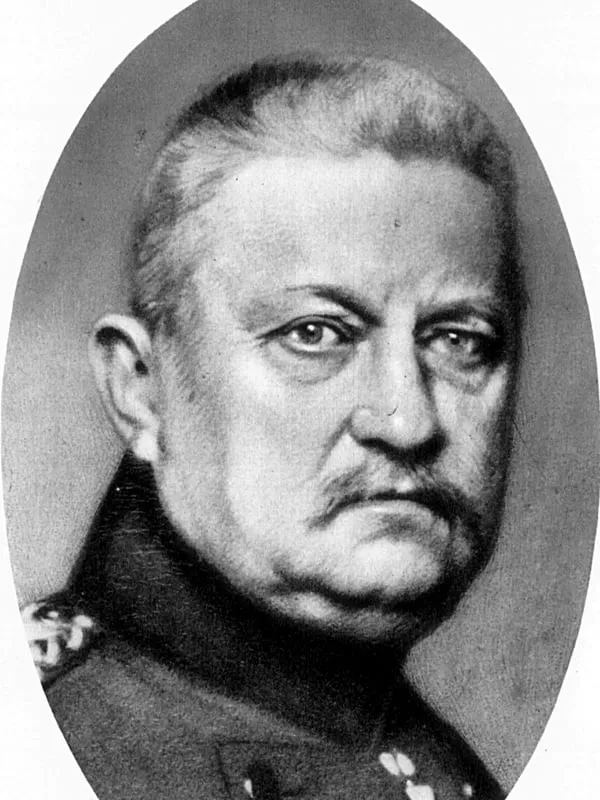
- Born:
- 24 March 1846, Berlin
- Died:
- 31 August 1921, Berlin
- Author:
- Łukasz Skowroń
- Photo:
- autor nieznany, domena publiczna, Wikimedia Commons

In 1914 Karl von Bülow commanded the German 2nd Army, which together with the 1st Army of Alexander von Kluck formed the striking right wing of the German forces in the west. His troops took Liège and Namur, defeated the French Fifth Army on the Sambre and at Guise, and in early September crossed the Marne. Yet it was Bülow who on 9 September, after a conversation with an envoy of the Supreme Army Command, was the first to order the retreat that ended the Battle of the Marne and wrecked the German plan for a quick victory. For years he was regarded as one of the main culprits of that defeat. Six months later a serious illness ended his career.
Before the war
He was born on 24 March 1846 in Berlin, into an old noble family from Mecklenburg with long military traditions. His grandfather was killed in 1813 at the Battle of Groß-Görschen. In 1864 he joined the 2nd Foot Guards Regiment and two years later fought the Austrians at Königgrätz. He also took part in the Franco-Prussian War, and from 1877 served on the Great General Staff. He commanded the 4th Foot Guards Regiment, headed the central department of the Prussian War Ministry and commanded the 2nd Guards Division.
From 1903 to 1912 he commanded III Corps in Berlin and Brandenburg. He became known then as an outstanding trainer of troops: on the training ground at Jüterbog he drilled his divisions with exceptional care, and his corps was considered one of the best trained in the army. In 1912 he became a colonel general and took over the III Army Inspectorate in Hanover, from which the 2nd Army was formed on mobilisation. In August 1914 he was 68 years old.
Liège and Namur
The 2nd Army assembled south of Aachen, and its first task was to open the road through Belgium. The fortress of Liège was attacked by a group of six brigades under General Otto von Emmich, detached from Bülow’s army. When the attack faltered, one of the 2nd Army’s staff officers, General Erich Ludendorff, took command of the brigade that entered the city on 7 August. After the last forts fell, the 2nd Army advanced through central Belgium alongside Kluck’s army.
The march through Belgium was stained by crimes against civilians. On 20 and 21 August units of the 2nd Army, convinced they were being fired on by partisans, killed more than 200 inhabitants of Andenne on the Meuse and set the town on fire, and on 22 August at Tamines on the Sambre they shot several hundred people. Bülow took personal responsibility for this. In a proclamation posted in Liège on 22 August he announced that Andenne had been burned and about a hundred people shot “with his consent”, and warned the inhabitants that the same fate awaited them if they behaved likewise. Witnesses from Andenne firmly denied that anyone there had attacked the Germans.
The 2nd Army’s heavy artillery took the fortress of Namur in a few days; it fell on 25 August. At the same time Bülow’s main forces crossed the Sambre between Namur and Charleroi and at the Battle of Charleroi, together with the 3rd Army of General Max von Hausen, forced the French Fifth Army of General Charles Lanrezac to retreat. For about ten days in the second half of August Bülow also commanded Kluck’s army. Worried about his own flank, he kept it close to himself, which in the view of many historians cost Kluck the chance to outflank the British at Mons. He had to leave part of the 2nd Army at Maubeuge, which it besieged from 25 August.
Guise
On 29 August Lanrezac, on Joffre’s orders, halted his retreat and struck at Guise. The Germans call this battle the Battle of Saint-Quentin. The French attack westwards stalled, but north of the Oise a counter-attack by the corps of Louis Franchet d’Espèrey threw back the German Guard. Bülow halted for a day and a half. He believed he had won, but he was alarmed by the enemy’s strength and asked Kluck for help. On the evening of 30 August Kluck turned south-east to cut off the Fifth Army’s retreat. From then on the 1st Army was to pass east of Paris rather than go round it to the west, which the French exploited a few days later.
The Marne
On 4 September Bülow’s army crossed the Marne. When the Allies went over to the counter-offensive on 6 September, the 2nd Army fought on two fronts: on its right wing against the French Fifth Army, now commanded by Franchet d’Espèrey, and in the centre and on the left wing, together with Hausen’s Saxons, against the Ninth Army of General Ferdinand Foch on the edge of the Saint-Gond marshes. Meanwhile Kluck was pulling successive corps away from the Marne and moving them to the Ourcq, against the French attacking from the direction of Paris. A gap some 40–50 kilometres wide opened between the 1st and 2nd Armies, covered only by cavalry. The British and the left wing of the Fifth Army were advancing into it. Under pressure from Franchet d’Espèrey, Bülow pulled back his right wing, which widened the gap still further.
On 8 September the Guard and the Saxons launched a dawn bayonet attack on Foch’s right wing and pushed it back beyond Fère-Champenoise. Bülow, however, saw no chance of victory in this. That evening at about 6.45 p.m. an envoy of the Chief of the General Staff, Helmuth von Moltke, Lieutenant Colonel Richard Hentsch, arrived at his headquarters at Montmort. The conversation was gloomy. Bülow believed that his exhausted army was incapable of attacking and that if Kluck did not close the gap the situation would become very dangerous. Hentsch shared his assessment. On the morning of 9 September airmen reported that British columns were crossing the Marne. Before noon Bülow ordered the 2nd Army to retreat northwards. A few hours later, on Hentsch’s instructions, Kluck’s army also began to fall back, and in the following days the remaining armies did too. Thus ended the Battle of the Marne.
After the Marne
The 2nd Army withdrew to the area of Reims, where in the First Battle of the Aisne it repulsed French attacks. The gap between it and Kluck was plugged at the last moment by VII Reserve Corps, which had arrived by forced march after the capitulation of Maubeuge. In autumn 1914 Bülow’s army was moved further north-west, to the sector on the Somme, where the front froze into trenches. On 27 January 1915, the birthday of Kaiser Wilhelm II, Bülow was made a field marshal.
In spring 1915 he suffered a heart attack. On 4 April he received the Pour le Mérite, and command of the 2nd Army passed to General Fritz von Below. Bülow never returned to service. In June 1916 he was formally retired.
After the war
After the war, amid the bitter dispute in Germany over who was to blame for the Marne, Bülow published in 1919 Mein Bericht zur Marneschlacht (My Report on the Battle of the Marne), in which he defended his decision. He died in Berlin on 31 August 1921 and was buried in the Invalids’ Cemetery. His son Vicco von Bülow-Schwante was a diplomat of the Third Reich in the 1930s.
Assessment
Bülow went to war with a reputation as one of the best generals in the Prussian army, and it was to him that the Supreme Army Command entrusted the coordination of the right wing. The war quickly showed that the outstanding instructor and tactician was no strategist. General Wilhelm Groener wrote after the war that Bülow, absorbed in training his corps, was “entangled” in tactical theories and lacked operational flair. Many German officers between the wars, especially Kluck’s supporters, saw him and Hentsch as the men who gave away victory at the moment when the 1st Army on the Ourcq was close to it. German public opinion also blamed him for the failure to take Paris.
Others judge him more leniently. Heinz Kraft, author of his entry in the Neue Deutsche Biographie, concedes that Bülow did not live up to the hopes placed in him and thought too little in operational terms, but does not consider him to blame for the defeat. He places responsibility on the Supreme Army Command, which weakened the right wing and directed operations from distant Luxembourg. Modern historians such as Holger Herwig point to Bülow’s caution and pessimism, his quarrels with Kluck and his tendency to overestimate the enemy’s strength, but concede that on 9 September, with a gap on his right wing and the British across the Marne, it would have been hard for him to act otherwise. The black mark on his record remains the Liège proclamation, in which he openly admitted to consenting to the execution of civilians at Andenne.
Sources
Spotted a mistake?Report an error
Commanded in battles
(07)- 7–25 August 1914Battle of the FrontiersWestern Front
- 20–25 August 1914Siege of NamurWestern Front
- 21–23 August 1914Battle of CharleroiWestern Front
- 25 August – 7 September 1914Siege of MaubeugeWestern Front
- 29–30 August 1914Battle of GuiseWestern Front
- 6–12 September 1914First Battle of the MarneWestern Front
- 12–15 September 1914First Battle of the AisneWestern Front
Mentioned in battles
(03)Often appears with
People who appear in the same events.