1914: The First Battle of the Marne
Battle of the Ourcq
- Dates:
- 5–9 September 1914
- Front:
- Western Front
- Location:
- The Ourcq valley and the hills between Meaux and Nanteuil-le-Haudouin, FranceOn the battle map →
- Sides:
- FranceMichel-Joseph Maunoury, Joseph GallieniGerman EmpireAlexander von Kluck
- Result:
- Tactically indecisive. The Germans held the Sixth Army, but by shifting forces to the Ourcq they opened a gap in the front and had to retreat.
- Author:
- Łukasz Skowroń
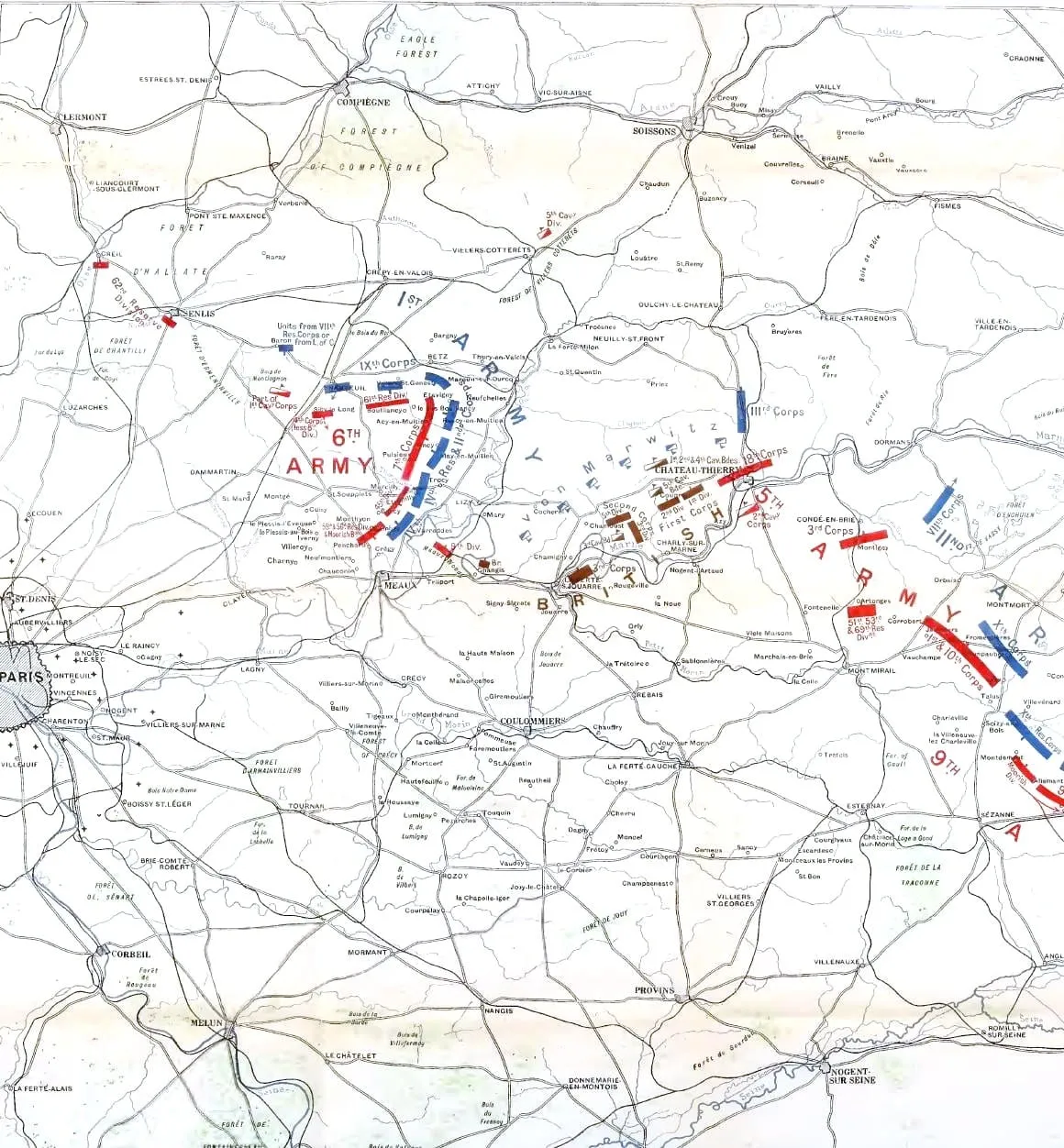
The Battle of the Ourcq, fought on 5–9 September 1914 north-east of Paris, was part of the First Battle of the Marne and at the same time its opening. The French Sixth Army of General Michel Maunoury struck at the right wing of the German First Army of General Alexander von Kluck between Meaux and the River Ourcq, a tributary of the Marne. The French failed to break the German defence, but they forced Kluck to turn his whole army west, which led to the German retreat. French historians sometimes date it to 5–10 September, also counting the day on which the last German units were leaving the battlefield.
An army for Paris
At the end of August 1914, after the lost Battle of the Frontiers, General Joseph Joffre began moving units by rail from Alsace and Lorraine to the left wing of the front. From them and from reserve divisions a new Sixth Army was formed, commanded by Maunoury. It fell back with the rest of the forces until at the beginning of September it found itself near Paris. There it was placed under the military governor of the capital, General Joseph Gallieni.
Meanwhile Kluck, instead of passing west of Paris as the Schlieffen Plan envisaged, turned south-east in pursuit of the French Fifth Army and crossed the Marne on 3 September. French airmen and cavalrymen reported that the German columns were passing Paris to the east. Gallieni saw a chance to strike at the exposed German flank. On the evening of 4 September Joffre issued the order for a general counter-offensive on 6 September, and the Sixth Army was to take up its starting positions east of Paris beforehand.
Forces
At the start of the battle the Sixth Army had several infantry divisions, mostly reserve divisions, supported by cavalry. Colonial soldiers also fought in its ranks, including a Moroccan brigade. Over the following days it received reinforcements from Paris and from other sectors of the front, among them IV Corps, transferred from the Third Army.
On the German side the right wing was at first covered only by General Hans von Gronau’s IV Reserve Corps, supported by a cavalry division. The rest of the First Army, four active corps, was south of the Marne. In the course of the battle Kluck moved all these corps to the Ourcq, gaining superiority, especially in heavy artillery.
Course of the battle
5 September. In the afternoon Maunoury’s units, moving to their starting positions, ran into Gronau’s corps on the hills near Monthyon and Penchard. Gronau, wishing to find out the enemy’s strength, went over to the attack himself. German artillery firing from high ground inflicted heavy losses on the French reserve divisions and the Moroccan brigade. That day the poet Charles Péguy was killed near Villeroy. During the night Gronau withdrew a few kilometres to the east and alerted army headquarters.
6 September. The French occupied the hills abandoned by the Germans and moved towards the Ourcq, but ran into a new line of defence. Kluck, informed during the night, turned back from the Marne first II Corps, and other corps over the following days. On the northern flank the French VII Corps fought heavily around Acy-en-Multien and Étavigny.
7 September. Both sides were committing fresh forces. The French 61st Reserve Division, detrained at Nanteuil-le-Haudouin, tried to outflank the German wing but was repulsed. On the night of 7/8 September Gallieni sent some of the soldiers of the 7th Division to the front in requisitioned Paris taxis, which passed into legend as the Taxis of the Marne. Their military significance was small, but their effect on morale was enormous.
8 September. The Germans, reinforced by further corps, went over to the attack on the northern flank and took Nanteuil-le-Haudouin. The position of the Sixth Army became critical. At the same time, however, south of the Marne, British troops and the French Fifth Army were advancing into the gap that had opened between Kluck’s army and the Second Army of General Karl von Bülow.
9 September. The British crossed the Marne. The envoy of the German Supreme Command, Lieutenant Colonel Richard Hentsch, agreed on the First Army’s retreat at its headquarters. Although Kluck was close to defeating Maunoury, his army began to withdraw north, towards Soissons and the Aisne.
Losses
Both sides suffered very heavy losses in these few days, especially from artillery fire. There are, however, no reliable figures separating the losses suffered on the Ourcq from the overall losses of the Battle of the Marne, which on each side ran to hundreds of thousands killed, wounded and taken prisoner.
Significance
Tactically the Battle of the Ourcq did not bring the French victory: the Sixth Army did not cross the river and several times came close to defeat. Strategically, however, it played a decisive role. The threat from the direction of Paris led Kluck to move his whole army north, which opened the gap into which the British and French advanced. The danger of the front being split forced the Germans to retreat along the whole right wing. The Battle of the Marne, begun on the Ourcq, buried German hopes of a quick victory in the west.
Spotted a mistake?Report an error