Germany · The Central Powers
Alexander von Kluck
Commander of the German First Army (1914–1915), colonel general
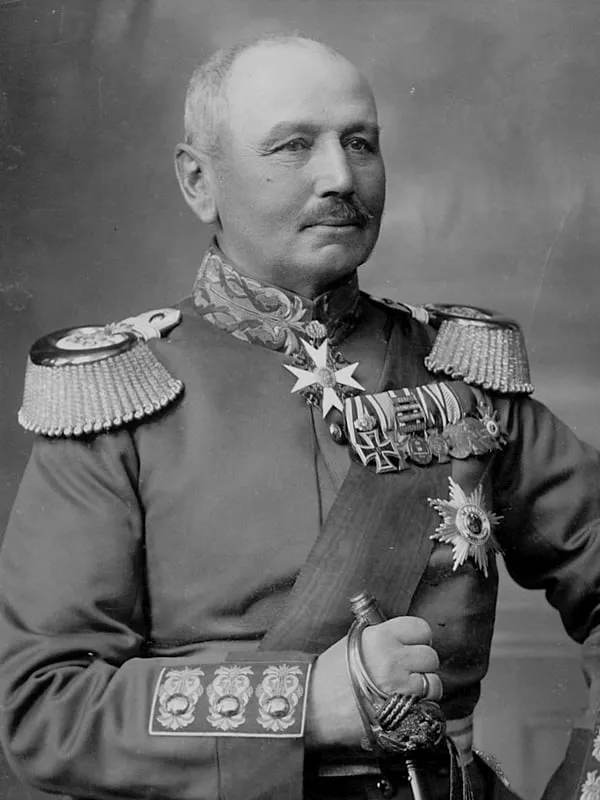
- Born:
- 20 May 1846, Münster (Prussia)
- Died:
- 19 October 1934, Berlin
- Author:
- Natalia
- Photo:
- autor nieznany, CC BY-SA 3.0, Wikimedia Commons

In 1914 Alexander von Kluck commanded the German First Army, the strongest and westernmost army of the right wing, which was to pass through Belgium and northern France, sweep round Paris and encircle the French armies. Within a month his soldiers marched several hundred kilometres, defeated the British at Mons and Le Cateau and came within a few dozen kilometres of the French capital. Yet it was Kluck’s own decisions, the turn east of Paris and the hasty march across the Marne, that exposed the German right wing and opened the way to their defeat on the Marne. To this day he remains one of the most disputed figures of that battle.
Before the war
He was born on 20 May 1846 in Münster in Westphalia, the son of an architect. In 1865 he joined the Prussian army and fought in the Austro-Prussian War and the Franco-Prussian War, in which, according to some biographers, he was twice wounded and received the Iron Cross. His career was unusual by Prussian standards. He did not graduate from the War Academy and never served as a General Staff officer. He made his name as a practitioner: a commander in line regiments, an instructor at NCO schools, the organiser of a training ground. He rose through the successive levels, from regiment to corps, almost entirely in garrisons in the east of the monarchy, in Bromberg, Gleiwitz, Allenstein, Posen and Königsberg. In 1909 he received hereditary nobility and from then on was called “von Kluck”.
In 1913 he took over the VIII Army Inspectorate in Berlin, and in January 1914 he became a colonel general. In the event of war the inspectorate turned into an army command. On 2 August 1914 the 68-year-old Kluck took command of the First Army, with General Hermann von Kuhl, an officer of equally offensive temperament, as his chief of staff.
The march through Belgium
The First Army, more than 300,000 strong, advanced on the far right wing of the German forces. Its task was to cover the longest route in the whole Schlieffen Plan: through Belgium, along the coast and on to the west of Paris. After the fall of the forts of Liège, Kluck’s troops pushed the Belgians back from the Gete and on 20 August marched through Brussels in a show of strength that witnesses described as an endless parade.
In the second half of August Kluck was for about ten days subordinated to the commander of the neighbouring Second Army, General Karl von Bülow. Bülow, concerned for his own right flank, kept the First Army close to him, while Kluck wanted to swing in a wider arc to the west. According to many historians, this restriction meant that on 23 August the First Army struck the British Expeditionary Force head-on at Mons instead of outflanking it. The British infantry inflicted heavy losses on the Germans and then withdrew. Three days later Kluck, convinced that the British were fleeing towards the Channel ports, ran into a day-long stand by Smith-Dorrien’s II Corps at Le Cateau. He won again but did not destroy his opponent. The British then nicknamed him “old one o’clock”, twisting his name into the clock-face “o’clock”.
The turn east of Paris
At the end of August the French Fifth Army under General Charles Lanrezac attacked Bülow’s army at Guise. Bülow asked Kluck for help in finishing off the French. On the evening of 30 August Kluck decided to turn south-east, towards Noyon and Compiègne, to cut off the Fifth Army’s retreat. The Supreme Army Command approved the move the next day. This meant abandoning the assumption that the right wing would go round Paris to the west: the First Army was now to pass east of the capital, skirting it on the flank.
On 2 September the Chief of the General Staff, Helmuth von Moltke, ordered the First Army to follow the Second Army in echelon and to cover the right flank facing Paris. Kluck, however, was already ahead of Bülow, not behind him. He judged that stopping would mean losing the chance to crush the retreating French, and on 3 September he crossed the Marne, leaving only General Hans von Gronau’s IV Reserve Corps and a cavalry division to cover his flank. In those days his patrols reached Claye, little more than 20 kilometres from Paris. French and British airmen noticed that the German columns were passing the capital to the east, and the Military Governor of Paris, General Joseph Gallieni, proposed a strike at the exposed flank. Only Moltke’s directive, which reached Kluck on the morning of 5 September, ordered the First and Second Armies to halt facing Paris.
The Marne
On 5 September the French Sixth Army under General Michel Maunoury clashed with Gronau’s corps on the Ourcq. Kluck reacted quickly and decisively. Within a few days he moved all his corps from the Marne to the north-west, first II and IV, then III and IX, and not only stopped Maunoury but began to threaten his left flank. German soldiers later praised this manoeuvre as proof of his energy. It came at a price, however. A gap some 40–50 kilometres wide opened between the First and Second Armies, screened only by two cavalry corps. The British and the left wing of the French Fifth Army slowly moved into it.
On the evening of 8 September Kluck telegraphed to headquarters that the decision on the Ourcq would come the next day. On the morning of 9 September Moltke’s emissary, Lieutenant-Colonel Richard Hentsch, who had spoken with Bülow the previous evening, arrived at his headquarters at Mareuil-sur-Ourcq. Hentsch did not meet Kluck himself, but his chief of staff Kuhl. He declared in the name of the Supreme Army Command that the Second Army was retreating and that the First Army had to do the same. Kuhl, and after him Kluck, faced with the neighbouring army’s retreat and the gap on their left, had no choice. In the afternoon the First Army began to withdraw northwards, towards Soissons and the river Aisne. Thus ended the Battle of the Marne.
The Aisne and Soissons
The retreat was carried out in good order. From 13 September the First Army defended the heights north of the Aisne, between the Oise and the area of Soissons, and repulsed French and British attacks in the First Battle of the Aisne. Kluck remained on this sector even when both sides tried to outflank each other to the north. The new Chief of the General Staff, Erich von Falkenhayn, sent further corps to his right, and then the whole Sixth Army of Rupprecht of Bavaria.
Kluck’s last major success was the Battle of Soissons in January 1915. When the French attacked the high ground north of the town, General Ewald von Lochow’s III Corps from his army counter-attacked and threw them back across the Aisne. In the same month Kluck lost his eldest son, Lieutenant Egon von Kluck, who was killed on 26 January 1915 at Middelkerke in Belgium during shelling by British warships.
Wound and retirement
On 27 March 1915, while touring forward positions near Vailly-sur-Aisne, Kluck was seriously wounded in the leg by shell splinters. He received the Pour le Mérite, awarded to him the next day, in hospital. Command of the First Army passed to General Max von Fabeck. Kluck recovered relatively quickly but was given no new post, probably because of his age. In October 1916 the 70-year-old general retired at his own request.
After the war
In retirement Kluck took part in the post-war dispute over responsibility for the Marne. In 1920 he published the book “Der Marsch auf Paris und die Marneschlacht 1914” (The March on Paris and the Battle of the Marne), in which he defended his decisions and argued that he had been close to victory on the Ourcq when the retreat was ordered from outside. His former chief of staff Kuhl wrote in a similar vein. Kluck died in Berlin on 19 October 1934 at the age of 88 and was buried in the cemetery at Stahnsdorf near Berlin.
Assessment
Kluck is regarded as an energetic, bold and self-confident commander who demanded enormous effort from his troops. In August 1914 his army covered the longest distance of all the German armies, and the manoeuvre on the Ourcq was skilfully executed. In inter-war Germany many soldiers and the German official history held that he and Kuhl had been close to winning the battle, and that victory had been thrown away by the irresolute Bülow and by Hentsch.
Most modern historians judge him more harshly. He is accused of being driven more by the wish to catch his opponent than by the plan as a whole, of disregarding intelligence and warnings of the threat from Paris, and of interpreting Moltke’s order of 2 September in his own way. The turn east of Paris, approved, it should be said, by the Supreme Army Command, and the hasty march across the Marne exposed his flank to a blow that the French had prepared with precisely this opportunity in mind. The British author Ian Senior calls it a myth that Kluck could still have won on 9 September, since the British were already across the Marne and the German attack on Maunoury’s left flank had broken down. The Canadian historian Holger Herwig sees in him and Bülow an example of a wider problem: army commanders who, under Moltke’s weak leadership, acted on their own and were unable to work together. There is agreement that the blame for the defeat on the Marne cannot be laid on a single man, but Kluck’s share in it was considerable.
Sources
Spotted a mistake?Report an error
Commanded in battles
(09)- 7–25 August 1914Battle of the FrontiersWestern Front
- 18–19 August 1914Battle of the GeteWestern Front
- 23 August 1914Battle of MonsWestern Front
- 26 August 1914Battle of Le CateauWestern Front
- 5–9 September 1914Battle of the OurcqWestern Front
- 6–12 September 1914First Battle of the MarneWestern Front
- 12–15 September 1914First Battle of the AisneWestern Front
- 22–26 September 1914First Battle of PicardyWestern Front
- 8–14 January 1915Battle of SoissonsWestern Front
Mentioned in battles
(01)Often appears with
People who appear in the same events.
On the timeline
(23)1914
August
- 25
- Germans occupy ValenciennesOn 25 August 1914 German troops entered Valenciennes in northern France. The town remained under occupation for more than four years.
- First air patrol over the British retreatOn 25 August 1914 British airmen patrolled the skies over the retreating army and forced a German aircraft to land. It was one of the first air combats.
- 26
- Key eventBattle of Le CateauOn 26 August 1914 Smith-Dorrien's II Corps stood and fought at Le Cateau against the wishes of GHQ. It paid a high price but halted the German pursuit.
- Germans take CambraiOn 26 August 1914, after street fighting with French Territorial units, the Germans took Cambrai. The occupation of the town lasted more than four years.
- Germans occupy DouaiA British chronology records the capture of Douai on 26 August 1914. The first occupation of the town was brief; the Germans entered for good on 1 October.
- 30
- Germans take Laon, La Fère and RoyeAt the turn of August and September 1914 the German armies took Laon, La Fère and Roye. The towns remained in their hands for most of the war.
- Battle of Guise endsOn 30 August 1914 the French Fifth Army broke off the fight with Bülow's army and withdrew behind the Serre. The Battle of Guise was over.
September
- 05
- End of the retreat from MonsOn 5 September 1914 the British Expeditionary Force ended its retreat from Mons. After almost two weeks of marching it halted south of the Marne, near Paris.
- Key eventBattle of the Ourcq beginsOn 5 September 1914 Maunoury's French Sixth Army struck the flank of Kluck's army near Meaux. The clash at Monthyon opened the great Battle of the Marne.
- Germans reach ClayeIn early September 1914 units of Kluck's army reached Claye, east of Paris. The British chronicle called it the closest point to the capital in the war.