France · The Entente
Louis Franchet d'Espérey
Commander of the Fifth Army (1914–1916), of the Eastern and Northern Army Groups (1916–1918), commander-in-chief of the Allied Armies of the Orient (1918–1920), Marshal of France
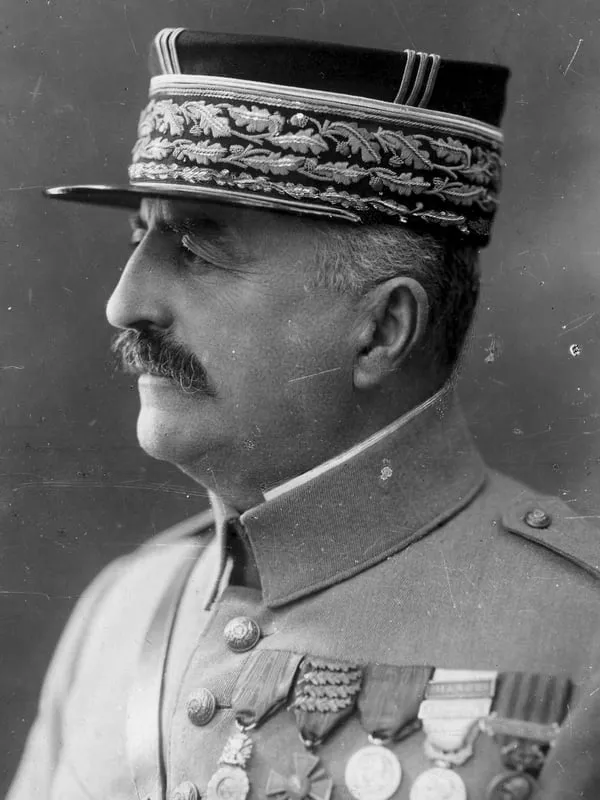
- Born:
- 25 May 1856, Mostaganem (Algeria)
- Died:
- 8 July 1942, Saint-Amancet (France)
- Author:
- Natalia
- Photo:
- Henri Manuel, domena publiczna, Wikimedia Commons

Louis Franchet d’Espérey was one of the few French generals who came out of the First World War with a reputation as a victor. In August 1914, as a corps commander, he won at Guise the only major counter-attack of the Great Retreat, and a few days later he took over the Fifth Army and led it into the gap between the German armies on the Marne. For the following years he commanded army groups on the Western Front, but in May 1918 the Germans broke through on the Aisne in his sector. Removed from France, he was given the command at Salonika, which was regarded almost as exile. Three months later his troops broke the Bulgarian front, and Bulgaria became the first of the Central Powers to ask for an armistice. The French usually spell the general’s name “d’Espèrey”, with a grave accent, but in Poland the form “d’Espérey” has become established.
Before the war
He was born on 25 May 1856 in Mostaganem in Algeria, the son of an officer of the Chasseurs d’Afrique, into a Catholic family with monarchist sympathies. In 1876 he graduated from the school at Saint-Cyr and joined a regiment of Algerian tirailleurs. He fought in Tunisia in 1881, graduated from the École supérieure de guerre, went to Tonkin in 1885, and in 1900 took part in the expedition against the Boxer Rebellion in China, during which his cousin, the German minister Clemens von Ketteler, was killed in Peking. He then commanded regiments in France. In 1908 he became a brigadier general, and in 1912 a divisional general. In 1912–1913, under General Hubert Lyautey, he commanded the occupation troops in western Morocco. In November 1913 he took over I Corps at Lille, with which he went to war. He was one of the few senior French officers who knew the Balkans.
1914: Guise and the Marne
In August 1914 I Corps formed part of the Fifth Army of General Charles Lanrezac. On 15 August its troops defended the bridge over the Meuse at Dinant. At Charleroi on 23 August Franchet d’Espérey asked from the morning onwards for permission to counter-attack from the right wing into the flank of the German Second Army, but Lanrezac refused. He got his chance a week later at Guise. On the afternoon of 29 August Lanrezac threw his last reserve, I Corps, into the fight. Franchet d’Espérey personally put the ranks in order and at about 5.30 p.m. led a counter-attack in which, according to accounts, the infantry advanced to the sound of bands. The German Guard was thrown back beyond the Oise. According to an anecdote, the general, riding on horseback, called out to the colonel commanding a brigade, Philippe Pétain, his former instructor, asking how he liked the attack.
On 3 September the commander-in-chief, General Joseph Joffre, dismissed Lanrezac and gave the Fifth Army to Franchet d’Espérey. Asked whether he was up to the task, the new commander reportedly replied that he was as much as anyone else. The British liaison officer Edward Spears compared his appearance to a howitzer shell and described the electrifying impression he made on the staff. He threatened to shoot anyone who failed in his duty, and to one corps commander who protested against an order he shouted down the telephone: “March or croak”. Within a few weeks he replaced three of his five corps commanders and seven of his thirteen divisional commanders. Immediately after taking command he also sent a cordial telegram to Field Marshal John French to repair the relations with the British that his predecessor had spoiled.
On 4 September he met the sub-chief of staff of the British force, General Henry Wilson, at Bray and agreed with him a plan for a joint attack. That evening his proposal reached Joffre and, according to British historians, became one of the foundations of the order for a general counter-offensive. In the Battle of the Marne the Fifth Army, together with the British, advanced into the gap between the armies of Kluck and Karl von Bülow, crossed the Grand Morin and the Petit Morin and threw back Bülow’s right wing at Montmirail. This pressure was one of the reasons why Bülow ordered a retreat on 9 September. On 13 September Franchet d’Espérey’s troops entered Reims, and in the Battle of the Aisne they tried in vain to take the heights at Craonne and Brimont. Joffre wrote in his memoirs that it was Franchet d’Espérey who made the victory on the Marne possible.
Army groups, 1915–1918
Throughout 1915 the Fifth Army held a relatively quiet sector on the Aisne and near Reims. Its commander was thinking about another theatre at the time. At the turn of 1914 and 1915 he put forward a plan for an expedition through Salonika and Serbia to the Danube, which was meant to detach Germany’s allies from it. He was supported by the Minister of Justice Aristide Briand, General Joseph Gallieni and President Raymond Poincaré, but Joffre did not want to weaken the front in France. At the end of March 1916 Franchet d’Espérey took over the Eastern Army Group in Lorraine and the Vosges. According to French biographers his son, an infantry second lieutenant, was killed at Douaumont.
At the end of December 1916 he took over the Northern Army Group, but the post of commander-in-chief went to an army commander younger than him, General Robert Nivelle. In the spring of 1917 his army group was to attack between the Oise and the Avre. On 4 March, seeing signs of German preparations for the retreat to the Hindenburg Line, he proposed an immediate attack, but Nivelle did not agree. The British official history considers that this refusal may have cost the French a great success. When the Germans withdrew, his troops took Roye and set off in pursuit. In October 1917 the Sixth Army of his group won the carefully prepared Battle of La Malmaison. In December Prime Minister Georges Clemenceau and Pétain saw him as the replacement for General Sarrail, recalled from Salonika, but Ferdinand Foch pushed through General Guillaumat.
The hardest moment came in the spring of 1918. The sector on the Aisne and on the Chemin des Dames ridge was regarded as quiet, but it was defended by the weak Sixth Army of General Denis Duchêne, reinforced by exhausted British divisions. Franchet d’Espérey placed the main defensive position south of the Aisne, in line with Pétain’s directive, but Duchêne crowded most of his infantry and artillery on the ridge itself, and Pétain reluctantly gave way to him. He ignored warnings: he assured the British that an attack “will certainly not come at once”. On 27 May the Germans broke through on the Aisne and within a few days reached the Marne. In the Chamber of Deputies there were demands that the guilty be punished. Duchêne lost his army, and around 10 June Franchet d’Espérey handed the army group over to General Paul Maistre.
Salonika and victory over Bulgaria
The general had too many services to his name simply to be removed. On 18 June 1918 he took command of the Allied armies at Salonika: French, Serbian, Greek, British and Italian. He inherited the offensive plan prepared by Guillaumat after the Greek victory at Skra-di-Legen, and as early as the end of June he agreed to a bold Serbian project of attacking in the highest mountains of the front, whose most ardent advocate was Vojvoda Živojin Mišić. Meanwhile, in Paris, Guillaumat was persuading the Allies, of whom the British held out longest. In the summer Franchet d’Espérey also supported the offensive in Albania.
The plan was based on the layout of the enemy’s communications: whoever took the Vardar valley at Gradsko would cut the Bulgarian forces in two. On 15 September the Serbs and the French stormed the Dobro Pole ridge, and the Second Army of Vojvoda Stepa Stepanović descended into the Vardar valley within a few days. The British and the Greeks were bloodily repulsed at Doiran, but the Bulgarian defence began to crumble. Franchet d’Espérey refused to be drawn into pushing deep into a narrow wedge and ordered the breach to be widened to the sides. On 29 September French cavalry burst into Skopje, and late that evening the general signed the Armistice of Salonica with the Bulgarian delegates. Its terms, agreed with Clemenceau, disarmed Bulgaria and gave the Allies the right of passage through its territory. According to Bulgarian historians the general also expected the abdication of Tsar Ferdinand, which came on 3 October.
The Vardar offensive opened the way north. Within a few weeks the Serbs cleared their country of the enemy and returned to Belgrade on 1 November, and on 7 November Franchet d’Espérey entered the capital alongside Prince Regent Alexander. There he received a delegation of the Hungarian prime minister Mihály Károlyi, made it clear to them that Hungary was a defeated state, and dictated the terms that formed the basis of the Armistice of Belgrade, signed on 13 November by his deputies. At the same time he was preparing an entry into Romania: on 10 November French battalions crossed the Danube, and Romania re-entered the war. He planned a march through Hungary on Germany, but the Armistice of Compiègne forestalled him.
After the war
In February 1919 the command of the Allied armies in the East was moved to Constantinople. On 8 February the general made a ceremonial entry into the occupied capital. The story that he rode in on a white horse in imitation of Mehmed II is regarded by recent research as a legend. His disputes with the British over authority in the occupation dragged on for months. He also commanded the troops sent to southern Russia, which in the spring of 1919, amid mutinies of French sailors on the Black Sea, had to evacuate Odessa, as well as the forces that in 1919 supported the Serbs and Romanians against the Hungarian Soviet Republic. He gave up the command in July 1920.
In February 1921 he received the baton of a Marshal of France, and from the King of the Serbs, Croats and Slovenes the title of vojvoda. In 1923–1931 he was inspector general of the troops in North Africa, in 1924 he crossed the Sahara by car, and in 1930 he represented France at the coronation of the Emperor of Ethiopia, Haile Selassie I. In 1934 he was elected to the Académie française. He was a monarchist and a nationalist, and according to the account of one far-right activist he financially supported secret anti-communist organisations in the 1930s. He died on 8 July 1942 at Saint-Amancet in the Tarn department. After the war, in 1947, his remains were transferred to Les Invalides.
Assessment
Historians value Franchet d’Espérey above all for two moments: September 1914 and September 1918. British authors, from Spears to John Terraine, stress the galvanising effect he had on the demoralised Fifth Army and his part in preparing the counter-offensive on the Marne. British soldiers nicknamed him “Desperate Frankie” for his ceaseless energy. Cyril Falls, author of the British official history of the Macedonian campaign, wrote that in 1918, at the age of 62, he had lost none of his energy, firmness and excellent memory for detail.
Credit for the victory in Macedonia is, however, shared among several men. The plan of attacking in the mountains was a Serbian one, and Guillaumat began the preparations. Franchet d’Espérey had the courage to adopt the plan, push it through and carry it out consistently. His defenders stress that he won his victory over an army still capable of stubborn defence, before the decisive battles in the west, and that Bulgaria’s collapse prompted the German Supreme Army Command to demand an armistice. On his account there also remains the defeat on the Aisne in May 1918, for which he was responsible as army group commander. Even authors well disposed towards him admit that his harshness towards subordinates, according to the British partly deliberately put on, and his firmness towards the Allies did not make cooperation with him easy, as shown by the post-war disputes with the British in Constantinople.
Sources
Spotted a mistake?Report an error
Commanded in battles
(10)- 29–30 August 1914Battle of GuiseWestern Front
- 6–12 September 1914First Battle of the MarneWestern Front
- 12–15 September 1914First Battle of the AisneWestern Front
- 5 October 1915 – 30 September 1918The Salonika FrontBalkan Front
- 22 February – 5 April 1917German retreat to the Hindenburg LineWestern Front
- 23 October – 1 November 1917Battle of La MalmaisonWestern Front
- 27 May – 6 June 1918Third Battle of the AisneWestern Front
- 6–22 July 1918Offensive in Albania (1918)Balkan Front
- 15–17 September 1918Battle of Dobro PoleBalkan Front
- 15–29 September 1918Vardar offensiveBalkan Front
Mentioned in battles
(05)Often appears with
People who appear in the same events.
On the timeline
(28)1914
1916
1917
1918
May
June
July
September
October
November
- 13
- Allies in ConstantinopleOn 12 November 1918 the Allied fleet passed through the Dardanelles and on the morning of 13 November lay off Constantinople. The occupation began.
- Armistice of BelgradeOn 13 November 1918 in Belgrade Hungary signed a military convention with the Allies. Its line left the Banat, Bačka and part of Transylvania to occupation.