1914: First clashes and the Battles of the Frontiers
Battle of Charleroi
- Dates:
- 21–23 August 1914
- Front:
- Western Front
- Location:
- The Sambre and Meuse valleys around Charleroi and Namur, BelgiumOn the battle map →
- Sides:
- FranceCharles LanrezacGerman EmpireKarl von Bülow, Max von Hausen
- Result:
- German victory. The French Fifth Army withdrew, exposing the right flank of the British at Mons.
- Author:
- Łukasz Skowroń
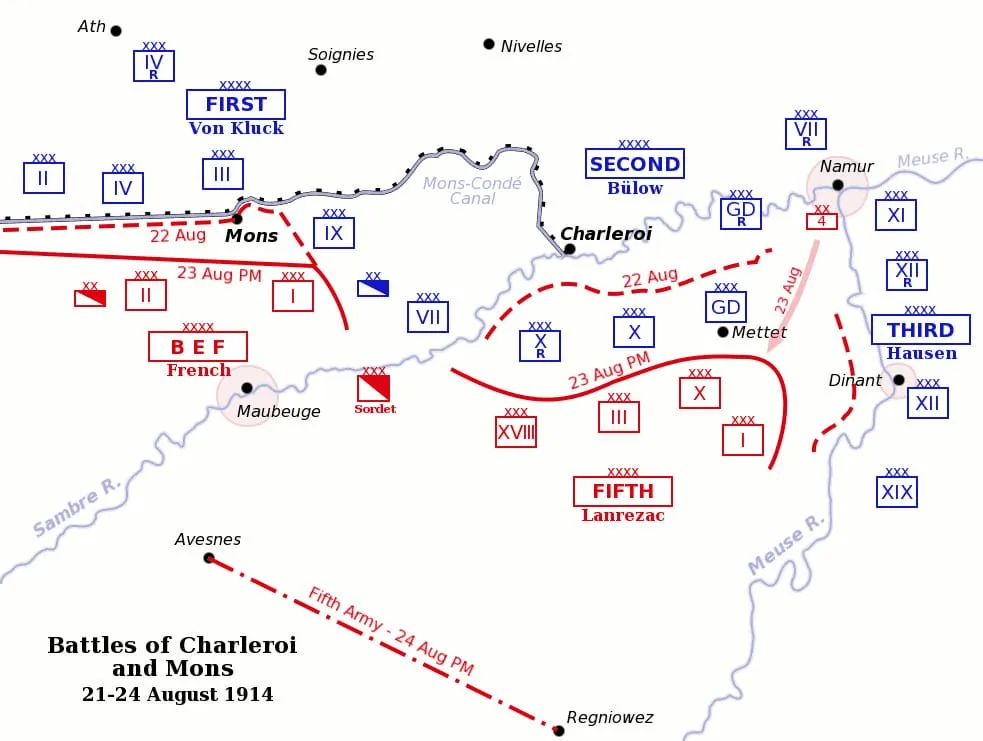
The Battle of Charleroi was fought on 21–23 August 1914 in Belgium, in the angle between the Sambre and the Meuse, between Namur and the French border. The French Fifth Army under General Charles Lanrezac, which was to strike at the Germans across the Sambre, was itself attacked by the German Second Army and in the end threatened from the east by the Third Army coming from the Meuse. After three days of fighting Lanrezac ordered a retreat. It was one of the Battles of the Frontiers, which decided the course of the first phase of the war in the west.
Name and dates
The French call it the Battle of Charleroi or the Battle of the Sambre. In his memoirs Lanrezac himself reserved the name for the fighting of his army south of the Sambre on 21, 22 and 23 August. He noted, however, that many writers called all the engagements of the Anglo-French left wing on 21–24 August, on a front 205 kilometres long from near Thionville to Condé, “the Battle of Charleroi”, and so attributed enormous consequences to it. Historians usually give the dates as 21–23 August. The British chronology of the war on which our calendar is based gives 24 August as the day the battle ended, when the Fifth Army broke contact with the enemy.
Background
From the start of the war Lanrezac had warned the Commander-in-Chief, Joseph Joffre, that the Germans were advancing through Belgium west of the Meuse in much greater strength than had been assumed. Only in mid-August did Joffre send his army north, into the angle of the Sambre and the Meuse, on the left wing of the French forces. Next to it, at Mons, the British Expeditionary Force of Field Marshal Sir John French, which was only just arriving, was to take its place.
According to the British liaison officer Edward Spears, Lanrezac’s army numbered over a quarter of a million men. On 20 August General Defforges’s X Corps and General Sauret’s III Corps stood on the Sambre between Namur and Charleroi, General Louis Franchet d’Espérey’s I Corps guarded the Meuse south of Namur, and General de Mas Latrie’s XVIII Corps stood in the rear, on the left wing. The army was reinforced by two divisions from North Africa, reserve divisions and General Sordet’s cavalry corps. Its front formed a wedge, at whose tip lay the Belgian fortress of Namur, besieged by the Germans since 20 August.
Facing it stood the German Second Army under General Karl von Bülow: on the Sambre the Guard Corps, X Corps, X Reserve Corps and VII Corps, and before Namur the Guard Reserve Corps and XI Corps. From the east came the Third Army of General Max von Hausen, made up of three Saxon corps. The German Supreme Command ordered the two armies to make a combined attack west and south of Namur on the morning of 23 August. Bülow, convinced that he faced only cavalry and weak infantry detachments, did not wait for Hausen.
On 21 August Joffre, who had lost the battle of Morhange and Sarrebourg the day before, threw the Third and Fourth Armies into the offensive in the Ardennes and ordered the Fifth Army to strike at the enemy’s northern group. Lanrezac did not want to cross the Sambre before the British came up. If attacked, he intended to defend himself not in the river valley but on the heights a few kilometres south of it.
21 August: the fight for the crossings
The battle began before anyone had planned it. Bülow had ordered only that the north bank of the Sambre be occupied, but some divisional commanders crossed the river. At about one in the afternoon the German Guard attacked the crossings at Auvelais (PL) and Tamines, held by General Bonnier’s 19th Division of X Corps. According to Lanrezac it took Auvelais at 2.30 p.m. Two hours later a regiment sent to retake the little town reached its edge, but without artillery preparation it could not break in. After this setback the French abandoned Tamines. Towards evening the Germans took Roselies in the III Corps sector, and Bonnier fell back, giving up Arsimont and leaving the heights above the river to the enemy. In the west Sordet’s cavalry lost the canal crossings at Luttre and Pont-à-Celles.
Lanrezac later wrote that Bonnier’s division had used only 7–8 of the corps’ 40 battalions that day and had lost about 1,500 men. The reports that reached his headquarters at Chimay (PL) in the evening described only contact with the enemy along the whole line of the river. Lanrezac concluded that his army could no longer go over to the offensive and would have to accept battle.
22 August: counter-attacks
During the night the 5th Division of III Corps tried to retake Roselies in order to free units cut off there. The corps commander allowed it, although Lanrezac had forbidden going down into the valley. The attack failed, and by morning the division was in disorder. At six o’clock, in fog, General Boë’s 20th Division of X Corps set off towards Tamines, and between eight and nine Bonnier’s division attacked. Lanrezac described how the French infantry, taught before the war that a resolute attack would catch the enemy off guard, ran into Germans waiting in fortified strongpoints with numerous machine guns. The French artillery could see no targets in the foggy, densely built-up valley, and the shells of the heavy German howitzers, which the soldiers called “marmites”, spread terror.
From eleven o’clock X Corps fell back from position to position. In the III Corps sector the Germans came out of Châtelet (PL) onto the south bank. A brigade of the 38th Division, made up of North African units, attacked the little town without artillery support; the artillery commander admitted he did not know where the German batteries were. It took the first houses, but in the afternoon had to withdraw, having lost, according to its commander, more than a third of its strength. At Mettet (PL) Spears saw a car carrying the badly wounded General Boë pass Lanrezac; Boë asked the army chief of staff: “Tell the General we held on as long as we could.”
By evening X Corps stood 8–16 kilometres south of the river, on the line Saint-Gérard–Biesme, and III Corps around Gerpinnes. The army staff reported to the high command “violent attacks on the front Namur–Charleroi” and heavy casualties among officers. XVIII Corps and I Corps had hardly fought. Between the army’s left wing and the British at Mons there yawned a gap about 10 kilometres wide.
23 August: the Meuse and the order to retreat
In the morning Franchet d’Espérey proposed that his I Corps strike the exposed flank of the Guard, which was again attacking X Corps. According to Spears, Lanrezac hesitated, and Captain Malick, sent to him, is said to have shouted: “By not attacking now, mon Général, you are committing suicide.” Lanrezac, for his part, claimed that he had been on the point of ordering the attack himself. At about one in the afternoon, when I Corps was ready to move, news came that Hausen’s Saxons had crossed the Meuse south of Dinant, routed the reservist battalions and occupied Onhaye, behind the army’s right wing. Franchet d’Espérey called off the attack and sent part of his forces to the Meuse. According to Spears, in the evening two battalions of General Charles Mangin’s brigade drove the Germans out of Onhaye with the bayonet. That same day German soldiers carried out a mass execution of the inhabitants of Dinant, one of the worst crimes against civilians during the invasion of Belgium.
At about four in the afternoon a German attack surprised the left wing of III Corps, which fell back in disorder towards Walcourt. XVIII Corps lost Gozée but held Thuin (PL) and kept the Germans from crossing the Sambre at Lobbes. That day the Germans took the northern forts of Namur and entered the town, and the Belgian 4th Division left the fortress. At 9.30 p.m. Lanrezac telegraphed Joffre: “In view of this situation and the delay of the Fourth Army I have decided to withdraw the army tomorrow to the front Beaumont–Givet.” The order directed the army to set off before dawn on 24 August for the line Givet–Philippeville–Beaumont–Maubeuge.
Lanrezac recalled that he was thinking then of Sedan, where 44 years earlier, at the same time of year, the Germans had surrounded the last French field army and forced it to capitulate. “Flight is not a glorious act,” he wrote, but any other course would have meant the destruction of the army. He did not warn the British of his decision. As soon as Spears learned of it, he drove to French’s headquarters at Le Cateau. Hausen meanwhile, at Bülow’s request, sent his troops not south-west, behind the French, but west, towards Mettet. When he crossed the Meuse on the morning of 24 August, the Fifth Army was already in retreat.
Casualties
French losses were never established precisely. The American historian Eric Dorn Brose put them at about 10,000 men. According to Spears, the German Second Army admitted the loss of 11,000 men and claimed to have taken 4,000 prisoners and 35 guns on the Sambre. Holger Herwig put the losses of the Third Army at Dinant at 4,275 men. More than 4,000 French soldiers lie in the Belle-Motte military cemetery at Le Roux, the largest French war cemetery in Wallonia. Spears believed that the heavy French losses were due above all to poor tactical handling of the troops, not to the enemy’s numerical superiority.
Significance
The battle laid bare the weaknesses of pre-war French doctrine. The infantry did not dig in, because it had been taught that trenches sap the offensive spirit; it attacked without artillery preparation and ran into machine-gun fire. Lanrezac blamed the corps commanders who, against his intentions, had gone down into the Sambre valley. Spears and some officers of the Fifth Army, for their part, accused him of passivity and of wasting the chance of a counter-attack on 23 August. The high command later wrote that Lanrezac, “believing himself threatened on his right, retreated instead of counter-attacking”. He himself believed he had saved the army from “a new Sedan”.
The retreat of the Fifth Army exposed the right flank of the British, who after the Battle of Mons also had to fall back. The defeat on the Sambre, together with the defeat in the Ardennes, began the Great Retreat of the Allies, halted only on the Marne. At the end of August Lanrezac’s army stood up to the Germans once more at Guise, but on 3 September Joffre removed him from command and gave it to Franchet d’Espérey. On the German side the army commanders reported decisive victories. After the fall of Namur the Guard Reserve Corps and XI Corps were sent to the Eastern Front, which in the view of some historians weakened the Germans before the Battle of the Marne.
Sources
Spotted a mistake?Report an error