France · The Entente
Charles Lanrezac
Commander of the French Fifth Army (April–September 1914)
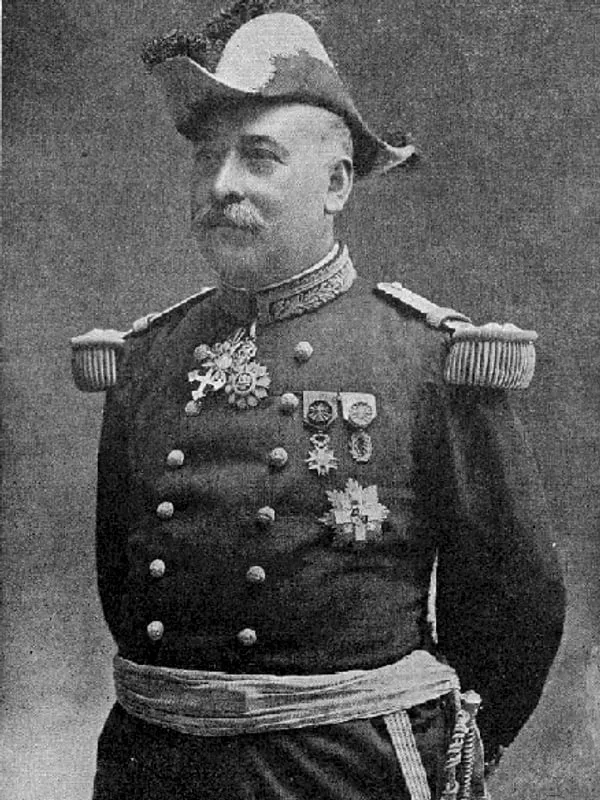
- Born:
- 30 July 1852, Pointe-à-Pitre (Guadeloupe)
- Died:
- 18 January 1925, Neuilly-sur-Seine
- Author:
- Łukasz Skowroń
- Photo:
- autor nieznany, domena publiczna, Wikimedia Commons

Charles Lanrezac commanded the French Fifth Army for less than five weeks, from mobilisation until 3 September 1914, but those weeks were enough to make him one of the most controversial figures of the opening of the war. His army stood on the left wing of the French forces, where the German right wing was advancing through Belgium. Lanrezac understood earlier than the high command where the main blow was coming from, and his retreat from Charleroi saved the Fifth Army from encirclement. At Guise he carried out the only major French counter-attack of the Great Retreat. Even so, just before the Battle of the Marne the commander-in-chief took his command from him. To some he was a victim who had saved France, to others a tired and quarrelsome general who could work neither with his superiors nor with the British.
Before the war
He was born on 30 July 1852 in Pointe-à-Pitre in Guadeloupe, the son of a marine infantry officer who had risen to commissioned rank from the ranks. Some sources give a date one day later. He was educated at the military school at La Flèche, and in 1869 he entered the school at Saint-Cyr. The very next year he went as a second lieutenant to the war with Prussia. He fought in the Army of the Loire at Coulmiers and Orléans, and in the winter in General Bourbaki’s army, which tried to relieve Belfort.
After the war he made his career mainly as a staff officer and lecturer. He graduated from the École supérieure de guerre and then for years taught military history, strategy and tactics there, finally as deputy director of studies. He wrote a well-regarded study of Napoleon’s spring campaign of 1813. He was considered one of the sharpest minds in the army, but also a sarcastic and hot-tempered man. At a time when the French staff believed more and more in the offensive at all costs, Lanrezac recommended manoeuvre and warned against commanders who throw themselves at the first enemy they meet, because the commander then loses all control of the battle. In 1906 he became a brigadier-general, and in 1911 a divisional general.
General Joseph Joffre, Chief of the General Staff from 1911, thought very highly of him. Years later he wrote that no one had seemed to him better prepared to command the Fifth Army, whose task was to be the most difficult. In April 1914 Lanrezac replaced the retiring General Joseph Gallieni as a member of the Supreme War Council and designated commander of the Fifth Army. Like his predecessor, he quickly came to doubt the concentration plan. The Fifth Army was to face the Ardennes, and he feared that the Germans would outflank it from the north, through Belgium, including west of the Meuse. In the last days of July 1914 he sent the high command a memorandum on the matter. After the war he claimed that Joffre had ignored him. Joffre replied that it had reached him only on 1 August and that discussing it at the moment of mobilisation would have been premature.
August 1914: the Sambre and Charleroi
In the first days of the war the Fifth Army, made up of five corps, reserve divisions and cavalry, concentrated between the Meuse and the Ardennes. Lanrezac reported ever more insistently that intelligence was seeing German columns around Huy, north of the Meuse. Headquarters considered these reports exaggerated. On 14 August Lanrezac went to see Joffre and asked to be allowed to turn his army to face north, instead of throwing the Third and Fourth Armies into the Ardennes. Joffre, pleased with the initial progress in Lorraine, would not listen. Lanrezac recalled that he left “with death in his soul”. Only on the evening of 15 August, when German cavalry appeared near Dinant, was he given permission to move the army into the angle between the Sambre and the Meuse. His soldiers had to cover more than a hundred kilometres in a few days.
On 17 August, at his headquarters in Rethel, he received Field Marshal Sir John French, commander of the British Expeditionary Force, which was to take position on his left wing. The meeting ended in mutual dislike. According to the British liaison officer Edward Spears, when French asked in broken French whether the Germans would cross the Meuse at Huy, Lanrezac replied that they had probably gone there to fish. The general’s son later disputed this account, but the mistrust between the two commanders was a fact and weighed on the whole campaign.
In the Battle of Charleroi, which began on 21 August, the Fifth Army found itself in the very position its commander had warned against. The Guard and X Corps of General Karl von Bülow’s German 2nd Army seized the crossings of the Sambre before the French could occupy them. On 22 August the French corps, contrary to Lanrezac’s instructions to hold the heights south of the river, counter-attacked amid the dense buildings of the industrial basin and suffered heavy losses. On 23 August the German 3rd Army forced the Meuse at Dinant and threatened the French right wing, while the Belgians were abandoning Namur. In the evening Lanrezac ordered a retreat without fully coordinating it with the British, who were fighting that day at Mons. The retreat exposed their right flank and forced them to withdraw. Winston Churchill wrote years later that Lanrezac’s accurate appreciation of the situation and firm decision deserved the gratitude of France, and added wryly that it was a pity he had forgotten to inform his British allies of it.
Guise
After the lost Battle of the Frontiers, during the Great Retreat, Lanrezac’s relations with headquarters and with the British grew even worse. On 26 August at Saint-Quentin there was a stormy conference with Joffre and French, at which Lanrezac gave the impression of being bored and dismissive. Joffre, however, needed time to assemble the new Sixth Army on the left wing and had to relieve the British, who had been beaten at Le Cateau. On 27 August he ordered the Fifth Army to halt and strike west, towards Saint-Quentin, into the flank of General Alexander von Kluck’s German 1st Army.
Lanrezac regarded this order as dangerous. Turning the army through 90 degrees exposed its right flank to a blow from Bülow, who was coming from the north. He reportedly dismissed a headquarters officer who had arrived with instructions by telling him that his “little strategists” should first learn their own trade. On 28 August Joffre came to his headquarters at Marle and, after a heated exchange, had the order written down and signed it on the spot. President Raymond Poincaré noted rumours going round that the commander-in-chief had threatened Lanrezac with a firing squad. Joffre recalled that for two nights he had considered whether to relieve him.
On the morning of 29 August, as the Battle of Guise began, Joffre came to Laon and for several hours watched in silence as Lanrezac directed the fighting. He left reassured. The attack on Saint-Quentin stalled, but north of the Oise the German Guard was thrown back by a counter-attack of the I Corps of General Louis Franchet d’Espèrey. Joffre later wrote that Lanrezac had shown great speed and understanding when he broke off the failed attack westwards and built on the success at Guise. Late in the evening the commander-in-chief allowed him to retreat, because the army was in danger of being outflanked. Bülow, whose troops had suffered heavy losses, called on Kluck for help, and Kluck turned south-east, passing Paris to the east. This move exposed the German flank to Maunoury’s army and became one of the causes of the victory on the Marne.
The retreat behind the Aisne and the Marne was hard. On 31 August German cavalry nearly seized the crossings of the Aisne behind the Fifth Army. Witnesses heard its commander, in a moment of despair, cry out that all was lost.
Dismissal
On the afternoon of 3 September 1914 Joffre came to Fifth Army headquarters and removed Lanrezac from command. His successor was Franchet d’Espèrey. In his memoirs Joffre explained that since Guise Lanrezac’s tendency to criticise and question orders, aggravated by fatigue, had been undermining the morale of the staff, and that he could not be relied on in the coming counter-offensive. Accounts of the conversation itself differ. Lanrezac wrote that he reminded the commander-in-chief that events had proved him right, and that Joffre avoided his eyes. Joffre claimed that the dismissed general accepted the decision calmly, even with relief. Lanrezac was no exception. By 6 September Joffre had removed two army commanders, ten corps commanders and several dozen divisional commanders.
He never returned to active service at the front. He was given ad hoc missions, mainly inspections of infantry training centres. After Joffre’s departure, at the turn of 1916 and 1917, he was offered posts suited to his qualifications, but the embittered general, who suffered from diabetes, declined. In July 1917, when Philippe Pétain was already commander-in-chief, he received the grand officer’s cross of the Legion of Honour. The citation stated that his army had withstood the onslaught of enemy masses of great numerical superiority, and that he had carried out one of the most difficult manoeuvres and rendered outstanding services to the country.
After the war
In 1920 he published a book on the war plan and the first month of the campaign, in which he settled scores sharply with Joffre. It provoked a long dispute. In 1922 the historian Jules Isaac devoted a critical study of the testimonies on the role of the Fifth Army to the dispute. Towards the end of his life Lanrezac judged his adversary more gently: he said that in Joffre’s place he would have done the same, because the two of them saw matters of tactics and strategy differently and could not come to an understanding. In 1924 he received the grand cross of the Legion of Honour, and earlier Belgian decorations for August 1914. He died on 18 January 1925 at Neuilly-sur-Seine. In accordance with his wishes, he was buried without military honours. According to the French Ministry of the Armed Forces, since 1933 he has rested in Les Invalides in Paris. His tomb bears the inscription: “To the one who saved France in August 1914”.
Assessment
How Lanrezac is judged depends largely on whose testimony is accepted. His poor image in English-language literature comes mainly from Spears, whose memoirs of 1930 portrayed him as an arrogant pedant, overwhelmed by the burden of command and reluctant to fight. Some of the British, including the BEF’s head of intelligence George Macdonogh, considered this portrait unjust. French, for that matter, wrote kindly of him in his diary right after their first meeting, and his dislike grew only later.
Many historians concede that Lanrezac was right in the dispute over the direction of the German thrust. The American author Sewell Tyng wrote that he had “the gift of Cassandra”: he foresaw the danger, but no one listened to him. The Canadian historian Holger Herwig believes that the retreat from Charleroi may have saved the Fifth Army from destruction, although he faults its commander for keeping Franchet d’Espèrey’s corps in reserve too long at Guise and failing to exploit the gap between the German armies. The British historian John Terraine saw Guise as a French tactical victory. The French military historian Rémy Porte observes that no one questioned Lanrezac’s military abilities, but that he largely brought about his own downfall through his brusque manner and sharp tongue towards superiors and allies. Most authors agree on one thing: Lanrezac understood the situation better than headquarters, but could not win either Joffre or the British over to his views.
Sources
Spotted a mistake?Report an error
Commanded in battles
(03)Mentioned in battles
(01)Often appears with
People who appear in the same events.