France · The Entente
Joseph Gallieni
Military governor of Paris (1914–1915), French minister of war (1915–1916), Marshal of France (posthumously)
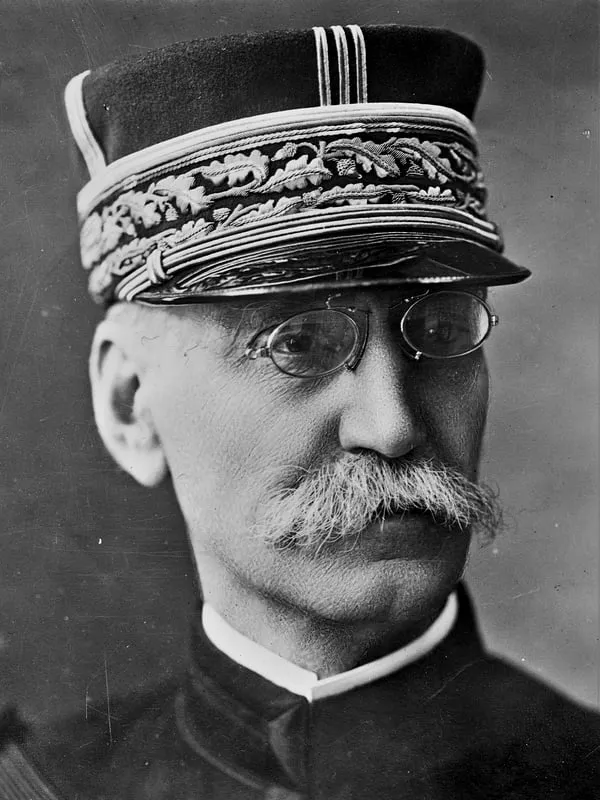
- Born:
- 24 April 1849, Saint-Béat (France)
- Died:
- 27 May 1916, Versailles
- Author:
- Natalia
- Photo:
- George Grantham Bain Collection (Library of Congress), domena publiczna, Wikimedia Commons

In 1914 Joseph Gallieni was a retired general, France’s most famous colonial soldier and the former superior of the commander-in-chief, Joseph Joffre. At the end of August, as the Germans approached Paris, he was entrusted with the defence of the capital. In early September he was one of the first to see that the German First Army had exposed its flank, and he pressed for an immediate attack. That manoeuvre grew into the Battle of the Marne, and the Paris taxis he sent to the front became one of the legends of the war. In the autumn of 1915 he became minister of war and tried to bring general headquarters under government control. He lost that struggle, resigned, gravely ill, in March 1916 and died two months later. For decades the French argued over how much of the victory on the Marne was owed to him and how much to Joffre.
Before the war
He was born on 24 April 1849 in Saint-Béat in the Pyrenees. His father, who came from the area around Milan, had risen in the French army from the ranks to the rank of captain. Gallieni studied at the military school in La Flèche and at Saint-Cyr. As a young officer of the marine infantry he fought in the Franco-Prussian War and at Bazeilles, during the Battle of Sedan, he was taken prisoner by the Germans, and in captivity he learnt German.
He spent almost all of the rest of his career in the colonies. From 1876 he served in Senegal, led an expedition to the upper Niger, and in 1886–1888 held command in what later became French Sudan, where he put down the rising of Mahmadu Lamine. In 1892–1896 he commanded a military district in Tonkin. In 1896, as a general, he took power in Madagascar, which remained under his rule, with a short break, until 1905. In February 1897 he abolished the monarchy and exiled Queen Ranavalona III to Réunion. He broke Malagasy resistance ruthlessly: by executing its leaders, by punitive expeditions and by forced labour. At the same time he built roads, a railway, hospitals and schools. His “oil stain” method, the gradual occupation of a country while winning over the population of the districts already taken, influenced later counter-insurgency doctrine, and Hubert Lyautey was his pupil. Joseph Joffre also served under his orders in Madagascar.
After returning to France he became military governor of Lyon and commander of XIV Corps, and from 1908 he sat on the Supreme War Council. In 1911 he was the natural candidate for chief of the General Staff and future commander-in-chief, but he declined. He cited his age and health, and he also feared that the metropolitan army would take badly to a colonial general. The post went to Joffre. Gallieni was then designated to command the Fifth Army in the event of war. He warned that the Germans might come through Belgium in great strength west of the Meuse, and demanded in vain that the fortress of Maubeuge be strengthened. He also argued for abandoning the infantry’s red trousers. In April 1914 he retired on reaching the age limit, and his place was taken by Charles Lanrezac. That summer his wife died.
1914: the defence of Paris
On 31 July 1914 Gallieni was designated Joffre’s successor should anything happen to the commander-in-chief. Joffre, however, did not want him at his headquarters. He is said to have remarked that it was hard to find a place for him, because he, Joffre, had always been his subordinate. On 26 August, after the lost Battle of the Frontiers, the minister of war Adolphe Messimy appointed him military governor of Paris. Gallieni demanded three active corps for the capital, but Joffre would not give up any troops, and that same day Messimy lost his post to Alexandre Millerand.
The new governor found the fortifications in poor condition and the garrison made up mainly of territorial troops. He ordered trenches dug, trees blocking the field of fire cut down, bridges prepared for demolition and food stocks gathered. At the turn of August and September the new Sixth Army of General Michel Joseph Maunoury, which was falling back from Amiens, was placed under his orders, while Gallieni himself was subordinated to Joffre. On 2 September the government left for Bordeaux, and Gallieni, convinced that he was staying in Paris to die, announced to the inhabitants the next day that he had received a mandate to defend the city against the invader and would carry it out to the end.
On 3 September the garrison’s airmen and scouts confirmed that the German First Army of General Alexander von Kluck was not marching on Paris but turning south-east, exposing its right flank. On the morning of 4 September Gallieni, on his own responsibility, ordered Maunoury to prepare his army to move east, informed President Raymond Poincaré and began telephone conversations with general headquarters. In the afternoon he drove with Maunoury to the British headquarters at Melun, but did not find Field Marshal French there and, after three hours of waiting, returned to Paris empty-handed. Joffre preferred the Sixth Army to attack south of the Marne, and a day later. In the evening Gallieni demanded to speak to the commander-in-chief himself and told him that the army’s movement was already under way. Joffre agreed to bring the general counter-offensive forward to 6 September and allowed the Sixth Army to advance north of the Marne. Gallieni later wrote that “the real Battle of the Marne was fought on the telephone”.
On 5 September Maunoury’s army clashed with the German IV Reserve Corps and the Battle of the Ourcq, the first engagement of the Battle of the Marne, began. Kluck moved one corps after another to the river, and Gallieni sent Maunoury everything he had. On the night of 7–8 September some of the soldiers of the 7th Division were carried to the front in requisitioned Paris taxis. At the sight of them Gallieni is said to have remarked: “Well, at least it is not commonplace!” The 7th Division’s attack failed, and the military significance of the transport was negligible, but its effect on morale was enormous. At the same time the conflict with Joffre was growing. The governor communicated directly with the government in Bordeaux and was preparing, just in case, the evacuation of the suburbs. Joffre demanded that the ministers remind him that he was subordinate to the commander-in-chief. On 9 September the Germans began to retreat.
Governor and minister
After the Marne Gallieni remained governor of Paris. His supporters in politics and the press saw him as the victor of the Marne and a candidate to replace Joffre or to become minister of war, which worried the president. In early 1915 he supported the plan for an expedition to the Balkans put forward by General Louis Franchet d’Espérey and the minister of justice, Aristide Briand.
At the end of October 1915, after the fall of the Viviani government, Briand made him minister of war. Gallieni accepted the portfolio reluctantly, saying he was going to the ministry “like a dog being whipped”. He promised to leave Joffre a free hand in conducting operations and shook his hand at the Élysée Palace. On 2 December, on his proposal, a presidential decree made Joffre commander-in-chief of all the French armies. On 4 December at Calais he and Briand discussed the fate of Salonika with the British. As minister he dealt with supplying the army with ammunition, equipment and gas masks, removed officers from comfortable posts in the rear and supported wider use of troops from Africa.
The calm did not last long. Gallieni accused general headquarters at Chantilly of running the army without any oversight, quarrelled with it over appointments to generals’ posts and kept up contacts with generals whom Joffre had dismissed. In December 1915, when the deputy and commander of chasseurs Lieutenant-Colonel Émile Driant raised the alarm about the disarming of the fortress of Verdun, the minister, at the president’s request, asked Joffre about the state of its defences. The commander-in-chief replied sharply and threatened to resign. After the German attack at Verdun on 21 February 1916 Gallieni concluded that he had been right. On 7 March, or a day earlier according to some authors, he presented a note to the cabinet in which he wrote that for Chantilly neither the ministry nor even the government existed any longer, and demanded that the high command be subordinated to civilian authority. Briand feared that such an accusation in the middle of a battle would undermine the army’s spirit and bring down the cabinet. The ministers did not back Gallieni, and he resigned, agreeing to keep his resignation secret for a few days. On 16 March he was replaced by General Pierre Roques, a friend of Joffre’s, who was appointed only after it had been made sure that the commander-in-chief had no objection.
Death and memory
Gallieni had long suffered from prostate cancer, and the malaria he had caught in the colonies still troubled him. After two operations at a clinic in Versailles he died on 27 May 1916. After a state funeral he was buried, according to his wishes, beside his wife in Saint-Raphaël. In 1920 his memoirs of the defence of Paris were published, later also in Polish. In May 1921 he was posthumously made a Marshal of France, as Maunoury later was in 1923, unlike Joffre and Ferdinand Foch, who received the dignity while the war was still going on.
Assessment
The dispute over the Marne began while both generals were still alive and had a clear political background. Gallieni’s supporters, and later some historians too, such as Basil Liddell Hart, regarded him as the true author of the victory: he was the one who saw the opportunity, pushed the Sixth Army into battle and forced the counter-offensive on a hesitant Joffre. Winston Churchill wrote admiringly that Gallieni thought not only of Paris but of the whole of France. Clemenceau said after the war that without him victory would have been impossible. Joffre is said to have replied that he did not know who had won the Battle of the Marne, but knew very well who would have lost it. As early as 1938 a French officer, Captain Lyet, convincingly challenged the most far-reaching claims of the governor’s supporters. The British official history notes that Gallieni was credited with detecting Kluck’s turn, but stresses that the decision to counter-attack was Joffre’s. The American historian Robert Doughty considers Gallieni’s role important, but holds that the essential concept and the key decisions came from the commander-in-chief. Holger Herwig calls him France’s most distinguished soldier, and the taxi transport a great advertisement for Gallieni that had no military significance.
Gallieni’s short tenure at the ministry was the last serious attempt before the Clemenceau government to subject the high command to a minister’s control. Today he is also judged through the prism of Madagascar. The bloody suppression of resistance, the executions and the forced labour mean that the honours paid to him in public spaces are increasingly being questioned in France and in Madagascar.
Sources
Spotted a mistake?Report an error
Commanded in battles
(02)Mentioned in battles
(01)Often appears with
People who appear in the same events.
On the timeline
(10)1914
1915
October
- 30
- Aristide Briand becomes prime minister of FranceOn 30 October 1915 France had a new government. Aristide Briand became prime minister and foreign minister and brought veteran politicians into his cabinet.
- Joseph Gallieni becomes minister of warOn 30 October 1915 General Joseph Gallieni, defender of Paris in 1914, became minister of war in Briand's government. He accepted the post very reluctantly.