1916: Verdun
Battle of Verdun
- Dates:
- 21 February – 18 December 1916
- Front:
- Western Front
- Location:
- The Meuse Heights north and north-east of Verdun, on both banks of the river (Bois des Caures, Douaumont, Vaux, Fleury, Mort-Homme, Hill 304), Meuse department, FranceOn the battle map →
- Sides:
- German EmpireErich von Falkenhayn, Crown Prince Wilhelm, Konstantin Schmidt von Knobelsdorf
- Result:
- French defensive victory. The Germans took Forts Douaumont and Vaux but did not capture the Meuse Heights. In the autumn the French regained most of the lost ground.
- Author:
- Łukasz Skowroń
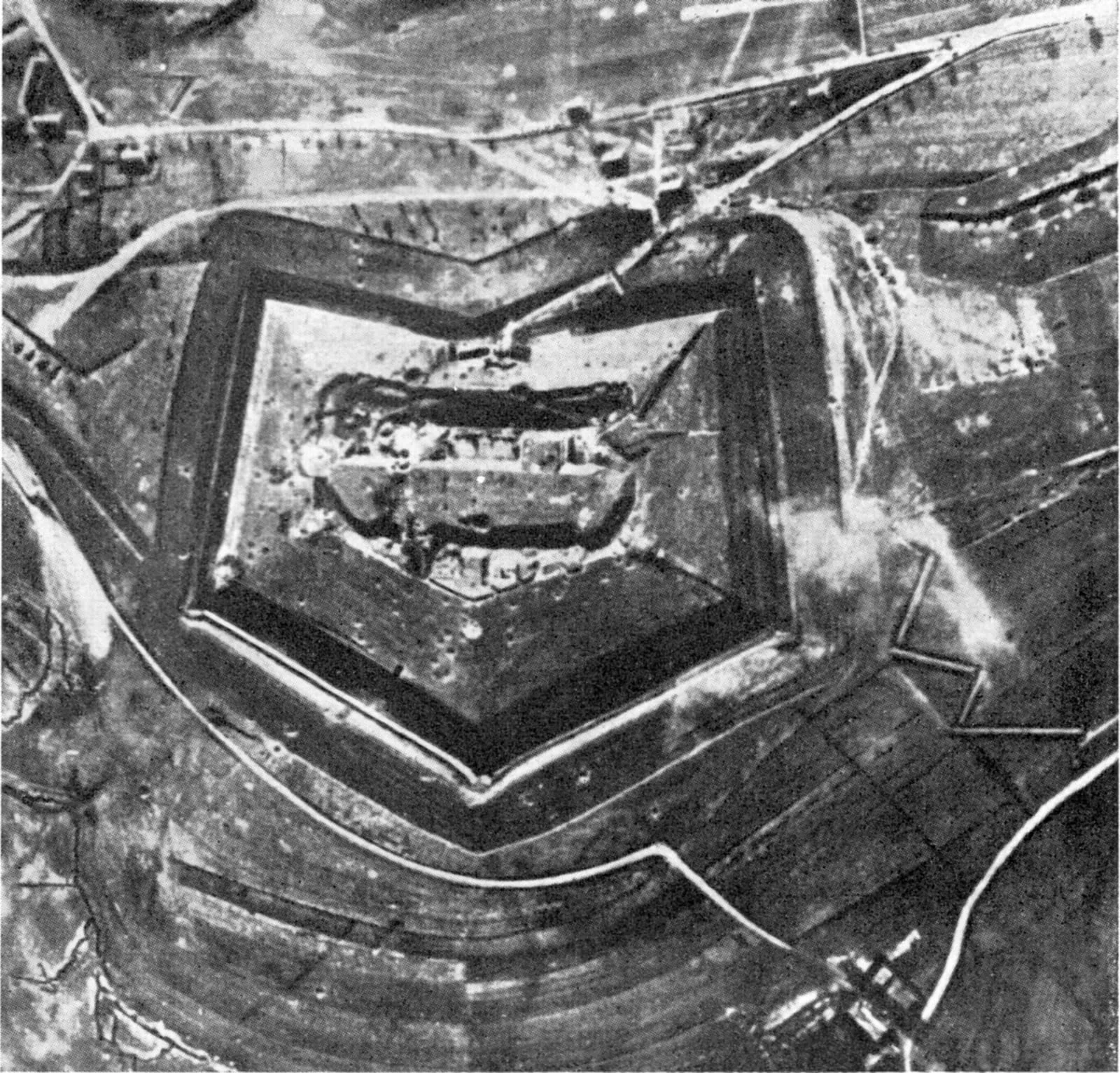
The Battle of Verdun was the longest battle of the First World War. On 21 February 1916 the German 5th Army, after an artillery bombardment without precedent, struck the French positions north of the old fortress on the Meuse. Within a few days it broke through two lines of defence and took Fort Douaumont, the largest of the Verdun forts, almost without a fight. The French, however, did not collapse. Under General Philippe Pétain they halted the advance, and along the single road from Bar-le-Duc they brought an unbroken stream of men and ammunition to the front. Over the following months the Germans assaulted the heights on both banks of the river; in June they took Fort Vaux and came within a few kilometres of the town, but got no further. When the Allied offensive on the Somme and the Russian offensive in the east began in the summer, the initiative passed to the French, who in October and December regained most of the lost ground. The battle cost the two sides together about 700,000 killed, wounded and missing, and Verdun became for the French the symbol of the whole war.
Name and dates
The French speak of the Battle of Verdun (bataille de Verdun), the Germans of the battle for Verdun (Schlacht um Verdun). We use the dates 21 February – 18 December 1916, that is from the first day of the German attack to the end of the second French counter-offensive. This is how the French and English Wikipedias and many historians date the battle. The end dates vary somewhat in the literature: German studies often end the battle on 19 December, and French casualty returns cover the period up to 20 December. The British chronology of the war on which our timeline is based divides the fighting of 1916 into the “defensive battle of Verdun” (from 21 February to the summer) and the “first offensive battle” (from 24 October to 18 December, including the December fighting for Louvemont and Bezonvaux). It calls the attack of August 1917, when the French retook Mort-Homme and Hill 304, the “second offensive battle”, but that is not part of the 1916 battle.
Background
Verdun, for centuries a fortress guarding a crossing of the Meuse, was surrounded after the Franco-Prussian War by two rings of forts and smaller works, built on the heights a few kilometres from the town. The largest of them was Fort Douaumont. The forts were modernised several times, strengthened with thick concrete roofs, and fitted with guns in retractable armoured turrets. In the autumn of 1914 Verdun survived the German invasion, but it was left in a projecting salient of the front. The Germans, who had taken Saint-Mihiel, cut the railway to the south, and in 1915 their fire from the Argonne blocked the main line to the west. The French were left with a narrow-gauge railway and the road from Bar-le-Duc.
The rapid fall of the Belgian forts under heavy mortars in 1914, at Liège and at Namur, convinced the French high command that forts had lost their value. On 5 August 1915 the fortress was replaced by the Fortified Region of Verdun (Région fortifiée de Verdun) under General Frédéric-Georges Herr, and most of the guns and ammunition were taken out of the forts. Only the guns in the armoured turrets and small garrisons remained, and some forts were prepared for demolition. The trench lines that were to replace the forts were built slowly, because men and equipment were sent to Champagne.
The Chief of the German General Staff, Erich von Falkenhayn, believed that after the failed offensives of 1915, including the French offensive in Champagne, neither side could break the front in the west by a mass attack. In his memoirs, published after the war, he quoted a memorandum that he said he had presented to the Kaiser around Christmas 1915. In it he wrote that one had to strike at a place for whose retention the French command would throw in every last man, and then “the forces of France will bleed to death”. France, drained of strength, would make peace, and Great Britain, which Falkenhayn saw as the main enemy, would lose its “best sword”. The original of this memorandum has never been found. The German historian Holger Afflerbach (PL) believes that in this form it was written after the war, though it reflects Falkenhayn’s thinking at the time, and some scholars, among them Gerd Krumeich, think that the idea of “bleeding France white” was a justification invented after the defeat. The British historian Robert Foley argues, on the other hand, that Falkenhayn planned a battle of attrition from the start. What is certain is that the German troops expected to take Verdun rather than to fight a long battle of exhaustion.
Forces and plans
The attack was entrusted to the 5th Army of Crown Prince Wilhelm, which was in practice directed by its chief of staff, General Konstantin Schmidt von Knobelsdorf. The operation was code-named “Gericht” (judgement, verdict). Falkenhayn limited the attack to the right, eastern bank of the Meuse, against the wishes of the 5th Army staff, who wanted to attack on both banks. The objective was the Meuse Heights, from which the German artillery would dominate the whole battlefield. Falkenhayn held back part of the reserves, because he expected a British relief offensive, which he intended to smash with a counter-stroke.
By various counts the Germans concentrated between 1,200 and 1,225 guns at Verdun, two thirds of them heavy and super-heavy, including the Krupp 420 mm mortars, and stocks for firing millions of shells. Six divisions from three corps were assigned to the first attack; they waited in deep shelters (Stollen) invisible from the air. On the sector to be attacked the French had two divisions of XXX Corps and much weaker, largely obsolete artillery. The Commander-in-Chief, General Joseph Joffre, absorbed in preparing the great offensive agreed at the Chantilly conference, long ignored intelligence warnings and the alarms of Lieutenant-Colonel Émile Driant, a deputy and commander of the chasseurs in the Bois des Caures, which reached the Minister of War, Joseph Gallieni. Only in January and early February did he reinforce Verdun with several divisions.
Course of the battle
The attack on the right bank (21–29 February). The attack was set for 12 February, but rain, snow and fog delayed it by more than a week. On 21 February at about 7.15 a.m. the German artillery opened fire, which lasted almost the whole day, and at about 4 p.m. French time strong patrols with sappers, grenades and flamethrowers went forward. Tens of thousands of shells fell on the Bois des Caures, held by Driant’s chasseurs, but the surviving soldiers resisted for almost a day. On 22 February Driant was killed, and of his roughly 1,200 chasseurs little more than a hundred made it back to the French lines. Over the following days the Germans took Haumont, Samogneux, Beaumont and Ornes. On 24 February the second French position collapsed, and at headquarters there was talk of giving up the whole right bank of the Meuse.
On 25 February Joffre’s chief of staff, General Noël de Castelnau, who had arrived on the Meuse during the night, ordered the right bank to be held at all costs. The same day soldiers of the Brandenburg 24th Infantry Regiment entered Fort Douaumont almost without a fight; only a handful of French soldiers were inside. Germany celebrated a great victory, France was dismayed. During the night of 25–26 February Pétain, commander of the 2nd Army, took over the defence. The attack, however, was already flagging. The German infantry had moved away from its own heavy artillery, which was hard to drag across the churned-up ground, and on 27 February a thaw turned the battlefield into a swamp. Fire from French guns on the left bank of the Meuse was also hitting the Germans ever harder. The French held the village of Douaumont until 4 March.
Pétain, the Sacred Way and the noria. Pétain divided the front into sectors, had the forts reoccupied, rearmed and linked by a trench line, and concentrated the artillery so that it could hit attackers from both banks of the river. Supply mattered most. The road from Bar-le-Duc through Souilly, where his headquarters stood, was closed to everything but motor vehicles. Columns of lorries drove along it day and night, by various accounts one every dozen or so seconds, and battalions of labourers constantly shovelled crushed stone from nearby quarries under their wheels. The writer Maurice Barrès named it the Sacred Way (Voie sacrée). Pétain also introduced a rotation of divisions known as the noria: units were relieved after a short spell of fighting, before they were completely bled white. As a result most of the French army passed through Verdun. By various counts about 70 of the not quite one hundred French divisions fought there, whereas German divisions stayed at the front much longer and were replenished in place.
Mort-Homme and Hill 304 (March–May). Because the French artillery on the left bank was hitting the Germans on the right, Falkenhayn agreed to extend the attack to the western bank of the Meuse. On 6 March the Germans attacked the hill of Mort-Homme (“Dead Man”) and then Hill 304. The fighting for these two hills, in which both sides lost thousands of men for a few hundred metres of ground, lasted more than two months. The Germans took Hill 304 at the beginning of May and the summit of Mort-Homme at the end of May. On the right bank there was bloody fighting at the same time for the village of Vaux and the woods in front of the forts. On 10 April Pétain ended his order of the day with the words “Courage… on les aura!” (“Courage… we’ll get them!”). At the turn of March and April Falkenhayn began to doubt the point of continuing the attack, but Knobelsdorf and the corps commanders persuaded him that the Germans had to go forward, or else they would have to return to their starting positions.
Nivelle and the first attempt to retake Douaumont (May). Joffre wanted to save divisions for the planned offensive on the Somme and was dissatisfied with Pétain’s caution. On 1 May he moved him to command of the Centre Army Group and gave the 2nd Army at Verdun to General Robert Nivelle, an advocate of constant counter-attacks. On 8 May a German store of ammunition and flamethrower fuel exploded in Fort Douaumont, killing several hundred soldiers, 679 of whom were buried in a walled-up casemate of the fort. On 22 May the division of General Charles Mangin, after a bombardment lasting several days, broke into the fort and took part of it, but on 24 May the Germans cut off and captured about a thousand Frenchmen.
Fort Vaux (June). On 1 June the Germans shifted their main effort back to the right bank, against the line Thiaumont – Fleury – Souville – Vaux. On 2 June they broke onto Fort Vaux, but its garrison under Major Sylvain-Eugène Raynal defended itself in the underground passages for five days, fighting flamethrowers and grenades. When the water ran out, Raynal surrendered on 7 June. The Crown Prince received him at his headquarters and expressed his admiration for the defence. French attempts to retake the fort in the following days ended in bloody failure.
Fleury and Souville (June–July). On 22 June the Germans fired more than 100,000 shells filled with a new war gas, diphosgene, marked with a green cross, to neutralise the French artillery. The next day they took the Thiaumont works and the village of Fleury and came up to Fort Souville, some four to five kilometres from the citadel of Verdun. That day Nivelle issued an order ending with the words “Vous ne les laisserez pas passer” (“You will not let them pass”), from which grew the slogan “Ils ne passeront pas” (“They shall not pass”). The French stopped the attack at the Sainte-Fine chapel, the furthest point the Germans reached. Fleury changed hands more than a dozen times, until mid-August. On 11 July three German divisions struck at Souville. A few dozen soldiers reached the top of the fort, from where they could see the roofs of Verdun, but French machine guns and a counter-attack forced them to withdraw or surrender. It was the last great German attempt to break through.
Relief and change of command. At the beginning of June the Brusilov offensive began in the east, and on 1 July the British and French attacked on the Somme. The Somme offensive was smaller than planned at Chantilly, because the French, bleeding at Verdun, had to reduce their share. The Germans, however, had to move divisions and artillery from Verdun to other fronts. After the failure at Souville Falkenhayn ordered the 5th Army to go over to the defensive, allowing only local attacks. In August Knobelsdorf lost his post as chief of staff of the 5th Army, and on 29 August, after Romania entered the war, Falkenhayn was replaced by Paul von Hindenburg and Erich Ludendorff, who at the beginning of September finally halted the attack on Verdun.
The French counter-offensives (October–December). Nivelle and Mangin prepared a carefully planned attack with limited objectives. After a bombardment lasting several days, in which two French 400 mm railway guns pierced the roofs of Fort Douaumont and set it on fire, on 24 October three divisions went into the attack behind a creeping barrage. That day the colonial Moroccan infantry regiment retook Fort Douaumont, and the French took about 6,000 prisoners. On 2 November the Germans abandoned the ruined Fort Vaux, which the French occupied without a fight. On 15 December, after a bombardment by more than 800 guns, four French divisions under Mangin attacked again. The German defence collapsed. By 18 December the French had regained the heights of Louvemont and the Côte du Poivre and Bezonvaux, taken more than 11,000 prisoners and 115 guns, and pushed the Germans several kilometres back from the town. After this defeat the Germans dismissed several commanders, according to English-language studies including General Ewald von Lochow, who was then commanding the 5th Army. The front returned to near the line of 24 February, though Mort-Homme and Hill 304 on the left bank stayed in German hands.
Casualties
The casualty figures for Verdun were disputed from the start, because the two armies counted them differently and French veterans after the war gave figures much higher than the official ones. According to modern calculations, based on French reports and German casualty lists, from 21 February to 20 December 1916 the French lost about 360,000–380,000 killed, wounded, missing and prisoners. The most often quoted figure is 377,231. German losses are estimated at about 330,000–340,000. In all, by various estimates, about 300,000 soldiers of both sides were killed or went missing. The German command believed it was inflicting losses on the French several times greater than its own, but in reality they were almost equal. By various estimates the two sides fired between a dozen or so and more than fifty million shells at Verdun. The battlefield turned into a lunar landscape of craters in which whole woods and villages perished. Nine villages were completely destroyed, and six of them were never rebuilt.
Significance
Falkenhayn’s plan, whether his aim was to take Verdun or to bleed France white, failed. The Germans did not capture the Meuse Heights and themselves suffered losses comparable to the French. The battle did, however, tie down French forces and reduce France’s share in the Somme offensive. For Pétain it was the beginning of his fame as the defender of Verdun, and for Nivelle a springboard to the post of Commander-in-Chief in December 1916, which ended with the defeat of his 1917 offensive. The successful French counter-offensives of autumn 1916, with the creeping barrage and limited objectives, influenced the way attacks were conducted in the following years.
For the French, Verdun became a symbol of the nation’s endurance and of the sacrifice of the whole army, since most of its soldiers had fought there. On 13 September 1916 President Raymond Poincaré awarded the town the Legion of Honour and the Croix de Guerre. After the war the Douaumont Ossuary was built on the battlefield, inaugurated in 1932, holding the remains of about 130,000 unidentified French and German soldiers, with a great military cemetery in front of it. In time Verdun also became a place of reconciliation. On 22 September 1984 the President of France, François Mitterrand, and the Chancellor of West Germany, Helmut Kohl, stood hand in hand at the cemetery at Douaumont, in a gesture that became a symbol of Franco-German friendship.
Spotted a mistake?Report an error