France · The Entente
Robert Nivelle
Commander of the Second Army at Verdun (1916), Commander-in-Chief of the French armies in France (December 1916 – May 1917)
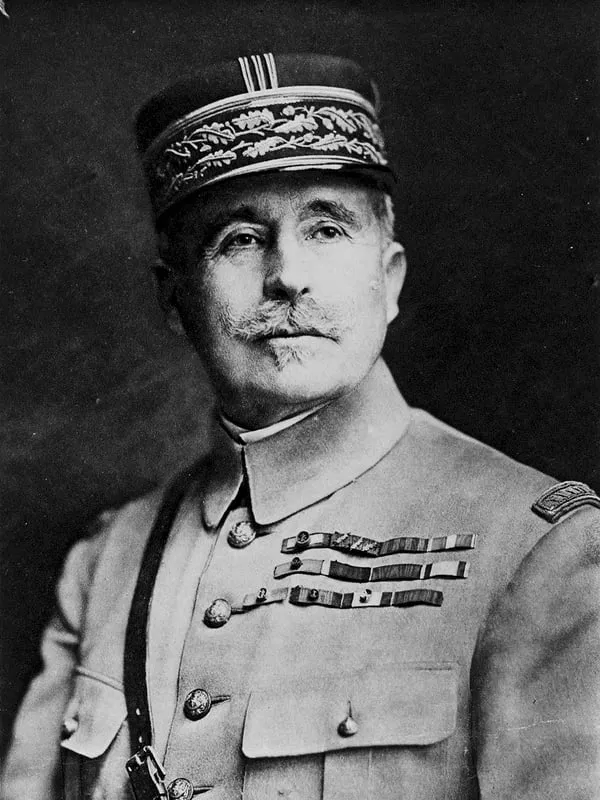
- Born:
- 15 October 1856, Tulle (France)
- Died:
- 22 March 1924, Paris
- Author:
- Łukasz Skowroń
- Photo:
- autor nieznany, domena publiczna, Wikimedia Commons

During the war Robert Nivelle travelled a path as dizzying as Pétain’s, only in the opposite direction. In August 1914 he was a colonel of artillery; in May 1916 he took over the defence of Verdun, and that autumn, together with General Charles Mangin, he retook the forts of Douaumont and Vaux. These victories, his eloquence, his self-assurance and his fluent English led the government in December 1916 to put him at the head of the French armies in place of Joseph Joffre, passing over generals senior to him in post. Nivelle promised that with the method tried at Verdun he would break the front within two days and end the war of position. He convinced French and British politicians of this, but not his own commanders. The offensive on the Chemin des Dames in April 1917 brought gains, but no breakthrough; instead it brought enormous losses and a disillusionment that drove the French army to mutiny. After five months in command Nivelle lost his post and remained far from the front until the end of the war. In France his name became a byword for excessive optimism, although some historians regard that verdict as too harsh.
Before the war
Robert Georges Nivelle was born on 15 October 1856 in Tulle in the Corrèze department, where his father, an officer of the French army, was stationed. His mother was English, and the family, which came from Poitou, was Protestant. His bilingualism was to prove very useful to him during the war. In 1876 he entered the École polytechnique and in 1878 became a sub-lieutenant of artillery.
His pre-war career was sound but not brilliant. He served in artillery regiments in France, and also in Algeria and Tunisia. He completed the staff course and worked on the general staff. In 1900 he went to China with the French expeditionary corps sent against the Boxer Rebellion. His promotion was slow: to major in 1901, to lieutenant-colonel in 1908, and to colonel only in December 1913, at the age of 57. From December 1911 he commanded the 5th Artillery Regiment at Besançon, which belonged to VII Corps. In July 1914 nothing suggested that this ageing colonel would, two and a half years later, take command of the whole French army.
1914–1915: from regiment to corps
On the outbreak of war VII Corps marched into Alsace. Nivelle’s regiment fought at Mulhouse, where, according to his French biographers, on 19 August his batteries destroyed several dozen German guns, earning him his first mention in orders. At the end of August the corps was taken to the Paris area, to General Maunoury’s newly formed Sixth Army. At the beginning of September, on the Ourcq, Nivelle’s artillery halted the attack of a corps from Alexander von Kluck’s First Army on the threatened flank of VII Corps. Later he fought on the Aisne, where, it was said, he pushed his guns almost up to the infantry line. In October 1914 he was made a brigadier-general, less than two months after Philippe Pétain.
In February 1915 he took over the 61st Reserve Division, which as part of the Sixth Army held the front north of the Aisne. In June his division carried out a subsidiary attack at Quennevières, near Moulin-sous-Touvent, intended to draw the Germans away from the offensive in Artois. The French broke into the German positions but suffered heavy losses for little gain of ground. In December 1915 Nivelle became a général de division and on 23 December took over III Corps. Until then he was not a figure known outside the army.
Verdun
When in February 1916 the Germans struck at Verdun, III Corps was in reserve. At the beginning of April it was on the right bank of the Meuse, in the area of Fort Douaumont, and the troops placed under Nivelle were named the Nivelle group. Joffre was increasingly dissatisfied with Pétain, who demanded reinforcements and was in no hurry to counter-attack. On 19 April he decided to promote him to command of the Centre Army Group and to entrust the Second Army to Nivelle, who assumed direct command on 1 May. Pétain continued to oversee the battle from the higher level, but it was Nivelle who directed it day to day.
The new commander was a believer in incessant counter-attacks, and this was soon felt. On 22 May Mangin’s division broke into Fort Douaumont, but two days later the Germans cut it off and took about a thousand Frenchmen prisoner. In June Nivelle threw unit after unit, to no effect, into counter-attacks on Fort Vaux, and then on Thiaumont. According to some historians, by mid-June the Second Army had only one fresh reserve brigade left. On 23 June, when the Germans took Thiaumont and Fleury and approached Fort Souville, Nivelle ended his order of the day with the words “Vous ne les laisserez pas passer, mes camarades” (“You will not let them pass, comrades”). From this sentence grew the slogan “Ils ne passeront pas” (“They shall not pass”), one of the symbols of the whole war. The attack was stopped, and in July the Germans, forced to send divisions to the Somme, made their last great attempt to take Souville.
In the autumn the roles were reversed. On the right bank of the Meuse, Nivelle and Mangin prepared an attack with limited objectives: a bombardment lasting several days from hundreds of guns, including two 400 mm railway mortars, followed by an infantry assault close behind a creeping barrage that moved ahead of it at a set pace. On 24 October three of Mangin’s divisions retook Fort Douaumont in a few hours, and on 2 November the French occupied Fort Vaux, abandoned by the Germans. Nivelle announced in an order of the day that Mangin’s soldiers had recovered “in four hours” ground whose capture had taken the enemy eight months. A second attack, on 15 December, pushed the Germans several kilometres back from the forts and brought in more than 11,000 prisoners. The First Offensive Battle of Verdun made heroes of Nivelle and Mangin, and Nivelle became convinced that he had found a method that could be applied on any sector of the front and on a much larger scale.
Commander-in-chief
By the end of 1916 Joffre’s position in Paris was untenable. Prime Minister Aristide Briand reshaped his government on 12 December and entrusted command of the Armies of the North and North-East, that is, of all French forces in France, to Nivelle. The choice surprised the army. Nivelle had commanded only an army, and he was promoted over the heads of the army group commanders: Ferdinand Foch, Pétain and Louis Franchet d’Espèrey. Briand and President Raymond Poincaré considered Pétain too cautious, Foch shared with Joffre the criticism for the Somme, and Nivelle promised victory. According to some accounts Joffre himself backed the candidacy, counting on an inexperienced successor being dependent on him. It turned out otherwise: within a few weeks Joffre was sidelined, and Nivelle dealt with the government and the allies directly. He did not, however, have the same authority as his predecessor. He was subordinate to the minister of war, General Hubert Lyautey, and the Salonika front ceased to fall within his remit.
Nivelle’s plan developed the decisions taken at Chantilly, but changed their spirit. Instead of attrition attacks like those on the Somme, the British and French were first to pin down the German reserves with blows between Arras and the Oise, and then a fresh army group of several dozen divisions was, with a sudden blow on the Aisne, to break the front within 24, at most 48 hours and emerge into open country. If the breakthrough failed, the attack was to be broken off. Nivelle won everyone over with his certainty: “The experience is conclusive. Our method has proved itself.” In January 1917, at the Rome conference, the French plan eclipsed the project of the new British Prime Minister, David Lloyd George, who wanted to support an Italian offensive on the Isonzo with the allies’ heavy guns.
Lloyd George in any case fell under Nivelle’s spell more than anyone. He did not trust his own commander-in-chief, Douglas Haig. Nivelle, who spoke English with ease, seemed to him a general who at last knew how to win. At the Calais conference on 26–27 February 1917 Lloyd George supported a French scheme that would have permanently subordinated the British army to Nivelle, leaving Haig little more than matters of discipline and personnel. The British generals were outraged and it ended in a compromise: Haig was to carry out Nivelle’s directives only for the duration of the offensive, with the right of appeal to his own government. Nivelle spoilt things the very next day, however, by sending Haig a letter in a peremptory tone, as if to a subordinate. Relations between the two commanders had to be repaired at the London conference in mid-March.
The plan falls apart
In the spring circumstances turned against Nivelle. In mid-March the Germans withdrew to the Hindenburg Line, shortened the front and gained a dozen or so reserve divisions, and the sector on which Franchet d’Espèrey’s army group was to attack ceased to exist. When Franchet d’Espèrey asked for permission to strike at the retreating Germans, Nivelle refused, because he did not want to change the plan. The British official history considers that this may have cost the French a great success. Revolution broke out in Russia, which removed the hope of a simultaneous Russian attack. On 17 March Briand’s government fell, and in Alexandre Ribot’s cabinet the minister of war became Paul Painlevé, who from the start distrusted Nivelle and his plan.
Painlevé spoke with the army group commanders behind the commander-in-chief’s back, and they did not hide their doubts. General Alfred Micheler, who was to lead the main blow, wrote on 22 March that the Germans had built more positions, had more reserves and were expecting an attack. On 6 April a council of war met at Compiègne, attended by the President, the Prime Minister, ministers and the army group commanders. Micheler would not vouch for a breakthrough; Pétain proposed an attack with limited objectives. Nivelle then offered his resignation. The ministers did not accept it, because changing the commander on the eve of the offensive seemed even more dangerous. Poincaré concluded that they had to attack and, if the front could not be broken, break off the attack. The Germans meanwhile had known of the preparations for weeks, and on 4 April at Sapigneul they captured the attack plan of one of the French battalions. Nivelle did not change the plan.
Chemin des Dames
On 16 April 1917, a week after the British attack at Arras, the offensive opened against the Chemin des Dames ridge. The preparatory bombardment, carried out in bad weather, failed to destroy many German wire entanglements and machine-gun nests, and the Germans, defending according to new principles of defence in depth, kept their reserves out of range of the French artillery. On the first day the French took only part of the ridge, and many of the first French tanks, thrown into battle near Berry-au-Bac, went up in flames. Even so, the Second Battle of the Aisne was not a defeat on the scale of earlier offensives: by 20 April the French had taken more than 20,000 prisoners and 147 guns, and Mangin’s Sixth Army forced the Germans to abandon the salient at Laffaux. But Nivelle had promised a decision, and the result was measured against that promise.
By about 20 April it was clear that there would be no breakthrough. The medical service, prepared for some fifteen thousand wounded, broke down, and losses in the first ten days reached, by various calculations, from about 96,000 to about 134,000 men. Nivelle did not break off the battle as he had promised the government. At Micheler’s request he changed its objective: instead of a breakthrough it was to take the whole ridge and push the Germans back from Reims. The government ceased to trust him and controlled his every step. On 29 April Pétain became Chief of the General Staff, that is, the government’s military adviser, which meant that Nivelle had been given a supervisor. On 2 May Mangin, Nivelle’s closest collaborator, blamed for the heavy losses, was dismissed. The last attacks of 4–5 May brought the capture of Craonne and the Californie plateau, but did not restore his position. According to the Canadian official historian Gerald Nicholson, by the end of the offensive the French had lost about 187,000 men.
Dismissal
On 11 May the government demanded that Nivelle resign of his own accord. He refused, convinced that they wanted to make him a scapegoat. On 15 May the Council of Ministers removed him and appointed Pétain commander-in-chief. Nivelle was promised command of an army group, but there was no vacant post and he was sent on leave, and at the end of June the appointment was withdrawn. Meanwhile mutinies were spreading through the army. Soldiers who had been promised an end to the war refused to go into attacks. The high command blamed pacifist propaganda from home, but historians agree in seeing their immediate cause in the disillusionment after Nivelle’s offensive.
From August to October 1917 the conduct of the offensive was investigated by a commission chaired by General Joseph Brugère, on which Foch and General Henri Gouraud also sat. It had no power to impose punishments. It found that in preparing and conducting the attack Nivelle “had not been equal to the overwhelming task he had undertaken”, but also that the battle on the Aisne could not be regarded as a military defeat. Nivelle was not brought to trial. In December 1917 the new Prime Minister, Georges Clemenceau, sent him to Algiers as commander of XIX Corps and of French troops in North Africa. It was only a partial rehabilitation: Nivelle never returned to the front.
After the war
In 1920 Nivelle joined the Supreme War Council and received the Grand Cross of the Legion of Honour and the Médaille militaire. In 1921 he retired. He did not take part in the victory parade in Paris on 14 July 1919, in which the other great commanders marched. He died in Paris on 22 March 1924. The minister of war, André Maginot, delivered the funeral oration over his coffin. He was buried in Passy Cemetery, and in 1931 his remains were moved to Les Invalides.
Assessment
For decades Nivelle was an almost entirely negative figure in historiography. British and American historians such as Robert Doughty and Julian Thompson write that his plan was superficially prepared, that he disregarded losses and could not accept facts that contradicted his convictions: the German withdrawal to the Hindenburg Line, the revolution in Russia, the loss of secrecy. A method that had succeeded at Verdun on a sector a few kilometres wide, against exhausted German divisions, could not simply be scaled up to a front of several dozen kilometres awaited by a prepared enemy. The gravest charge remains the promise he could not keep: it was this that made soldiers and politicians see gains that were normal in trench warfare as a catastrophe. At Verdun his critics also reproached him for the costly, continual counter-attacks of June 1916.
There is, however, no lack of more lenient voices. The British official history acknowledged that the gains of April 1917 were large compared with earlier offensives, and the losses lower than in Champagne in 1915 or on the Somme. Joffre wrote in his memoirs that the true saviour of Verdun was Nivelle, supported by Mangin. The French historian Denis Rolland, in a 2012 biography, argued that the image of Nivelle as a “butcher” was shaped largely by politics: Painlevé and Pétain’s supporters needed someone to blame, and the legend of the “saviour of Verdun” required the merits of other generals to be diminished. Most historians agree today that Nivelle was a capable gunner and army commander who was raised to a post beyond his abilities, and that his failure taught the French and British to be wary of generals promising a quick victory.
Sources
Spotted a mistake?Report an error
Commanded in battles
(06)- 21 February – 18 December 1916Battle of VerdunWestern Front
- 24 October – 18 December 1916First Offensive Battle of VerdunWestern Front
- 22 February – 5 April 1917German retreat to the Hindenburg LineWestern Front
- 16 April – 9 May 1917Second Battle of the AisneWestern Front
- 16 April – 9 May 1917Nivelle OffensiveWestern Front
- 17 April – 20 May 1917Third Battle of ChampagneWestern Front
Mentioned in battles
(03)Often appears with
People who appear in the same events.
On the timeline
(29)1916
June
August
October
November
December
- 26
- London conference on the peace notesOn 26–28 December 1916 British and French ministers met in London to discuss the reply to the peace notes, Salonika and the Nivelle plan.
- Joffre becomes Marshal of FranceOn 26 December 1916 Joffre gave up the last of his authority over the army and was made Marshal of France, the first since 1870. It was a consolation prize.
1917
January
February
March
- 17
- French take RoyeOn 17 March 1917 the French advance guard entered Roye, ruined by the Germans. About 800 inhabitants whom the occupiers had not deported awaited the troops.
- Fall of the Briand governmentOn 17 March 1917 Aristide Briand, French prime minister since October 1915, resigned with his cabinet. After Lyautey left he found no new war minister.
April
May
- 04
- French retake CraonneOn 4 May 1917 the French 36th Division took the ruins of Craonne and broke onto the Californie plateau, one of the last successes of the Nivelle offensive.
- Third Battle of the Scarpe endsOn 4 May 1917 the British pulled the last troops out of the failed Scarpe attack. In Paris Haig and the French agreed the time for a breakthrough had passed.