Key event
Battle of the Hills begins
- Category:
- Military operations
- Front:
- Western Front
- Date:
- 17 April 1917
- Author:
- Łukasz Skowroń
- Battle:
- Third Battle of Champagne
- Tags:
- France, Germany, Robert Nivelle
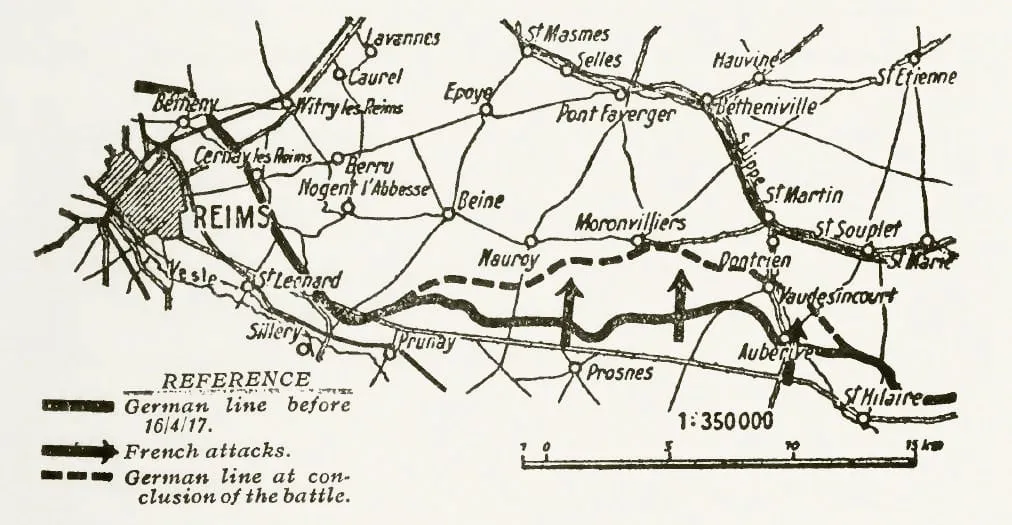
On 17 April 1917 at 4.45 a.m., still in darkness, in rain and snow, the French 4th Army of General François Anthoine attacked the Moronvilliers massif in Champagne, east of Reims. It was the second, subsidiary blow of the Nivelle Offensive, delivered the day after the 5th and 6th Armies went forward against the Chemin des Dames. By evening the French had passed through the first German position, taken Mont Sans Nom and reached the summits of Mont Blond and Mont Cornillet. They took more than 2,000 prisoners, but nowhere broke the front, and on the western wing the attack stalled in the very first hours. The French called the fighting that began then the Battle of the Hills (bataille des Monts).
Hills above the plain
The Moronvilliers massif is a chain of chalk hills about 10 kilometres long, towering over the plain around it. From the west it was formed by Mont Cornillet, Mont Blond, the highest, Mont Haut (257 m), Mont Perthois, Le Casque and Le Téton, and in the east, above the river Suippe, the solitary Mont Sans Nom. The Germans had held these hills since the autumn of 1914 and from them could see the whole plain around Châlons, and so also the French rear, roads and camps. In the Second Battle of Champagne in the autumn of 1915 the French had attacked further east and had not reached the hills.
The defence was deep and solid. Behind the first line at the foot of the hills ran a second, halfway up the slopes, and the summits were ringed with concrete shelters and machine-gun nests. Under the northern slopes of Mont Cornillet and Mont Perthois the Germans had cut tunnels into the chalk, in which they could keep whole companies safe from shellfire and ready to counter-attack. The French did not know about the tunnels. The hills were defended by Group Prosnes, that is XIV Corps with four divisions in line. According to the British and German official histories it was already subordinate to the 1st Army of General Fritz von Below, inserted in the spring between the 7th and 3rd Armies. Below took command only on 16 April, which is why some works still assign this sector to the 3rd Army of General Karl von Einem, which had held it before and whose right wing stood beyond the Suippe. According to some accounts the German command expected only feint attacks in front of Reims, but when the French bombardment began at the beginning of April it started bringing up divisions intended for counter-attacks behind the hills.
Bombardment and assault
On a dozen or so kilometres of front from Prunay to Aubérive the French assembled, according to French sources, about 1,600 guns. The artillery had been registering since the beginning of April, and the bombardment proper lasted several days, in snow and rain that often grounded the observation aircraft. It destroyed most of the trenches on the southern slopes, but not the concrete bunkers in the Bois de la Grille copse in the west, nor the tunnels. On the night of 16–17 April the infantry moved into its jumping-off positions, wading across waterlogged meadows. The 4th Army belonged to General Philippe Pétain’s Centre Army Group. Its immediate objective was the ridge with the German observation posts, and once it was taken the army was to push on northwards towards the Suippe.
At 4.45 a.m. the first wave left the trenches, with a creeping barrage moving ahead of it. The German artillery replied late. One French telephonist recalled that at first a strange silence fell, and then “everything shook and burst into flame”. Flares rose over the battlefield, green and red from the Germans, white from the French, and in the grey dawn thick snow began to fall.
The course of the day
Things went best on the right wing of XVII Corps. General Degoutte’s Moroccan Division, made up of the Foreign Legion, Zouaves and North African tirailleurs, attacked between Mont Sans Nom and the Suippe. The 8th Zouave Regiment ran up Mont Sans Nom in the half-light and took the summit at 5.55 a.m. The Zouaves also captured several guns and pressed on through the woods towards Moronvilliers. To their right the Foreign Legion Regiment and the 4th Tirailleur Regiment met fierce resistance in a fortified salient called the Golfe, in front of Aubérive. The commander of the legionnaires, Lieutenant-Colonel Duriez, was mortally wounded and died the next day. Over the following days the legionnaires took trench after trench.
The 33rd Division advanced roughly 1,800 metres and reached Le Téton and Le Casque, but there it was stopped by machine-gun fire from the woods on the slopes. The 45th Division, in which African battalions, Zouaves and tirailleurs fought, reached the edge of the wood below Mont Perthois. It repulsed four counter-attacks, but did not take the concrete shelter complex the Germans called the Konstanzlager, which withstood even close-range fire from field guns.
On the left wing, in VIII Corps, the 34th Division crossed two lines of trenches and by about 9 a.m. had reached the summits of Mont Blond and Mont Cornillet. Its soldiers pulled prisoners out of shelters buried by the bombardment. In the afternoon, however, the German garrison came out of the tunnel under Cornillet, supported by reserves, and pushed the French off the ridge. A battalion of the 83rd Infantry Regiment held on at the northern edge of a captured trench until evening, when its ammunition ran out. Alongside, the 16th Division came under fire from intact bunkers in the Bois de la Grille. The 95th Regiment broke through the copse, but from about 9 a.m. German counter-attacks pushed it back, until at noon, out of grenades, it withdrew into shell holes. The division’s two other regiments were stuck on the open slope. Beyond the Suippe the 24th Division occupied the eastern part of Aubérive. One of its regiments, brought up by lorry at the last moment, went into the attack in confusion. A dozen or so soldiers abandoned their positions at that point. Twelve of them were later sentenced to death, but they were pardoned. This is sometimes regarded as the first sign of the crisis that engulfed the French army in May.
The first day’s balance
By evening the French line lay between half a kilometre and 2.5 kilometres ahead of the jumping-off positions. The 4th Army had passed through the first position, on several sectors reached the intermediate position and taken some of the German observation points. More than 2,000 soldiers were taken prisoner, and several guns and many machine guns were captured. The day’s objectives, the whole ridge from Cornillet to Le Téton, were not achieved. During the night the Germans counter-attacked three times on Mont Blond and Cornillet, but were repulsed. The British official history later judged that the results in Champagne were similar to those on the Aisne, perhaps even slightly better, but no breakthrough was in sight.
The fighting was only beginning. On 18 April the French took the Konstanzlager and broke onto Mont Haut, and on 19 April onto Le Téton, after which they repulsed a great German counter-attack. Mont Cornillet, defended by the tunnel garrison, fell only on 20 May.
Remember the articles you have read? Only in this browser; nothing is sent anywhere.How it works
Read ·
Spotted a mistake?Report an error
Meanwhile
(04)Elsewhere in the same days.
- 17 April 1917 · War at seaSinking of the Lanfranc and DonegalOn 17 April 1917 German submarines sank two ships carrying wounded from Le Havre in the Channel. The Lanfranc also carried 167 wounded German prisoners.
- 19 April 1917 · Middle EastEnd of the Second Battle of GazaOn 19 April 1917 the British assault on Gaza, despite tanks and gas, broke on the Turkish redoubts. The British lost over 6,000 men and failed to take the town.
- 19 April 1917 · DiplomacySaint-Jean-de-Maurienne conferenceOn 19 April 1917 the prime ministers of Britain, France and Italy agreed an Italian zone in Asia Minor. Sonnino rejected a separate peace with Austria.
- 20 April 1917 · War at seaClash of Swift and BrokeOn the night of 20/21 April 1917 the British leaders Swift and Broke caught German torpedo boats in the Dover Strait and sank two of them, G 42 and G 85.
Related events
(04)The same battle, people or subject.
- 16 April 1917 · Western FrontNivelle offensive beginsAt 6 a.m. on 16 April 1917 the French attacked on the Chemin des Dames. Meant to break through in two days, by evening they were stuck below the ridge.
- 20 April 1917 · Western FrontCollapse of the Nivelle offensiveAround 20 April 1917 the French gave up hope of a breakthrough on the Aisne. They had 20,000 prisoners and huge losses; the Chemin des Dames fighting went on.
- 4 May 1917 · Western FrontFrench retake CraonneOn 4 May 1917 the French 36th Division took the ruins of Craonne and broke onto the Californie plateau, one of the last successes of the Nivelle offensive.
- 4 May 1917 · Western FrontThird Battle of the Scarpe endsOn 4 May 1917 the British pulled the last troops out of the failed Scarpe attack. In Paris Haig and the French agreed the time for a breakthrough had passed.