1915: The autumn offensive – Loos and Champagne
Second Battle of Champagne
- Dates:
- 25 September – 6 November 1915
- Front:
- Western Front
- Location:
- Champagne east of Reims, between Aubérive, Souain, Tahure, Massiges and Ville-sur-Tourbe (Marne department), FranceOn the battle map →
- Sides:
- German EmpireErich von Falkenhayn, Karl von Einem
- Result:
- Inconclusive. The French advanced 3–4 kilometres and took the Main de Massiges and Tahure, but did not break the German second position and suffered enormous losses.
- Author:
- Natalia
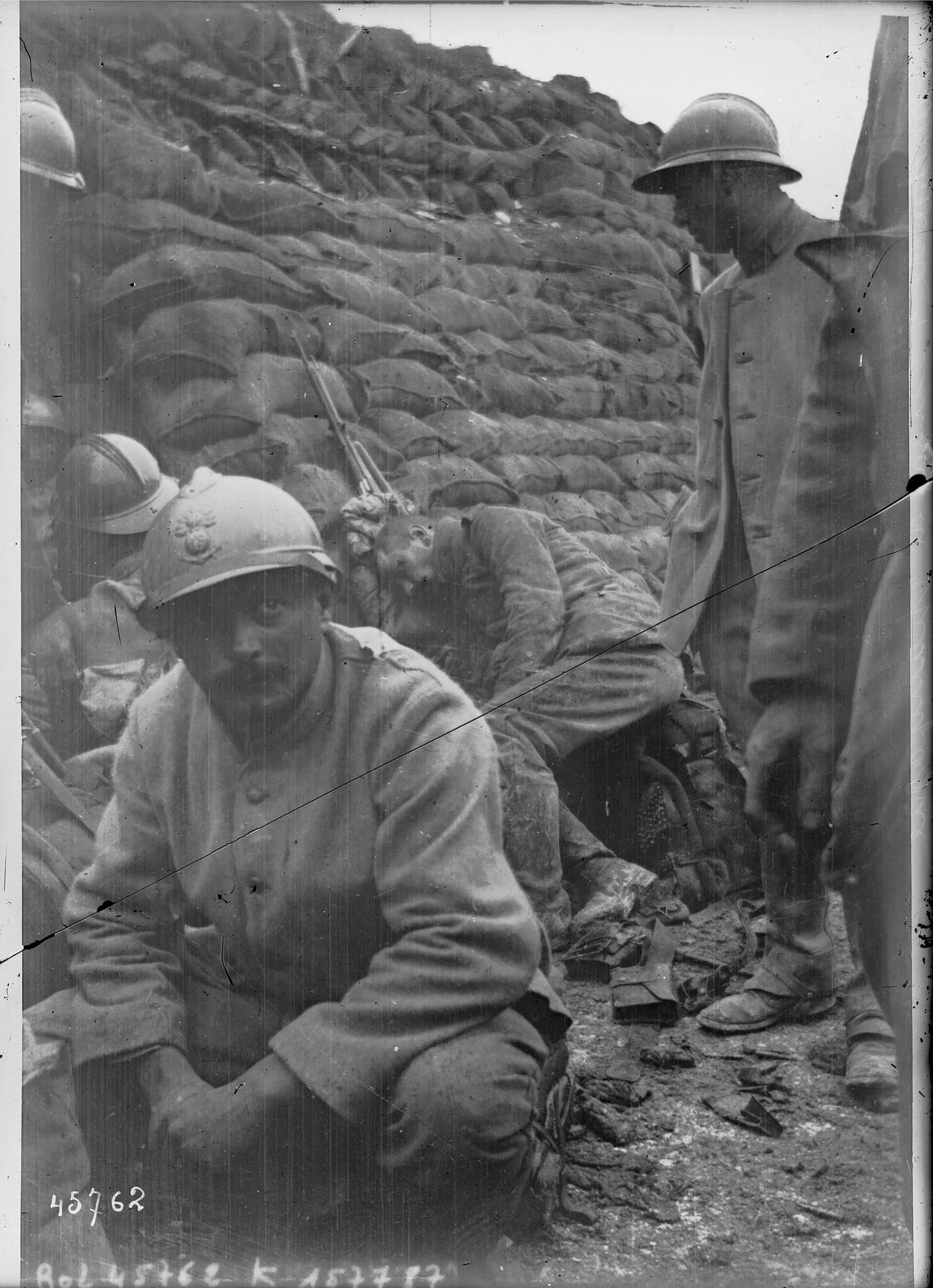
The Second Battle of Champagne was the largest offensive of the French army in 1915 and the main part of the Allies’ autumn attack on the Western Front. On 25 September two armies of General Noël de Castelnau’s army group, General Philippe Pétain’s 2nd Army and General Fernand de Langle de Cary’s 4th Army, struck the German 3rd Army east of Reims, on the same chalk hills where fighting had raged in winter and spring in the First Battle of Champagne. This time the French threw far more divisions and artillery into the fight. On the first day they got through the German first line in several sectors and took well over ten thousand prisoners. The German second position, hidden on the reverse slopes, nevertheless withstood all attacks. The fighting, with pauses, went on until November and cost the French about 140,000–180,000 killed, wounded and missing.
Name and dates
On this page we adopt the dates 25 September – 6 November 1915. This is how the battle is dated by the British chronology of the war on which our timeline is based, and also by the Polish, English and German Wikipedias. The offensive proper, aimed at breaking through the front, lasted only a few days, however. After 29 September Joffre halted the attack to bring up artillery and ammunition, and on 3 October he abandoned the attempt at a breakthrough. On 6 October the French attacked again, and after that they fought only for individual hills and salients. That is why the French Wikipedia ends the battle on 9 October, and some French studies on 1 November. The last fighting, including German counter-attacks at the turn of October and November, died down on 6 November.
The French speak simply of the Battle of Champagne of 1915 or of the Second Battle of Champagne, and the Germans of the autumn battle in Champagne (Herbstschlacht in der Champagne), as distinct from the winter battle of February and March 1915.
Background
In the summer of 1915 the armies of the Central Powers were driving the Russians out of Congress Poland, and in August they took Warsaw. The commander-in-chief of the French army, General Joseph Joffre, wanted to take advantage of the Germans keeping relatively few troops in the west, to help Russia, to win over the wavering neutrals and finally to return to a war of manoeuvre. The plan provided for two simultaneous blows about 150 kilometres apart: the main one in Champagne and a second one, in Artois, with British participation. The British government long resisted, and at the Calais conference in July proposed confining itself to the defensive in the west, but in August it agreed to take part in the offensive.
The Champagne sector was chosen by Castelnau. The ground here was relatively flat and open, covered with sparse pine copses, and between the lines there were no larger villages that the Germans could turn into fortresses, as in Artois. After the breakthrough the troops were to advance north, in the general direction of Sedan, while the cavalry was to cross the Aisne and ride on Mézières and beyond, across the supply lines of the German armies. According to the British official history, 34 infantry divisions and 8 cavalry divisions were assembled for the attack. On a front about 25–30 kilometres long, from Aubérive on the Suippe to Ville-sur-Tourbe, 20 divisions stood in the first line, 7 more behind them, and in reserve an infantry division and 6 cavalry divisions that were to go out into the open through the breach. On the left, from Aubérive to the area of Perthes, the 4th Army attacked, and on the right, as far as Massiges, the 2nd Army. Pétain, who had taken over the 2nd Army in June, according to French sources secured the postponement of the attack from 8 September first to 15 and then to 25 September, so as to prepare it better.
The preparations were enormous. The French built new roads and railway sidings, and before the assault the troops were assembled in extensive “places d’armes” behind the front, hidden from observation. Some of the soldiers received the new Adrian steel helmets, worn in Champagne for the first time on such a large scale. The Germans knew what was coming, because from the higher hills they could see the French works. General Karl von Einem, commander of the 3rd Army, had only seven divisions and hardly any reserves in the threatened sector, but his soldiers had built a second position behind the first line, set further back, largely on the reverse slopes. Most of the field artillery had also been withdrawn there. The chief of the German General Staff, General Erich von Falkenhayn, made light of the threat. As late as 24 September, according to German sources, he wrote to Einem that the French “had no dash” and that their attack need not be feared.
Course
22–24 September. On the morning of 22 September more than a thousand French guns began a three-day artillery preparation. Field guns and trench mortars, used for the first time on such a vast scale, smashed the first line and cut the wire, while long-range heavy guns shelled the roads, stations and the Bazancourt–Challerange railway line.
25 September. During the night heavy rain began to fall, which did not let up until noon and grounded the aircraft directing the artillery fire. At 9.15 a.m. the infantry went over to the attack, in some regiments with colours unfurled and to the sound of bands. In most sectors the German first line did not hold. On the left wing the 4th Army’s attack stalled on the fortifications of the Épine de Vedegrange and in front of the Wacques farm, but in the centre the II Colonial Corps got through the trenches by the road from Souain to Somme-Py and came up to the Navarin farm, where it was stopped in front of intact wire. The corps of the 2nd Army crossed the road from Souain to Tahure, but were stopped in front of the Bois Jaune wood and the Butte du Mesnil hill. On the right wing the I Colonial Corps broke onto the Main de Massiges, a system of hills that from the air resembles a hand with outspread fingers. That day General Jean-Baptiste Marchand, known from the Fashoda incident of 1898 and commander of a colonial division, was seriously wounded in the stomach. The French took about 14,000 prisoners and captured many guns. By evening only two breaches reached the German second position, and there the attackers were stopped by wire that the artillery had not destroyed, because it could not see it. In the rear further waves of infantry and the cavalry waiting for the breakthrough crowded together.
26–29 September. The German command was close to panic. The chief of staff of the 3rd Army proposed falling back about 3 kilometres, behind a nearby river. Falkenhayn replaced him with Colonel Fritz von Loßberg, who cancelled the retreat, ordered the second position to be held, and moved the artillery observers to the ridges behind it. Further divisions were brought in from the reserves and from the Eastern Front, including X Corps. On 26 September the French reached the second position on a sector of about 12 kilometres and briefly broke into it at one point. According to French sources, on 27 September about 2,000 Germans surrounded in the Trou Bricot woods laid down their arms, while the cavalry that tried to get through along the road to Somme-Py suffered heavy losses and had to withdraw. On 28 September a French attack pierced the second position, but the next day a German counter-attack took back the ground won. In the fighting near the Navarin farm on 28 September the legionnaire Blaise Cendrars, a Swiss-born poet, was seriously wounded. He lost his right arm, and many years later described his war in the book La Main coupée (“The Severed Hand”). Exhausted ammunition and enormous losses forced Joffre to halt the offensive. According to the British official history the first phase of the attack ended on 30 September. He ordered the ground won to be consolidated and the cavalry withdrawn.
October and November. On 3 October Joffre abandoned the attempt at a breakthrough and ordered a battle of attrition. After a bombardment lasting several days, on 6 October the 2nd and 4th Armies attacked again. In the centre the French took the village of Tahure and the Butte de Tahure hill, capturing several hundred prisoners, but on the wings they suffered an almost complete failure. From 7 October further German divisions arrived from the east, and further attacks, among others on 13 October, no longer changed anything. At the turn of October and November the Germans went over to counter-attacks. On 30 October they retook the summit of the Butte de Tahure, and at the beginning of November hill 199 above Massiges. On 6 November the fighting died down.
Casualties
Casualty figures differ depending on the source and the period they cover. According to French figures, cited by the British official history and the German official history, the armies fighting in Champagne lost 3,743 officers and 139,824 other ranks from 25 September to 7 October, a total of about 143,500 men. The French Wikipedia gives for the whole battle 27,851 killed, 98,305 wounded and 53,658 missing or taken prisoner, a total of nearly 180,000. German losses are estimated at 72,000–85,000 men. The British official history, based on German lists, gives about 85,000, and the German official history 81,000 in the period from 22 September to 14 October. The French took more than 20,000 soldiers prisoner, according to some sources about 25,000, and captured more than a hundred guns. The armies fighting in Champagne alone fired about 2.8 million field shells and nearly 580,000 heavy ones, which together with the fighting in Artois exhausted the French ammunition stocks.
Significance
The French advanced 3–4 kilometres on a front a dozen or so kilometres wide and took the Main de Massiges, Tahure and the Navarin farm, but they did not break through the front. The battle showed that two successive defensive positions could not be crossed in a single blow. The first could be taken after careful artillery preparation, but the second, hidden from observation, required a separate operation, and in the meantime the defender had time to bring up reserves. Joffre later claimed that the offensive had brought important tactical gains and moral superiority, and that the strategic aims had not been achieved only for lack of artillery. Pétain and many other commanders drew a different conclusion: instead of a breakthrough in one blow, what was needed was a series of methodical attacks, each of which had to be carefully prepared.
The Germans concluded that building the second position had saved the front, and based the further development of defence in depth, with positions on reverse slopes, on their experience in Champagne. Falkenhayn wrote in his memoirs that the autumn battles had proved that mass attempts at a breakthrough had no chance of success in the west. From these considerations grew his plan for 1916, which led to the Battle of Verdun.
The offensive caused a political crisis in France. At the end of October the government of René Viviani fell, and Aristide Briand became the new prime minister. On the battlefield, near the Navarin farm, a monument and ossuary to those who fell in Champagne were erected after the war.
Spotted a mistake?Report an error