Germany · The Central Powers
Erich von Falkenhayn
Chief of the General Staff of the German Army (1914–1916), Prussian Minister of War (1913–1915)
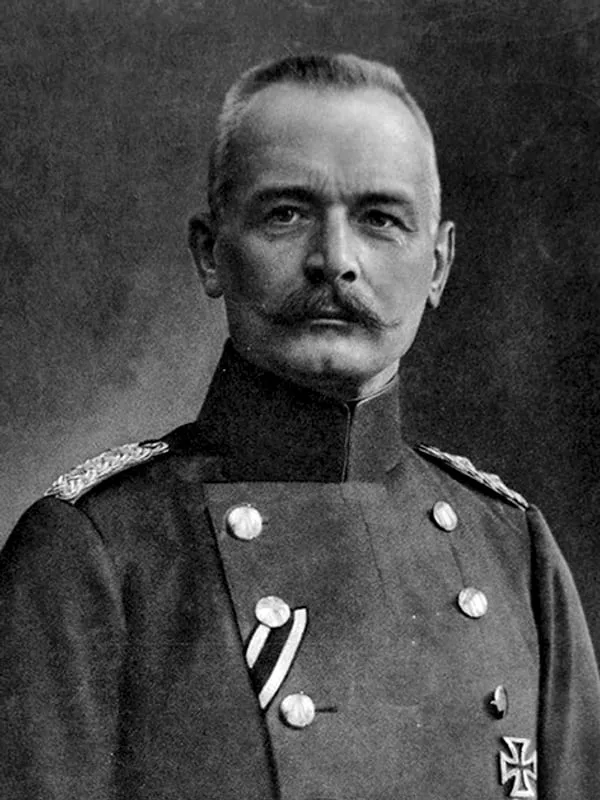
- Born:
- 11 September 1861, Burg Belchau, now Białochowo near Graudenz (West Prussia)
- Died:
- 8 April 1922, Lindstedt Palace near Potsdam
- Author:
- Łukasz Skowroń
- Photo:
- Albert Meyer, domena publiczna, Wikimedia Commons

Erich von Falkenhayn led the German army for almost two years, from the defeat on the Marne to August 1916. Earlier than most German generals, he understood that Germany could not defeat all its enemies at once and that only a favourable compromise could end the war. From this conviction grew his strategy of attrition: limited offensives in the east, defence in the west and one great blow that was to break France. That blow was the Battle of Verdun, which consumed hundreds of thousands of men on both sides and brought no decision. After his dismissal Falkenhayn smashed the Romanian army within a few months, but in Palestine he failed to stop the British. To this day he remains one of the most controversial figures of the German high command.
Before the war
He was born on 11 September 1861 on the Burg Belchau estate, today Białochowo near Graudenz, into a family of Prussian nobility. At the age of eleven he entered the cadet corps at Culm, and in 1880 he became a second lieutenant in an Oldenburg infantry regiment. He graduated from the War Academy and in 1891 joined the Great General Staff. In 1896, for financial reasons and with his career in mind, he took leave and went to China as a military instructor. He then served in the German leased territory of Kiautschou and on the staff of the expeditionary corps that suppressed the Boxer Rebellion. With interruptions, he spent several years in the Far East. From this period he took away a conviction that he understood the peoples of the East well, a conviction that was to cost him dearly in 1917.
After that his career gathered pace. He was chief of staff of a corps in Metz, commander of the 4th Foot Guards Regiment and chief of staff of a corps in Magdeburg. While organising the imperial manoeuvres he caught the eye of Wilhelm II. In July 1913, to the surprise of many senior generals, Falkenhayn became Prussian Minister of War. At the turn of 1913 and 1914 he made his name in the Reichstag as a ruthless defender of the army in the Saverne (Zabern) affair, when officers in Alsace arbitrarily arrested civilians. In the July Crisis of 1914, according to the research of his biographer Holger Afflerbach (PL), he did not at first expect a great war, but in the last days of July he was among those pressing for mobilisation to be declared quickly.
Moltke’s successor
On 14 September 1914, when Helmuth von Moltke broke down after the defeat on the Marne, the Kaiser entrusted Falkenhayn with the direction of the General Staff of the Field Army. The change was announced only on 3 November. Falkenhayn was 53 and younger than many of the generals he was now to command. His power rested not on the support of the General Staff, in which he had built up no influence during his years abroad, but on the Kaiser’s trust. Until January 1915 he combined command of the army with the office of Minister of War, which aroused the resentment of many officers.
In the west he still tried to regain the initiative. In the Race to the Sea both sides tried to outflank each other until the front reached the coast. In October and November Falkenhayn struck in Flanders, counting on breaking through the weak Allied front and opening the way to the Channel ports. In the First Battle of Ypres he threw into the attack newly formed reserve corps, made up largely of poorly trained volunteers, which suffered heavy losses at Langemarck. The attack failed, and the Western Front froze in the trenches.
The defeat at Ypres shook Falkenhayn. On 18 November 1914 he is said to have told the chancellor, Theobald von Bethmann Hollweg, that the army was a “broken instrument” and that Germany could no longer defeat Russia, France and Britain at once. He advised seeking a separate peace with Russia so as to wage the war in the west afterwards. The chancellor did not take up the idea, and Falkenhayn never again returned to it so openly.
The dispute over the east
Throughout 1915 Falkenhayn was locked in a dispute with the command of the Eastern Front, Paul von Hindenburg and Erich Ludendorff. The victors of Tannenberg wanted to move large forces east and destroy the Russian army in gigantic encircling manoeuvres. Falkenhayn believed that Russia could not be defeated completely, because it could always withdraw into the depths of its vast country, and that weakening the west would be too risky. In January 1915 Hindenburg demanded his removal and threatened to resign. The Kaiser refused, but nor did he want to alienate the most popular commander in Germany. Falkenhayn had to give up the War Ministry and accept that he had powerful enemies in the army. Men around Ludendorff called him a “criminal” in their private letters.
His relations with the chief of the Austro-Hungarian staff, Franz Conrad von Hötzendorf, were just as difficult. For Conrad the most important enemy was Russia, followed by Serbia and Italy; for Falkenhayn all these fronts were secondary to France. In the spring of 1915, however, when the Austro-Hungarian army was close to collapse after the Carpathian winter battle, Falkenhayn decided that the ally had to be helped. He moved the new Eleventh Army under August von Mackensen to the east, and on 2 May it broke through the Russian front at Gorlice. It was the greatest victory of his tenure. In the following months the Central Powers recaptured Galicia and occupied the Kingdom of Poland.
In the summer of 1915 the dispute flared up again. Ludendorff proposed a deep thrust from the north into the Russian rear, through Kovno and Vilna, while Falkenhayn preferred more limited attacks that pushed the Russians back frontally. The Russians withdrew from Poland but escaped encirclement. In the autumn, after Bulgaria entered the war, Falkenhayn prepared the conquest of Serbia. He thereby opened a land route to Turkey, and then refused to let the Central Powers’ troops pursue the Allies deep into Greece. When Conrad attacked Montenegro against his wishes, the two chiefs of staff stopped communicating with each other for several weeks.
Verdun
For 1916 Falkenhayn prepared a blow in the west. He regarded Britain as the main enemy, but could not reach it on land. He therefore decided to knock its “best sword”, the French army, out of its hand. He chose Verdun, a salient in the front that the French had to defend at all costs for reasons of prestige. He also demanded unrestricted submarine warfare against Britain, but in March 1916 the chancellor and the Kaiser agreed only to a restricted campaign.
The Battle of Verdun began on 21 February 1916. Falkenhayn limited the attack to the right bank of the Meuse, against the wishes of the Fifth Army staff, who wanted to attack on both banks, and held back some of the reserves, expecting a British relief offensive. The Germans took Fort Douaumont, but the French under Philippe Pétain held on. The attack was extended to the left bank, dragged on for months and swallowed more and more German divisions. After the failure at Fort Souville in July Falkenhayn ordered a switch to the defensive.
After the war Falkenhayn wrote that from the outset he had intended to “bleed white” the French army in a battle of attrition. He quoted a memorandum that he said he had presented to the Kaiser at Christmas 1915. Its original, however, has never been found. Afflerbach believes that the text in this form was written after the war, though it reflects Falkenhayn’s thinking at the time, while some scholars, among them Gerd Krumeich, think that the idea of “bleeding France white” was a justification invented after the failure. The British historian Robert Foley argues in turn that Falkenhayn planned a battle of attrition from the start, but also wanted to provoke the French and British into hasty relief offensives, which he intended to smash with a counter-stroke. All that is certain is that the plan failed. German losses proved only slightly smaller than French ones.
Dismissal
In the summer of 1916 Germany’s position deteriorated sharply. On 1 July the British and French attacked on the Somme, and in the east the Brusilov offensive shattered the Austro-Hungarian front. Falkenhayn had to send division after division to the east and agree to an extension of Hindenburg’s command. His opponents at court, among them the chancellor and the Bavarian crown prince Rupprecht, urged the Kaiser that the chief of staff had lost the army’s confidence.
The final blow was Romania’s entry into the war. Falkenhayn believed the Romanians would not move before the autumn, but on 27 August Romania declared war on Austria-Hungary. When the Kaiser summoned Hindenburg to a conference, bypassing the chief of staff, Falkenhayn took it as a sign of distrust and asked to be relieved. On 29 August 1916 Hindenburg replaced him, and Ludendorff became First Quartermaster General. According to Hindenburg’s memoirs, Falkenhayn, when handing over his duties, shook his hand with the words: “God help you and our fatherland.” According to his biographers, he turned down the post of ambassador in Constantinople that he was offered and asked for a command at the front.
Romania
In September 1916 Falkenhayn took command of the new Ninth Army in Transylvania, which Romanian troops had entered. In the Battle of Hermannstadt at the end of September he failed to encircle a Romanian corps as he had intended, but drove the Romanians out of the Hermannstadt basin, and at the beginning of October he beat them at Kronstadt. He himself admitted that at critical moments he was saved by the indecision of the Romanian command. The first attempts to cross the Southern Carpathians stalled in the mountains, but in November his troops broke through the front at Târgu Jiu, took Craiova and descended onto the Wallachian plain.
There he cooperated with Mackensen’s Danube Army, which had crossed the Danube from Bulgaria. At the beginning of December the two armies smashed a Romanian counter-offensive in the Battle of the Argeș, and on 6 December they entered Bucharest. In January 1917 the Germans took Focșani, and the front settled in Moldavia. The Romanian campaign is regarded as Falkenhayn’s finest performance as a commander. The occupied lands supplied the Central Powers with grain and oil, and the Russians had to extend their front far to the south.
Palestine
In July 1917 Falkenhayn took command of the Ottoman “Yıldırım” (Lightning) Army Group, which was being formed in Syria with the participation of the German Asia Corps. It was to recapture Baghdad, lost in March. The plan was abandoned in the face of supply difficulties and the threat in Palestine, and the group’s forces were sent to the front at Gaza. Falkenhayn, appointed a field marshal of the Ottoman army, directed operations for the first weeks from distant Aleppo. His brusque manner and distrust of Turkish officers alienated many of his allies, including the Minister of War Enver Pasha and the commander in Syria, Djemal Pasha.
At the turn of October and November the British under General Edmund Allenby broke through the front in the Third Battle of Gaza, while the Ottoman troops were in the middle of regrouping. In December Falkenhayn tried without success to defend and then to recapture Jerusalem, which surrendered on 9 December. He is credited with finally withdrawing his troops from the city, sparing it and its holy places from street fighting. At the beginning of 1918 he was recalled, and command of the army group passed to Otto Liman von Sanders.
From this period comes an episode that his biographer regards as Falkenhayn’s greatest merit. Djemal Pasha was planning the deportation of the Jews from Palestine, which made many observers fear a repetition of the fate of the Armenians. Falkenhayn opposed it and forbade collective punishments in the area under his command, and the German embassy in Constantinople put pressure on the Ottoman authorities. According to Afflerbach, it was only thanks to Falkenhayn’s stance that an “inhuman excess” against the Jews of Palestine did not take place at that time.
After the war
In March 1918 Falkenhayn took command of the Tenth Army, which occupied Belarusian lands, and remained in that post until the end of the war. On hearing of the formation of a parliamentary government in October he proposed to the Kaiser that a military dictatorship be established, but by then no one took this seriously. In the winter of 1918/1919 he brought the army back to Germany and, after it was disbanded, left the service. Immediately after the war he published memoirs of his direction of the army in 1914–1916, in which he defended his decisions, and later books on the Romanian campaign. He died on 8 April 1922 at Lindstedt Palace near Potsdam and was buried in the cemetery at Bornstedt.
Assessment
After the war Falkenhayn’s image was shaped mainly by his enemies. The German Reichsarchiv, linked to Ludendorff’s former associates, portrayed him as a man of half-measures who had squandered the chance of victory in the east. The British military theorist Basil Liddell Hart judged him similarly, seeing in him a capable professional without the courage for bold decisions. Then there was the shadow of Verdun: the nickname “blood miller” clung to him for many years.
Others rated him much more highly. Winston Churchill wrote in 1931 that many experts considered him the ablest soldier Germany produced in this war. The German military historian Hans Delbrück concluded that Falkenhayn, unlike Ludendorff, correctly assessed the Entente’s superiority and chose the right strategy of attrition to meet it, though at Verdun he pushed it to a ruinous extreme. Afflerbach and Foley stress that Falkenhayn sought a military path to a compromise peace, whereas Hindenburg and Ludendorff, who promised total victory, ultimately led Germany to defeat.
Herfried Münkler, however, points to a contradiction in his stance. Falkenhayn understood early and clearly how hopeless Germany’s position was, but drew no political conclusions from it. Instead of helping the chancellor in the search for peace, he kept looking for a military solution and, like the whole Prussian General Staff, wanted the situation at the front to dictate political decisions. Verdun remains his critics’ strongest argument: a strategy that was meant to spare German strength turned into one of the bloodiest battles of the war.
Sources
Spotted a mistake?Report an error
Commanded in battles
(30)- 15 September – 19 October 1914Race to the SeaWestern Front
- 22–25 September 1914First Battle of AlbertWestern Front
- 22–26 September 1914First Battle of PicardyWestern Front
- 27 September – 12 October 1914First Battle of ArtoisWestern Front
- 10 October – 2 November 1914Battle of La BasséeWestern Front
- 12 October – 2 November 1914Battle of Messines (1914)Western Front
- 19 October – 22 November 1914First Battle of YpresWestern Front
- 29–31 October 1914Battle of GheluveltWestern Front
- 20 December 1914 – 17 March 1915First Battle of ChampagneWestern Front
- 26 January 1915 – 30 October 1918Sinai and Palestine campaignMiddle East
- 22 April – 25 May 1915Second Battle of YpresWestern Front
- 1–5 May 1915Battle of GorliceEastern Front
- 9 May – 18 June 1915Second Battle of ArtoisWestern Front
- 25 September – 6 November 1915Second Battle of ChampagneWestern Front
- 25 September – 15 October 1915Third Battle of ArtoisWestern Front
- 21 February – 18 December 1916Battle of VerdunWestern Front
- 1 July – 18 November 1916Battle of the SommeWestern Front
- 1–13 July 1916Battle of Albert (1916)Western Front
- 27 August – 14 October 1916Battle of TransylvaniaBalkan Front
- 26–29 September 1916Battle of HermannstadtBalkan Front
- 7–9 October 1916Battle of BrașovBalkan Front
- 11–17 November 1916Second Battle of the JiuBalkan Front
- 1–5 December 1916Battle of the ArgeșBalkan Front
- 27 October – 7 November 1917Third Battle of GazaMiddle East
- 13–14 November 1917Battle of Mughar RidgeMiddle East
- 17–24 November 1917Battle of Nebi SamwilMiddle East
- 7–9 December 1917Capture of JerusalemMiddle East
- 21–22 December 1917Battle of JaffaMiddle East
- 26–30 December 1917Defence of JerusalemMiddle East
- 19–21 February 1918Capture of JerichoMiddle East
Mentioned in battles
(30)- First Battle of the Marne
- Siege of Antwerp
- Battle of Langemarck (1914)
- Winter Battle in Masuria
- Battle of the San
- Battle of the Stryj
- Recapture of Przemyśl
- Battle of Mościska and Lubaczów
- Recapture of Lviv
- Battle of the Gniła Lipa
- Battle of the Narew and Biebrza
- Second Battle of Przasnysz
- Siege of Kovno
- Battle of the Gulf of Riga
- Battle of Tarnopol
- Battle of Vilna
- The Salonika Front
- Defence of Belgrade
- Conquest of Serbia
- Battle of Kosturino
- Conquest of Montenegro
- Battle of Asiago
- Brusilov offensive
- Battle of Bazentin Ridge
- Battle of Delville Wood
- Battle of Fromelles
- Battle of Florina
- Battle of Tutrakan
- Battle of Tikrit
- Battle of Tafileh
Often appears with
People who appear in the same events.
On the timeline
(72)The 40 most important of 72 events. All tagged “Erich von Falkenhayn” (22) →
1914
July
August
September
- 22
- Key eventFirst Battle of Picardy beginsOn 22 September 1914 General de Castelnau's new French Second Army attacked north of the Oise. The Race to the Sea had begun.
- Key eventFirst Battle of Albert beginsIn September 1914 the French and Germans clashed at Albert and Bapaume. On the heights above the Somme a front formed that held until the Somme battle of 1916.
- 27
- Key eventSiege of Antwerp beginsOn 27 September 1914 the Germans began the siege of Antwerp, Belgium's last fortress. The next day heavy mortars began to smash the outer forts.
- Key eventFirst Battle of Artois beginsOn 27 September 1914 the Race to the Sea reached Artois. The French and Germans began fighting for Arras, Lens and the heights that shaped the front for years.