1914: The First Battle of the Marne
First Battle of the Marne
- Dates:
- 6–12 September 1914
- Front:
- Western Front
- Location:
- The Marne valley and its surroundings, from Paris to Verdun, FranceOn the battle map →
- Sides:
- FranceJoseph Joffre, Joseph Gallieni, Michel-Joseph Maunoury, Louis Franchet d'Espèrey, Ferdinand FochUnited KingdomJohn FrenchGerman EmpireHelmuth von Moltke, Alexander von Kluck, Karl von Bülow
- Result:
- Strategic victory for France and the United Kingdom. The Germans withdrew to the Aisne and the plan for a quick defeat of France collapsed.
- Author:
- Łukasz Skowroń
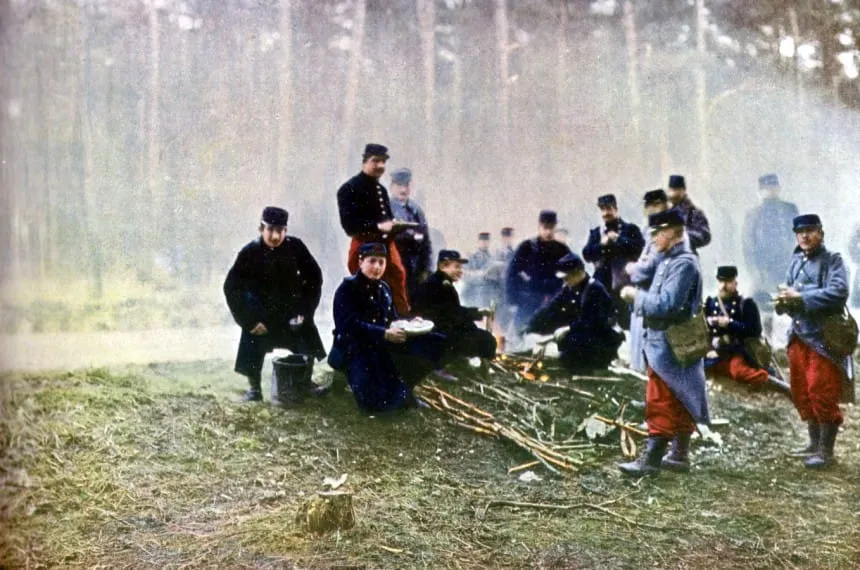
The First Battle of the Marne, fought in September 1914 on a front some 200 kilometres long, from the outskirts of Paris to Verdun, was one of the most important battles of the First World War. After two weeks of retreat, the French armies and the British Expeditionary Force went over to the counter-offensive and forced the German armies to fall back to the Aisne. The German plan to defeat France in a few weeks collapsed, and the war in the west changed its character.
Altogether nearly two million soldiers fought on both sides. The battle was not a single clash but a series of connected battles, fought simultaneously by more than a dozen armies. The most important took place on the river Ourcq, in the wooded valleys between the Marne and the Grand Morin, in the marshes of Saint-Gond, around Vitry-le-François and west of Verdun. Linked to the Battle of the Marne is also the simultaneous defence of the heights before Nancy, where the French repelled the attack of the Bavarian army.
Dates of the battle
Sources date the start of the battle differently. French tradition and the British chronology of the war count it from 6 September, the day of the general Allied offensive and of Joffre’s famous order of the day. The fighting of the French Sixth Army on the Ourcq, however, began as early as 5 September. The French treat it as a separate Battle of the Ourcq, part of the great Battle of the Marne, whereas many German and English-language studies date the whole battle from 5 September. Its end is usually set at 12 September, when the retreating German armies reached the Aisne and began to dig in there. On this page we adopt the dates 6–12 September.
Background: the Schlieffen Plan and the Great Retreat
The Germans entered the war with a plan known as the Schlieffen Plan. It assumed that the main German forces, passing through Belgium, would outflank the French fortifications from the north and then, sweeping round in a great arc, encircle the French armies east of Paris. After defeating France the Germans were to transfer their troops east, against Russia.
For the first few weeks the plan seemed to work. The Belgian army withdrew to Antwerp, and the French and British lost the Battle of the Frontiers in Lorraine, in the Ardennes, at Charleroi and at Mons. From 24 August the Allies fell back southwards. The Great Retreat did not, however, turn into a rout. The troops put up resistance at Le Cateau and at Guise, and the commander-in-chief of the French army, General Joseph Joffre, kept his calm. He dismissed incompetent generals and moved divisions from Lorraine to the threatened left wing.
Joffre formed two new armies. The Sixth Army of General Michel-Joseph Maunoury assembled in the Paris area, in the zone of the military governor of the capital, General Joseph Gallieni. The Ninth Army of General Ferdinand Foch, formed at the end of August from corps detached from neighbouring armies, took its place in the centre of the front. On 3 September the energetic General Louis Franchet d’Espèrey took over command of the Fifth Army from General Lanrezac.
Kluck’s turn
On the German side more and more things were going differently from what the plan had assumed. The Chief of the General Staff, Helmuth von Moltke, commanded from Luxembourg, hundreds of kilometres from the front, and had poor communications with the army commanders. He had sent two corps east to strengthen the defence of East Prussia, and further forces were tied down by the sieges of Maubeuge and Antwerp. The soldiers of the right wing were exhausted after three weeks of marching, and the supply lines were growing ever longer.
At the end of August the commander of the German 1st Army, General Alexander von Kluck, turned south-east to catch the retreating French Fifth Army. His troops were now to pass east of Paris rather than go round the city from the west. Moltke accepted this change, and on 2 September ordered the 1st Army to follow the 2nd Army in echelon and cover the right flank on the Paris side. Kluck, convinced that the French were beaten, did not stop, however, and on 3 September crossed the Marne, leaving only IV Reserve Corps to cover his flank.
French and British airmen noticed that Kluck’s columns were bypassing Paris. Gallieni at once proposed a strike against the exposed flank. On 4 September Joffre issued the order for a general counter-offensive, setting its start for 6 September. The hardest task was to persuade Field Marshal John French to take part in the battle; his British troops, after the retreat from Mons, were to refit behind the Seine. On 5 September Joffre came to his headquarters and, according to witnesses, asked him for help in the name of the honour of England. French agreed.
Forces
From the west stood, in turn: Maunoury’s French Sixth Army, the British Expeditionary Force, Franchet d’Espèrey’s French Fifth Army, Foch’s Ninth Army, the Fourth Army of General Fernand de Langle de Cary and the Third Army of General Maurice Sarrail at Verdun. Facing them stood five German armies: Kluck’s 1st Army, the 2nd Army of General Karl von Bülow, the 3rd Army of General Max von Hausen, the 4th Army of Duke Albrecht of Württemberg and the 5th Army of Crown Prince Wilhelm. On the western wing the Allies had a numerical superiority, which Joffre had gained by moving troops by rail from other sectors.
5–6 September: the beginning
On 5 September the Sixth Army, advancing east of Paris towards the river Ourcq, unexpectedly ran into the German IV Reserve Corps. Instead of waiting, General Hans von Gronau attacked himself and then fell back to better positions. Kluck realised that his flank was threatened.
On the morning of 6 September Joffre issued an order of the day to the troops. In it he reminded them that a battle was beginning on which the salvation of the country depended, and that the time for looking back was past. A unit that could no longer advance was to hold the ground it had won at any cost and let itself be killed on the spot rather than retreat. That day all the Allied armies went over to the attack. The Germans, convinced that they faced a beaten enemy, were taken by surprise. Heavy encounter battles broke out along the whole length of the front.
7–8 September: the crisis
Kluck moved one corps after another from the Marne to the Ourcq, first II and IV, then III and IX. He halted Maunoury and himself began to threaten his left wing. Gallieni sent reinforcements to the Sixth Army from Paris. On the night of 7 to 8 September some of the soldiers of the 7th Infantry Division were carried to the front in Paris taxis. According to various sources, about 600 cars carried several thousand men. The military significance of this transport was limited, but the “taxis of the Marne” became one of the legends of the battle.
Moving troops to the Ourcq had its price. Between Kluck’s 1st Army and Bülow’s 2nd Army a gap some 40–50 kilometres wide opened up, covered only by two cavalry corps and a few battalions of Jäger. Into this gap the British and the left wing of the Fifth Army slowly advanced. The British moved cautiously, crossing one small river after another, the Grand Morin and the Petit Morin. Franchet d’Espèrey threw back Bülow’s right wing in the area of Montmirail.
In the centre the heaviest fighting fell to Foch’s Ninth Army, defending itself on the edge of the marshes of Saint-Gond. On 8 September the troops of Bülow and Hausen attacked it, and units of the Saxon 3rd Army made a bayonet charge at dawn, without artillery preparation. Foch’s right wing was pushed back, but the front did not break. Foch shifted his reserves and never stopped counter-attacking. The saying attributed to him, that his right was giving way, his left was falling back, the situation was excellent, and so he was attacking, is more a later legend than a faithful quotation, but it captures his attitude well. To the east of him the armies of de Langle de Cary and Sarrail repelled the attacks of the German 4th and 5th Armies around Vitry-le-François, Revigny and west of Verdun.
The Hentsch mission
Moltke in Luxembourg had no clear picture of the situation. On 8 September he sent Lieutenant Colonel Richard Hentsch, an officer of his staff, to the front with wide powers. Hentsch toured the army headquarters. On the evening of 8 September he reached Bülow, who was worried about the gap on his right and the state of his troops. On the morning of 9 September airmen reported British columns entering the gap and crossing the Marne. Bülow ordered the 2nd Army to retreat. Hentsch went to the headquarters of the 1st Army and, in the name of the Supreme Command, ordered it to withdraw as well. Kluck, although he believed he was close to success on the Ourcq, had to comply.
The role of Hentsch remains controversial to this day. Some saw him as the man who gave victory away, others believe he merely confirmed what was inevitable. All agree that the decisive factors were the gap between the German armies and the lack of firm leadership on Moltke’s part.
Retreat to the Aisne
On 9 September the German right wing began to withdraw northwards. In the following days the retreat spread to the armies in the centre and in the east as well. The Allies followed the Germans, but exhausted, without fresh reserves and in dreadful weather, they were unable to turn the enemy’s retreat into a rout. By 12–13 September the Germans had fallen back several dozen kilometres, to the heights above the river Aisne, and dug in there. Attempts to drive them from these positions in the days that followed failed.
Losses
Losses in the Battle of the Marne are hard to establish, because the fighting merged smoothly into the operations before and after it. Estimates vary widely. The most commonly given figure is that about 250,000 soldiers were killed, wounded, missing or taken prisoner on the French side, and a similar number on the German side. British losses were much smaller, by typical estimates about 13,000, including about 1,700 killed. Some studies give higher figures for both sides, covering the whole period from the end of August to the middle of September.
Significance
The French called the battle the “Miracle of the Marne”. A few days earlier it had seemed that Paris would fall and France would share the fate of 1870. Instead the German armies had to fall back, and the German war plan, based on a quick defeat of France before turning against Russia, lost its raison d’être. Germany was condemned to a long war on two fronts, the thing its staff officers had feared most.
The defeat broke Moltke. On 14 September his duties were taken over by the Minister of War, Erich von Falkenhayn, although the change was announced to the public only several weeks later. Joffre became a national hero, and the disputes over who deserved the credit for the victory, he or Gallieni, went on long after the war.
The Battle of the Marne ended the period of manoeuvre warfare in the west. Once the Germans had dug in on the Aisne, both sides tried to outflank each other to the north until the front reached the North Sea. By the end of 1914 an unbroken line of trenches stretched from the Belgian coast to the Swiss border. Trench warfare had begun, and it was to last almost four years.
Spotted a mistake?Report an error