Key event
Germans retreat from the Marne
- Category:
- Military operations
- Front:
- Western Front
- Date:
- 9 September 1914
- Author:
- Łukasz Skowroń
- Battle:
- First Battle of the Marne
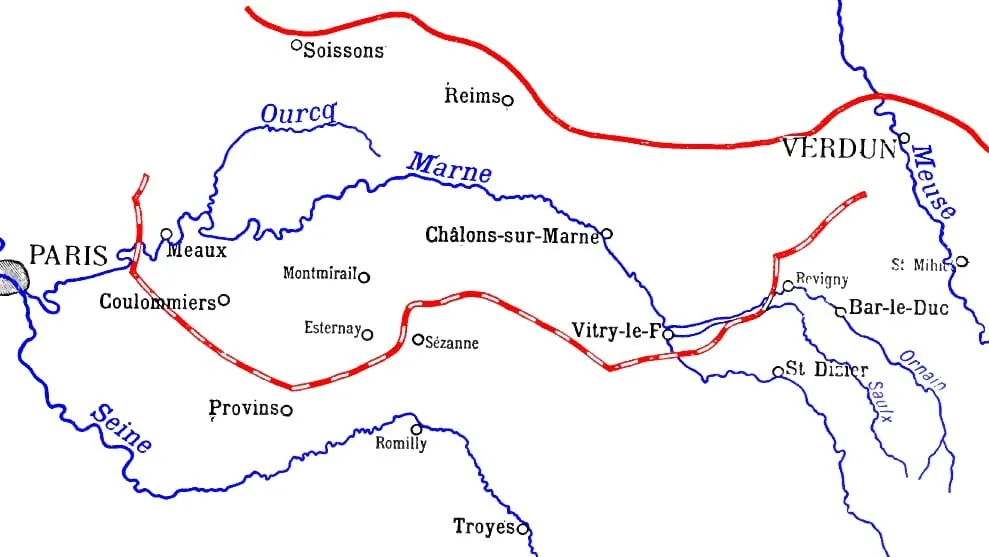
On 9 September 1914 the armies of the German right wing began to withdraw from the Marne. The retreat was first ordered by the commander of the 2nd Army, General Karl von Bülow. A few hours later, on the instruction of an envoy of the Supreme Army Command, Lieutenant-Colonel Richard Hentsch, the 1st Army of General Alexander von Kluck also began to fall back. That day the Battle of the Marne was decided, and with it the fate of the German plan to defeat France quickly. For the French it was the “Miracle of the Marne”.
A gap between the armies
Three days earlier, on 6 September, the French and British had gone over to a counter-offensive along the whole front from Paris to Verdun. The most dangerous blow for the Germans proved to be the one on the western wing. The French 6th Army of General Michel-Joseph Maunoury attacked from the direction of Paris into the flank of the 1st Army on the River Ourcq. To repel this attack, Kluck took corps after corps away from the Marne and moved them north-west, to the Ourcq. He did well there and even began to threaten Maunoury’s left wing, but he paid a high price for it.
A gap some 40–50 kilometres wide opened between his 1st Army and Bülow’s 2nd Army. It was covered only by cavalry corps and a few Jäger battalions. From the south the British Expeditionary Force was entering it, and beside it the left wing of the French 5th Army of General Louis Franchet d’Espèrey. They advanced cautiously, but every step they took threatened to cut the German front in two.
Moltke in Luxembourg
The chief of the German General Staff, General Helmuth von Moltke, directed the war from headquarters in Luxembourg, several hundred kilometres from the battlefield. Communications with the army commanders were poor, and reports arrived hours late and often contradicted one another. Moltke, a pessimist by nature, grew ever more depressed. He did not go to the front in person. On 8 September he sent Lieutenant-Colonel Richard Hentsch there, head of the intelligence section of his staff, a respected officer but not one of high rank.
The extent of Hentsch’s powers is disputed to this day, because Moltke gave them to him orally. It is known that he was to assess the position of the armies of the right wing and, if necessary, arrange a joint retreat so as to close the gap between them. Both men died before the end of the war, so it is not known exactly what was said at the time.
Hentsch’s journey
On 8 September Hentsch left Luxembourg by car. On the way he visited the headquarters of the 5th, 4th and 3rd Armies, where the situation was judged satisfactory. In the evening, at about 6.45 p.m., he reached Bülow’s headquarters at Montmort. The conversation was gloomy. Bülow believed that his army, exhausted by the fighting with the French, was unable to attack, and that if Kluck did not close the gap, the situation could become very dangerous. He had already pulled back his right wing under pressure from Franchet d’Espèrey.
On the morning of 9 September airmen reported that British columns were crossing the Marne and entering the gap. For Bülow this settled the matter. Before noon he issued the order for the 2nd Army to retreat north, behind the Marne. Hentsch meanwhile drove to the headquarters of the 1st Army at Mareuil-sur-Ourcq. On the way, travelling through the rear of the front, he saw columns of supply trains and wounded falling back in haste, and in one place, according to his report, outright panic caused by rumours of British cavalry.
The decision at Mareuil
Hentsch reached Mareuil at about 11.30 a.m. (some sources give a later hour). He did not speak to Kluck himself but to his chief of staff, General Hermann von Kuhl. He described the position of the 2nd Army and declared, in the name of the Supreme Army Command, that the 1st Army must withdraw. Kuhl was surprised. On the Ourcq his troops were just attacking Maunoury’s left wing, and he believed victory was close. Faced with Bülow’s retreat and the gap on his left wing, however, he had no choice. At about 2 p.m. the 1st Army received the order to retreat north, towards Soissons and the River Aisne.
The British on the Marne
The same day the British crossed the Marne. The I Corps of General Douglas Haig crossed the river in the morning by undamaged bridges at Nogent-l’Artaud and Charly, and the II Corps at Nanteuil and Saâcy. The III Corps was held up at La Ferté-sous-Jouarre, where the Germans had blown the bridges and were defending themselves in houses by the river. Some of its soldiers crossed the Marne by a weir and in boats only in the afternoon and evening.
The British advance was, however, slow. Haig halted his divisions for several hours because airmen had wrongly reported strong German forces north of Château-Thierry. Only at about 5.30 p.m. did the British command realise that the Germans were leaving the battlefield. In the afternoon French cavalry of the 5th Army entered Château-Thierry. Even so, the British official history concluded that it was precisely the British entry into the gap that decided the German retreat.
Moltke breaks down
East of the gap the fighting continued all day. In the Marshes of Saint-Gond the German 2nd and 3rd Armies again attacked the 9th Army of General Ferdinand Foch and pushed back his right wing. In the afternoon Foch prepared a counter-attack, but then the Germans themselves began to withdraw, because Bülow’s retreat was exposing his neighbours. In the evening Franchet d’Espèrey announced to his soldiers that the enemy, threatened on his flanks and broken in the centre, was falling back by forced marches.
The news of the retreat struck Moltke like a blow. Witnesses described him in those days as a broken man. On 11 September he toured the headquarters of the 5th, 4th and 3rd Armies himself and ordered them to retreat as well. By 12–13 September the German armies had withdrawn to the Aisne, where they dug in. On 14 September Moltke was removed from command. His duties were taken over by the Minister of War, General Erich von Falkenhayn, although the public learned of this only several weeks later.
The scapegoat
Many German officers, both during the war and after it, blamed Hentsch for “giving away” the victory on the Marne. In 1917 an internal inquiry was held into his mission, which found that he had acted in accordance with Moltke’s instructions. Even so, in the eyes of many he remained a scapegoat. He died in February 1918 in Bucharest. Most historians today believe that Hentsch merely sealed what was inevitable. The retreat was decided by the gap between the armies, the exhaustion of the troops and the lack of firm leadership from Moltke himself.
Significance
The retreat from the Marne meant the collapse of the Schlieffen Plan in the form in which Germany had entered the war. France had not been defeated in a few weeks, and Germany had to prepare for a long war on two fronts. Paris, which only a few days earlier German patrols had been a few dozen kilometres from, was saved. The Allies, exhausted by three weeks of retreat and several days of battle, were however unable to turn the German retreat into a rout. Soon the front came to a halt on the Aisne, and the war in the west began to turn into trench warfare.
Remember the articles you have read? Only in this browser; nothing is sent anywhere.How it works
Read ·
A voice from the front
“Things are going badly. The battles east of Paris will turn out against us. One of our armies must retreat, the others will have to follow. The beginning of the war, so full of hope, will turn into its opposite. I must bear what is happening, and I will stand or fall with my country.”
Translated · Original (de)
Es geht schlecht. Die Kämpfe im Osten von Paris werden zu unseren Ungunsten ausfallen. Die eine unserer Armeen muß zurückgehen, die andern werden folgen müssen. Der so hoffnungsvoll begonnene Anfang des Krieges wird in das Gegenteil umschlagen. — Ich muß das, was geschieht, tragen, und werde mit meinem Lande stehen oder fallen.
Spotted a mistake?Report an error
Meanwhile
(04)Elsewhere in the same days.
- 9 September 1914 · Middle EastOttoman Empire abolishes the capitulationsOn 9 September 1914 the Ottoman government announced an end to the capitulations, foreign privileges, from 1 October. All the powers, Germany too, objected.
- 9 September 1914 · AfricaFighting at KarongaOn 9 September 1914 British troops repulsed a German attack on Karonga in Nyasaland, now Malawi, the first serious clash of the war in this part of Africa.
- 9 September 1914 · AfricaDefence of Abercorn endsOn 9 September 1914 relief reached Abercorn in Northern Rhodesia. The reinforced garrison beat off another German attack and the raiders fell back.
- 9 September 1914 · Middle EastIndian troops arrive at SuezIn September 1914 the first units of Indian Expeditionary Force A reached Suez. Some stayed in Egypt, while the rest sailed on to France.
Related events
(04)The same battle, people or subject.
- 6 September 1914 · Western FrontBattle of the Marne beginsOn 6 September 1914 the French armies and the British went over to the counter-offensive from Paris to Verdun. The battle that decided 1914 had begun.
- 12 September 1914 · Western FrontBattle of the Aisne beginsOn 12 September 1914 the British and French, pursuing the Germans after the Marne, reached the Aisne. The Germans dug in on the heights beyond the river.
- 29 August 1914 · Western FrontBattle of Guise beginsOn 29 August 1914 Lanrezac's French Fifth Army broke off its retreat and counter-attacked Bülow's German Second Army on the river Oise.
- 10 September 1914 · Western FrontEnd of the Battle of the MarneOn 10 September 1914 the British and French pursued the retreating Germans. British historiography regards this day as the end of the Battle of the Marne.