German Empire · The Central Powers
Helmuth von Moltke the Younger
Chief of the General Staff of the German Army (1906–1914)
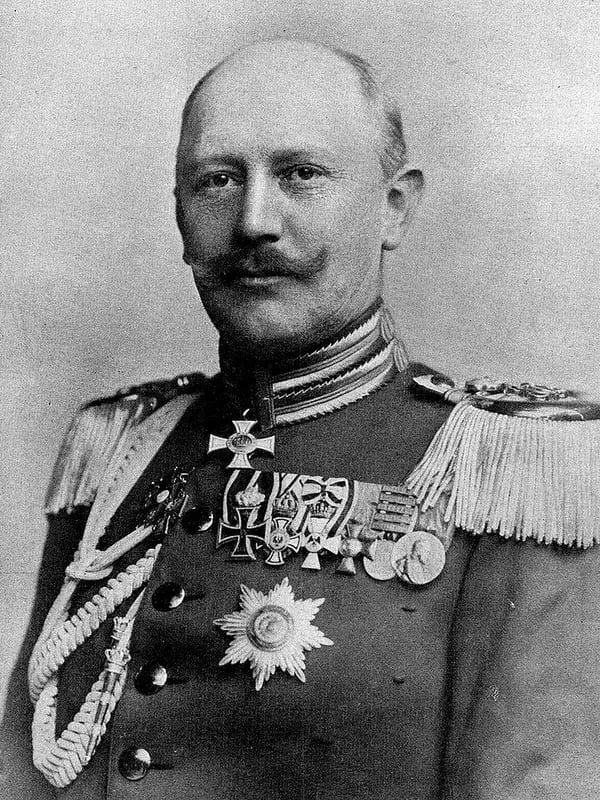
- Born:
- 25 May 1848, Gersdorf (Mecklenburg)
- Died:
- 18 June 1916, Berlin
- Author:
- Natalia
- Photo:
- E. Bieber, domena publiczna, Wikimedia Commons

Helmuth von Moltke, known as the Younger, spent eight years preparing the German Army for a great war and then commanded it for six weeks. He inherited from his predecessor a plan that was to crush France within a few weeks, before Russia could mobilise, and in August 1914 he put it into effect. In the July Crisis he was among those who pressed hardest for war, but once it had broken out he could not bear the burden of command. The defeat on the Marne in September 1914 wrecked German hopes of a quick victory and broke the man himself. Historians still argue over how much of the defeat was his fault and how much was due to the flaws of the plan itself.
Before the war
He was born on 25 May 1848 on the Gersdorf estate in Mecklenburg, into an old noble family. He was named after his uncle, Helmuth von Moltke, an officer of the Prussian General Staff who less than two decades later led Prussia to victory over Austria and France. In the Franco-Prussian War the young Moltke fought as a second lieutenant in a grenadier regiment. In 1882 he became adjutant to his uncle, then Chief of the General Staff, and after his uncle’s death in 1891 adjutant to Kaiser Wilhelm II. He thus entered the inner circle of the monarch, who was very fond of him and jokingly called him “Julius”.
In 1904 he became Quartermaster General, in effect deputy Chief of the Great General Staff, and on 1 January 1906 he succeeded Alfred von Schlieffen in that post. The appointment raised doubts even then. Critics believed he owed it to his name and to his friendship with the Kaiser, who wanted to have “his own Moltke”. Moltke himself made no secret of being unsure of his abilities as a commander. He was a cultured man who played the cello, painted and read widely, and he was also interested in theosophy, which his wife Eliza practised.
As Chief of Staff he reworked the Schlieffen Plan he had inherited. He abandoned the march through the Netherlands, because he wanted to keep it as a neutral “window” on the world through which Germany could trade in wartime. In exchange the armies of the right wing had to pass through a narrow corridor in Belgium and take the fortress of Liège in the first days of the war. Moltke also strengthened the armies in Alsace and Lorraine at the expense of the right wing. In 1913 work on a separate plan for a war against Russia alone was dropped. From then on any war with Russia meant an immediate German attack on France through Belgium.
Moltke was convinced that time was working against Germany. At a conference with the Kaiser on 8 December 1912 he said that war was inevitable, “the sooner the better”. According to the account of the Foreign Secretary, Gottlieb von Jagow, in May 1914 he argued that in two or three years Russia’s rearmament would be complete, and Germany would then no longer be able to match its enemies. There was therefore nothing left but a preventive war while it could still be won.
The July Crisis
When, after the assassination in Sarajevo, Vienna was preparing to settle accounts with Serbia, Moltke was taking a cure in Karlsbad. He returned to Berlin in the last days of July, after the Kaiser had already broken off his cruise off Norway. As early as 26 July he sent the Foreign Office a draft of the ultimatum to Belgium, delivered a week later. When Russia announced mobilisation, he pressed the government not to lose a single day. On the night of 30/31 July, over the Chancellor’s head, he telegraphed the Austro-Hungarian Chief of Staff, Franz Conrad von Hötzendorf, urging immediate mobilisation against Russia and assuring him that “Germany will go along unconditionally” with Austria-Hungary. Some historians see this telegram as exceeding his powers and as one of the steps that made the outbreak of war certain.
On 1 August, the day of mobilisation and the declaration of war on Russia, he went through the hardest moment before the fighting began. A telegram arrived from London from the ambassador, Prince Karl Max Lichnowsky, suggesting that Britain might guarantee France’s neutrality. The Kaiser concluded that war in the west could be avoided and demanded that the whole army be sent east. Moltke replied that the deployment of millions of soldiers, prepared over years, could not be changed in a few hours, as the result would be not an army but a disorderly mass. The Kaiser is then said to have told him that his uncle would have given him a different answer. It soon turned out that the telegram had been a misunderstanding, and the plan was carried out as prepared. According to those around him, he returned home that evening badly shaken, and he himself later wrote that something had broken in him then and never healed.
August 1914
On 2 August Moltke became Chief of the General Staff of the Field Army, that is, of the Supreme Army Command. Formally the Kaiser was Supreme War Lord, but in practice orders were issued in his name by the Chief of Staff. Headquarters remained in Berlin at first, moved to Koblenz in the second half of August and to Luxembourg at the end of the month, hundreds of kilometres from the armies of the right wing. Moltke rarely visited the front and relied on unreliable radio and telephone communications. His style of command consisted of setting objectives and leaving army commanders wide latitude. With commanders such as Alexander von Kluck and Karl von Bülow, who were at odds with each other and acted on their own initiative, this proved disastrous.
The first weeks brought success. After the capture of Liège the German armies passed through Belgium and defeated the French and British in the Battle of the Frontiers. Moltke, however, took several decisions for which he was later severely criticised. He allowed the Crown Prince of Bavaria, Rupprecht, who had repulsed the French in Lorraine, to go over to the attack against the French fortifications instead of shifting his troops to the right wing. On 25 August, convinced that the decision in the west had already been reached and alarmed by the Russian invasion of East Prussia, he decided to send two corps from the right wing to the east. They arrived there only after the Battle of Tannenberg and were missing on the Marne. Further forces of the right wing had to be left behind for the siege of Maubeuge and to watch Antwerp.
The Marne
At the end of August Kluck, instead of passing west of Paris, turned south-east to catch the retreating French. Moltke accepted this change, and on 2 September ordered the First Army to follow behind the Second Army and cover the right flank on the Paris side. The order could not be carried out, because Kluck was already ahead of Bülow. Accounts from the staff show that Moltke was increasingly depressed. On 4 September he observed that the lack of prisoners and captured guns showed that the enemy was retreating but had not been defeated. Between 2 and 5 September he sent no new orders to the three armies of the right wing.
On 6 September the French and British struck in the First Battle of the Marne. A gap opened between the armies of Kluck and Bülow, into which the British and the French Fifth Army advanced. Moltke in Luxembourg had no clear picture of the situation, so on 8 September he sent the head of the intelligence section, Lieutenant Colonel Richard Hentsch, to the front with verbal authority. Hentsch judged the position of the First and Second Armies to be dangerous and on 9 September decided on their retreat. That evening Moltke wrote to his wife that things had not gone well and that the Germans would have to pay for the damage they had done. According to an often repeated but unconfirmed anecdote, he also told the Kaiser: “Your Majesty, we have lost the war.” On 11 September he toured the headquarters of the Third, Fourth and Fifth Armies himself and ordered them to retreat too, in order to straighten the front on the Aisne.
Dismissal
The Kaiser’s entourage concluded that the Chief of Staff was no longer able to command. On 14 September the chief of the Military Cabinet, General Moriz von Lyncker, told him that Wilhelm II expected him to step down on grounds of health. That same evening the Prussian Minister of War, Erich von Falkenhayn, took over the direction of the army. The change was not announced, so as not to admit defeat, and for several weeks Moltke remained at headquarters without any influence on decisions. Only on 3 November was it made public that Falkenhayn was Chief of Staff, while Moltke took the subordinate post of Chief of the Deputy General Staff in Berlin, which dealt among other things with replacements.
Moltke did not accept being sidelined. In the winter of 1914/1915 he supported the campaign against Falkenhayn waged by the Eastern Front command of Paul von Hindenburg and Erich Ludendorff, his former colleague from the Great General Staff. He lobbied the Kaiser for Falkenhayn’s dismissal. The campaign achieved only that in January 1915 Falkenhayn gave up the War Ministry. Increasingly ill, Moltke sought consolation in the anthroposophy of Rudolf Steiner, with whom he and his wife were on close terms.
On 18 June 1916 a memorial ceremony was held in the Reichstag building in honour of Field Marshal Colmar von der Goltz, who had died in Baghdad in April. Moltke gave one of the speeches and, after returning to his seat, suffered a stroke and died. He was 68. He was buried in Berlin’s Invalids’ Cemetery. He left a memorandum on the guilt for the outbreak of the war, but his widow, visited by an emissary of the General Staff, gave up publishing it after the war and instead brought out a volume of memoirs and letters.
Assessment
For decades Moltke was regarded above all as the man who “ruined” the Schlieffen Plan. This picture was created after the war by former General Staff officers, among them Wilhelm Groener, who called him a “commander against his own will”, and it was cemented by historians such as Gerhard Ritter. He was accused of weakening the right wing in favour of Lorraine, sending corps to East Prussia at the worst possible moment and commanding from afar, leaving the initiative to the army commanders. In this version the plan was a recipe for victory squandered by an indecisive executor.
More recent research sees things differently. The American historian Terence Zuber questioned whether a coherent “Schlieffen Plan” in the form described after the war ever existed at all. Other scholars, above all Annika Mombauer, author of a monograph on Moltke, do not go that far, but stress that the plan was beyond the capabilities of the army, its supply system and the railways, and that Moltke’s changes had a rational justification. The Canadian historian Holger Herwig, in his book on the Battle of the Marne, points not only to Moltke’s own mistakes but also to the weakness of the whole command system and the wilfulness of the army commanders. Moltke’s flaws of character, his pessimism and his tendency to hesitate, are, however, not in dispute.
His role in the outbreak of the war, on the other hand, is judged more harshly than before. Mombauer and other historians show that Moltke had for years regarded war as inevitable and in July 1914 was among the most determined advocates of starting it before Russia became too strong. The American historian David Fromkin even considered him the main culprit for the outbreak of the war, although most scholars spread that responsibility among many people in Berlin and Vienna. The paradox of Moltke was that the man who wanted war so badly proved the least capable of waging it.
Sources
Spotted a mistake?Report an error
Commanded in battles
(02)Mentioned in battles
(03)Often appears with
People who appear in the same events.
On the timeline
(14)1914
July
August
- 02
- Germany delivers an ultimatum to BelgiumOn the evening of 2 August 1914 Germany demanded that Belgium allow its troops to pass through, giving it 12 hours to reply.
- German troops enter LuxembourgOn the morning of 2 August 1914 German troops occupied neutral Luxembourg despite the protests of Grand Duchess Marie-Adélaïde and the government.
- Moltke becomes Chief of the General Staff of the Field ArmyOn 2 August 1914 General Helmuth von Moltke, Chief of the Great General Staff since 1906, took charge of the staff of Germany's field army.