Germany · The Central Powers
Colmar von der Goltz
Governor-General of occupied Belgium (1914), commander of the Ottoman First Army (1915) and Sixth Army (1915–1916)
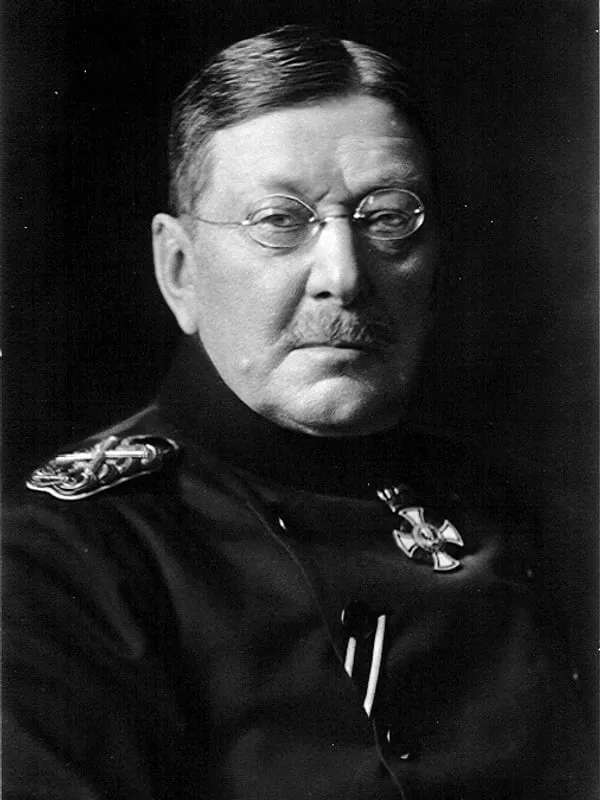
- Born:
- 12 August 1843, Bielkenfeld (East Prussia)
- Died:
- 19 April 1916, Baghdad (Ottoman Empire)
- Author:
- Natalia
- Photo:
- autor nieznany, domena publiczna, Wikimedia Commons

Field Marshal Colmar von der Goltz, known to the Turks as Goltz Pasha, was in 1914 one of the oldest and best-known soldiers of the German Empire. He had made his name with the book “The Nation in Arms” of 1883, in which he foretold wars waged with the strength of entire nations, and in Turkey he was remembered as the teacher of the generation of officers who commanded the Ottoman army in the Great War. When war broke out he was 71 and retired. He first governed occupied Belgium, then returned to the Bosporus as adviser to the Sultan, and in the last months of his life commanded the Ottoman Sixth Army in Iraq, which shut up a British division in Kut. He died ten days before its surrender.
Before the war
He was born on 12 August 1843 on the Bielkenfeld estate in East Prussia (today the village of Ivanovka in Kaliningrad Oblast), into an impoverished noble family. He grew up on the Fabiansfelde estate near Preußisch Eylau (today Bagrationovsk). From 1861 he served in the infantry, studied at the war academy in Berlin, and in the war with Austria in 1866 was seriously wounded at Trutnov. In the war with France of 1870–1871 he was a staff officer of the Second Army of Prince Friedrich Karl. The lessons of that war became the axis of his writing. In a book on the armies of Léon Gambetta he showed how the Republic, after the defeat at Sedan, managed to mobilise the whole nation and prolong the war by many months. In “The Nation in Arms” he went further: the era of cabinet wars was over, and future wars would be decided by the exhaustion of the warring nations, which had to be prepared for them already in peacetime. Historians see in him one of the theorists of total war and at the same time a supporter, typical of the era, of social Darwinism, who regarded war as inevitable and necessary.
In 1883–1895 he reorganised the Ottoman army at the request of Sultan Abdul Hamid II. He directed training at the general staff school, lengthened the courses, learnt Turkish and won over his pupils, who saw in him a master and almost a father. He persuaded the Sultan to send officers to Prussia for training and secured a privileged position on the Ottoman market for the German arms industry. He received the rank of marshal (müşir) and the title of pasha. After returning to Germany he commanded a division and a corps, was inspector-general of fortresses, and in 1907 took over one of the army inspectorates. In 1909–1910 he returned to Turkey several times to advise on the reform of the army after the Young Turk Revolution. In 1911 he was promoted to field marshal and founded the Jungdeutschlandbund, a youth association that was to prepare boys for war through sport and field exercises. In 1913, at his own request, he retired.
1914: Belgium
Because of his age Goltz was not given a command at the front in August 1914. On 23 August, a few days after the Germans occupied Brussels, he became Governor-General of occupied Belgium. In this post he distinguished himself above all by his harshness towards the civilian population. In September he announced that punishment for hostile acts must fall not only on the guilty but also on the innocent, and on 5 October he declared that localities near destroyed railway and telegraph lines would be punished without mercy, regardless of whether their inhabitants were guilty, and that hostages would be shot at the first attempt at sabotage. Some German biographers write that he himself disagreed with the orders he had received on the treatment of the Belgians and asked to be recalled. At the end of November Emperor Wilhelm II appointed General Moritz von Bissing as his successor.
Adviser to the Sultan
The new task was devised by the German ambassador in Constantinople, Hans von Wangenheim. He hoped that Goltz would replace General Otto Liman von Sanders, with whom the embassy was constantly at odds, at the head of the German military mission. The Turks did not agree to the change, but the field marshal’s journey was not called off. On 10 December 1914 Goltz left Germany, and according to Liman’s memoirs he was in Constantinople two days later. He became adjutant-general to Sultan Mehmed V, that is, his military adviser, without command authority. The real head of the army was the Minister of War, Enver Pasha, whom Goltz called his “young friend”. His relations with Liman remained cool.
At the end of March 1915, when Liman took command at the Dardanelles, Goltz took over from him the First Army, which defended the capital and the European part of the country. He did not fight at Gallipoli. At the same time the decisions on the deportation of the Armenians were taken. According to the American historian Isabel Hull, when Enver showed him the orders for the resettlement of Armenians from threatened areas near the front, Goltz approved them as a military necessity. As early as around 1900 he had in fact written about resettling the Armenians from the Russian border to Mesopotamia. Some historians, however, believe that he did not then understand what these deportations would become.
Mesopotamia and Persia
In mid-October 1915, as the British division of General Charles Townshend was advancing up the Tigris towards Baghdad, Enver entrusted the 72-year-old field marshal with the new Sixth Army, comprising all Ottoman forces from the Persian Gulf to the area of Lake Van. According to the German ambassador, Enver had long wanted to get him out of the capital “without offending the old gentleman”. Goltz was also to direct operations in Persia: to support German agents, stir up the country against the British and Russians, and create a Persian army. The journey to Baghdad took several weeks. The Battle of Ctesiphon, which halted the British at the end of November, was fought and won without him by Nureddin Bey, although some studies credit Goltz with the victory.
On 12 December Goltz arrived at Nureddin’s headquarters before besieged Kut. He judged that Townshend had kept most of his division in the town, forbade further costly assaults and decided to starve the defenders out. His authority, however, had limits. When at the end of December he left for the Persian border, Nureddin, against his orders, launched the Christmas Eve assault, which collapsed with heavy losses. In Persia Goltz sent a few battalions to Qasr-e Shirin and Kermanshah, and on 2 January 1916 he himself arrived in Kermanshah, where he conferred with Persian nationalists. The help was modest and did not stop the Russian corps of General Baratov.
On his return he found a British relief force at the front. On 13 January he was at the headquarters of Halil Bey, Nureddin’s successor, on the Wadi, and during the night he ordered the troops to break contact with the British and withdraw to a position in the Hanna defile. In February he judged that his four divisions on the Tigris were weaker than the combined forces of the relief force and the garrison. The Turks, however, withstood all subsequent attacks. The British official history, citing German authors, notes that Goltz’s influence on Turkish strategy was slight: a German chief of staff was refused, and on the Tigris it was in practice Halil, Enver’s uncle, who decided. In December 1915 the field marshal threatened to resign if the deportations of the Armenians were not stopped. He obtained, as Hull writes, only a short pause, and only in Mesopotamia.
Death
The field marshal died at his headquarters in Baghdad on 19 April (according to some German studies during the night of 18–19 April), according to the British official history and German biographers of typhus contracted at the front. Rumours that the Young Turks had poisoned him were never confirmed. Kut surrendered ten days later, and in Turkey the victory was credited above all to Halil, who took over the Sixth Army. Goltz’s coffin was taken to Constantinople and on 24 June laid to rest in the park of the German embassy’s summer residence at Tarabya on the Bosporus, next to Ambassador Wangenheim. On 18 June a ceremony in his honour was held in the Reichstag, during which General Helmuth von Moltke died of a stroke. According to a frequently repeated account, the conqueror of the city, the British General Frederick Stanley Maude, died in the same Baghdad house in November 1917.
Assessment
In his lifetime Goltz was widely respected in Turkey, and many Ottoman commanders of the Great War considered themselves his pupils. German critics, in the embassy, the Foreign Office and at headquarters, accused him in Mesopotamia of lack of energy and of having “gone Turkish”, while other observers praised his patience, authority and feel for affairs in the East. Historians acknowledge that at Kut he chose the right strategy of blockade, but note that real power over the troops on the Tigris lay in Turkish hands. After his death, as Liman von Sanders wrote, the Turks stopped listening to German advice and, instead of following up their success, sent troops to Persia.
The darker side of his war was Belgium, where he announced collective punishment for the innocent, and his attitude to the Armenian genocide: first approval of the deportations, then a belated and ineffective attempt to stop them. As a military thinker he remains important to this day. His vision of war waged by whole nations, exhausting and merciless, proved truer in 1914–1918 than his general staff colleagues’ faith in a quick, decisive victory.
Sources
Spotted a mistake?Report an error
Commanded in battles
(06)- 6 November 1914 – 10 November 1918Mesopotamian campaignMiddle East
- 7 December 1915 – 29 April 1916Siege of KutMiddle East
- 13–14 January 1916Battle of the WadiMiddle East
- 21 January 1916First Battle of HannaMiddle East
- 8–9 March 1916Battle of DujailaMiddle East
- 5–24 April 1916Third attempt to relieve KutMiddle East
Mentioned in battles
(02)Often appears with
People who appear in the same events.
On the timeline
(12)1914
1915
1916
January
- 13
- Ottoman troops in KermanshahIn January 1916 Ottoman battalions arrived in Kermanshah. The city was not captured, but was a centre of Persian nationalists allied with Germany.
- Russians take KangavarOn 13 January 1916 Baratov's corps took Kangavar in western Persia after hard fighting, routing Kanitz's detachments and the Turkish battalion supporting them.