German Empire · The Central Powers
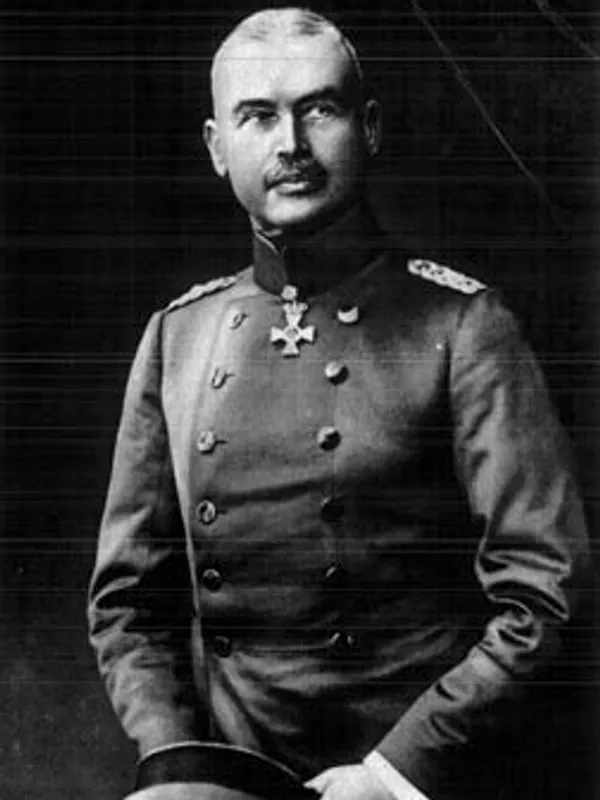
Otto Liman von Sanders
Head of the German military mission to the Ottoman Empire (1913–1918), commander of the Fifth Army and of the Yildirim Army Group, General of Cavalry and Ottoman marshal
- Born:
- 17 February 1855, Stolp (Prussia)
- Died:
- 22 August 1929, Munich
- Author:
- Natalia
- Photo:
- "Photo © by American Press Assn.", domena publiczna, Wikimedia Commons

Otto Liman von Sanders spent the whole of the First World War in Turkish service. He came to Constantinople at the end of 1913 as head of the German military mission that was to reform the Ottoman army after its defeats in the Balkan Wars, and his very arrival set off an international crisis. In 1915 he commanded the Fifth Army, which defended the Gallipoli peninsula against the Allied landing, Turkey’s greatest victory of the war. In 1918 he took over the front in Palestine and Syria, where his armies were routed by the British at Megiddo. He was the only senior German commander to lead Ottoman troops throughout the war, and his relations with the Turkish leaders and with German diplomats were almost always strained.
Before the war
He was born on 17 February 1855 in Stolp in Pomerania as Otto Liman, the son of a wealthy merchant and landowner. The family had Jewish roots: an ancestor from the Liepmann family had been baptised at the beginning of the 19th century. After finishing school in Berlin in 1874 he joined the army. He graduated from the War Academy and served on the General Staff, but spent most of his career in the cavalry. He commanded a hussar regiment, and from 1908 the 22nd Division in Kassel. In June 1913, on the 25th anniversary of the reign of Wilhelm II, he was ennobled and took the maiden name of his late first wife, Amelie von Sanders. Hence his surname, which German usage shortens to “Liman”, not “Sanders”.
In the summer of 1913 he was given charge of a new military mission to Turkey. Other Prussian officers had headed missions before him, among them Colmar von der Goltz, but none had ever had such wide powers. In December 1913 Liman arrived in Constantinople, and the Turks gave him command of the corps stationed in the capital. This provoked sharp protests from Russia, which did not want a German general commanding troops on the Bosporus, and then from France. The dispute was settled in January 1914: Liman was made a General of Cavalry and at the same time a marshal of the Ottoman army, and became inspector-general of the army, giving up command of the corps. The crisis showed how strained relations between Germany and Russia already were.
1914: Turkey enters the war
Under the secret alliance between Germany and the Ottoman Empire, concluded at the beginning of August 1914, the German mission was to have “an effective influence” on the conduct of the Turkish army. In practice the Turks had no intention of handing the conduct of the war to the Germans. Liman considered the army unready for war and, according to some accounts, asked to be recalled to Germany even before Turkey entered the fighting. After Turkey entered the war he took over the First Army, which defended the European part of the country and the area around the capital. He often quarrelled with the War Minister, Enver Pasha, and the German ambassador even tried to replace him with Field Marshal von der Goltz.
1915: Gallipoli
After the Turkish forts and mines had beaten off the Allied fleet’s attack on 18 March 1915, Liman had no doubt that the British and French would attempt a landing. On 24 or 25 March Enver gave him the new Fifth Army, which was to defend the Dardanelles and the Gallipoli peninsula. Liman arrived with a Turkish chief of staff, Kâzım Bey, and two aides-de-camp. His staff consisted almost entirely of Turks.
He decided that divisions spread along the whole coast could defend nothing, and had them concentrated inland, leaving only outposts on the beaches. He most feared a landing at the Bulair isthmus at the neck of the peninsula and on the Asian shore of the strait, and placed most of his troops there. In reserve on the peninsula itself he kept the 19th Division of Lieutenant-Colonel Mustafa Kemal. The soldiers built roads and fortifications, and the units practised rapid marches. “The British gave me four full weeks,” he later wrote.
On 25 April the Allies landed at Cape Helles and at Ari Burnu. Liman, convinced that the main blow would fall at Bulair, where warships were feigning one, went there to watch the Gulf of Saros and only later began sending troops south. The situation was saved by independent decisions of the commanders on the spot, above all Mustafa Kemal, who on his own responsibility threw his regiments against the Australians and New Zealanders. Liman acknowledged this openly in his memoirs.
In August the Allies tried again, attacking the Sari Bair heights and landing at Suvla Bay. Liman again kept strong reserves at Bulair, but this time he moved them quickly. When the commander of the group that was to counter-attack at Suvla put off the attack until morning, Liman relieved him on the evening of 8 August and gave the command to Kemal. Kemal’s counter-attack drove the Allies off the Chunuk Bair ridge. The campaign turned into trench warfare, and in December and January the Allies evacuated, so skilfully that the Turks, as Liman admitted, did not know their intentions until the last moment. For the defence of Gallipoli he received the Pour le Mérite with oak leaves.
1916–1917: Smyrna and the coast
After the campaign Liman remained commander of the Fifth Army, which defended the Aegean coast, including Izmir, the former Smyrna. During this period, according to German Foreign Office documents and his own accounts, he several times opposed deportations of the civilian population. In Smyrna, by threatening the authorities with the use of troops, he stopped the deportation of the local Armenians, and in 1917 he opposed the removal of Greeks from the coast. His stance was not, however, unambiguous: in the spring of 1917 he himself ordered part of the Greeks of Ayvalık to be evacuated for military reasons, although he later softened that order. During the years of the Armenian genocide he was one of the few senior German officers who openly opposed deportations where they had authority.
1918: Palestine
At the end of 1917 General Edmund Allenby’s British took Jerusalem. The commander of the Yildirim Army Group, Erich von Falkenhayn, was recalled, and on 1 March 1918 Liman took his place. Under him he had three weakened Ottoman armies, the Seventh and Eighth in Palestine and the Fourth beyond the Jordan, and the small German Asia Corps. He extracted a promise of reinforcements but never received them, because Enver was sending the best forces to the Caucasus.
In the spring he beat off two British raids across the Jordan, on Amman and on Es Salt. For the Turks, after a series of defeats, it was a first victory that raised morale. Both raids, however, convinced Liman that the British would strike again across the Jordan, on the eastern flank. In September, when a deserter warned of an attack by the sea, Liman took him for a British plant and did not allow his commanders to fall back to the second line.
On 19 September 1918 Allenby struck precisely on the coastal plain. The Eighth Army’s front collapsed within a few hours, and the British cavalry broke through into the rear. On the morning of 20 September one of its brigades burst into Nazareth, where the army group headquarters stood. Liman, woken by gunfire, organised a defence from German clerks, orderlies and the remnants of a depot regiment and escaped capture at the last moment. Within a few days his armies had ceased to exist as a fighting force. The remnants fell back through Damascus, which fell on 1 October, and on north towards Aleppo. After the Armistice of Mudros Liman handed over command to Mustafa Kemal on 31 October.
After the war
In January 1919 Liman set off home to Germany. At the beginning of February the British detained him on Malta in connection with accusations of complicity in crimes against Armenians and Greeks. The charges were not proved, but he was held there until August, part of the time in solitary confinement. He returned to Berlin in September 1919 and retired. In 1920 he published his memoirs, Fünf Jahre Türkei (“Five Years in Turkey”), later translated into several languages. In 1921 he testified in Berlin at the trial of the Armenian who had shot the former Grand Vizier Talaat Pasha. He settled in Munich, where he died on 22 August 1929. He was buried in Darmstadt, beside his first wife.
Assessment
Liman is today associated above all with the defence of Gallipoli, but how his part is judged depends on who is judging. The Austro-Hungarian military plenipotentiary in Constantinople, General Joseph Pomiankowski, wrote that the chief credit for the defence of the straits belonged to Liman, and regretted that after the victory he was received coolly in the capital, without the honours he deserved. Turkish tradition, and many writers following it, ascribe the victory above all to Mustafa Kemal and lower-ranking commanders. Critics fault Liman for pulling the defence back from the beaches and for believing too long, on the day of the landing, in an attack on Bulair. His defenders reply that it was he who prepared the army, built up its reserves and gave Kemal the freedom that proved decisive, and that in August he unhesitatingly gave him command.
As head of the military mission he did not meet Berlin’s expectations. The Turks, with Enver at their head, had no intention of handing the conduct of the war to the Germans, and Liman, straightforward and often brusque, alienated Turkish leaders as well as German diplomats and officers with whom he competed for influence. German biographers also link the coolness he met with in Germany to his Jewish origins. His command in Palestine in 1918 is judged harshly: given the crushing British superiority, defeat was hard to avoid, but the ban on withdrawal and his misreading of Allenby’s intentions increased its scale. Historians agree, however, that his opposition to the deportation of Armenians and Greeks on the coast under his command saved many people, although this does not cancel the fact that throughout the war he served a state that committed genocide.
Sources
Spotted a mistake?Report an error
Commanded in battles
(15)- 26 January 1915 – 30 October 1918Sinai and Palestine campaignMiddle East
- 19 February 1915 – 9 January 1916Gallipoli campaignMiddle East
- 25–26 April 1915Landing at GallipoliMiddle East
- 28 April 1915First Battle of KrithiaMiddle East
- 6–8 May 1915Second Battle of KrithiaMiddle East
- 4 June 1915Third Battle of KrithiaMiddle East
- 28 June – 5 July 1915Battle of Gully RavineMiddle East
- 6–10 August 1915Battle of Sari BairMiddle East
- 6–15 August 1915Landing at Suvla BayMiddle East
- 21 August 1915Battle of Scimitar HillMiddle East
- 18 December 1915 – 9 January 1916Evacuation of GallipoliMiddle East
- 10 June 1916 – 30 October 1918Arab RevoltMiddle East
- 21 March – 2 April 1918First raid on AmmanMiddle East
- 30 April – 4 May 1918Second raid on Es SaltMiddle East
- 19–25 September 1918Battle of MegiddoMiddle East
Mentioned in battles
(02)Often appears with
People who appear in the same events.