United Kingdom · The Entente
Frederick Maude
Commander-in-Chief of British forces in Mesopotamia (1916–1917)
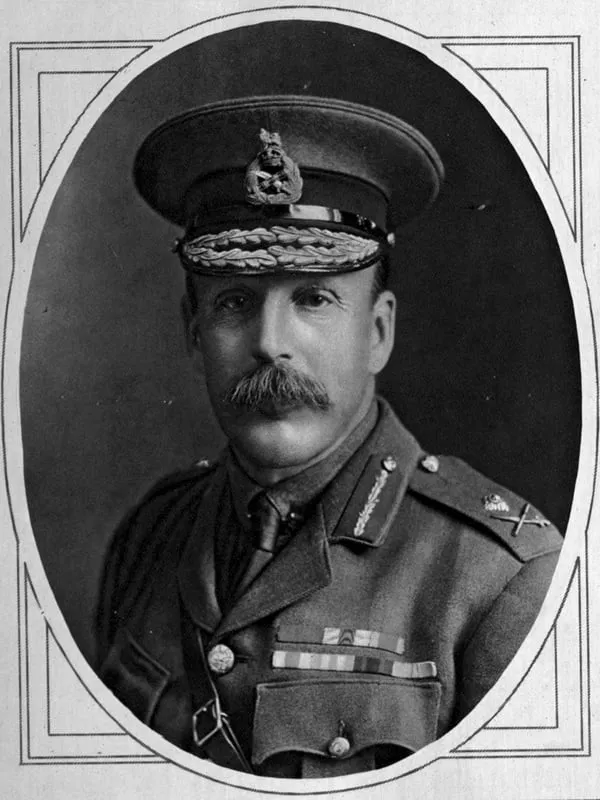
- Born:
- 24 June 1864, Gibraltar
- Died:
- 18 November 1917, Baghdad (Ottoman Empire)
- Author:
- Łukasz Skowroń
- Photo:
- Maull and Fox, domena publiczna, Wikimedia Commons

Lieutenant-General Sir Frederick Stanley Maude, known in the army and in his family simply as Stanley Maude, was one of the few British commanders of the Great War who went down in history as winners of a campaign. He took command in Mesopotamia in the summer of 1916, a few months after the humiliating surrender of Kut, when the army was sick, badly supplied and demoralised. Within half a year he turned it into an efficient army, and in the winter of 1917 he led it to victories that brought the British Kut and Baghdad. For the government in London, weary of bloody and fruitless offensives in France, the capture of Baghdad was one of the few great successes of that spring. Maude did not live to see the end of the war: he died of cholera in the captured city in November 1917.
Before the war
He was born on 24 June 1864 in Gibraltar, the youngest child of an officer, later General Sir Frederick Francis Maude, who had won the Victoria Cross in the Crimean War. Some sources give 25 June, but his biographer, General Charles Callwell, writes of 24 June. He was educated at Eton and at the Royal Military College, Sandhurst, and in 1884 joined the Coldstream Guards. In 1885 he fought against the Mahdists at Suakin in the Sudan, in 1895–1896 he completed the Staff College at Camberley, and for the Boer War he received the Distinguished Service Order. From 1901 he was military secretary to the Governor General of Canada, Lord Minto, and then in turn second-in-command of his regiment, a general staff officer, an assistant director at the War Office and chief of staff of the 5th Division. Callwell, who knew him well, admitted that Maude loved drill and ceremonial, and that his greatest weakness was a desire to concentrate everything in his own hands. In July 1914 he was a colonel in the training directorate of the War Office, working under General William Robertson, later Chief of the Imperial General Staff.
France and Gallipoli
He began the war in France as a staff officer of III Corps in the army of John French. In October 1914, during the fighting at La Bassée, he was given the 14th Infantry Brigade of the 5th Division, which he commanded through the winter in the trenches of Flanders. In April 1915 he was wounded at St Eloi. After his return, in June, he was promoted to major-general and called back to England to take over the 33rd Division, one of the new divisions of Kitchener’s volunteer army. He did not lead it to the front, however. In mid-August, when the August offensive at Gallipoli collapsed, he was sent to the peninsula, where he took over the depleted 13th Division in the Suvla Bay area.
At Gallipoli Maude made his name above all during the evacuation. In December 1915 his division was one of the last to leave Suvla, and it was then moved to Cape Helles. On the last night of the evacuation of Helles, 8–9 January 1916, a lighter at Gully Beach ran aground, and Maude himself led the last 160 soldiers on foot for three kilometres to W Beach, from which they managed to get away. Maude refused to abandon the staff baggage, which his men dragged to the beach on stretchers. That night someone among the W Beach staff composed a humorous rhyme in which General Lawrence urged: “Come into the lighter, Maude, and never mind your kit.”
Mesopotamia: from division to army
At the beginning of 1916 the 13th Division was transferred from Egypt to Mesopotamia, where an Anglo-Indian corps was trying to break through to besieged Kut. Made up of volunteers who were veterans of Gallipoli, it was the main striking force of the third attempt at relief. On 5 April it took the trenches in the Hanna defile and at Fallahiyah, but the next attacks at Sannaiyat and on the right bank of the Tigris broke down in the mud and floods. On 29 April Kut surrendered. The defeat did not harm Maude’s reputation, however. On 11 July he succeeded General Gorringe in command of the whole Tigris Corps, although he was one of the most junior major-generals in Mesopotamia, and at the end of August, chosen by Robertson, he replaced the sick General Percy Lake as commander-in-chief. He did not know India or the Indian Army, which provided most of his soldiers, but he quickly won their confidence.
He devoted the autumn of 1916 to putting the rear in order. The port of Basra, the flotilla of river steamers and the light railways were expanded, medical care and supply were improved, and the four divisions on the Tigris were divided into two corps. Maude moved his headquarters from Basra closer to the front and was often seen among the troops. In London a defensive policy was in force: Robertson wanted no new adventures in Mesopotamia and forbade operations that would bring heavy losses without corresponding gain. Historians argue whether Maude planned the march on Baghdad from the start, against these instructions. Basil Liddell Hart claimed that, consciously or not, he disregarded them, while David Woodward points out that Robertson himself changed his mind and agreed to the advance.
Kut and Baghdad
On the night of 13–14 December 1916 Maude went over to the offensive. He did not attack head-on the Turkish trenches at Sannaiyat, which throughout 1916 had cost the British thousands of men. Instead, methodically, trench by trench, in rain and mud, he drove the Turks off the right bank of the Tigris, from the Khudhaira bend to the salient on the Shatt al-Hai and the Dahra bend. This cost more than 8,000 men, but it wore out the Turkish XVIII Corps. On 23 February 1917 his troops crossed the Tigris at Shumran, and on 24 February the Turks gave up Sannaiyat and Kut without a fight. Maude soberly telegraphed that the town itself now had only sentimental value, and that the destruction of the enemy mattered more.
The British set off in pursuit, and on 28 February the War Cabinet allowed Maude to press on towards Baghdad. The Turks under Halil Pasha had only part of their forces, because their XIII Corps was fighting in Persia. On 7–10 March the British forced the Diyala and outflanked the Turks on the right bank of the Tigris, and on the morning of 11 March they entered Baghdad, which Halil had abandoned during the night. Maude received congratulations from King George V and promotion to substantive lieutenant-general. On 19 March he issued to the inhabitants a proclamation prepared in London, assuring them that the British armies came “not as conquerors or enemies, but as liberators”. These words were later often recalled with irony.
After the capture of Baghdad Maude had to secure the city against floods and against the Turks, who still had troops to the north and east. He counted on co-operation with General Baratov’s Russians, but the Russian army, disintegrating after the revolution, gave him little. In April his troops won heavy fighting at Istabulat and took Samarra. In summer the heat halted operations, and the July raid on Ramadi, undertaken despite Maude’s own initial doubts, ended in failure and heavy losses from heatstroke. In autumn Maude struck again: at the end of September General Brooking captured Ramadi, in October the Jebel Hamrin hills above the Diyala were taken, and at the beginning of November the Battle of Tikrit gave the British this important base on the Tigris.
Death
On 14 November 1917 Maude took the American journalist Eleanor Franklin Egan to a performance at one of the Jewish schools in Baghdad, put on in his honour. Coffee was served, which he drank with milk. On 16 November he fell ill, and the doctors diagnosed a severe form of cholera. He had had his staff inoculated, but had refused inoculation himself, convinced that at his age he was immune. He died on the evening of 18 November. The army’s medical consultant, Colonel William Willcox, considered it most likely that he had been infected by the milk, and firmly rejected rumours of poisoning. According to an often repeated account, Maude died in the same house in which the German field marshal Colmar von der Goltz had died in April 1916. He was buried on 19 November in the military cemetery outside the North Gate of Baghdad, and command passed to General William Marshall. Parliament granted his widow £25,000. In 1923 an equestrian statue of him was unveiled in Baghdad; it was pulled down by participants in the revolution of 1958.
Assessment
The British official history writes that Maude’s name had become a byword for success, and that his death was regarded throughout the Empire as a national misfortune. The soldiers valued him for his care for their conditions, his personal courage and his generous recognition of their work. Callwell called his campaign a masterpiece and compared him with Napoleon. Most historians appreciate above all that he understood that in Mesopotamia the war was won in the rear, and that he did not throw his army into the attack before it was ready for it.
There is no shortage of reservations, however. The same Callwell and the official history point out his tendency to deal with details he should have left to subordinates, and his distrust of them. He rarely revealed his plans to anyone, and after his death no notes on his future intentions were found. Critics also reproach him for caution in pursuit, which allowed the Turks to slip out of encirclement, and for the costly, methodical attacks of the winter of 1916–1917. It must also be remembered that he won in different conditions from his predecessors: he had numerical superiority, an efficient rear and an opponent weakened by the expedition to Persia. Even so, for the British he remained the commander who wiped out the disgrace of Kut.
Sources
Spotted a mistake?Report an error
Commanded in battles
(05)Mentioned in battles
(01)Often appears with
People who appear in the same events.
On the timeline
(30)1915
1916
1917
January
February
March
- 11
- Key eventBritish take BaghdadOn 11 March 1917 Maude's troops entered Baghdad unopposed, the Turks having left it overnight. It was Britain's greatest success in the Middle East so far.
- Russians retake KermanshahOn 11 March 1917, the day Baghdad fell, Baratov's Russians entered Kermanshah. The Turkish rearguard fell back westwards, towards the border with Iraq.