Ottoman Empire · The Central Powers
Halil Kut
Commander of the Ottoman Sixth Army in Iraq (1916–1918), then of Army Group East in the Caucasus
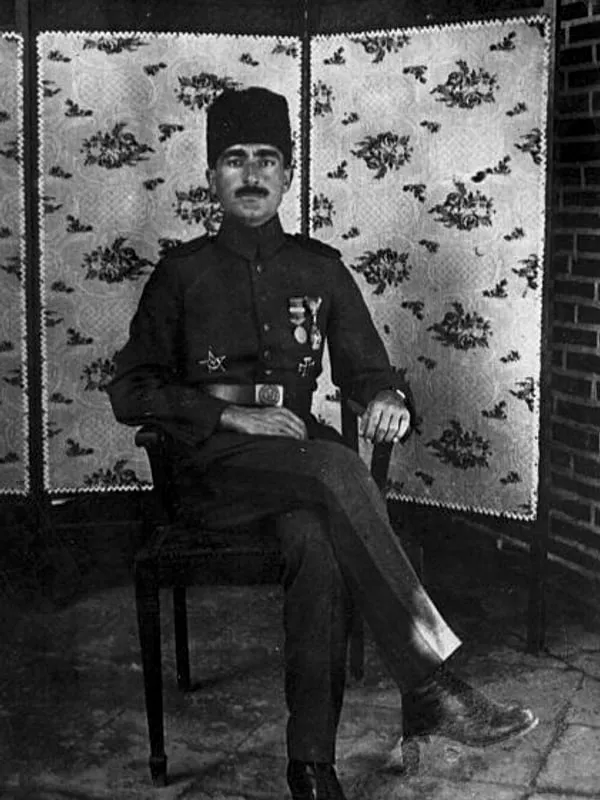
- Born:
- 1882, Constantinople (Ottoman Empire)
- Died:
- 20 August 1957, Istanbul (Turkey)
- Author:
- Łukasz Skowroń
- Photo:
- autor nieznany, domena publiczna, Wikimedia Commons

Halil, during the Great War first Halil Bey, then Halil Pasha, and from 1934 Halil Kut, was one of the “political soldiers” of the Committee of Union and Progress who, thanks to the Young Turk Revolution and their kinship with the powerful, rose quickly to the highest posts. He was the younger brother of the father of the minister of war Enver Pasha, although he was a year younger than his nephew. He went down in history as the victor of Kut, where in April 1916 he accepted the surrender of more than 13,000 British and Indian soldiers of General Charles Townshend. A year later he lost Baghdad to the British, and in 1918 he commanded the troops that took Baku. Historians also count him among the perpetrators of the Armenian genocide, something he himself did not conceal in his memoirs.
Before the war
He was born in Constantinople. Most biographies give the year 1882, some 1881. The exact date, 22 November, appears only in some works and is uncertain. He graduated from the general staff college (according to most sources in 1905) and then served for three years in the Third Army in Macedonia. There he joined the secret Committee of Union and Progress. After the revolution of 1908 the committee sent him to Persia, where he was to support the constitutional movement against the shah. After the counter-revolution of April 1909 he returned to the capital and served in the guard, and then commanded mobile gendarmerie units around Salonika, hunting down bands. In the war with Italy he belonged to a group of young officers who organised Arab resistance in Libya, and during the Balkan Wars he commanded a detachment in Thrace. For a short time he headed a gendarmerie regiment in Van. Historians point out that before the war he knew above all fighting against guerrillas, and that commanding large formations in the field was foreign to him. In 1914 he was military commandant of Constantinople.
1915: Persia and Bitlis
After the defeat at Sarikamish Enver looked for a success in the Caucasus that would overshadow the setback. In January 1915 he gave his uncle command on the border of Persian Azerbaijan. Halil reached Diyarbakır in mid-January and assembled the so-called 1st Expeditionary Corps: the 36th Division, new frontier guard and gendarmerie units and several thousand mounted Kurds. He was to drive the Russians out of northern Persia, rouse the Muslims there and threaten the Russian front in the Caucasus from the south. In April his troops went round Lake Van from the south, and on 16 April reached Urmia. At Dilman Halil ran into the Russian detachment of General Nazarbekov and on 1 May lost the battle. According to the historians W. E. D. Allen and Paul Muratoff, he left nearly a thousand dead on the field. The Kurds scattered, and Halil withdrew across the border. He bypassed Van, where the Armenians had been defending themselves since 20 April, and moved off towards Bitlis. In the summer, according to Allen and Muratoff, he supported the plan of the German Major Guse that led to a successful Turkish counter-stroke against the Russian IV Caucasian Corps at Malazgirt.
The gravest accusation against Halil is linked to the Persian expedition and the fighting around Lake Van. The German vice-consul in Erzurum, Max Erwin von Scheubner-Richter, reported that during the campaign in northern Persia the Armenian and Assyrian labour battalions of his troops had been massacred, and the Armenian, Assyrian and Persian population driven out. A Turkish officer of Halil’s corps later testified that his commander had ordered the whole Armenian population, men, women and children, in the districts of Bitlis, Muş and Bayazıt to be massacred without mercy, and that many of the victims were buried alive. Historians of the genocide, among them Vahakn Dadrian, David Gaunt and Ben Kiernan, count him among the chief perpetrators of the massacres in eastern Anatolia. The events in Urmia and on the Salmas plain are also linked to the Assyrian genocide.
Ctesiphon and Kut
In the autumn of 1915 Halil was ordered to move from Bitlis to Iraq, where the British were advancing up the Tigris towards Baghdad. According to British intelligence his troops set out around mid-October. Halil reached the front on 25 November, as the Battle of Ctesiphon was drawing to a close, and took over XVIII Corps. The battle had been won by Nureddin Bey, but Halil took part in the pursuit of the retreating Townshend and in the encirclement of his division at Kut. From December the whole Sixth Army was commanded by the German field marshal Colmar von der Goltz.
At the beginning of January 1916, as the British relief force approached, Halil replaced Nureddin at the head of the troops on the Tigris. According to Turkish works Enver’s formal order was dated 20 January, but the British felt the change already after the Battle of Sheikh Sa’ad. The British official history surmises that it was Halil who halted the retreat and ordered the troops to dig in on the Wadi stream. Over the next three months his troops beat off one relief attempt after another: on the Wadi, in the Hanna defile, at Dujaila, where on 8 March he moved reserves to the threatened flank in time, and in April in the third relief attempt. On 10 March he called on Townshend to surrender, but Townshend refused.
On 19 April Goltz died and Halil took command of the whole Sixth Army. Ten days later Kut surrendered. Townshend tried to negotiate the release of the garrison in exchange for his guns and money, and Halil, courteous in conversation aboard a motor launch, was according to German accounts inclined to make concessions. The decision, however, lay with Enver, who demanded unconditional surrender. On 29 April more than 13,000 men went into captivity. Halil did not hide his anger that the British had destroyed their guns before surrendering. For the victory he was promoted to general (mirliva), that is pasha, and appointed governor of Baghdad, where a new street was named after him. The tragic fate of the prisoners, of whom according to the British official history more than 4,000 died on the march to Anatolia and in the camps, weighs on the whole Ottoman command. Historians attribute it to extreme neglect rather than deliberate policy.
The loss of Baghdad
The victory at Kut, as the German general Otto Liman von Sanders later wrote, made Halil so proud that he stopped listening to German advice. At a conference in Baghdad in May 1916 Enver, Halil and the German general Otto von Lossow decided, instead of pursuing the beaten British, to send Ali İhsan’s XIII Corps into western Persia. The Turks retook Kermanshah and Hamadan, but only the weak XVIII Corps was left on the Tigris. The Turkish officer Muhammad Amin, who served on Halil’s staff, later accused him of ignoring British preparations for seven months, assuring Constantinople that the enemy was demoralised and incapable of attacking, and calling the corps back from Persia too late.
In December 1916 General Frederick Stanley Maude launched his offensive. For a long time Halil had the troops hold on to the right bank of the Tigris. When on 23 February 1917 the British crossed the river at Shumran, he ordered a retreat from Sannaiyat and Kut, and on 26 February he returned to Baghdad. Enver ordered him to defend the city, and Halil, as the British official history puts it, hesitated and prepared little. On the evening of 10 March, at a conference in the Khar pavilion, he wanted to give battle, because he considered surrendering Baghdad without a fight a disgrace, but the corps and division commanders convinced him that this risked the loss of the whole army. After ten minutes’ thought he agreed to retreat, and on the morning of 11 March the British entered the city. At the end of March Halil still tried to strike at the British right wing on the Diyala, but the appearance of the Russians at Khanaqin put an end to this plan. Even so, he kept command of the Sixth Army until the end of June 1918, while his troops fell back further up the Tigris and the Euphrates.
1918: the Caucasus and Baku
After the disintegration of the Russian army Enver sent his best forces and closest men to the Caucasus. On 29 June 1918 Halil took command of Army Group East, which controlled the Ottoman troops in the Caucasus and the Caucasian Army of Islam of his nephew Nuri. According to Allen and Muratoff he was furious with the Germans, who had taken Georgia under their protection. In the summer, at a meeting with Armenian politicians in Yerevan, he reportedly threatened, according to accounts cited by historians, that if the Armenians rose against the Turks again, he would not leave a single one of them alive. On 15 September Turkish and Azerbaijani troops took Baku, and a massacre of Armenians followed in the city. On 16 September Halil took a parade in Baku. Promoted to lieutenant-general (ferik), he commanded the army group until it was disbanded on 21 October. Soon afterwards, following the Armistice of Mudros, the Turks had to leave Transcaucasia.
After the war
In 1919 he was arrested in occupied Constantinople on suspicion of crimes against the Armenians, but escaped from the Bekirağa military prison and made his way to Anatolia. He met Mustafa Kemal, who sent him to Moscow. Halil acted as an intermediary between the national movement and the Bolsheviks and brought part of the Soviet aid in gold to Anatolia. The authorities in Ankara, however, would not let him stay in the country, so Halil left for Russia and then for Berlin. He returned after the proclamation of the republic and retired in 1923. In 1934, when surnames were introduced, he took the surname Kut in memory of his victory. He took no further part in politics. He died in Istanbul on 20 August 1957 (some sources give 4 August). His memoirs were published in 1972 under the title “Bitmeyen Savaş” (“The Unending War”).
Assessment
In Turkey Halil Kut is remembered as “the hero of Kut”, the author of one of the two great Ottoman victories of the war, alongside the Dardanelles. Military historians judge him more coolly. At Kut he inherited the siege from Nureddin and Goltz, and himself proved an able defender rather than a commander. The author of his biographical entry in the international encyclopedia 1914-1918-online notes that he usually allowed his commanders to fall back under fire. He is also blamed for his arrogance after the victory, for agreeing to the expedition to Persia at a time when the British were rebuilding their strength on the Tigris, and for his indecision in the defence of Baghdad. Part of the blame, however, falls on Enver, who gave him orders from afar and took troops away to other fronts.
Outside Turkey his name is linked above all with the crimes against Armenians and Assyrians in 1915 and 1918. In his memoirs Halil wrote that he had killed “more or less” 300,000 Armenians, and explained this by the treason he attributed to the Armenian nation. Historians treat these words as an admission of participation in the genocide, although the figures themselves cannot be verified.
Sources
Spotted a mistake?Report an error
Commanded in battles
(10)- 6 November 1914 – 10 November 1918Mesopotamian campaignMiddle East
- 22–25 November 1915Battle of CtesiphonMiddle East
- 7 December 1915 – 29 April 1916Siege of KutMiddle East
- 13–14 January 1916Battle of the WadiMiddle East
- 21 January 1916First Battle of HannaMiddle East
- 8–9 March 1916Battle of DujailaMiddle East
- 5–24 April 1916Third attempt to relieve KutMiddle East
- 13 December 1916 – 24 February 1917Second Battle of KutMiddle East
- 5–11 March 1917Capture of BaghdadMiddle East
- 5–6 November 1917Battle of TikritMiddle East
Mentioned in battles
(02)Often appears with
People who appear in the same events.
On the timeline
(19)1915
1916
1917
February
March
- 11
- Key eventBritish take BaghdadOn 11 March 1917 Maude's troops entered Baghdad unopposed, the Turks having left it overnight. It was Britain's greatest success in the Middle East so far.
- Russians retake KermanshahOn 11 March 1917, the day Baghdad fell, Baratov's Russians entered Kermanshah. The Turkish rearguard fell back westwards, towards the border with Iraq.