1917: Baghdad and Gaza
Capture of Baghdad
- Dates:
- 5–11 March 1917
- Front:
- Middle East
- Location:
- Both banks of the Tigris from the positions at Lajj and Ctesiphon to Baghdad, including the lower Diyala at its confluence with the Tigris and the Tel Aswad and Umm at-Tubul positions on the right bank, central Mesopotamia (present-day Iraq)On the battle map →
- Sides:
- United Kingdom and British IndiaFrederick Stanley Maude, Alexander Cobbe, William MarshallOttoman EmpireHalil Pasha, Kâzım Karabekir
- Result:
- British victory. The Turks withdrew northwards on the night of 10–11 March, and on 11 March the British occupied Baghdad without a fight.
- Author:
- Łukasz Skowroń
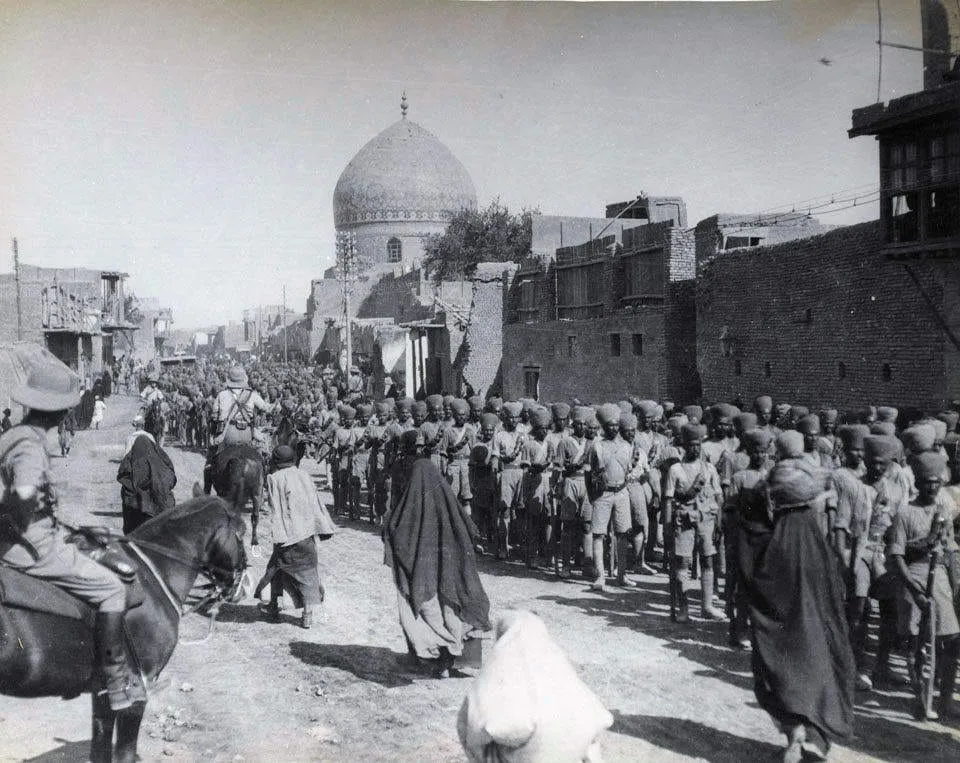
The capture of Baghdad was the greatest British success in the Middle East since the start of the war. Less than two weeks after retaking Kut, the troops of General Frederick Stanley Maude set off from the Tigris at Aziziyah towards the capital of Ottoman Mesopotamia. The battered XVIII Corps no longer had the strength to hold them for long. First it defended itself for three nights on the Diyala, which flows into the Tigris some ten or fifteen kilometres below the city. Then it stood against the columns outflanking it along the right bank of the Tigris. On the evening of 10 March the commander of the Sixth Army, Halil Pasha (Halil Kut), concluded that further fighting risked the loss of the whole corps, and withdrew northwards during the night. On the morning of 11 March the British entered Baghdad without a fight.
Name and dates
The British chronology of the war (Principal Events) lists the forcing of the Diyala (Passage of the Diyala, 7–10 March) and the occupation of Baghdad (11 March) separately. The British official history (Moberly, The Campaign in Mesopotamia, vol. III) describes both events in a single chapter entitled The Occupation of Baghdad, which it begins with the advance from Aziziyah on 5 March. On this site we combine them under the name of the capture of Baghdad. We take 5 March as the start, when after a five-day halt Maude’s troops moved on and on the same day fought the Turkish rearguard at Lajj. We take 11 March, the day of the entry into the city, as the end. The pursuit of the Turks north of Baghdad and the fighting for the railway to Samarra in the following days we treat as a separate chapter of the campaign.
Background
After the pursuit began on 25 February, the British cavalry and gunboats caught up with the retreating Turks only at Aziziyah, about 80 kilometres from Baghdad. There Maude halted for several days. His supply lines already stretched several hundred kilometres down the river, and the government in London had not yet decided whether he might march on Baghdad. An order of 28 February from the Chief of the Imperial General Staff, General William Robertson, spoke of “establishing British influence in the Baghdad vilayet”, but considered the occupation of the city itself premature until the Russians took the offensive. Maude received it on the evening of 2 March and replied the next day that the Turks before him were no longer capable of fighting, and that any delay would give them time to dig in. He proposed to set out on 5 or 6 March and reach Baghdad in four or five days. On 4 March Robertson agreed. He added that Grand Duke Nicholas Nikolaevich had ordered the troops in the Caucasus and Persia to go over to the attack as soon as possible. General Baratov’s corps, which had retaken Hamadan on 2 March, was to push on westwards.
On the Turkish side chaos reigned. Halil, who had returned to Baghdad on 26 February, for a long time would not even consider a retreat, and for several days had the old position at Ctesiphon strengthened, where the Turks had stopped Townshend in November 1915. The Minister of War, Enver Pasha, ordered the city to be defended stubbornly and the eastern bank of the Tigris not to be given up, because the XIII Corps, falling back from Persia before the Russians, was to arrive that way. It was already too late to flood the approaches, which in the season of the spring floods could have closed the road to Baghdad. The XVIII Corps, commanded by Colonel Kâzım Bey (Karabekir), numbered according to Turkish figures about 500 sabres, 10,000 rifles and 50 guns. The soldiers were exhausted and hungry, because supply had broken down. Work on trenches along the Diyala began only on 1 March, and the army staff and the divisional commanders were still arguing on 7 March over where to make a stand on the right bank of the Tigris. Maude had about 3,900 sabres, 41,500 rifles and 174 guns on the Tigris.
Lajj and Ctesiphon (5–6 March)
At dawn on 5 March the cavalry division set out from Aziziyah, convinced that there were no serious enemy forces left before the Diyala. At noon, in a thick sandstorm, it ran into the 51st Division at Lajj, about 2,500 infantry with 16 guns, dug in from the Tigris eastwards. The commander of the 13th Hussars, Lieutenant-Colonel Richardson, believing that he faced a weak rearguard, led three squadrons in a charge. The hussars rode through the first trench, killing and capturing about fifty Turks, but a second line of trenches emerged from the dust and opened heavy fire. The squadrons turned back and fought on dismounted. The regiment lost 86 men and the whole division about 130. Its regimental history later compared this charge to the charge of the Light Brigade at Balaclava. After dark the cavalry broke off the fight. The Turks also left: the 51st Division began to withdraw at sunset and, together with the rest of the corps, struggled all through the dark, rainy night across canals and mud to the Diyala. On 6 March British patrols found the trenches at Lajj and at Ctesiphon empty. In the evening Maude assumed that the Turks would not seriously defend the Diyala.
Forcing the Diyala (7–10 March)
He was wrong. On 7 March General William Marshall’s III Corps approached the village of Diyala at the river’s confluence with the Tigris and found that the Turks held the whole of its right bank. The river there was about 110 metres wide, with steep banks six metres high. Two attempts by the 38th Brigade to cross at night in pontoons, on 7/8 and 8/9 March, broke down under fire from the far bank. On the second occasion, however, about a hundred men of the 6th Battalion of the Loyal North Lancashire Regiment got across. Dug in on a strip of the bank, they beat off the attacks of the Turkish 44th Regiment for more than a day. At four in the morning on 10 March two columns crossed almost without loss, because the Turks were already retreating. Before noon the sappers built a bridge by the village, and the 13th Division advanced on the Karara–Tel Muhammad position, where the Turkish rearguard stopped it in the evening.
The right bank of the Tigris (8–10 March)
While the attempts to cross the Diyala were failing, Maude shifted the weight of operations to the other bank of the Tigris. On 7 March the 35th Brigade was ferried by steamer to the right bank at Bawi, and on 8 March the sappers built a boat bridge there. In the afternoon the cavalry division crossed it, and during the night and early morning the 7th Division of General Alexander Cobbe’s I Corps. The commander of the XVIII Corps, who had already sent the 52nd Division to the right bank on 6 March, concluded from the reports of an airman and of the cavalry that the main blow would come that way, and on 9 March moved most of the 51st Division there too. He defended himself on two lines: an advanced one at Tel Aswad and the main one on the sandhills of Umm at-Tubul, a few kilometres short of Baghdad railway station.
On 9 March the cavalry, which had lost its way among the canals in the night, came up against the Turkish line at dawn, and after a few hours had to withdraw to the river to water its horses, which had not drunk for a day. General Fane’s 7th Division attacked across the flat plain towards Tel Aswad, while its left wing tried to outflank the Turks from the west. Under accurate fire from the Turkish artillery, directed from the Khar pavilion near the Iron Bridge, from which the plain could be seen for over ten kilometres, the attack came to a halt a few hundred metres from the trenches. The British lost 768 men, including 196 in the 56th Rifles. In the evening, however, the Turks fell back from the Tel Aswad line to Umm at-Tubul. On 10 March a gale blew up. In the clouds of dust nothing could be seen beyond 150 metres, brigades lost their way and direction, and the attack planned for the afternoon was called off. The Turks could see even less, because the wind was blowing in their faces. Mistaking the dismounted cavalry for infantry, the corps commander concluded that the British were outflanking his right wing with an infantry division and a cavalry division.
Halil’s decision (10 March)
On the evening of 10 March Halil called a conference in the Khar pavilion. He himself wanted to accept battle, because he considered giving up Baghdad without a fight a disgrace worth several thousand killed and wounded. The corps commander and the divisional commanders were against it: they had no reserves to repel the outflanking move, the 14th Division reported that it could hold on the Diyala at most until the evening, ammunition was short, and a retreat through the city itself would be a disaster. Halil went out for ten minutes with his chief of staff and came back with the decision to retreat. At about 8 p.m. the corps commander issued the order to withdraw: the 51st and 52nd Divisions were to go along the right bank following the railway to Samarra, and the 14th Division along the left bank to the north. At 10 p.m. Halil telegraphed Enver that the morale of the corps was so broken “from the commander to the youngest soldier” that accepting battle would mean the loss of Baghdad and of the whole army with its guns.
The retreat in the darkness and the sandstorm was chaotic. The boat bridge in Baghdad was torn away by the gale, columns of transport blocked the road at Kadhimiya, and there were not enough wagons at the station, so equipment, stores, the sick and the wounded were left behind. Muhammad Amin, who was then on Halil’s staff, recalled that the train carrying army headquarters was already leaving in the glare of explosions. The Turks blew up the German wireless station, through which the city was in direct contact with Berlin, and set fire to the depots in the citadel. Muhammad Amin also wrote that a small but determined enemy column could have wrought havoc in that crush that night. The British knew nothing of it.
Entry into Baghdad (11 March)
After midnight British patrols on both banks found the Turkish trenches empty. Just before six in the morning a patrol of the Scottish Black Watch battalion occupied the railway station on the right bank, and at about nine the 35th Brigade, led by the 1/5th Battalion of the Buffs, entered the part of the city on the right bank. On the left bank the advance guard of the 13th Division marched in almost simultaneously. Men of the Buffs crossed the Tigris in round wicker boats, and one of their officers, Captain G. K. Harrison, hoisted the British flag on the citadel. In the afternoon Maude arrived by river with the gunboat flotilla. In the city the soldiers first had to stop the looting that Arabs and Kurds had been carrying on since the night, but by the evening they had restored order. The cavalry occupied Kadhimiya, where it took a hundred prisoners and four damaged aeroplanes.
Losses
The official history gives no overall figure for losses. The figures for the individual actions show that from 5 to 11 March the British lost more than 1,200 men, most of them on 9 March at Tel Aswad. Turkish losses cannot be established. Moberly states only that the 44th Regiment lost hundreds of men and almost all its officers on the Diyala, and that on the Tel Aswad line the Turks lost only 95 men on 9 March. Several hundred Turks were taken prisoner, including about 200 on the Diyala and 100 at Kadhimiya. Most of the XVIII Corps, however, escaped to the north, and on 10 March, according to Turkish figures, it numbered only about 9,000 rifles and 48 guns. In Baghdad itself the British found guns, rifles, ammunition, railway workshops and rolling stock, as well as the guns that Townshend had lost at the surrender of Kut.
Significance
The occupation of Baghdad wiped out the humiliation of Kut and was the greatest British victory over the Turks so far. The Turks lost their most important base in Mesopotamia, and the Russian march from Persia towards the Ottoman frontier became much easier. In Persia and Afghanistan, where the British feared German–Turkish agitation, the news strengthened their prestige. Maude was promoted to lieutenant-general. Paul von Hindenburg wrote years later that the loss of Baghdad buried many German dreams. On 19 March Maude issued a proclamation to the inhabitants of the vilayet, drafted in London, in which he assured them that the British armies came “not as conquerors or enemies, but as liberators”, and invited the Arab notables to take part in the administration of the country. The war for Mesopotamia nevertheless went on: the Turks halted a few dozen kilometres north of the city, and the British were threatened by the spring floods and the summer heat.
Spotted a mistake?Report an error