Russian Empire · The Entente
Grand Duke Nicholas Nikolaevich
Commander-in-chief of the Russian Army (1914–1915), Viceroy of the Caucasus (1915–1917)
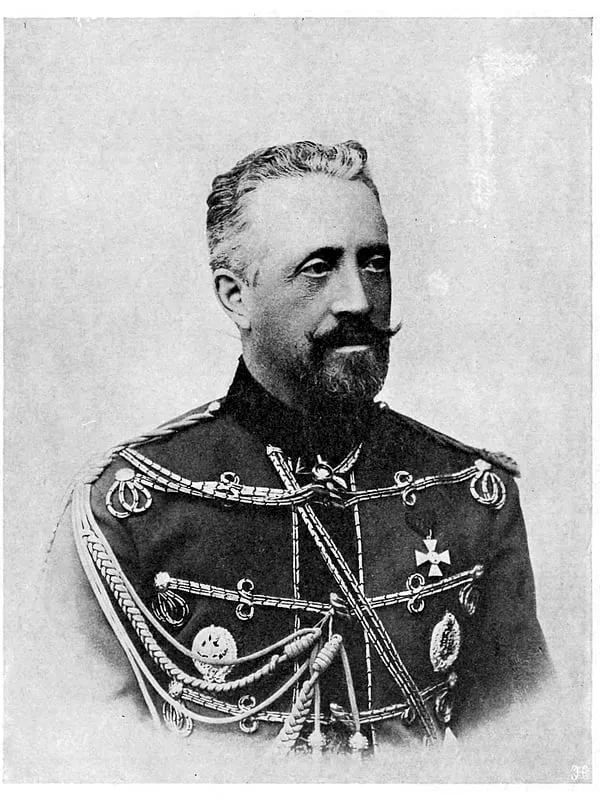
- Born:
- 18 November 1856, St Petersburg (Russian Empire)
- Died:
- 5 January 1929, Antibes (France)
- Author:
- Łukasz Skowroń
- Photo:
- «ВЭС». (СПб; 1914 год), domena publiczna, Wikimedia Commons

Grand Duke Nicholas Nikolaevich Romanov, known in the family as “Nikolasha”, was commander-in-chief of the Russian Army for the first thirteen months of the war. He was in command during the great victories over Austria-Hungary in Galicia and the heavy defeats in the clashes with the Germans, from Tannenberg to the Great Retreat of 1915. Almost two metres tall, stern and hot-tempered, he enjoyed a popularity in the army and in society that no other member of the dynasty had. That popularity eventually became one of the reasons for his fall: in September 1915 Tsar Nicholas II took command himself and sent his uncle to the Caucasus. In Poland his name is associated above all with the proclamation to the Poles of August 1914.
Before the war
He was born on 18 November 1856 in St Petersburg, the eldest son of Grand Duke Nicholas Nikolaevich (the Elder), a grandson of Emperor Nicholas I and a distant relative of the later tsar. He graduated from the Nikolaevsky Engineering School and the General Staff Academy. In the Russo-Turkish War he served on the staff of his father, then commander-in-chief, and received the Order of St George 4th class for the crossing of the Danube. He then served for more than a decade in the Guard hussar regiment, which he commanded from 1884, and in 1895–1905 he was inspector-general of cavalry. He was considered an excellent organiser and a demanding instructor, but he had never commanded large formations in the field. In the war with Japan he was given no posting.
He did, however, play an important part in politics. During the 1905 Revolution the tsar considered entrusting him with a military dictatorship. According to court accounts the grand duke then drew a revolver and threatened to shoot himself if the monarch did not accept the programme of Sergei Witte, which contributed greatly to the proclamation of the October Manifesto. In 1905–1908 he chaired the Council of State Defence, and from 1905 until the outbreak of war he commanded the Guard and the St Petersburg Military District. He was in sharp conflict with the Minister of War, Vladimir Sukhomlinov. In 1907 he married Anastasia of Montenegro, daughter of the King of Montenegro, which strengthened his Pan-Slavist sympathies. The war plans were prepared without his involvement.
Commander-in-chief
Under the plans it was the tsar who was to take command of the army. His ministers, however, persuaded him that his place was in the capital, and on 2 August 1914 (20 July in the Julian calendar) Nicholas II appointed the grand duke commander-in-chief. The appointment was popular in the army, but the grand duke took over a ready-made staff and could not choose his own associates. The chief of staff was General Nikolai Yanushkevich, and operations were planned by the quartermaster-general, General Yuri Danilov. The new field regulations, written under Sukhomlinov’s eye, gave front commanders wide independence. General Headquarters, the Stavka, was set up at Baranovichi.
On 14 August the grand duke issued a proclamation to the Poles, in which he promised the unification of the Polish lands under the sceptre of the tsar, “free in its faith, in its language, in self-government”. The proclamation was vague and offered no guarantees, but for the first time since the partitions one of the powers was publicly courting the Poles.
Russia had committed itself to France to strike quickly at Germany, and the grand duke kept that commitment at the expense of preparation. The offensive in East Prussia ended with the destruction of Alexander Samsonov’s army at Tannenberg and the expulsion of Paul von Rennenkampf’s army, but it forced the Germans to transfer two corps from the Western Front. At the same time the armies of General Nikolai Ivanov’s Southwestern Front won the Battle of Galicia and took Lviv. The grand duke then called off the planned thrust into the Posen region and sent the freed forces to Galicia.
In the autumn the Stavka repulsed the German and Austrian advance at Warsaw and Dęblin and was preparing a great offensive into Silesia. It was forestalled by August von Mackensen, who in November struck the Russian flank. The grand duke grasped the danger too late, and the Battle of Łódź brought no decision. On 29 November he ordered the troops to withdraw to a shorter line closer to Warsaw, along the Bzura and Rawka. At the end of December, when the Turks attacked at Sarikamish, he asked the British for an operation that would relieve the Caucasus front. That request became one of the impulses for the decision to attack the Dardanelles.
1915: from Przemyśl to the Great Retreat
At the beginning of 1915 the grand duke wavered between two directions. The Northwestern Front wanted to strike at East Prussia, while Ivanov and his chief of staff Mikhail Alekseyev argued that the road to victory led across the Carpathians into Hungary. The Stavka fully committed to neither plan and dispersed its forces. The Russians captured Przemyśl, but the winter offensive in the Carpathians cost them hundreds of thousands of men. By the spring the army was beginning to run short of shells and rifles.
In May the Germans and Austrians broke through the front at Gorlice. For several weeks the grand duke forbade retreat and demanded that positions be held at all costs, which increased the losses. In June the Russians lost Przemyśl and Lviv, and on 19 July, at a conference in Siedlce, the grand duke agreed to the withdrawal of the armies from the Vistula. Over the summer Russia lost the Kingdom of Poland, Lithuania and part of Belarus, and the Stavka had to leave Baranovichi.
This period also weighs on his record in another way. The Stavka sought the culprits for the defeats among “internal enemies”. The grand duke confirmed the death sentence on Colonel Sergei Myasoyedov, accused of espionage on dubious evidence, which fuelled spy mania in the country. With his consent Yanushkevich ordered Jews and German colonists to be deported from the frontline provinces, and during the retreat the property of the population to be destroyed and the people driven east. Hundreds of thousands of deportees and refugees ended up deep inside Russia. Historians regard these deportations as one of the darkest chapters of the Russian high command in this war.
The defeats weakened the grand duke’s position at court. Empress Alexandra Feodorovna and Grigori Rasputin had long distrusted him, and the tsar watched with unease as the Stavka received public delegations and meddled in civilian affairs. In June the grand duke also contributed to the dismissal of Sukhomlinov. Despite the protest of eight ministers, on 5 September 1915 the tsar arrived at the Stavka in Mogilev and took supreme command himself.
Viceroy of the Caucasus
The removed commander became Viceroy of the Caucasus and commander of the Caucasus Army. After a few weeks on his estate near Tula he arrived in Tiflis. Since the administration of the region required his presence in the capital, General Nikolai Yudenich continued to command in the field, while the grand duke approved his plans and dealt with the rear. He sent Baratov’s corps to Persia, which in November 1915 took Qazvin. At the turn of 1915 and 1916, despite his doubts, he approved the winter Erzurum offensive, and on 16 February 1916 he reported to the tsar by telegraph the capture of Erzurum. In April the Russians took Trebizond. The Caucasus proved to be the only front on which Russia kept winning right up to the revolution.
According to the memoirs of the mayor of Tiflis, Alexander Khatisov, in December 1916 conspirators from the circle of Prince Georgy Lvov proposed to the grand duke that he take part in overthrowing the tsar and assume the throne. After two days’ reflection he refused, explaining that the peasant and the soldier would not understand a coup.
Revolution and abdication
In March 1917, when General Headquarters asked the front commanders for their views, the grand duke begged Nicholas II by telegraph, “on bended knee”, to renounce the crown to save Russia and the dynasty. One of the tsar’s last acts before his abdication on 15 March was to reappoint him commander-in-chief. The grand duke left Tiflis and reached Mogilev on 24 March, greeted enthusiastically along the way. There, however, he found a letter from Prime Minister Lvov: the Provisional Government had decided that a member of the Romanov dynasty could not head the army. After a conversation with Alekseyev he resigned, and in April he was discharged from the service at his own request.
After the war
For two years he lived in the Crimea, on his brother’s estate, under the supervision of successive authorities, including during the German occupation in 1918. In April 1919 he left Russia aboard the British battleship HMS Marlborough. He lived in Italy, and from 1922 in France. Part of the White emigration saw him as a candidate for the throne, although he himself made no claim. From 1924 he headed the Russian All-Military Union, an organisation of former officers of the White armies which the Soviet political police tried to penetrate. He died on 5 January 1929 in Antibes. He was buried in Cannes, and in 2015 his remains were moved to Moscow.
Assessment
Opinions of the grand duke differ sharply. Contemporary soldiers and many émigré historians stressed his authority, integrity and organisational talent, and credited him with the successes in Galicia and the skilful extraction of the army from the “Polish sack” in 1915. Even the German command admitted that the Russians had then slipped out of the pincers. The American historian Richard Pipes called him the most outstanding member of the dynasty in its last decades.
Other historians, particularly Western ones, point out that the grand duke was more a symbol than a real commander. He could not impose his will on the front commanders, adopted contradictory plans in turn and dispersed his forces, while the Stavka had little control over supply and did not cooperate with the government. Critics also blame him for the spy mania and the mass deportations of 1915. Most scholars agree that he was overwhelmed by a task for which no one in Russia was prepared, and that his dismissal, though not groundless militarily, proved to be a political mistake by the tsar.
Sources
Spotted a mistake?Report an error
Commanded in battles
(02)Mentioned in battles
(11)Often appears with
People who appear in the same events.
On the timeline
(26)1914
1915
May
June
July
- 19
- End of the second battle of KraśnikOn the night of 18–19 July 1915 the Russians abandoned their positions at Kraśnik and Urzędów and fell back closer to Lublin. As they left, they burned Urzędów.
- Battles of Hrubieszów and Wojsławice beginOn 19 July 1915 the Russians fell back to a new line running west from Hrubieszów. The Army of the Bug followed them and stopped before more trenches.