Russia · The Entente
Grigori Rasputin
Healer and confidant of the imperial family, regarded as an informal adviser to Empress Alexandra Feodorovna (1905–1916)
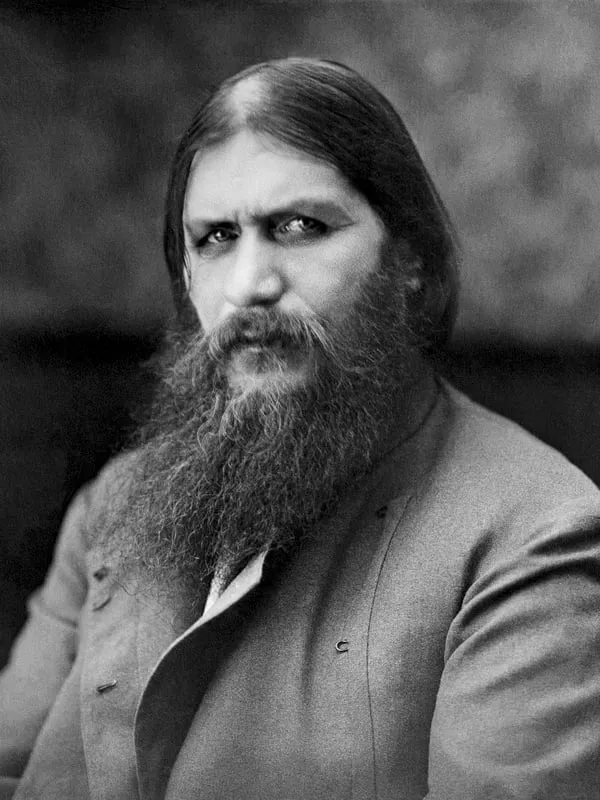
- Born:
- 21 January 1869, Pokrovskoye, Tobolsk Governorate (Russian Empire)
- Died:
- 30 December 1916, Petrograd
- Author:
- Natalia
- Photo:
- autor nieznany, domena publiczna, Wikimedia Commons

Grigori Yefimovich Rasputin held no office and was neither a clergyman nor a soldier, yet he became one of the most famous figures of wartime Russia. A Siberian peasant, wandering pilgrim and self-styled “starets”, he won the trust of Emperor Nicholas II and his wife Alexandra Feodorovna, because they believed that his prayers saved the life of their son, who suffered from haemophilia. When the Tsar left for Headquarters in 1915, it was widely believed in the capital that Rasputin, through the Empress, appointed and dismissed ministers. His drunken excesses and rumours of treason discredited the dynasty more than the defeats at the front. In December 1916 aristocratic conspirators murdered him, but the monarchy outlived him by only ten weeks. Historians still argue over how much of his power was reality and how much legend.
Before the war
According to the parish register he was born on 21 January 1869 (9 January in the Julian calendar) in the village of Pokrovskoye on the River Tura in Tobolsk Governorate, into the family of a prosperous peasant who earned extra money as a carter. Various accounts, however, give dates from 1864 to 1873. Little is known of his youth, and the later stories of horse theft and blasphemy were largely invented by his enemies. He was illiterate; in 1887 he married Praskovya Dubrovina, and they had three children who survived to adulthood. In 1897 he underwent a religious conversion. After a stay at the monastery in Verkhoturye he became a wandering pilgrim, travelling across Russia from Kiev to remote hermitages, and according to some accounts he reached Mount Athos. In his home village he gathered a circle of followers, which the local priest regarded as heresy. The Church twice investigated charges that he belonged to the Khlysty sect, but proved nothing against him.
Around 1903, with letters of recommendation from clergy in Kazan, he came to St Petersburg, where he was received by the inspector of the theological academy, Archimandrite Feofan. Through him he entered the salons of the aristocracy, which were fascinated by mysticism and spiritualism. He was introduced to the imperial couple by the Montenegrin princesses Militsa and Anastasia, daughters of King Nicholas I Petrović-Njegoš and wives of grand dukes. On 1 November 1905 (in the Julian calendar) the Tsar noted in his diary that he had met “a man of God, Grigori from Tobolsk Governorate”.
Rasputin’s strength lay in the illness of the heir to the throne, Alexei, who suffered from haemophilia, a fact the court kept secret. The Empress was convinced that the starets’s prayers had several times stopped the boy’s bleeding, and in the autumn of 1912 at Spała, when the doctors were already losing hope, his telegram assuring her that “the little one will not die” was enough. Historians look for explanations in the calming effect of his presence on the boy and his mother, or in the fact that he advised against doctors, but for Alexandra he was from then on her indispensable “Friend”. To others he was a scandalous enigma. There were rumours of drunkenness, affairs and abuse of his female admirers; Prime Minister Pyotr Stolypin had him watched by the police, and in 1912 his influence at court became the subject of a heated debate in the Duma. The Tsar sent him back to Siberia several times, but each time he returned.
July 1914
On 29 June 1914 in the Julian calendar, that is 12 July in the Gregorian, at Pokrovskoye the peasant woman Khioniya Guseva, a follower of his former ally and later bitter enemy, the ex-monk Iliodor, stabbed him in the stomach. The Russian press devoted more space to the state of his health than to the assassination in Sarajevo. Rasputin spent several weeks in hospital in Tyumen and could not be in the capital while the question of war was being decided. Many historians believe that had he been in St Petersburg, he would have tried to hold the Tsar back from mobilisation. From the hospital he sent telegrams warning that war would bring disaster upon Russia. According to his daughter and to the Empress’s friend Anna Vyrubova, one of them, sent in the last days of July, when general mobilisation hung in the balance, declared that a menacing cloud hung over Russia and that war would drown it in blood. Nicholas II ignored these warnings. Once war broke out, Rasputin no longer spoke openly against it, but he remained convinced that it would bring the peasants nothing but suffering.
The “Friend” in wartime
The first year of the war brought Rasputin powerful enemies. The Supreme Commander-in-Chief, Grand Duke Nicholas Nikolaevich, formerly his patron, distrusted him. According to an anecdote repeated by contemporaries, when told that the starets intended to visit Headquarters, he replied that if he came he would have him hanged. In the spring of 1915 the Moscow police reported a drunken brawl by Rasputin at the Yar restaurant, where he was said to have boasted of his intimacy with the Empress. The head of the gendarmerie and deputy minister of the interior, Vladimir Dzhunkovsky, presented the Tsar with a report on the matter and in August lost his post. The authenticity of this incident is, moreover, doubted by historians, because the police agents who followed Rasputin step by step recorded no scandal at the time.
Rasputin became a truly political figure after 5 September 1915, when the Tsar assumed supreme command and took up residence in Mogilev. The Empress, who together with Rasputin had worked for the removal of the Grand Duke, took over the supervision of state affairs in the capital. Her daily letters to her husband are full of the names of ministers and bishops whom the “Friend” recommended or opposed. Changes of office followed so quickly that Russians spoke of “ministerial leapfrog”. In the autumn of 1915 the ministers who had opposed the Tsar’s departure for the army lost their posts, among them the Minister of the Interior, Nikolai Shcherbatov, and the Chief Procurator of the Holy Synod, Alexander Samarin, an open opponent of the starets. His protégé Pitirim (PL) became Metropolitan of Petrograd. Also regarded as Rasputin’s men were the new Prime Minister, Boris Stürmer, appointed at the beginning of 1916, and the Minister of the Interior, Alexander Protopopov, who took over the ministry in the autumn. The Empress also contributed to the departure of the War Minister, Polivanov, by asking her husband whether he was not an enemy of the “Friend”, and in July 1916 to the dismissal of Sazonov.
Rasputin also gave his views on military matters. Alexandra passed on his “visions” and advice to her husband, asked for his blessing on orders issued to the fronts, and in August 1916 wrote that the “Friend” hoped the army would not climb the Carpathians, because the losses would again be too great. The Tsar sometimes asked her not to reveal the plans of operations to Rasputin. To his waiting room came merchants seeking contracts, ladies seeking promotion for their husbands, peasants asking for a son to be released from the army, and Jews seeking the right of residence in the capital. Rasputin wrote them short notes to officials and accepted gifts. He also figured in politicians’ plots. At the beginning of 1916 the Minister of the Interior, Alexei Khvostov, whom he had himself earlier supported, planned, according to contemporary accounts, to have him killed. The affair came to light and Khvostov lost his post.
“Dark forces”
Rasputin acquired the label of leader of the “dark forces” that were supposedly betraying Russia to the enemy. In Petrograd it was repeated that the peasant and “the German woman”, as the Hesse-born Empress was called, were preparing a separate peace with Germany, and obscene caricatures and leaflets circulated around the country. The rumours were fuelled, among others, by Khvostov himself. No evidence of Rasputin’s contacts with the Germans was ever found, although he made no secret of the fact that he would have preferred the war to end as soon as possible. Rumours of treason nevertheless reached the front and undermined the monarch’s authority among soldiers and officers.
In the autumn of 1916 the entire opposition came out against the government. On 14 November the leader of the Kadets, Pavel Milyukov, named Rasputin in the Duma among the “court party”, which contributed to the fall of Stürmer. Warnings reached the Tsar from his family: the Empress’s sister, Grand Duchess Elizabeth Feodorovna, and several grand dukes asked in vain for the starets to be removed. The new Prime Minister, Alexander Trepov, according to several accounts tried to bribe him. On 2 December 1916 the far-right deputy Vladimir Purishkevich called on ministers in the Duma to beg the Tsar on their knees to rid Russia of Rasputin. The monarchists concluded that since the Tsar would not get rid of him, it had to be done for him.
Death
The conspiracy was formed by Prince Felix Yusupov, husband of the Tsar’s niece, Grand Duke Dmitri Pavlovich, Purishkevich, Lieutenant Sergei Sukhotin and the physician Stanislaus Lazovert. On the night of 29–30 December 1916 (16–17 December in the Julian calendar) Yusupov lured Rasputin to his palace on the Moika. According to his later memoirs, the guest ate poisoned cakes and drank poisoned wine without effect, but the post-mortem found no trace of poison. What is certain is that Rasputin was hit by several bullets, including a fatal shot to the forehead at close range, and the conspirators threw his body into a hole in the ice of the Malaya Nevka. It was recovered on 1 January 1917. The circumstances of the murder are still overgrown with legends, including hypotheses, unconfirmed by documents, of the involvement of British intelligence.
Rasputin was buried quietly in the park at Tsarskoye Selo in the presence of the imperial family. The murderers were not brought to trial. The Tsar exiled Grand Duke Dmitri to Persia and Yusupov to his estate, and shut himself away with his wife in an even narrower circle of trusted people. In the streets and salons the death of the starets was greeted with joy, but it did not change the court’s policy. In March 1917, after the February Revolution, soldiers acting on the orders of the new authorities dug up his coffin and burned the body so that the grave would not become a place of veneration.
Assessment
So many rumours, slanders and false memoirs have grown up around Rasputin that separating fact from legend is very difficult. Some of his opponents, such as Iliodor, published sensational books in 1917, and later accounts, including Yusupov’s memoirs, were written with readers in mind. The traditional picture, established by Bernard Pares, Robert Massie and many others, presents him as the evil spirit of the dynasty who in 1915–1916 effectively ruled Russia through the Empress. The British historian Dominic Lieven and the biographer Joseph Fuhrmann point out, however, that the Tsar ignored much of his advice, for example disregarding his warnings against war, and in November 1916 dismissed Stürmer against his wishes. In their view the frequent changes of ministers can also be explained by a lack of candidates who were both loyal to the autocracy and capable of working with the Duma. The American historian Douglas Smith, in an extensive biography published in 2016, shows Rasputin as a more complex figure: sincerely religious, yet vain and helpless before the temptations of power.
Whatever his real influence, historians agree that what mattered above all was what people believed. Orlando Figes and Boris Kolonitskii have shown how the rumours about the “starets” and “the German woman” stripped the monarchy of its aura of sanctity and made its overthrow appear a patriotic act. In this way the Rasputin affair became one of the causes of the fall of a dynasty that had ruled Russia for more than three hundred years.
Sources
Spotted a mistake?Report an error
Often appears with
People who appear in the same events.