Russia · The Entente
Nicholas II
Emperor of All Russia (1894–1917), Supreme Commander-in-Chief of the Russian Army (1915–1917)
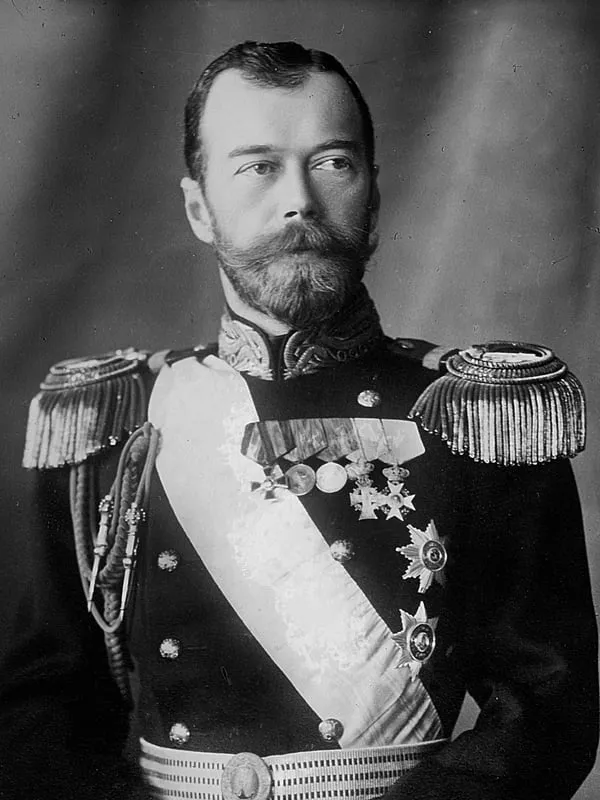
- Born:
- 18 May 1868, Tsarskoye Selo (Russian Empire)
- Died:
- 17 July 1918, Yekaterinburg
- Author:
- Łukasz Skowroń
- Photo:
- autor nieznany, domena publiczna, Wikimedia Commons

Nicholas II Romanov was the last Emperor of Russia and the only monarch of a great power who personally took command of his army during this war. In the summer of 1914, after long hesitation, he agreed to the general mobilisation that pushed Europe into war. In the autumn of 1915, against the advice of almost all his ministers, he removed his uncle from command and went to Headquarters, which made him personally responsible from then on for every defeat. When the capital’s garrison mutinied in March 1917, his own generals abandoned him and he was forced to renounce the throne. Sixteen months later the Bolsheviks murdered him together with his family in Yekaterinburg. He was courteous, pious and devoted to his family, but throughout his reign he defended an autocracy to which he could no longer give effective government.
Before the war
He was born on 18 May 1868 (6 May in the Julian calendar) at Tsarskoye Selo near St Petersburg, the eldest son of the heir to the throne, the future Emperor Alexander III. He received a careful education at home, knew several languages and served for some years in Guards regiments. He was poorly prepared for power, because his father, strong and healthy, was expected to reign for many more years. Alexander III, however, died suddenly on 1 November 1894 and the 26-year-old Nicholas became emperor. A few weeks later he married Princess Alix of Hesse, who took the name Alexandra Feodorovna. The couple had four daughters and a son.
From the outset he declared that he would defend the principle of autocracy as firmly as his father had, and he called the zemstvos’ hopes of public participation in government “senseless dreams”. The coronation festivities in Moscow in 1896 were overshadowed by the Khodynka tragedy, in which more than a thousand people died in the crush. On Russia’s initiative the first peace conference at The Hague was convened in 1899, and it adopted the first Hague Conventions. Expansion in the Far East, however, led to the lost war with Japan of 1904–1905, and the defeats and the massacre of demonstrators in St Petersburg in January 1905 sparked the revolution. Under its pressure the Tsar issued the manifesto of October 1905, which gave Russia a parliament, the State Duma. He never fully accepted this concession. He dissolved the first two Dumas and supported the reforms of the prime minister Pyotr Stolypin, assassinated in 1911, ever less willingly.
In 1904 the long-awaited heir to the throne, Alexei, was born with haemophilia. The illness was a state secret, and the family withdrew more and more into Tsarskoye Selo. The Empress placed her trust in the Siberian peasant Grigori Rasputin, who in her view could ease the boy’s suffering. His presence at court was discrediting the dynasty even before the war.
July 1914
In foreign policy the Tsar wanted peace, but he believed that Russia could not give way in the Balkans a second time, as it had during the Bosnian crisis of 1909. After the Sarajevo assassination and the visit of the French President Raymond Poincaré to St Petersburg on 20–23 July, Russia stood behind Serbia. Until the last moment Nicholas II kept up a telegraphic correspondence with his cousin, Emperor Wilhelm II, signing himself “Nicky”. On 29 July he even proposed referring the Austro-Serbian dispute to the Hague conference. That same evening, under the influence of a telegram from Berlin, he halted the already signed order for general mobilisation. The next day, however, the foreign minister Sergey Sazonov convinced him that war with Germany was unavoidable, and on 30 July the Tsar agreed to the mobilisation of the whole army. According to the minister’s account, he spoke as he did so of the thousands of men he was sending to their deaths. On 1 August Germany declared war on Russia.
The emperor in wartime
On 2 August in the Winter Palace the Tsar proclaimed the manifesto on the war and repeated the oath of his ancestor Alexander I from 1812 that he would not make peace while a single enemy soldier remained on Russian soil. The crowd in the square in front of the palace fell to its knees and sang the anthem. For a few weeks the monarchy enjoyed support it had not known for decades. The sale of vodka was banned for the period of mobilisation and then for the whole war, which was meant to improve discipline but deprived the treasury of enormous revenue. At the end of August the German-sounding St Petersburg was renamed Petrograd.
The Tsar wanted to lead the army into the field himself, but his ministers talked him out of it, and on 2 August his uncle, Grand Duke Nicholas Nikolaevich, became Supreme Commander-in-Chief. Nicholas II often visited Headquarters and the armies, took parades and handed out decorations. The Tsar also had his own war aims. On 3 March 1915 he told the French ambassador Maurice Paléologue that he could not demand such terrible sacrifices of his people without giving them Constantinople and the Straits as their reward. Sazonov put this demand to the allies, and London and Paris agreed to it in the spring. In April 1915, after the capitulation of Przemyśl, the Tsar travelled to Lviv and Przemyśl to celebrate the gains in Galicia. A few days later the Germans and Austrians broke through the front at Gorlice and the Great Retreat began, which over the summer cost Russia Galicia, the Kingdom of Poland and Lithuania.
Defeats and the shortage of ammunition forced the Tsar to make concessions. In June 1915 he dismissed the war minister Vladimir Sukhomlinov and several other conservative ministers, and in August he recalled the Duma. At the same time he decided to take command of the army himself. Eight ministers, Sazonov among them, warned him in a collective letter that the decision threatened Russia and the dynasty with grave consequences. The Tsar remained unmoved, and on 5 September 1915 he arrived at the Stavka in Mogilev, sending the Grand Duke to the Caucasus. He believed that in the hour of trial his place was with his soldiers. Many historians also point to the influence of the Empress and Rasputin, who distrusted the popular Grand Duke.
Supreme Commander-in-Chief
From September 1915 Nicholas II spent most of his time in Mogilev. Operations were in fact directed by his chief of staff, General Mikhail Alekseyev, with whom the Tsar discussed the situation at the front every day and whose decisions he usually approved. This partnership bore some fruit. In the autumn the front stabilised, the army was better supplied with weapons and ammunition, and in 1916 the Brusilov offensive shattered the Austro-Hungarian armies in Volhynia and Galicia. Offensives on other sectors, however, such as at Lake Naroch and at Baranovichi, cost hundreds of thousands of men without significant gains.
The Tsar’s absence from the capital had much worse consequences. In Petrograd control over appointments passed to the Empress, who in her letters to her husband advised him on nominations, often in line with Rasputin’s wishes. In 1915–1917 Russia had four prime ministers, and the ministers of the interior and of war changed even more often. In February 1916 Boris Stürmer became prime minister, and the Tsar visited the Duma for the first time in history. The gesture did not change policy. In July 1916 the Emperor dismissed Sazonov, who had been urging him to proclaim autonomy for the Kingdom of Poland, and the promised manifesto never appeared. The Central Powers forestalled Russia with the Act of 5 November, and the Tsar responded only with his order to the army and navy of 25 December 1916, in which he named the creation of a free Poland from its three parts as a war aim.
In the autumn of 1916 the whole opposition came out against the government, and the Kadet leader Pavel Milyukov asked from the rostrum of the Duma whether the authorities’ policy was stupidity or treason. The Tsar dismissed Stürmer but would not agree to a government responsible to the Duma. Warnings reached him from his family, from the Allied ambassadors and from the generals. On 30 December 1916 conspirators from aristocratic and right-wing circles murdered Rasputin. Instead of a change of course there came another wave of appointments of people trusted by the court.
Downfall
At the beginning of March 1917 the Tsar left Tsarskoye Selo for Mogilev. On 8 March strikes and demonstrations began in Petrograd, and on 12 March the garrison mutinied and revolution broke out. Nicholas II at first ordered the disturbances to be put down by force and sent a detachment under General Nikolai Ivanov against the capital, and then decided to return to his family. His train was unable to reach Tsarskoye Selo and turned back to Pskov, headquarters of the Northern Front. There the front commander, General Nikolai Ruzsky, urged him to make concessions, and Alekseyev gathered the opinions of the front commanders. The front commanders, and Grand Duke Nicholas Nikolaevich as well, advised abdication.
Late in the evening of 15 March 1917 the Tsar renounced the throne for himself and his sick son in favour of his brother, Grand Duke Michael, who the next day declined to accept the crown. In his diary Nicholas wrote: “All around is treason, cowardice and deceit!” In the act of abdication, however, he called on the Russians to carry on the war to a victorious end. On 21 March in Mogilev he was told that he was under arrest, and the next day he returned under guard to Tsarskoye Selo.
The Provisional Government wanted to send the imperial family to Great Britain, and in March London provisionally agreed to receive them. Under the influence of public feeling in Britain and the fears of King George V, Nicholas’s cousin, that the presence of the deposed Tsar would harm the British monarchy, the invitation was soon withdrawn. In August 1917 the Romanovs were taken to Tobolsk in Siberia. After the Bolshevik coup their situation worsened, and in the spring of 1918 they were moved to Yekaterinburg. On the night of 16–17 July 1918, as the Czechoslovaks and the Whites approached the city, the Bolsheviks murdered Nicholas, his wife, their five children and four of their companions.
After his death
For years the Soviet authorities concealed the fact that the whole family had been killed. The remains were found near Yekaterinburg at the end of the 20th century and, after DNA testing, were buried in 1998 in the Peter and Paul Cathedral in St Petersburg. The Russian Orthodox Church Outside Russia canonised Nicholas and his family as martyrs in 1981, and the Russian Orthodox Church recognised them as saints in 2000.
Assessment
Few rulers provoke such differing judgements. To his critics, from liberal contemporaries to many Western historians, he was a man of limited horizons, stubborn and susceptible to his wife’s influence, who did not understand that autocracy no longer suited modern Russia. He is accused of dragging a poorly prepared state into war in 1914, of leaving the capital without control against all advice in 1915, and of rejecting to the end an agreement with the Duma that might have saved the monarchy. A harsh judgement is offered, for example, by Orlando Figes in his history of the Russian Revolution.
Others, such as the British historian Dominic Lieven, stress that the Tsar was more intelligent and more hard-working than legend had it, that he took his duties seriously and that he faced a task which few could have mastered in the conditions of total war. They point out that in 1916 the Russian army was better supplied than a year earlier, and that the collapse was decided by the crisis of supply in the capital and the attitude of the elites. In today’s Russia the image of Nicholas II as martyr and saint clashes with that of an incompetent ruler. In Poland he is remembered above all because his state ruled the largest part of the Polish lands, and concrete promises to the Poles came only when the Kingdom of Poland had already been lost.
Sources
Spotted a mistake?Report an error
Mentioned in battles
(02)Often appears with
People who appear in the same events.
On the timeline
(51)The 40 most important of 51 events. All tagged “Nicholas II” (26) →
1907
1913
1914
1915
1916
January
February
March
April
May
June
July
October
- 20
- Explosion of the battleship Imperatritsa MariyaOn 20 October 1916 the dreadnought Imperatritsa Mariya, flagship of the Black Sea Fleet, blew up and sank at Sevastopol. More than 200 sailors were killed.
- Boulogne conference on GreeceOn 20 October 1916 the leaders of Britain and France met at Boulogne to discuss Greece. They did not recognise Venizelos's government but agreed to fund it.