France · The Entente
Raymond Poincaré
President of the French Republic (1913–1920)
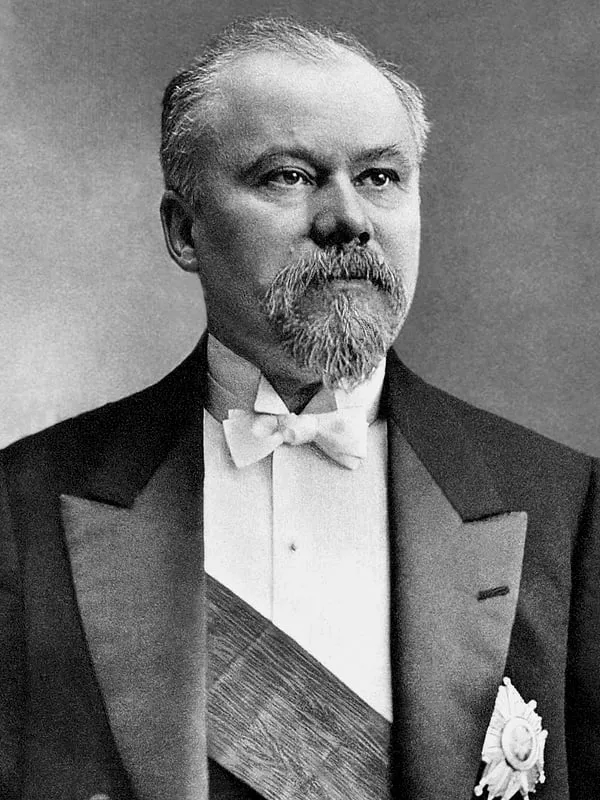
- Born:
- 20 August 1860, Bar-le-Duc (France)
- Died:
- 15 October 1934, Paris
- Author:
- Natalia
- Photo:
- Braun, domena publiczna, Wikimedia Commons

Raymond Poincaré was President of France throughout the war. A lawyer and politician of the moderate centre, he came from Lorraine and remembered from childhood the German occupation after the defeat of 1870. As prime minister and president he strengthened the alliance with Russia, and in July 1914 he visited St Petersburg, a few days before the outbreak of war. It was he who in August called on the French to form a “sacred union” of all parties. The constitution of the Third Republic gave the president little power, and in the first years of the war military decisions were taken over by the commander-in-chief, Joseph Joffre. Poincaré was nevertheless a persistent observer, adviser and intermediary between governments, generals and allies. In November 1917 he made the most important choice of his presidency: he entrusted the government to Georges Clemenceau, whom he could not stand but who promised victory.
Before the war
Raymond Nicolas Landry Poincaré was born on 20 August 1860 in Bar-le-Duc in the Meuse department, into the well-to-do family of an engineer. His cousin was the mathematician Henri Poincaré. As a ten-year-old boy he saw Prussian soldiers occupy his parents’ house, and the loss of Alsace and part of Lorraine shaped his patriotism for ever. He studied law in Paris and became a sought-after barrister. In 1887, as the youngest deputy in the Chamber, he entered parliament for the Meuse department. In 1893–1895 he was successively minister of education and of finance, and from 1903 a senator. In 1909 he was elected to the Académie française.
In January 1912, after the Moroccan crisis, he became head of the government and at the same time took over the foreign ministry. He pursued a policy of firmness towards Germany, tightened the entente with Great Britain and the alliance with Russia, which had been strained in previous years. In August 1912 he visited St Petersburg. On 17 January 1913 the National Assembly elected him president, even though the left, led by Georges Clemenceau, did everything to prevent it. He took office on 18 February 1913. Unlike his predecessors, he wanted to be an active president, especially in foreign policy. He supported the law extending military service to three years, passed in the summer of 1913.
July 1914
In mid-July 1914 Poincaré and the prime minister, René Viviani, sailed on a visit to Russia. From 20 to 23 July they held talks with Tsar Nicholas II and his ministers. Vienna deliberately delivered its ultimatum to Serbia only on the evening of 23 July, so that the French guests would already be on their way home. For the following days the president and the prime minister were at sea, with poor communications, and in Paris affairs were run by the acting foreign minister, Jean-Baptiste Bienvenu-Martin. Poincaré returned to Paris on 29 July. On 30 July the government agreed to pull the covering troops back 10 kilometres from the German border, so as not to give Germany a pretext for attack and to convince the British that France was not the aggressor. On 1 August France ordered general mobilisation, and on 3 August Germany declared war on it. The next day, in a message read out in parliament, Poincaré declared that France would be heroically defended by all her sons, “whose sacred union” would not break in the face of the enemy.
President in wartime
At the end of August, after the defeats in the Battle of the Frontiers, Poincaré and Viviani reshaped the government into a broad coalition including the socialists, and Alexandre Millerand became minister of war. The president hesitated for a long time over whether to leave Paris, fearing it would be seen as flight. In the end, on 2 September, the government left for Bordeaux, and the president’s opponents reproached him for it for years. After the victory on the Marne he pressed for the return to the capital, which took place in December.
In the first years of the war power in military matters passed in practice to the commander-in-chief, Joseph Joffre. In his private notes Poincaré spoke of a “military dictatorship” and complained that he was a president without power. He made use, however, of what he had left: he presided over the council of ministers, often travelled to the front and to headquarters, and his extensive diary, later published as the memoirs “Au service de la France”, is one of the most important sources for the history of French policy in those years. In 1915 he supported the Balkan expedition, viewed Russia’s claims to Constantinople not without misgivings, and in October, after the fall of the Viviani government, entrusted the premiership to Aristide Briand. On 2 December he signed the decree making Joffre commander-in-chief of all the French armies.
In 1916, during Verdun and the Somme, he often visited soldiers and commanders. At the end of the year, when Briand was easing Joffre out, the president, like the prime minister, considered Philippe Pétain too cautious and backed the promotion of Robert Nivelle. After the failure of the Nivelle offensive it was he, with the minister of war Paul Painlevé, who tried to persuade the general to resign, and on 15 May 1917 the government gave the command to Pétain. In the spring of 1917 the president also held secret talks with Prince Sixtus of Bourbon-Parma, who brought him a letter from Emperor Karl offering a separate peace with Austria-Hungary. The talks came to nothing, because Italy had no intention of giving up its gains.
Important for the Poles was the decree that Poincaré signed on 4 June 1917: it created an autonomous Polish army in France, fighting under the Polish flag. A year later, on 22 June 1918, the president was present at Mailly when its regiments received their colours, and on 30 June he presented a colour to a Czechoslovak regiment at Darney.
The choice of Clemenceau
In the autumn of 1917 France was going through a crisis: mutinies in the army, strikes, spy scandals, and in politics the influence of the supporters of a compromise peace was growing. After the fall of two successive cabinets Poincaré faced a choice between Clemenceau and Joseph Caillaux, a former prime minister suspected of contacts with the Germans. Clemenceau had attacked the president for years, and the president repaid him with a dislike bordering on obsession. Even so, on 16 November 1917 he entrusted him with the government, because he judged that only Clemenceau could bring the war to an end. It was a decision that to a large extent sidelined the president himself: the new prime minister governed energetically and seldom took his views into account.
Poincaré nevertheless remained present at the most important moments. On 26 March 1918, during the German offensive in Picardy, he opened the Doullens conference, at which Ferdinand Foch was given the task of coordinating the actions of the Allies. He considered the armistice of 11 November premature, because he wanted the armies to advance deeper into Germany. In December 1918 he travelled with Clemenceau through the recovered Alsace and Lorraine, in Metz he presented the marshal’s baton to Pétain, and in Strasbourg crowds greeted him. On 14 December he welcomed President Wilson in Paris.
During the peace conference he argued for the permanent separation from Germany of the lands on the left bank of the Rhine, or at least for a long occupation of the Rhineland. Foch urged him to use his constitutional powers and take matters into his own hands. Poincaré even considered resigning, but in the end accepted the compromise negotiated by Clemenceau and written into the Treaty of Versailles.
After the war
Poincaré’s term ended on 18 February 1920. He returned to the Senate, and in January 1922 became prime minister again. When Germany fell behind with reparations, in January 1923 he ordered French and Belgian troops to occupy the Ruhr. After losing the elections in 1924 he stepped down, but in 1926 he was called back to save the currency. His government stabilised the franc, known from then on as the “Poincaré franc”. Because of illness he withdrew in July 1929. He died in Paris on 15 October 1934 and was buried at Nubécourt in his native Meuse.
Assessment
After the war a legend of “Poincaré-la-guerre” grew up around Poincaré. German and Soviet propaganda, as well as part of the French left, portrayed him as a revanchist from Lorraine who had encouraged Russia to go to war in St Petersburg. Serious historians mostly reject this thesis, but they still argue over his role. The British historian John Keiger, author of his biography, considers his policy to have been essentially defensive: Poincaré wanted to deter Germany with a strong alliance, not to start a war. Christopher Clark in his book “The Sleepwalkers” points out, however, that his assurances of loyalty to Russia, given in July 1914, may have emboldened St Petersburg, and that France did little to restrain its ally.
As to his role in the war itself, the judgements are milder. Poincaré was not a leader of the stature of Clemenceau or Lloyd George. He was regarded as a cold, pedantic lawyer who could not sway the crowds. He was, however, a symbol of the continuity of the state and of the sacred union, and his most important decision, the choice of Clemenceau, showed that he put the good of the war effort above personal grudges.
Sources
Spotted a mistake?Report an error
Mentioned in battles
(06)Often appears with
People who appear in the same events.
On the timeline
(54)The 40 most important of 54 events. All tagged “Raymond Poincaré” (12) →
1914
1915
March
April
October
- 13
- Britain breaks off relations with BulgariaIn mid-October 1915 Britain broke off diplomatic relations with Bulgaria. The Bulgarian minister left London, and the Bulgarian army moved against Serbia.
- Théophile Delcassé resignsOn 13 October 1915 the French foreign minister Théophile Delcassé finally stepped down. He left ill, after the failure of Entente diplomacy in Bulgaria.
- 29
- Fall of the Viviani governmentOn 29 October 1915 René Viviani's government fell. After Balkan setbacks and failed offensives he could not reshape his cabinet and gave way to Briand.
- Millerand leaves the Ministry of WarOn 29 October 1915 War Minister Alexandre Millerand, criticised for munitions shortages and deference to Joffre, left office with Viviani's government.
- 30
- Aristide Briand becomes prime minister of FranceOn 30 October 1915 France had a new government. Aristide Briand became prime minister and foreign minister and brought veteran politicians into his cabinet.
- Joseph Gallieni becomes minister of warOn 30 October 1915 General Joseph Gallieni, defender of Paris in 1914, became minister of war in Briand's government. He accepted the post very reluctantly.