France · The Entente
Joseph Joffre
Commander-in-chief of the French Army (1914–1916), Marshal of France
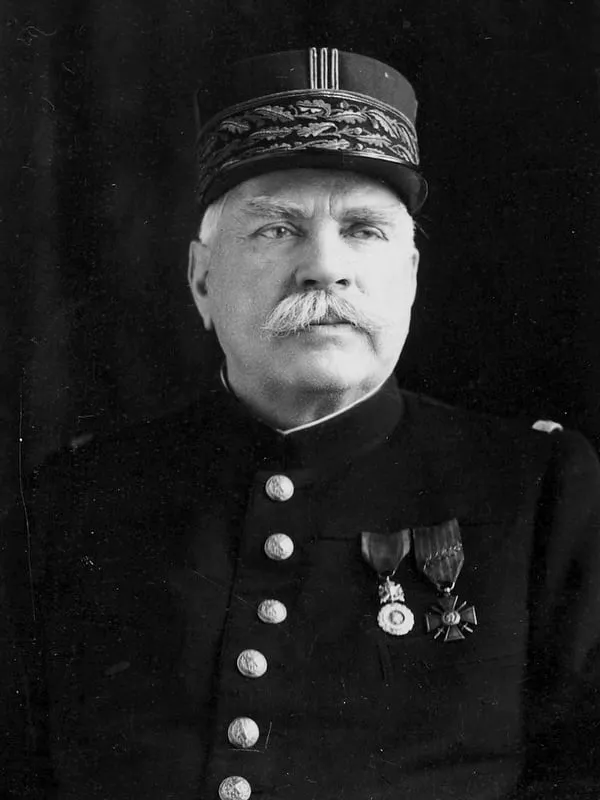
- Born:
- 12 January 1852, Rivesaltes (France)
- Died:
- 3 January 1931, Paris
- Author:
- Łukasz Skowroń
- Photo:
- autor nieznany, domena publiczna, Wikimedia Commons

Joseph Joffre commanded the French Army for the first two and a half years of the war. He entered it with a plan that failed in August 1914. The French armies lost the Battle of the Frontiers and within a few weeks lost hundreds of thousands of men. Joffre, however, did not lose his head: he regrouped his forces, dismissed incompetent generals and in September led the Allies to victory on the Marne, which wrecked the German plan for a quick war. For the next two years he was the most powerful man in France, and at the same time the commander of costly and largely fruitless offensives. In December 1916 he was relieved of command and, by way of consolation, made the first Marshal of France in half a century. To the French he remained above all “the victor of the Marne”, but historians still argue about his merits and about the price French infantry paid for his decisions.
Before the war
Joseph Jacques Césaire Joffre was born on 12 January 1852 in Rivesaltes in the Pyrénées-Orientales department, into the Catalan family of a cooper who had prospered by growing vines. In 1869, aged seventeen and the youngest of his intake, he entered the École Polytechnique in Paris. During the Franco-Prussian War he was a junior artillery officer in besieged Paris. He then transferred to the engineers and built forts on the eastern frontier.
He spent most of his career in the colonies. In 1885 he fortified the French base on Formosa during the war with China, then served in Indochina and West Africa. In February 1894 his column reached Timbuktu, which brought him promotion. Under General Joseph Gallieni he fortified the port of Diego-Suarez in Madagascar, where he was made a brigadier general. After returning to France he headed the engineering service at the War Ministry, commanded a division and a corps, and in 1910 joined the Supreme War Council (Conseil supérieur de la guerre), the body of generals designated to command armies.
In July 1911 the war minister Adolphe Messimy combined the posts of Chief of the General Staff and commander-in-chief designate in the event of war. He first offered the post to Gallieni and to General Paul Pau, but both declined. On 28 July 1911 it went to Joffre, an engineer and logistician who had never commanded an army. He was probably helped by being a republican and a Freemason, unlike many generals suspected of clerical sympathies. His deputy was General Noël de Castelnau. Under Joffre’s direction the staff drew up Plan XVII (PL), in force from the spring of 1914. It was above all a plan for deploying five armies facing the German frontier, with the intention of attacking in Lorraine and the Ardennes. Joffre shared the conviction, prevalent in the army at the time, that attack was superior to defence.
1914: from defeat to the Marne
After mobilisation was proclaimed, on 2 August 1914 Joffre took command of the Armies of the North and North-East. His headquarters were set up at Vitry-le-François. In accordance with the plan, the offensive in Lorraine began on 14 August, and the attack in the Ardennes on 20–21 August. Joffre knew of the German corps marching through Belgium, but he believed that few of them would cross west of the Meuse and hoped that the blow in the Ardennes would strike the enemy’s weakened centre. All these hopes were dashed. In the Battle of the Frontiers the French armies were defeated at Morhange, in the Ardennes and at Charleroi. 22 August was the bloodiest day in the history of the French Army.
From then on came the best part of his war. Joffre gave up the attack in Belgium and decided to fall back until he could gather forces for a counter-stroke. He moved corps by rail from Lorraine to the threatened left wing and created a new Sixth Army under General Michel-Joseph Maunoury and a Ninth Army under General Ferdinand Foch. He changed commanders ruthlessly. On 30 August he dismissed the commander of the Third Army, General Pierre Ruffey, and on 3 September the commander of the Fifth Army, General Charles Lanrezac, even though Lanrezac had checked the Germans at Guise a few days earlier. His place was taken by the energetic Louis Franchet d’Espérey. According to French figures, more than 160 generals had been removed from command by the end of 1914, including three army commanders. Many of them were sent to the rear, among other places to Limoges, which gave French the word limoger, meaning to dismiss from a post.
The most important decision came at the beginning of September. Kluck turned east of Paris and exposed his flank to Maunoury’s army, which was subordinated to the military governor of Paris, General Gallieni. On 4 September Gallieni proposed an immediate attack. Joffre preferred to attack south of the Marne first, and the British and Franchet d’Espérey were already agreeing plans of their own. In the evening, after a telephone conversation with Gallieni, Joffre brought the offensive forward and ordered a general attack from Paris to Verdun for 6 September. On 5 September he went to the headquarters of Field Marshal Sir John French and, according to witnesses, appealed to him in the name of England’s honour for the British to take part in the battle. On the morning of 6 September he issued an order of the day calling on the soldiers to let themselves be killed where they stood rather than fall back. In the Battle of the Marne the German armies had to withdraw to the Aisne.
Who deserved the credit was argued over for decades. Gallieni’s supporters attributed the idea and the initiative to him, and Joffre is said to have replied that he did not know who had won the Battle of the Marne, but he knew who would have lost it. The American historian Robert Doughty, author of the most important modern study of French strategy in this war, considers that Gallieni’s role was significant, but that the essential concept and the key decisions were Joffre’s. In the autumn the commander-in-chief tried to outflank the German wing in the north. In successive stages of the Race to the Sea he sent Castelnau north, and then Foch, whom he appointed as his deputy. By the end of the year the front had frozen from the sea to Switzerland.
1915: the year of offensives
Joffre had no intention of waiting. He held that the Germans were occupying ten French departments and had to be driven out before they shifted forces against Russia. From December 1914 to the autumn of 1915 the French Army attacked again and again: in the First Battle of Champagne, in Artois in May and June, and in the September offensive in Champagne and Artois. In May 1915 he told the British general Henry Wilson that he would reach Namur and that the war would be over within three months. Each attack gained most on the first day and then bogged down in front of the second German position. According to typical estimates, in 1915 the French Army lost nearly 1.4 million men killed, wounded, missing and taken prisoner.
Despite this, Joffre’s standing grew. He drew on the popularity won on the Marne and on the fact that in the first months of the war the government had in practice handed him the conduct of operations. He admitted politicians to his headquarters at Chantilly reluctantly, and his independence irritated deputies used to overseeing the army. He opposed expeditions to the periphery. He regarded the Salonika expedition, backed by President Raymond Poincaré and Aristide Briand, as drawing divisions away from the most important front. At the first Calais conference and in talks with the British he demanded that the British Army take over a larger share of the Western Front.
In the autumn of 1915 his former superior, Gallieni, became war minister. Relations between them were cool, but Joffre won the struggle for power. On 2 December a presidential decree made him commander-in-chief of all French armies, including those in Macedonia and at the Dardanelles. A few days later at Chantilly he chaired a conference of the coalition’s commanders, which agreed on simultaneous offensives on all the main fronts in 1916, and Castelnau became his chief of staff.
Verdun and the Somme
The main offensive of 1916 was to be a joint Franco-British attack on the Somme, agreed with General Douglas Haig in February. The plans were upset by Erich von Falkenhayn, who on 21 February struck at Verdun. The fortress, judged of little use in the summer of 1915, had earlier been stripped of most of its guns. When in the autumn of 1915 Lieutenant Colonel Émile Driant, a deputy, alerted the war minister to the weakening of the defences, Joffre reacted with indignation and disputed the minister’s right to make such remarks. As the German attack approached the Meuse, Joffre sent Castelnau there with full powers, and Castelnau entrusted the defence to General Philippe Pétain. Rumours circulated in Paris that the commander-in-chief had been ready to give up the right bank of the river. Gallieni demanded the documents from those days and in March, after a sharp report on the conduct of the war, resigned.
Throughout the spring Joffre divided his forces between Verdun and the Somme. He limited reinforcements for Pétain, whom he considered too cautious, and pressed Haig for the British to attack as soon as possible. According to British accounts, when Haig wanted to postpone the offensive until mid-August, Joffre exclaimed that by then the French Army would have ceased to exist. The Battle of the Somme began on 1 July. The French, attacking on the southern wing, achieved more than the British, but by November the Allies had advanced at most a dozen or so kilometres, at the cost of enormous losses. At the Chantilly conference in November Joffre agreed with the Allies a plan for 1917 similar to the previous one.
Dismissal
By the autumn of 1916 confidence in Joffre had run out. He was blamed for neglecting the defence of Verdun, for the meagre results of the Somme and for the defeat of Romania, and in secret sessions parliament demanded that his powers be curtailed. On 12 December Briand’s government entrusted command of the forces in France to General Robert Nivelle. Joffre kept the title of commander-in-chief and was to be technical adviser to the government, but it soon became clear that the title carried no power. The new war minister, General Hubert Lyautey, would not accept such an adviser alongside him. On 26 December Joffre asked to be relieved and on the same day was made a Marshal of France, the first since the fall of the Second Empire.
He never again held real command, but the government made use of his fame. In April and May 1917 he travelled to the United States with the former prime minister René Viviani. He addressed Congress, toured the country and persuaded the Americans to send one division to France as soon as possible, before a large army was raised. In June 1917 he welcomed General John Pershing in Paris, and on 4 July, together with President Poincaré, he took the salute at a parade of an American battalion on the Champs-Élysées. In February 1918 he was elected to the Académie française.
After the war
After the armistice Joffre was one of the most revered figures in France and abroad. He travelled abroad, among other places to Spain, Japan and the United States, where in 1922 he was greeted with a parade on Broadway. He settled at Louveciennes near Paris and wrote his memoirs, published after his death in two volumes. Gravely ill, after the amputation of a leg, he died in Paris on 3 January 1931. After a state funeral at the church of Les Invalides he was buried on his estate at Louveciennes.
Assessment
Joffre is one of the hardest commanders of this war to assess. His defenders stress his calm and strength of character in the worst weeks of August 1914, when the French Army was close to breaking. General Lyautey considered him a better logistician than strategist, and it was precisely the organisation of rail transport, ammunition supply and the transfer of divisions from one wing to the other that made victory on the Marne possible. Robert Doughty and many French historians give him the main credit for that victory, and also for building the Allied cooperation which in 1916 rested largely on his authority.
Critics point out that Plan XVII and the doctrine of attack at all costs led to slaughter in August 1914, and that in 1915 Joffre sent infantry against fortified positions with insufficient artillery, hoping for a breakthrough that never came. He is also blamed for neglecting Verdun and for long refusing to listen to criticism, dismissing incompetent commanders faster than his own mistaken assumptions. Some historians note that in 1914–1916 the French Army bore the main burden of the war in the west and that some of the losses stemmed from a situation over which the commander-in-chief had no control. The prevailing view is that Joffre was a commander for a time of crisis, but found no answer to trench warfare, which in any case no one found at the time.
Sources
Spotted a mistake?Report an error
Commanded in battles
(15)- 7–25 August 1914Battle of the FrontiersWestern Front
- 6–12 September 1914First Battle of the MarneWestern Front
- 12–15 September 1914First Battle of the AisneWestern Front
- 15 September – 19 October 1914Race to the SeaWestern Front
- 22–25 September 1914First Battle of AlbertWestern Front
- 22–26 September 1914First Battle of PicardyWestern Front
- 27 September – 12 October 1914First Battle of ArtoisWestern Front
- 20 December 1914 – 17 March 1915First Battle of ChampagneWestern Front
- 8–14 January 1915Battle of SoissonsWestern Front
- 9 May – 18 June 1915Second Battle of ArtoisWestern Front
- 20 July – 16 October 1915Battle of Le LingeWestern Front
- 25 September – 6 November 1915Second Battle of ChampagneWestern Front
- 25 September – 15 October 1915Third Battle of ArtoisWestern Front
- 21 February – 18 December 1916Battle of VerdunWestern Front
- 1 July – 18 November 1916Battle of the SommeWestern Front
Mentioned in battles
(22)- Battle of Mulhouse
- Battle of Lorraine
- Battle of Charleroi
- Battle of the Ardennes
- Battle of Mons
- Battle of the Mortagne
- Battle of the Meuse
- Battle of Guise
- Battle of the Grand Couronné
- Battle of the Ourcq
- Defence of Givenchy
- Battle of Neuve Chapelle
- Battle of Aubers Ridge
- Battle of Loos
- Battle of Krivolak
- Lake Naroch offensive
- Battle of Albert (1916)
- Battle of Flers–Courcelette
- Battle of the Transloy Ridges
- Battle of the Ancre Heights
- Battle of the Crna and Bitola
- First Offensive Battle of Verdun
Often appears with
People who appear in the same events.
On the timeline
(88)The 40 most important of 88 events. All tagged “Joseph Joffre” (31) →
1914
August
- 24
- End of the Battle of CharleroiOn 24 August 1914 the French Fifth Army was retreating from the Sambre towards the French border. The Battle of Charleroi ended in a French defeat.
- Battle of the Ardennes endsOn 24 August 1914 the French Third and Fourth Armies, beaten in the Ardennes, fell back behind the Meuse on Joffre's orders. A bloody frontier battle was over.
- 25
- Key eventBattle of the Meuse beginsOn 25 August 1914 the French Fourth Army, pulled back from the Ardennes, took post behind the Meuse from Mézières to Stenay. The fight for the crossings began.
- Key eventBattle of the Mortagne beginsOn 25 August 1914 the armies of Castelnau and Dubail halted the German drive on the Trouée de Charmes in Lorraine and went over to a counter-offensive.
- Germans retake Mulhouse for the second timeOn 25 August 1914, after the French withdrawal, German troops occupied Mulhouse for the second time. The city remained in their hands until the end of the war.
September
- 05
- End of the retreat from MonsOn 5 September 1914 the British Expeditionary Force ended its retreat from Mons. After almost two weeks of marching it halted south of the Marne, near Paris.
- Key eventBattle of the Ourcq beginsOn 5 September 1914 Maunoury's French Sixth Army struck the flank of Kluck's army near Meaux. The clash at Monthyon opened the great Battle of the Marne.
- 22
- Key eventFirst Battle of Picardy beginsOn 22 September 1914 General de Castelnau's new French Second Army attacked north of the Oise. The Race to the Sea had begun.
- Key eventFirst Battle of Albert beginsIn September 1914 the French and Germans clashed at Albert and Bapaume. On the heights above the Somme a front formed that held until the Somme battle of 1916.
October
December
1915
January
May
July
September
- 25
- Key eventThird Battle of Artois beginsOn 25 September 1915 the French Tenth Army again attacked Vimy Ridge. The left wing reached Souchez, but on the rest of the front the attack broke down.
- Key eventSecond Battle of Champagne beginsOn 25 September 1915 two French armies attacked in Champagne. They took the German first line and 14,000 prisoners, but the second position stopped the attack.