1916: The Battle of the Somme
Battle of the Ancre Heights
- Dates:
- 1 October – 11 November 1916
- Front:
- Western Front
- Location:
- The northern edge of the Thiepval ridge, from the Courcelette–Pys road westwards to Saint-Pierre-Divion on the Ancre, with the Stuff and Schwaben redoubts and Regina and Stuff trenches, facing Grandcourt and Miraumont, Somme department (France)On the battle map →
- Sides:
- United Kingdom and CanadaDouglas Haig, Hubert Gough, Julian Byng, Claud JacobGerman EmpireRupprecht, Crown Prince of Bavaria, Fritz von Below
- Result:
- British victory. The Reserve Army took the Stuff and Schwaben redoubts and Stuff and Regina trenches and secured the whole Thiepval ridge, but only after six weeks of fighting in the mud instead of the few days that had been planned.
- Author:
- Natalia
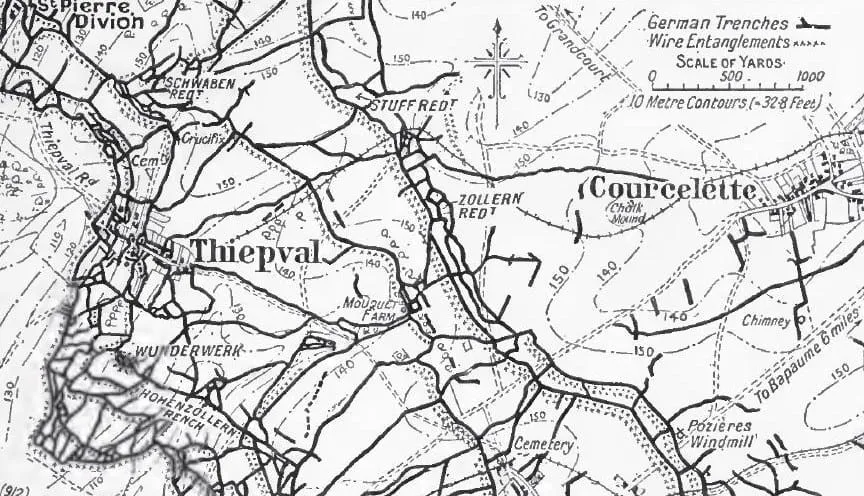
The Battle of the Ancre Heights was the continuation of the Battle of Thiepval Ridge and the penultimate stage of the Battle of the Somme. At the end of September 1916 General Hubert Gough’s Reserve Army had taken the ruins of Thiepval and Mouquet Farm, but the Germans still held the northern edge of the ridge: part of the Stuff Redoubt, the northern corner of the Schwaben Redoubt and the trench running just behind the crest that the Canadians called Regina. Whoever held this edge looked down into the valley of the Ancre, with the villages of Grandcourt and Miraumont, and onto the German batteries hidden beyond the river. Gough wanted to clear the ridge in a few days and then strike northwards and, together with an attack from the other bank of the river, cut off the Germans in the upper Ancre valley. But the autumn rains set in. The battlefield turned into a swamp, and the Germans defended every trench and counter-attacked without respite. The British took the Stuff Redoubt on 9 October, the last scrap of the Schwaben Redoubt on 14 October, and Stuff Trench and most of Regina Trench on 21 October; the Canadians took the rest of Regina Trench only on the night of 10–11 November. The ridge, which was meant to be the starting point for a larger offensive, took six weeks to capture.
Name and dates
The name “Battle of the Ancre Heights” and the dates 1 October – 11 November 1916 were fixed after the war by the British Battles Nomenclature Committee. It covers all the operations of the Reserve Army south of the Ancre in that period. The boundary with the Battle of Thiepval Ridge is arbitrary, since the fighting for the Stuff and Schwaben redoubts and for Regina Trench went on without a break from 26 September, and the British official history describes that battle as lasting until 30 September. Two days after it ended, on 13 November, the Battle of the Ancre began on both banks of the river, the last phase of the Battle of the Somme. The Germans did not treat this fighting separately and counted it as part of the Battle of the Somme. To the right of the Reserve Army, east of the Courcelette–Pys road, the Fourth Army was fighting the Battle of the Transloy Ridges at the same time.
At the end of October the Reserve Army was renamed the Fifth Army. On this page we use the name in force at the time. The main sources are the British official history (Miles, Military Operations France and Belgium 1916, vol. II), the Canadian official history (Nicholson, Canadian Expeditionary Force 1914–1919, 1962), the despatches of Douglas Haig and the history of the 18th Division (G.H.F. Nichols, 1922).
Background
On 29 September, while the fighting for the Thiepval ridge was still going on, Haig’s headquarters sent the armies the plan for the next great attack. The Fourth Army was to advance on Le Transloy and the heights in front of Bapaume. The Reserve Army was to attack from two directions: northwards from the Thiepval ridge towards Pys, Irles and Miraumont, and eastwards from the line between Beaumont-Hamel and Hébuterne towards Puisieux. The two arms were to meet near Miraumont and cut off the German troops in the upper Ancre valley. The Third Army was to cover the left flank. Haig wanted to begin this attack around 12 October and believed that, in normal autumn weather, the tasks were within his armies’ reach.
The precondition was the capture of the northern edge of the ridge. Regina Trench, in German the Staufen Riegel, ran along the reverse slope just behind the crest, roughly from west to east, from the Stuff Redoubt to beyond the road from Courcelette to Pys. The British called its western extension Stuff Trench. British artillery found it hard to hit a trench lying behind the ridge, and in front of it the Germans put out new coils of barbed wire every night to patch the gaps cut during the day. Behind it a deep ravine and several sunken roads allowed the defenders to bring up ammunition and reinforcements safely. The Stuff and Schwaben redoubts, linked by trenches to the old German second position, were at the end of September divided between the two sides. In their northern parts ceaseless bombing fights went on.
On the German side the ridge was defended by the right wing of General Fritz von Below’s First Army, part of the army group of Rupprecht, Crown Prince of Bavaria. At the end of September Regina Trench was taken over from the exhausted 8th Division by the Marine Infantry Brigade, brought in from the naval corps on the Flanders coast. It was a fresh, well-trained unit roughly the strength of a division. Facing the Canadian right stood the 4th Ersatz Division, and in the Stuff and Schwaben redoubts regiments of the 52nd Division fought under the command of the 26th Reserve Division, replaced at the beginning of October by regiments of the 28th Reserve Division. From mid-September the Germans were receiving more and more heavy artillery and aircraft. According to the British official history, between 15 September and 8 October the First Army received 23 new heavy batteries. Below regarded the ridge as the last obstacle hiding the Ancre valley from the British and demanded that it be held to the end and the lost redoubts retaken. A German regimental order of 20 October, captured later, explained to the soldiers that if the enemy remained on the ridge he would smash the German artillery in the Ancre valley.
Course: 1–14 October
1 October. At 3.15 p.m. General Julian Byng’s Canadian Corps attacked Regina Trench, at the same hour as the Fourth Army advanced on Eaucourt l’Abbaye and Le Sars. The commander of the 2nd Canadian Division, General Richard Turner, had warned that morning that the bombardment had been too weak, and at noon it was reported that the wire in front of the trench was intact. The attack failed. The Canadians of the 22nd Battalion, the corps’s only French-speaking battalion, ran into barrage and machine-gun fire, and fewer than fifty of them reached Regina Trench. The 25th Battalion from Nova Scotia took and held Kenora Trench on the crest of the hill. Companies of the 24th Battalion and of two battalions of the Canadian Mounted Rifles from the 3rd Canadian Division broke into Regina Trench, but the marine infantry drove them out with counter-attacks. The 5th Canadian Brigade, which had entered the line on 27 September with 1,717 men, left it on 2 October with 773. In the west the 18th Division fought on for the northern corner of the Schwaben Redoubt, and the 25th Division, which had relieved the 11th Division during the night, consolidated in the Stuff Redoubt.
Rain and a pause. After 1 October the weather broke. Downpours, strong winds and mist made aerial observation and accurate artillery fire impossible. The Canadian attack was postponed to 8 October. Meanwhile the Canadians dug new jumping-off trenches under fire, in places barely 300 metres from Regina Trench, and General Arthur Currie’s 1st Canadian Division relieved the bled-white 2nd Division. In the Schwaben Redoubt the 55th Brigade of the 18th Division spent several days repelling German attacks with gas and flamethrowers. The divisional history records that posts in the northern corner of the redoubt changed hands three or four times a day, the trenches were full of knee-deep mud and the dead of both sides, and rations carried from less than three kilometres away took ten hours to arrive. On 5 October the 18th Division, which by then had taken almost the whole redoubt except a narrow strip in its north-western corner, was relieved by the 39th Division. Meanwhile Gough was regrouping his forces north of the Ancre, where the second arm of the great attack was to go in.
8 October. At 4.50 a.m., in cold rain, the 1st and 3rd Canadian Divisions again attacked Regina Trench and the so-called Quadrilateral on the right flank, at the junction with the Fourth Army. On the right two battalions of the 1st Brigade took the front line of the German Le Sars position, but in the afternoon the Germans counter-attacked from two sides under cover of heavy fire, and the Canadians, who had run out of bombs, had to fall back. The two battalions lost 700 of their 1,100 men. Further west the wire stopped most of the attackers, and the few groups that got into Regina Trench were driven out by nightfall. Piper James Richardson of the 16th Battalion (Canadian Scottish) played under fire in front of the uncut wire until his company broke through into the trench. He went missing later that day and was posthumously awarded the Victoria Cross. The Canadian Corps lost 1,364 men on 8 October. The commanders blamed the uncut wire, but the Canadian official history points out that more important was the fact that the artillery had not destroyed the trench itself, and with the trench and its garrison intact even the weakest wire became an impassable obstacle.
9 October: the Stuff Redoubt. At 12.35 p.m. the 10th Battalion of the Cheshire Regiment of the 25th Division stormed the northern face of the Stuff Redoubt and ended the fight for it. In the evening it beat off two counter-attacks, taking 116 prisoners from the 111th Reserve Infantry Regiment. Before dawn the same day the 16th Battalion Sherwood Foresters of the 39th Division tried to surprise the Germans in the northern corner of the Schwaben Redoubt, but the defenders were on the alert and the attack failed. In the following days the Germans made several attempts to retake the Stuff Redoubt.
14 October: the Schwaben Redoubt. At 2.45 p.m. two battalions of the 118th Brigade of the 39th Division, the Black Watch and the Cambridgeshires, with the help of a battalion of the King’s Royal Rifle Corps, attacked across open ground against the last German scrap of the Schwaben Redoubt. The fighting lasted until 11 p.m. and ended with the Germans being driven out. The British took more than 150 prisoners. At the same hour a Lancashire battalion of the 25th Division seized a rise north-west of the Stuff Redoubt called The Mounds, from which Grandcourt could be seen, taking more than a hundred prisoners. The next day the defenders of the Schwaben Redoubt beat off three German counter-attacks, two of them with flamethrowers. Three and a half months after the first day of the Battle of the Somme, when the 36th (Ulster) Division had broken into the redoubt for a few hours, the whole of the Schwaben Redoubt was in British hands.
Change of plans
By mid-October almost nothing was left of the plans of late September. The British official history describes life on the battlefield and behind it as having become “a severe trial of body and spirit”. Little could be seen from the air through the rain and mist, shells sank into the mud, and many guns that had been firing non-stop for two months were too worn to shoot accurately. Dragging a single field gun sometimes took ten or twelve horses, and ammunition was hauled on improvised sledges of corrugated iron. On 17 October Haig gave up the Third Army’s participation and the attack from both sides of the valley. The Reserve Army was now to attack straight along both banks of the Ancre. At a conference on 19 October attended by General Ferdinand Foch the order was settled: first, on 21 October, the capture of Regina and Stuff trenches, then the great attack on the Ancre. The commander-in-chief of the French army, General Joseph Joffre, was pressing in sharp letters in those days for a return to a broad offensive towards Bapaume, and Haig replied that he alone decided what the British armies could do and when.
The Canadian Corps took no further part in the fighting on the Somme. From 10 October the 4th Canadian Division, freshly arrived from England via Flanders, relieved first the 3rd and then the 1st Division, and on 17 October the rest of the corps left for a quieter sector between Arras and Lens, facing Vimy Ridge. The 4th Canadian Division came under the command of General Claud Jacob’s II Corps, which took over the whole fight for Regina Trench.
Course: 21 October – 11 November
21 October. After a day of rain came a cold, clear day. In the morning, as if they knew what was coming, the Germans attacked the northern face of the Schwaben Redoubt but were driven back. At 12.06 p.m. four divisions, the 4th Canadian, 18th, 25th and 39th, advanced on a front of about 4.5 kilometres behind an excellent creeping barrage, supported by 200 heavy guns and the field artillery of seven divisions. This time the methodical bombardment had destroyed the wire. Many defenders of the 5th Ersatz Division, which had relieved the marine infantry in mid-October, and of the 28th Reserve Division were caught without their weapons and equipment. The Canadians of the 87th and 102nd Battalions took their section of Regina Trench in a quarter of an hour, the 53rd Brigade of the 18th Division took a further section of the trench in half an hour, taking more than 300 prisoners according to the divisional history, and the 25th Division and the 116th Brigade of the 39th Division captured Stuff Trench. By the evening of the following day II Corps counted 16 officers and 1,041 other ranks taken prisoner. Haig wrote in his despatch that British losses were only slightly greater than the number of Germans captured. The whole crest of the Thiepval ridge was in British hands. Only the eastern section of Regina Trench, about a kilometre long, remained in German hands.
Mud and postponements. On 25 October, after a day of waiting in flooded trenches, the 44th Battalion of the 4th Canadian Division attacked the eastern section of Regina Trench on its own. The barrage was too weak, machine-gun fire from the Quadrilateral swept the ground of the attack, and no one reached the trench. The battalion lost nearly 200 men, on the blackest day of its war. On 26 October the Germans again attacked the Stuff Redoubt and were repulsed. Then came the downpours. According to the Canadian official history, from the time the 4th Division entered the line it rained on 16 of 21 days. The great attack on the Ancre was postponed from 23 to 25 October, to 1, 5 and 9 November, and finally indefinitely. The trenches turned into ditches with knee-deep water, and the soldiers dug holes under the parapets because there were not enough dugouts.
10–11 November. On 9 and 10 November, when the weather improved, the heavy artillery at last effectively shelled the rest of Regina Trench. At midnight on 10–11 November, by moonlight, the 46th and 47th Battalions of the 4th Canadian Division and a company of the 102nd Battalion moved out silently in front of their own trenches, and when after eight minutes the barrage lifted, they rushed into the trench before the defenders could get ready. They took about 90 prisoners and four machine guns, losing about two hundred men according to the British official history, few according to the Canadian one. The Canadian official history ends its account of the battle here. Regina Trench, which had cost so much blood, was by then only a depression in the chalk, in places six metres wide, and along long stretches filled with debris and the bodies of the fallen.
Losses
The losses of both sides in this battle have never been compiled in full. According to the Canadian official history, the Canadians lost a total of 24,029 men on the Somme from September to November, a large part of them in the October attacks on Regina Trench. The 2nd Canadian Division lost 6,530 men between 1 September and 4 October, and the 3rd Division 2,969 between 27 September and 14 October. The British 18th Division lost 1,990 men in the fighting for the Schwaben Redoubt between 28 September and 5 October, according to the divisional history, and its 53rd Brigade on 21–23 October lost 48 killed, almost 200 wounded and 32 missing.
German losses cannot be given even approximately. The history of the 18th Division estimates that about 600 Germans were killed in and around the Schwaben Redoubt, and Maxse believed that about 2,500 men had been put out of action there. In the attack of 21 October alone more than a thousand Germans were taken prisoner, and in October the Germans had to replace every division on the sector from Le Transloy to the Ancre, some of them twice.
Significance
The Battle of the Ancre Heights ended the struggle for the Thiepval ridge that the British had begun on 1 July. When it was over, except for a spur west of Pys, all the high ground overlooking Grandcourt and Miraumont from the south was in British hands. The British now looked down into the Ancre valley and onto the German positions on the far side of the river. After the loss of Regina and Stuff trenches Rupprecht proposed withdrawing from the salient in the front between Saint-Pierre-Divion and Beaumont-Hamel, and Erich Ludendorff agreed with him. Below, however, persuaded them that the position south of the Ancre was strong and well sited, and the troops stayed where they were.
The great offensive for which the ridge was to be the starting point never took place. Rain and mud reduced Haig’s plans to a single attack with limited objectives. On 13 November the Fifth Army attacked on both banks of the Ancre, from the lines won in this battle and from the trenches near Beaumont-Hamel it had held since July. The Battle of the Ancre brought the capture of Saint-Pierre-Divion, Beaumont-Hamel and Beaucourt, and on 18 November Canadians and British attacked in a snowstorm the next trench beyond Regina Trench. With that the Battle of the Somme came to an end.
The battle was also a hard lesson, especially for the Canadians. Their reports after the fighting for Regina Trench stressed that wire must be destroyed methodically, the trench demolished before the attack, and the infantry given a barrage so dense that it could advance close behind it. Commanders pointed out that once an attack had begun it was impossible to command a battalion, so companies and platoons had to know their objectives and have freedom of action. The attack of 21 October, and even more the night attack of 11 November, showed that with well-prepared artillery a strong position could be taken at little cost even in the autumn mud. The Canadians used these lessons during the winter in preparing the attack on Vimy Ridge in April 1917.
Spotted a mistake?Report an error