Canada · The Entente
Arthur Currie
Commander of the Canadian Corps (1917–1918), lieutenant-general
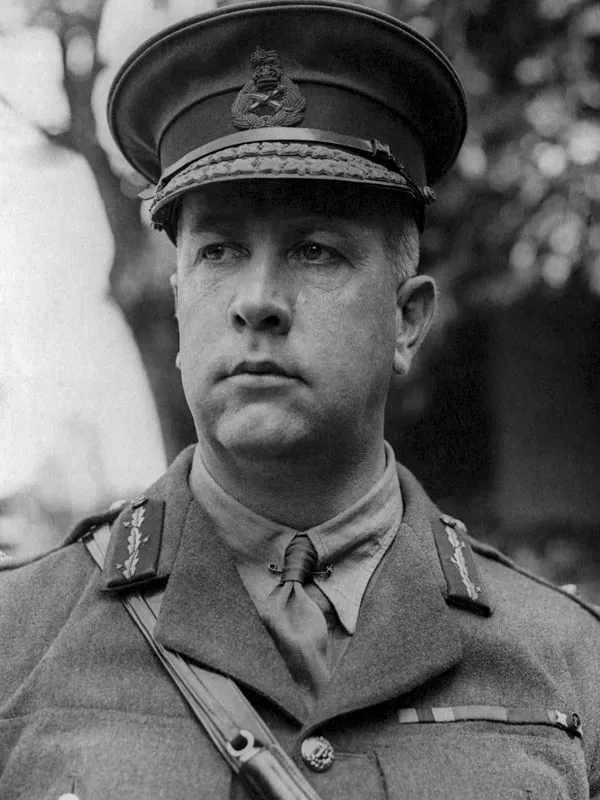
- Born:
- 5 December 1875, Napperton (Ontario, Canada)
- Died:
- 30 November 1933, Montreal
- Author:
- Łukasz Skowroń
- Photo:
- autor nieznany, domena publiczna, Wikimedia Commons

Sir Arthur Currie was one of only two corps commanders on the Western Front, the other being the Australian John Monash, who were not professional soldiers. He started in 1897 as a gunner in the ranks of the Canadian militia, and in June 1917 he became the first Canadian to command the Canadian Corps, one of the best formations in the entire British Army. He led it at Hill 70 and Passchendaele, and in the last hundred days of the war from Amiens through the Drocourt–Quéant Line, the Canal du Nord, Cambrai and Valenciennes all the way to Mons. He liked to say that victory had to be paid for with shells, not with soldiers’ lives. Canadian historians, among them Pierre Berton and Jack Granatstein, consider him the finest commander in their country’s history. In his lifetime, however, he was a controversial figure, and his record is burdened by a pre-war embezzlement of regimental funds.
Before the war
He was born on 5 December 1875 on a farm near the village of Napperton in Ontario, west of Strathroy, the third of eight children. His grandparents had come from Ireland and changed the name Corrigan to Curry, and in 1897 he himself began to spell it Currie. After his father’s death he could not study law or medicine. In 1894, after a quarrel with a teacher, he left for British Columbia, where he taught at schools in Saanich and Victoria. In 1900 he became an insurance agent, and later he dealt in real estate. In 1901 he married Lucy Chaworth-Musters.
In May 1897 he joined the militia’s 5th Regiment of Field Artillery as a gunner. He took the service very seriously: he completed every course available, ordered manuals from London and was an excellent shot. He rose through every rank until in 1909 he took command of the regiment. When the property boom in Victoria collapsed in 1912, he fell into debt. In 1913 he accepted command of a new Scottish regiment, the 50th Gordon Highlanders of Canada. At the end of July 1914 he received more than 10,000 dollars from the Department of Militia for the regiment’s uniforms and used the money to pay off his own debts. The affair was kept hidden for many years.
Second Battle of Ypres
After the outbreak of war the Minister of Militia, Sam Hughes, at the urging of his son Garnet, a friend of Currie’s, gave him the 2nd Brigade of the 1st Canadian Division. After a winter of training in England the division arrived in France in February 1915, and in April it entered the Ypres salient. On 22 April the Germans used chlorine and the Second Battle of Ypres began. In the fighting for Gravenstafel Ridge and at St. Julien Currie’s brigade held the sector east of the village of Sint-Juliaan. On 24 April the neighbouring 3rd Brigade of General Richard Turner, having misunderstood its orders, fell back and exposed his left flank. Currie, whose headquarters had been gassed and then burned down, went to the rear in person to look for British reinforcements.
After the war the British official historian James Edmonds accused him of having given the order to retreat prematurely and of having left his troops. Currie and the Canadian official historian Archer Fortescue Duguid defended him vigorously, and later scholars such as Tim Travers judged Edmonds’s verdict unfair. After the battle Currie was promoted to major-general, and in May his brigade also fought at Festubert. In September 1915 he took over the whole 1st Canadian Division.
Divisional commander
In 1916 the 1st Division fought at Ypres, where in June it helped to retake Mount Sorrel, and in the autumn on the Somme, among other places on Thiepval Ridge and in the fighting for Regina Trench on the Ancre Heights. Currie earned a reputation as a master of the carefully prepared attack on a limited objective. In the process he came into conflict with the Hughes family, because he refused to give a division to Garnet Hughes, whom he had seen in action at Ypres and considered incompetent. From then on Sam Hughes became his bitter enemy.
In the winter of 1916 the commander of the Canadian Corps, General Julian Byng, told Currie to study the lessons of the Somme. In January 1917 Currie attended lectures in which the French described their successful attacks at Verdun. He questioned not only senior officers but also company and platoon commanders, and compared their accounts. From 20 January he lectured to the corps and divisional staffs. His conclusions contributed to the reorganisation of the Canadian platoon into a self-contained team with a machine gun, rifle grenadiers and riflemen. On 9 April 1917 his 1st Division attacked on the right wing of the corps, on the widest sector of Vimy Ridge, and took all its objectives. At the end of April and the beginning of May it also fought at Arleux and on the Scarpe.
Corps commander: Hill 70 and Passchendaele
When Byng took over the Third Army, on 9 June 1917 Currie took command of the Canadian Corps and was promoted to lieutenant-general. A few days earlier the King had knighted him. Just then he learned that the government in Ottawa knew about the matter of the regimental funds. To avoid a scandal he borrowed money from two subordinate generals and paid off the debt. The appointment of a Canadian was an important argument for Robert Borden’s government in its campaign for the introduction of conscription.
In July the commander of the First Army, General Henry Horne, ordered him to take Lens. Currie considered the order mistaken and persuaded his superiors that instead of the ruined town they should take Hill 70, which dominated it. He reckoned that the Germans would have to try to retake it and would come under the fire of the Canadian artillery. On 15 August the Canadians took the summit within a few dozen minutes and over three days, according to Currie, repulsed 21 counter-attacks. The later attacks on Lens itself, on the other hand, were hasty and badly prepared.
In October Haig entrusted him with finishing the Third Battle of Ypres and taking Passchendaele. Currie protested, predicting 16,000 killed and wounded, but carried out the order, demanding time to build roads, move the artillery forward and prepare carefully. In the Second Battle of Passchendaele the corps, in four attacks from 26 October to 10 November, took the ruins of the village and the ridge. According to the Canadian official history it lost 15,654 men, almost exactly as many as Currie had predicted.
1918: Canada’s Hundred Days
At the beginning of 1918 it was proposed to reorganise the corps on the British model, with smaller brigades and a larger number of weaker divisions, and even to attach American battalions to it. Currie opposed these plans. Instead of forming new divisions he strengthened the existing ones: the 5th Division, stationed in England, was broken up, and its soldiers reinforced the battalions in France, which received extra men. The corps also got its own engineer brigades and machine-gun battalions. During the German spring offensive he also defended the principle that his divisions should not be parcelled out among British corps, which brought him accusations of selfishness but meant that in the summer the corps was rested and at full strength.
At the beginning of August the corps was secretly moved from Arras to Amiens, and two battalions and a wireless station were sent to Flanders to deceive the Germans. On 8 August the Canadians on the right wing of the Fourth Army advanced as much as 13 kilometres at Amiens. The corps then returned to Arras, where it fought on the Scarpe and on 2 September broke through the Drocourt–Quéant Line, which Currie considered the corps’ greatest victory. On 27 September he carried out his boldest operation: four divisions crossed a dry stretch of the Canal du Nord on a front only two and a half kilometres wide, after which the troops fanned out and took Bourlon Wood. On 9 October the Canadians entered Cambrai, on 1 November they took Mont Houy near Valenciennes, and on the morning of 11 November they retook Mons, where the British had begun the war in August 1914. In the hundred days the corps fought victorious battles against several dozen German divisions, but lost more than 45,000 killed, wounded and missing, the most it had ever lost in so short a time.
After the war
Currie returned home in August 1919. Nobody welcomed him at the port, and Parliament received him coolly. In the House of Commons Sam Hughes called him a butcher who had sent men to their deaths for his own glory, especially on the last day of the war at Mons. Currie became Inspector General of the army and a full general, but because of budget cuts he left the army in 1920 and became principal of McGill University in Montreal. He proved a very good administrator: he raised millions of dollars for the university and expanded it.
In 1927 a small newspaper from Port Hope, Ontario, repeated the charge that at Mons he had needlessly sacrificed soldiers’ lives. Currie sued the publisher for libel and won in 1928, although he received only a small part of the damages he had claimed. The trial restored his good name but undermined his health. In 1929 he suffered a stroke. He died in Montreal on 30 November 1933, aged 57. His funeral was the largest in Canada’s history up to that time: about 150,000 people watched from the streets.
Assessment
Currie was not a charismatic leader. Tall, stout and stiff, he could not speak to his soldiers, who gave him the nickname “Guts and Gaiters”. He was, however, a very good organiser and tactician, open to the advice of his staff and subordinates. Historians praise him for the careful preparation of every operation, his masterly use of artillery and machine guns, his courage in standing up to his superiors when he thought their orders were wrong, and for keeping the Canadian Corps together as a cohesive national formation. The British historian Denis Winter called the breaking of the Drocourt–Quéant Line the greatest single achievement of the British Army in the war.
Critics point out that Currie’s corps, as a shock formation, suffered very heavy losses in 1918, and that the last attacks at Valenciennes and Mons already raised questions about their purpose at the time. The embezzlement of regimental funds in 1914, revealed more widely only by historians in the 1980s, remains a dark stain on his record. Even so, in Canada today Currie is above all a symbol of the coming of age of a country whose soldiers, under their own commander, became one of the most effective forces on the Western Front.
Sources
Spotted a mistake?Report an error
Commanded in battles
(16)- 22–23 April 1915Battle of Gravenstafel RidgeWestern Front
- 24 April – 4 May 1915Battle of St. JulienWestern Front
- 2–13 June 1916Battle of Mount SorrelWestern Front
- 9–12 April 1917Battle of Vimy RidgeWestern Front
- 28–29 April 1917Battle of ArleuxWestern Front
- 3–4 May 1917Third Battle of the Scarpe (1917)Western Front
- 31 July – 10 November 1917Third Battle of YpresWestern Front
- 15–25 August 1917Battle of Hill 70Western Front
- 26 October – 10 November 1917Second Battle of PasschendaeleWestern Front
- 8–11 August 1918Battle of AmiensWestern Front
- 26–30 August 1918Battle of the Scarpe (1918)Western Front
- 2–3 September 1918Battle of the Drocourt–Quéant LineWestern Front
- 12 September – 12 October 1918Battles of the Hindenburg LineWestern Front
- 27 September – 1 October 1918Battle of the Canal du NordWestern Front
- 8–9 October 1918Battle of CambraiWestern Front
- 1–2 November 1918Battle of ValenciennesWestern Front
Mentioned in battles
(08)Often appears with
People who appear in the same events.