Key event
First Battle of Passchendaele
- Category:
- Military operations
- Front:
- Western Front
- Date:
- 12 October 1917
- Author:
- Natalia
- Battle:
- First Battle of Passchendaele
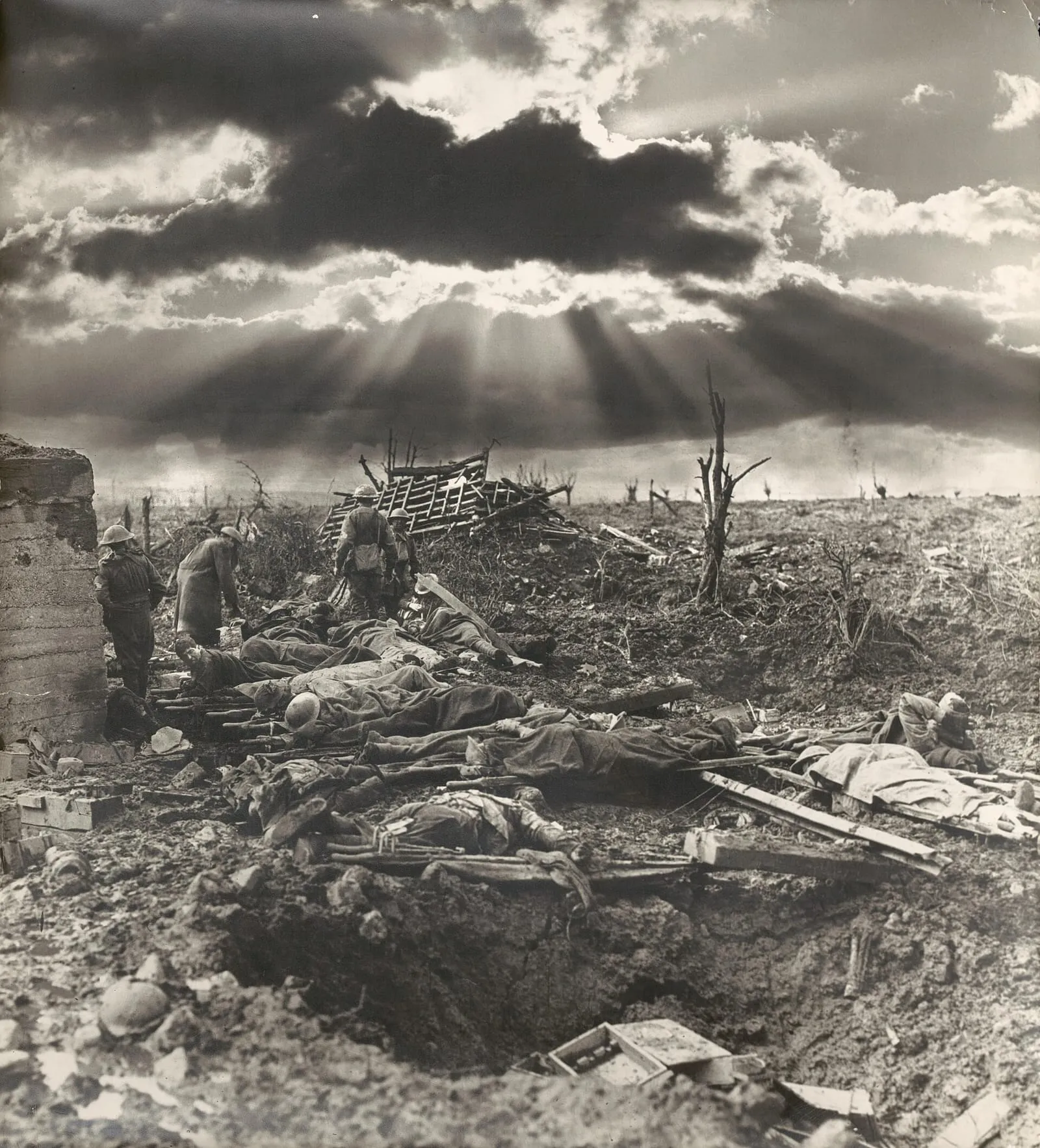
On 12 October 1917 at 5.25 a.m., in rain and mud, two divisions of II Anzac Corps advanced on the ridge above the village of Passchendaele, the last high ground before the plain east of Ypres. The 3rd Australian Division of General John Monash was to take the village itself, and the New Zealand Division the Bellevue spur north of it. The attack, prepared within three days of the failed attack at Poelcappelle, broke down in front of uncut wire and concrete pillboxes. A handful of Australians reached the church in Passchendaele and turned back without meeting anyone, and in the afternoon both divisions fell back almost to their start line. For New Zealand it was the day with the greatest number of casualties in its entire history.
The night before the attack
Field Marshal Douglas Haig still believed that the Germans in Flanders were close to collapse and wanted to take the ridge before the autumn rains brought the Ypres offensive to a complete halt. On 11 October he told correspondents that on 9 October the army had been beaten only by the mud. At the front things looked different. The New Zealanders, who had taken over the sector in front of Bellevue the day before, found the slopes strewn with wounded from 9 October, who had been lying there for several days without help, and their patrol saw belts of barbed wire 20–45 metres wide in front of the German pillboxes. They had almost two and a half kilometres to go to the final objective, and the artillery, which had been unable to get forward through the mud, was firing from makeshift positions far to the rear. On the evening of 11 October, after a whole afternoon of rain, the commander of the neighbouring Fifth Army, General Hubert Gough, asked General Herbert Plumer by telephone to postpone the attack. Plumer consulted his corps commanders and refused.
The Australian brigades set out from the fields near Potijze at about 6 p.m. The duckboard tracks along which they marched were shelled with high-explosive and gas shells, and units relieved from the front were coming the other way. That night the Germans carried out a long-planned gas bombardment, but a strong wind dispersed the gas. At about 1.30 a.m. it began to rain. By 3.30 it was pouring. The men moved in single file in total darkness, holding on to the equipment of the man in front. Only on the way did they learn that the line from which they were to advance was not in British hands at all. The New Zealanders crossed the Ravebeek stream on footbridges of coconut matting laid by the engineers and took up their positions on time. The troops on the jumping-off tapes lay under fire, covered with groundsheets, and some of the men fell asleep in the rain.
Morning: Bellevue
At 5.25 a.m. the barrage opened. It was weak and ragged, some of the shells fell on their own lines, and the howitzer shells buried themselves in the mud and exploded without harming the pillboxes. Machine guns at once opened fire from the German positions on the Bellevue spur and from Crest Farm in front of Passchendaele. At about 6 a.m. a strong wind sprang up and the drizzle turned into a downpour.
The New Zealand 2nd Brigade, with battalions from Otago and Canterbury, reached the wire and could not cut it. The only gap led along the sunken road to Gravenstafel, but machine guns placed on either side of it killed everyone who stepped onto it. Battalion after battalion threw itself at the same wire. Some men crawled under two belts of entanglements and were killed just in front of the loopholes of the pillboxes. On the left wing the 3rd Rifle Brigade took the cemetery on the edge of the spur and got as far as Wolf Copse, but at about 8 a.m. its commanders ordered the men to dig in. The only clear success was achieved in the marshes by the Ravebeek by Second Lieutenant Arthur Cockerell, whose platoon took two pillboxes and several dozen prisoners. Only one soldier of the platoon remained with him.
Morning: by the church in Passchendaele
The Australian 9th Brigade advanced along the ridge beside the road to the village. Disorganised from the first minutes, it lost an hour capturing machine-gun nests, until Captain Clarence Jeffries of the 34th Battalion led men round to the rear of the German positions and took 25 prisoners. When he repeated this at another machine gun, he was killed. He was posthumously awarded the Victoria Cross. At about 8.30 a.m. some hundred men from three battalions stood on the eastern slope of the ridge, roughly where the second objective was to run, and sent several hundred prisoners to the rear. In the Ravebeek valley the 10th Brigade was held up near the first objective by fire from the Bellevue spur, which the New Zealanders had not taken.
One group, however, about twenty men, mostly of the 38th Battalion, went on up the valley, because they could see no barrage in front of them to keep close behind. At Crest Farm, on the edge of the village, the garrison of a large pillbox surrendered to them. The Australians reached the church in Passchendaele and found neither Germans nor any of their own men there. They turned back. On the way back they saw the Germans returning to Crest Farm and opening fire from it. One of the division’s units carried an Australian flag that it was to plant in the village. It was not planted.
Afternoon: the retreat
News reached the headquarters with delays of many hours. Monash believed until noon that his division was advancing, and he learned that the New Zealanders were held up along their whole front only shortly before eleven. Corps ordered the New Zealanders to renew the attack at 3 p.m. The battalion commanders, convinced that it was a death sentence for what was left of their brigades, were already preparing to go with their men when the order was cancelled.
At about 3 p.m. it began to rain again. The Australians on the ridge, fired on directly by German guns and from the flank from the Bellevue spur, received no reply to the messages they had been sending since morning. Major Giblin in the Ravebeek valley, seeing Germans infiltrating behind his left flank, withdrew his men in small groups, and by 3.30 p.m. they were back on the start line. On the ridge the retreat began at about 3.45 p.m. and was disorderly. The 12th Brigade of the 4th Australian Division, which had taken the railway cutting on the Keiberg hill and repelled two German counter-attacks, had to withdraw along the embankment when it lost its cover on the left. By the evening the front ran practically where it had in the morning. In the north the units of the Fifth Army also for the most part stopped not far from their start lines. Only near the boundary with the French did a brigade of the 17th Division and the Guards advance towards Houthulst Forest.
The wounded in the mud
The night of 12/13 October was dark and rainy. In the Ravebeek valley the wounded of the 3rd Australian Division lay beside the wounded of 9 October, and an Australian lieutenant who returned there with his battalion the following night counted more than forty dead within twenty yards of himself. A single stretcher needed six or even eight men. At the New Zealand dressing stations dozens of stretchers stood in the rain and hail, and in two dugouts measuring roughly three by four metres, which housed the headquarters of two battalions, 56 men were crowded, most of them wounded. The next day an informal truce settled over the slopes. German riflemen let the stretcher-bearers work, and the last of the wounded were carried out only on 14 October.
The day’s toll
On 12 October the New Zealand Division lost about 2,700 men, including about 845 killed or mortally wounded. In a few hours more New Zealanders died than on any other day in the country’s history. The division, which in June had taken the village of Messines, suffered its only great defeat. The 3rd Australian Division lost 3,199 men according to the Australian official historian Charles Bean, and the 12th Brigade about a thousand. Total British and Dominion losses that day are estimated at about 13,000. The German 195th Division, which defended Passchendaele, lost more than 3,300 men on 9 and 12 October. The Crown Prince of Bavaria, Rupprecht, commanding the German armies in Flanders, noted that the rain was his “most effective ally”.
On 13 October the British command decided to suspend attacks until the weather improved and the roads were repaired. A few days later the exhausted II Anzac Corps was replaced by the Canadian Corps of General Arthur Currie, whom Haig entrusted with the capture of Passchendaele.
Remember the articles you have read? Only in this browser; nothing is sent anywhere.How it works
Read ·
A voice from the front
“Just in the degree that the battle of October 4th was brilliantly successful, so were the operations of October 12th deeply disappointing, although the Third Australian Division did magnificently under the most adverse circumstances. […] There was no flying and no photographing, no definite information of the German re-dispositions, no effective bombardment, […] and the whole of the country from Zonnebeke forward to the limits of our previous captures was literally a sea of mud, in most places waist deep”
Spotted a mistake?Report an error
Meanwhile
(04)Elsewhere in the same days.
- 12 October 1917 · PoliticsUnion government in CanadaOn 12 October 1917 Borden announced a coalition government of Conservatives and pro-conscription Liberals. The next day the first call-up was proclaimed.
- 15 October 1917 · SocietyExecution of Mata HariOn 15 October 1917 Mata Hari, a Dutch dancer convicted of spying for Germany, was shot at Vincennes. The evidence of her guilt is disputed to this day.
- 9 October 1917 · Middle EastDeath of Sultan Hussein KamelOn 9 October 1917 Sultan Hussein Kamel of Egypt died in Cairo. The throne passed to his half-brother Ahmed Fuad, chosen by the British a few weeks earlier.
- 15 October 1917 · PoliticsRegency Council is appointedOn 15 October 1917 Berlin and Vienna approved the regents of the Kingdom of Poland, Archbishop Kakowski, Prince Lubomirski and Józef Ostrowski.
Related events
(04)The same battle, people or subject.
- 4 October 1917 · Western FrontBattle of BroodseindeOn 4 October 1917 the Anzacs took the Broodseinde ridge near Ypres, colliding in no man's land with attacking Germans. They took thousands of prisoners.
- 9 October 1917 · Western FrontBattle of PoelcappelleOn 9 October 1917, after a night march through mud, the British attacked at Ypres towards Passchendaele and were repulsed. Guards and French reached Houthulst.
- 25 September 1917 · Western FrontEnd of the Battle of the Menin Road RidgeOn 25 September 1917 the Germans attacked at Ypres south of Polygon Wood and pushed back the 33rd Division. Plumer still kept the attack set for the morning.
- 26 September 1917 · Western FrontBattle of Polygon Wood beginsOn 26 September 1917 the Australians took Polygon Wood and the Butte near Ypres, and the British entered Zonnebeke. Artillery broke the German counter-attacks.