Key event
Battle of Broodseinde
- Category:
- Military operations
- Front:
- Western Front
- Date:
- 4 October 1917
- Author:
- Łukasz Skowroń
- Battle:
- Battle of Broodseinde
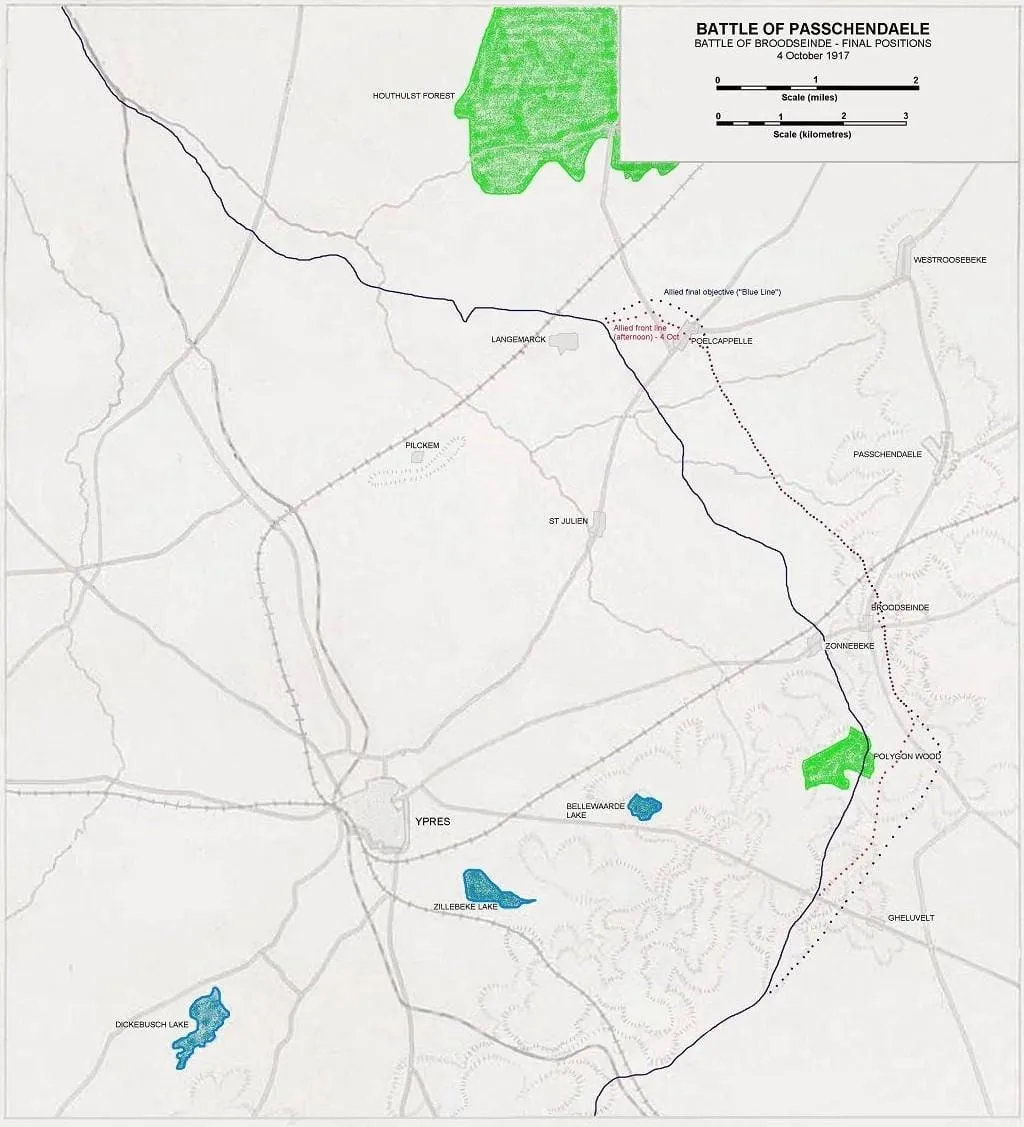
At six in the morning on 4 October 1917, in drizzle and a gusty wind, twelve British and Dominion divisions attacked east of Ypres against the Broodseinde ridge, from which the Germans had overlooked the whole Ypres salient since 1915. It was General Herbert Plumer’s third step in the Third Battle of Ypres, eight days after the Battle of Polygon Wood. The main burden was borne by four Anzac divisions, three Australian and the New Zealand Division, attacking side by side for the first time in this war. For the same dawn the German 4th Guard Division and a regiment of the 45th Reserve Division had prepared an attack of their own, so the Australians collided with the advancing Germans in no man’s land. Before nine the ridge had been taken, several thousand Germans had been captured, and their counter-attacks broke down under artillery fire. At noon it began to rain.
A night on the tapes
The battalions moved up to their positions from dusk on 3 October. Around midnight a drizzle began, clouds hid the full moon, and beyond the end of the duckboards the men floundered over slippery ground, keeping to the tapes and pickets. The hardest task fell to General John Monash’s 3rd Australian Division, which had to cross the marshy valley of the stream below Zonnebeke under the eyes of German observers and halted every time flares went up. Almost all the battalions were packed close to the front line so that after zero hour they could quickly get out from under the German barrage. Spirits were good. The veterans of the 1st and 2nd Divisions, who two weeks earlier had won the Battle of the Menin Road Ridge, were glad to be attacking together with the 3rd Division and the New Zealanders rather than alone, as on the Somme.
The Germans were not asleep either. From 11 p.m. men of the Australian 25th Battalion on the edge of Zonnebeke saw groups moving in front of them, which they took for a relief. At 5.15 a.m. a patrol of the 5th Battalion brought in five prisoners, who were very anxious to be sent quickly to the rear and said that a German bombardment was due to begin at 5.30. They said nothing about an attack.
Yellow flares
At about 5.20 a.m. a yellow flare instead of the usual white one rose over the ridge, followed by others, and a few minutes later a storm of shells came down. It was the bombardment preparing the German operation “Höhensturm”, which had been postponed by a day after the bloody failure of 1 October. The Australian officers were certain that their attack had been discovered. Shells and mortar bombs fell above all on the 1st and 2nd Australian Divisions, lying in shell holes with their capes pulled over their heads. When a shell struck an empty hole, the damage was slight. When it struck an occupied one, everyone lying in it was killed. According to the Australian official historian Charles Bean, about one seventh of the attacking men of I Anzac Corps were killed or wounded even before zero hour. About twenty officers were killed. Among them was Major Philip Howell-Price, whose two brothers had fallen on the Somme and at Bullecourt. General William Birdwood, wishing to spare him, had taken him onto the corps staff, but Howell-Price had begged to return to his 1st Battalion for this attack. It was impossible to call down a protective barrage: in the last ten minutes before the attack the artillery did not answer signals.
Meeting in no man’s land
At six the British barrage came down, and the German bombardment stopped as if cut off with a knife. The men rose from their shell holes, lit cigarettes and moved off. The barrage was thinner than on 20 and 26 September. The wet ground threw up no dust, and the bursts looked, as one observer noted, like a crowd of steaming plates set close together over the whole slope. After a few dozen metres the Australians made out in the half-light a second line of skirmishers rising from shell holes about 30 metres in front of them. They were men of the German 212th Reserve Regiment, ready to attack, some with bayonets fixed. Most of the Australians opened fire at once. Someone shouted that they were their own men and not to shoot, but was told only to mind his own business. The first German wave fell, and the rest fled, often straight into the British barrage.
In this confusion there was no lack of strange scenes. Major Page of the 25th Battalion walked up in the mist to a group of soldiers whom he took for Australians and was captured. When a British shell scattered his guards, he fired at them with his revolver and escaped. Lieutenant McIntyre of the 22nd Battalion, leading his men by compass, shot several Germans before he himself fell with a bullet in the head. In Zonnebeke some of the Germans fell back in good order, in bounds of 30–40 metres, their NCOs ordering rapid fire at every halt. The ruins of the village were cleared by the 26th Battalion following the first wave. Beyond no man’s land the pillboxes were defended by guardsmen, who this time fought more fiercely than the Australians’ opponents of 20 September.
The crater by the road
Between 6.45 and 7.20 a.m. the Anzac divisions reached the first objective, a few hundred metres short of the crest. The pause before the second stage proved the hardest part of the day. Along the road from Beselare to Passchendaele, which ran along the ridge, machine guns fired from pillboxes and trenches, and field guns fired over open sights. The toughest point was a large crater by the road, which housed the headquarters of two German battalions. Victorians of the 6th Battalion worked their way up to it with Lewis guns and rifle grenades. Captain Annear calmly walked round the rim of the crater, firing down into it with his revolver while the Germans pelted him with grenades, and fell mortally wounded. After twenty minutes the crater was taken, and a group of German officers who were still holding out in a ditch behind a hedge surrendered. One of them, who turned out to be a battalion commander, refused to surrender and died of a bayonet wound. A few hundred metres further on, Captain Traill of the 8th Battalion, with Lieutenant Waters and three men, crawled along a trench to a German battery. As they rushed forward, a white flag was pushed out through a hatch in the roof of an underground dugout. It was an artillery headquarters. Some of the Australians tried at once to turn the captured guns against the Germans.
For the German staffs on the ridge, waiting for news of their own attack, it was a shock. The commander of one of the battalions of the 5th Foot Guards Regiment, Major Wegehaupt, who had managed to escape from the crater, reported at seven at the headquarters of the support battalion that both battalions on the ridge had been destroyed.
Beyond the ridge
At 8.10 a.m. the second stage began. The 1st and 2nd Australian Divisions crossed the crest almost without resistance, and for the first time since May 1915 British soldiers saw what the Germans had seen from there for two and a half years. Before them lay the green Keiberg spur, on the right the trees and church tower of Beselare, and beyond that the undamaged Flemish plain, on which, when the shelling died down, carts could be seen moving, cows grazing and smoke rising from chimneys. A kilometre to the north, on the same road, the ruins of the church at Passchendaele showed red. On the slope below, German soldiers were running away. The Australians dug in in sandy, well-drained soil. The 7th Brigade at the Broodseinde crossroads halted in the face of fire from the copse of Daisy Wood and occupied an old trench in which the men, as they dug, came upon the uniforms of British soldiers killed in 1914–1915.
North of the railway the hardest task fell to the Tasmanian 40th Battalion, which on the Gravenstafel spur was advancing on the Flandern I line under fire from the front and the left from ten machine guns. Captain Ruddock led a company out onto the flank through the New Zealanders’ sector, and from there the pillboxes were taken one by one. Sergeant Lewis McGee ran 50 metres under fire and shot the crew of a machine gun on the roof of one of the pillboxes with his revolver, and Lance Corporal Walter Peeler of the 3rd Pioneer Battalion, attached to the 37th Battalion, led attacks on one nest after another. Both received the Victoria Cross. Lieutenant Cane of the 40th Battalion took 31 prisoners in a single pillbox without firing a shot. By 9.12 a.m. the whole objective of the 3rd Division had been taken, and the New Zealanders had occupied the Gravenstafel spur with Abraham Heights and Kronprinz Farm, taking 1,159 Germans prisoner. Men of the 6th Australian Brigade caught two German carrier pigeons. They released one with a note: “Deutschland über Alles. Ha! Ha! Not likely”.
Counter-attacks at Daisy Wood
German reserves came out against the ridge all day, but could not even get close. Major Freiherr von Schleinitz, commander of the 5th Guard Grenadier Regiment, sat in a farm on the Keiberg without any reserves and with reports that the British were advancing eastwards. “I decided, whatever happened, to hold my headquarters,” he wrote after the war. When a Bavarian soldier looking for his regiment happened to reach him, Schleinitz sent a Bavarian lieutenant-colonel an order to attack, although he was only a major and the regiment was not under his command. The Bavarians obeyed. At about 1.30 p.m. a report reached him from the line: “Hurrah, reinforcements!”. In reality the battalions of the 4th Bavarian Division, directed towards the Broodseinde crossroads, ran one after another into the British barrage and the machine-gun fire from the ridge and bunched up in the copse of Daisy Wood, which Australian observers deluged with artillery fire all afternoon. An officer of the 26th Battalion saw mounted men driving the scattering soldiers back into formation like cattle on a pasture. In front of the 41st Battalion, where the Germans had gone to ground in old trenches 200 metres from the Australian line and begun to fire on it, Lieutenant Skewes led his men in a counter-attack with a shout and scattered the enemy, but was himself killed.
Rain
At about 11 a.m. airmen’s reports confirmed that the objectives had been taken along almost the whole front of the attack, from Polygon Wood to Poelcappelle. The corps commanders wanted to press on, and Plumer considered an attack on the Keiberg, but Birdwood was opposed, and at 2 p.m. Plumer gave up the idea. Half an hour after noon it began to rain. The way across the valleys behind the ridge at once turned into an ordeal for the stretcher-bearers and carriers, and in the 3rd Division, where the route to the aid posts was longest, the evacuation of the wounded broke down. The badly wounded lay all night in the mud around the overcrowded pillboxes. In the evening a shell killed Lieutenant-Colonel Rave, commander of the 212th Reserve Regiment, at his headquarters by Dame Wood.
On the Anzac sector the German counter-attacks did not force the commitment of a single battalion from the reserve. The British counted 4,759 prisoners, and Field Marshal Douglas Haig reported more than 5,000, including 138 officers. Plumer is said to have called the day “the greatest victory since the Marne”, and the German official history later wrote of the “black day of 4 October”. In the evening Haig’s chief of intelligence reported that the Germans had not a single fresh division near the front, and Haig was sure that the enemy was close to collapse. The next attack was to go in within a few days, but the rain that had begun at noon did not stop.
Remember the articles you have read? Only in this browser; nothing is sent anywhere.How it works
Read ·
Voices from the front
“I cabled Melbourne to following effect:- "ALL WELL DIVISION AGAIN BRILLIANTLY VICTORIOUS IN "GREATEST BATTLE OF WAR." We have had a magnificent success […] A fine bag of prisoners is pouring in. All are most elated particularly at the fine feat of pulling off so big a job with only 3 days for all our local preparation.”
“We snatched a few hours' sleep, and twenty minutes before zero emerged from our burrows to a wet, bleak morning, with a cold wind blowing from the Hun lines. It was pitch dark, but the men quickly mustered. […] turning my head, I could see in the semi-darkness the Companies winding over the summit like snakes. Silhouetted against the sky-line, they might have been long caravans creeping over the desert.”
Spotted a mistake?Report an error
Meanwhile
(02)Elsewhere in the same days.
- 2 October 1917 · War at seaSinking of HMS DrakeOn 2 October 1917 the German U-79 torpedoed the armoured cruiser Drake off the coast of Ireland. The ship capsized in a bay of Rathlin Island. 18 men died.
- 7 October 1917 · DiplomacyUruguay breaks off relations with GermanyEarly on 7 October 1917 the Uruguayan parliament authorised a break in relations with Germany. President Viera signed the decree the same day.
Related events
(04)The same battle, people or subject.
- 12 October 1917 · Western FrontFirst Battle of PasschendaeleOn 12 October 1917 Anzacs advanced in the rain on Passchendaele. By evening they were back on their old lines, and 845 New Zealanders were dead.
- 9 October 1917 · Western FrontBattle of PoelcappelleOn 9 October 1917, after a night march through mud, the British attacked at Ypres towards Passchendaele and were repulsed. Guards and French reached Houthulst.
- 25 September 1917 · Western FrontEnd of the Battle of the Menin Road RidgeOn 25 September 1917 the Germans attacked at Ypres south of Polygon Wood and pushed back the 33rd Division. Plumer still kept the attack set for the morning.
- 20 September 1917 · Western FrontStart of the Battle of the Menin Road RidgeOn 20 September 1917 Plumer's armies advanced at Ypres behind a huge barrage. The Australians took Glencorse Wood and Nonne Bosschen and reached Polygon Wood.